-
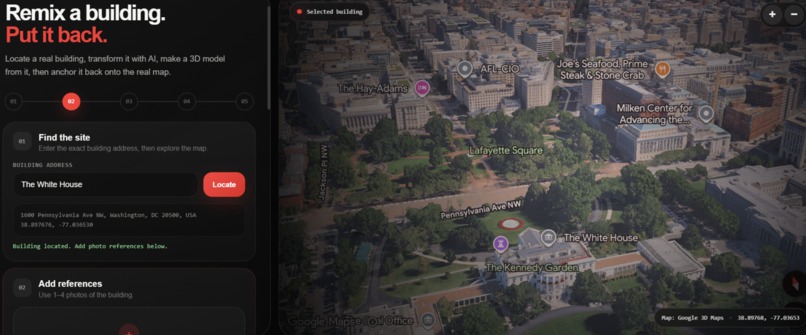
Website
-
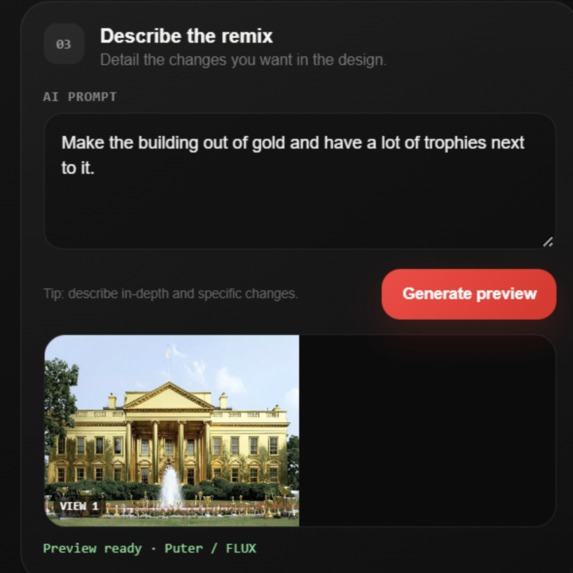
Prompt Input
Inspiration
We were inspired to tackle 3D modeling because of our shared interest in video games and design work. We also believe that using Artificial Intelligence (AI) to digitalize physical things could become valuable in more critical situations in the future, as more of the world becomes digital and AI becomes more integrated in our daily lives. We also wanted to gain more hands-on experience with AI while working on something different from a typical app or web development project.
What it does
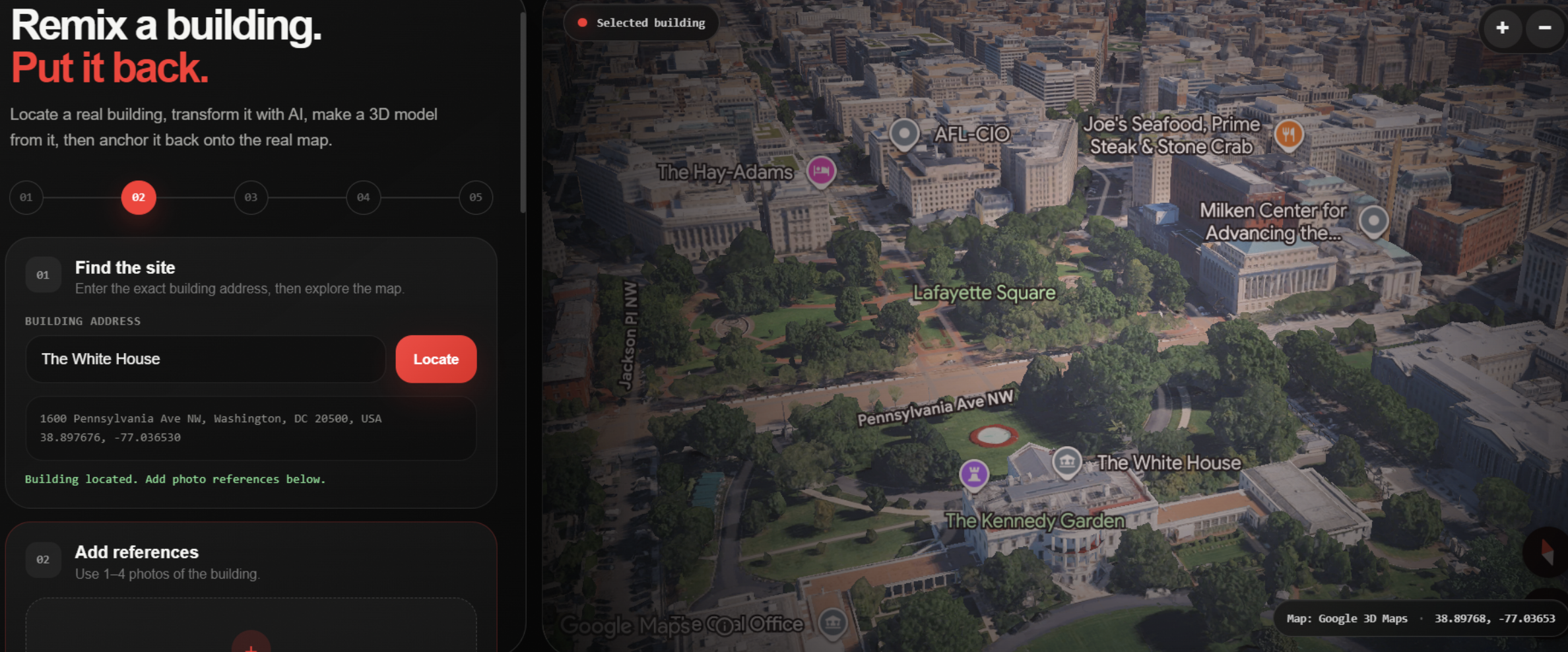
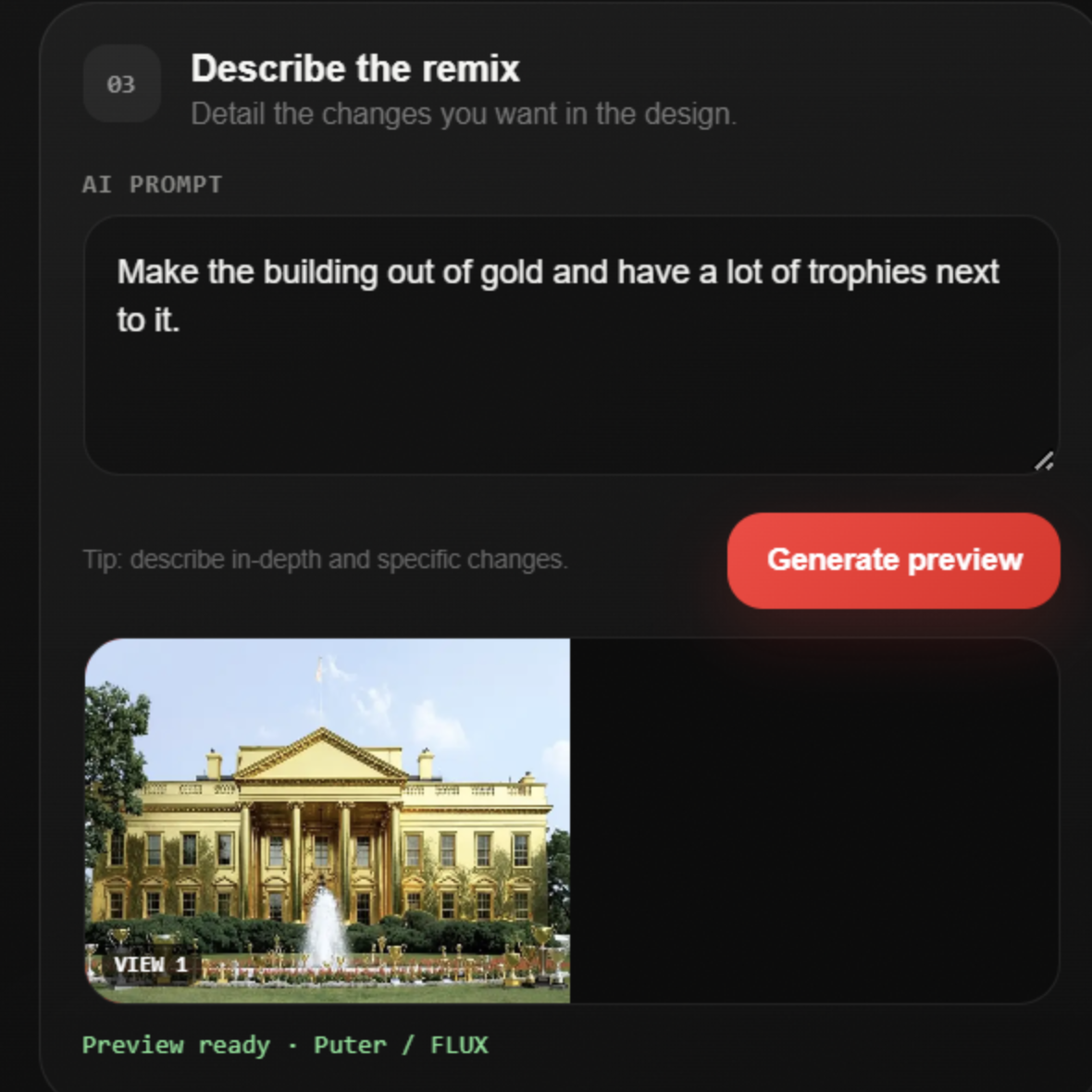
In a nutshell, it is a website that allows users to enter a real building address, upload up to four reference photos, and describe how they want the building redesigned in plain language. The system geocodes the address and pulls the building's real-world footprint. It sends the photos and prompts an AI image editing model to generate a redesigned 2D concept and then with approval from the user it converts the image into a 3D mesh. The system can automatically normalize, rotate, scale, and plot that mesh so it snaps onto the map at the correct position, matching the real building's actual footprint.
How we built it
We first built the overall website using JavaScript and HTML. We used Google Maps to find buildings and pull location and address data from user input, and its map gave us a surface to place the 3D model on so users can visualize it. We integrated Tripo, a 3D modeling AI software, to generate the 3D models, which can then be exported and used for visuals. We also used OpenAI to assist with debugging code.
Challenges we ran into
- The model generation system would fail to produce high-quality, efficient meshes.
- The heavy files we generated and by an AI workflow that took a long time to load.
Accomplishments that we're proud of
- Team bonding we had as a team while working through this project.
- Getting hands-on experience we gained with both the capabilities and the limitations of AI.
What we learned
- AI mesh and model generation has great potential, but it is still far from beating a human modeler.
- Publicly available AI modeling systems are not yet capable of providing the most optimized solutions.
What's next for Brick-By-Click
Our next steps focus on improving both the quality and the reach of the software. We plan to switch from tris to quads, which will allow for cleaner geometry, and to minimize file sizes by removing unnecessary geometry. We also want to avoid interference with premade models while keeping proper scaling, and to specify higher quality textures so the output can match the realistic look of a human-made model. Beyond those technical improvements, we want to practice with more complex buildings and eventually add route mapping for emergency rescue too.
Built With
- google-maps
- html
- hugging-face
- javascript
- model
- openai
- python
- pytorch
- tripo


Log in or sign up for Devpost to join the conversation.