-
-

Login
-

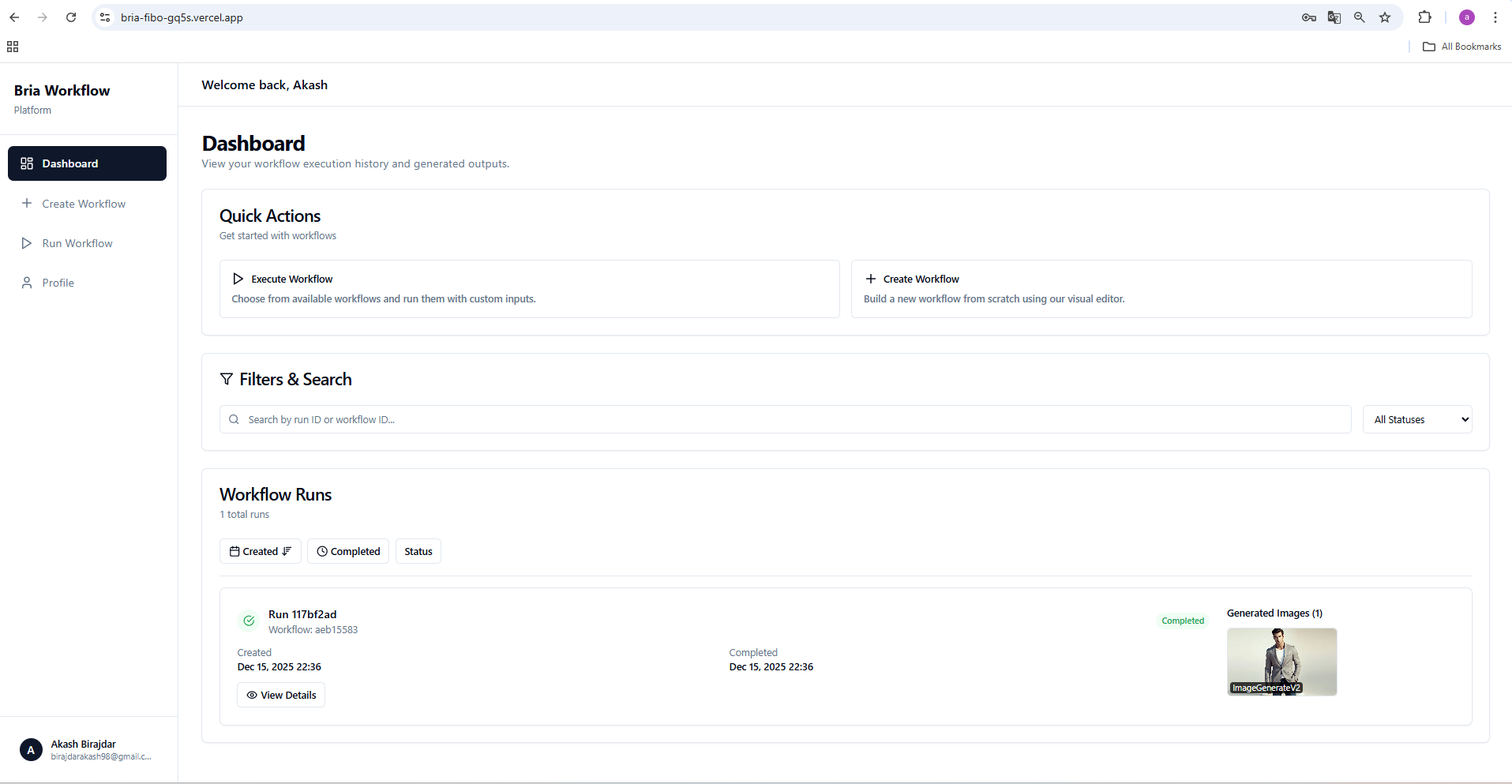
Dashboard
-

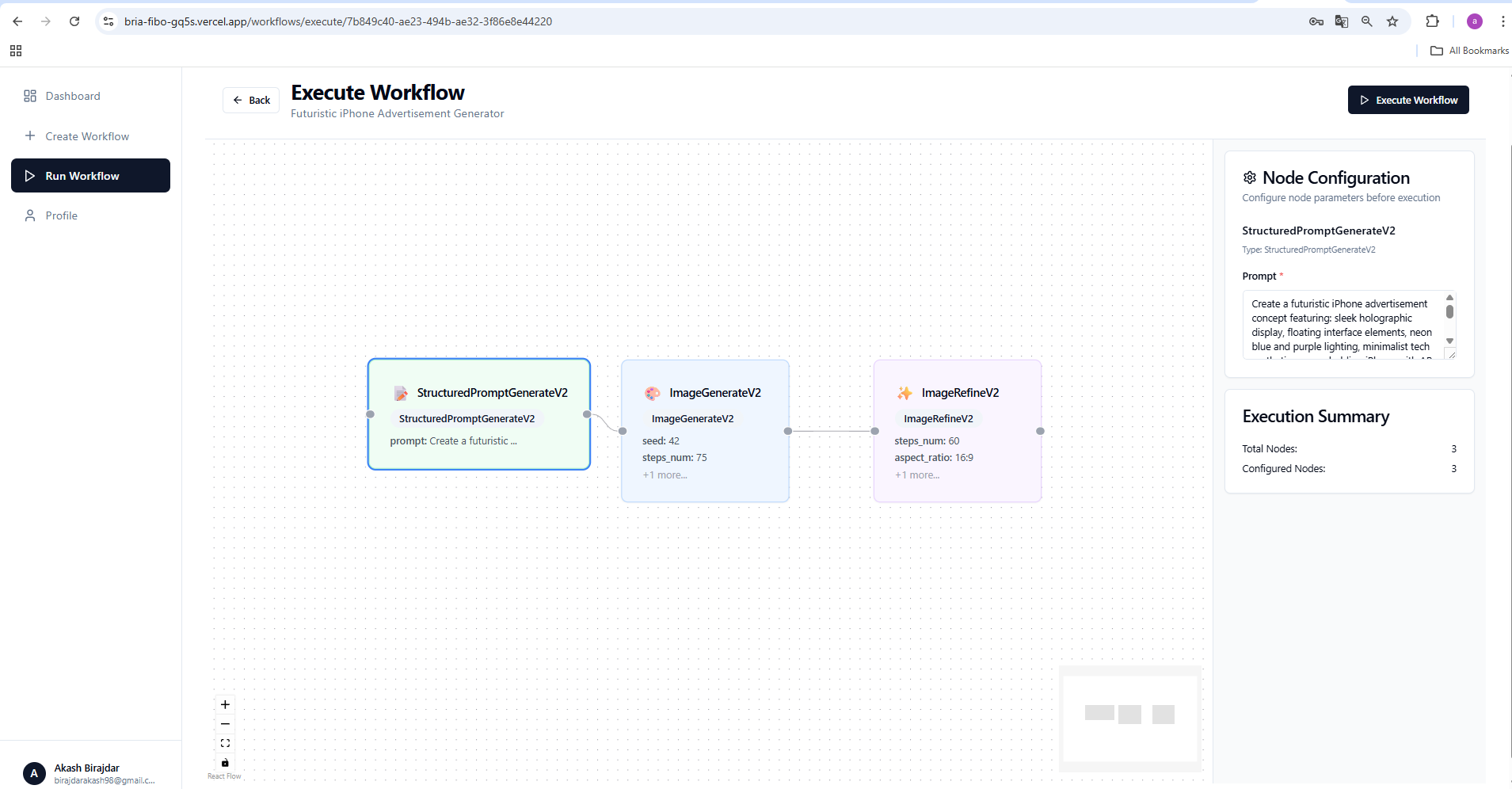
Execute workflow
-

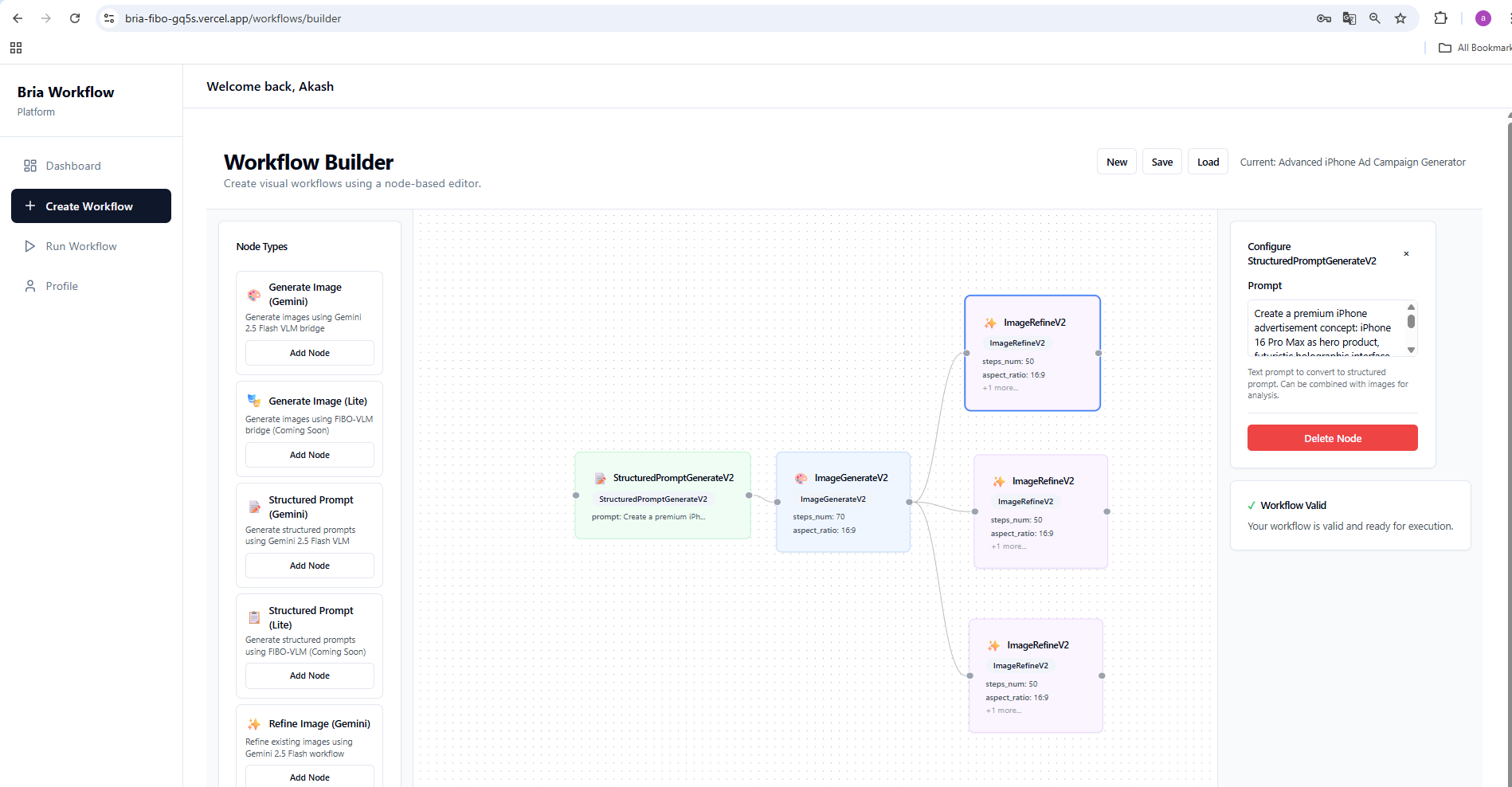
Create Workflow

Bria Workflow Platform - Project Story
Inspiration
While Bria AI offers powerful, commercially safe, and responsible AI models, harnessing them typically requires technical expertise to interact with raw APIs. I noticed that creative teams—the people who benefit most from these tools—often struggle with complex documentation and JSON payloads.
I was inspired by open-source tools like ComfyUI but wanted to build something specifically tailored for the enterprise and commercial context, where brand safety and consistency are non-negotiable. My goal was to bridge the gap between "Raw API capability" and "Creative Workflow," democratizing access to responsible AI without requiring a single line of code.
What it does
The Bria Workflow Platform is a comprehensive visual interface for orchestrating image generation pipelines.
- Visual Builder: Users can drag-and-drop nodes to design custom workflows. Nodes include
GenerateImageV2,StructuredPromptV2, andRefineImageV2. - Commercial-Grade Generation: It leverages Bria's v2 APIs to ensure all outputs are safe for commercial use.
- Human-in-the-Loop: Uniquely, the platform supports interactive approval steps. A workflow can generate a structured prompt, pause for human review and editing, and only proceed to final generation once approved. This ensures creative control and saves compute resources.
- Real-Time Orchestration: Users can watch their workflows execute step-by-step with live status updates.
- Asset Management dashboard: A centralized view to manage, inspect, and download all generated assets and their associated metadata.
How I built it
I adopted a modern, type-safe stack to ensure reliability and scalability:
- Frontend: Built with React and TypeScript. I used ReactFlow for the core node-based editor, allowing for intuitive connections and state visualization. The UI is polished with Tailwind CSS and ShadCN components for a premium feel.
- Backend: A high-performance FastAPI service written in Python. It handles the complex graph traversal logic and state management.
- Integration: I built a custom asynchronous client for the Bria API that handles authentication, retries, and the polling mechanism required for Bria's async endpoints.
- Database: PostgreSQL (via SQLAlchemy) stores workflow definitions and granular execution snapshots, enabling "time-travel" debugging of how every asset was created.
- Security: Full JWT-based authentication system to secure user data and API usage.
Challenges I ran into
- Async Orchestration: Bria's APIs operate asynchronously (submit request $\rightarrow$ receive ID $\rightarrow$ poll status). Mapping this non-linear process to a linear user experience, while keeping the frontend responsive, required a robust state machine in my backend.
- The "Pause" Problem: Implementing the Approval Node was tricky. I had to design the execution engine to serialize its state to the database, halt completely, and then accurately resume context days later when a user clicks "Approve."
- Data Mapping: Ensuring that the complex JSON output of a
StructuredPromptnode correctly mapped to the inputs of aRefineImagenode required strict schema validation using Pydantic models.
Accomplishments that I'm proud of
- The Approval Workflow: I successfully implemented a stateful "Pause & Resume" logic. Seeing a workflow stop automatically, wait for user input, and then resume execution is a seamless experience I am very proud of.
- UX/UI Polish: I didn't just build a prototype; I built a tool that feels like a production SaaS product, with dark mode, responsive design, and intuitive controls.
- Robust Error Handling: The system gracefully handles API failures, network issues, and validation errors, providing clear feedback to the user instead of crashing.
What I learned
- The Power of Structured Prompts: I learned that Bria's
structured_promptcapability is a game-changer. It shifts the workflow from "guessing words" to "engineering assets" by strictly defining style, lighting, and composition. - State Management is Key: In visual programming tools, keeping the frontend graph state in sync with the backend execution state is the hardest part of the puzzle.
- Responsible AI: Working with Bria highlighted the importance of having models that are trained on licensed data, removing the legal anxiety often associated with generative AI.
What's next for Bria Workflow Platform
- Expanded Node Library: Integrating Bria's other powerful tools like Background Removal, Eraser, and Expansion as native nodes.
- Team Collaboration: Adding shared workspaces where teams can fork, version, and improve each other's workflows.
- Batch Processing: Implementing a "Batch Runner" to execute a single refined workflow across a folder of hundreds of input images for bulk content creation.
Built With
- bria
- fastapi
- fibo
- postgresql
- react
- schadcn
- supabase


Log in or sign up for Devpost to join the conversation.