-
-
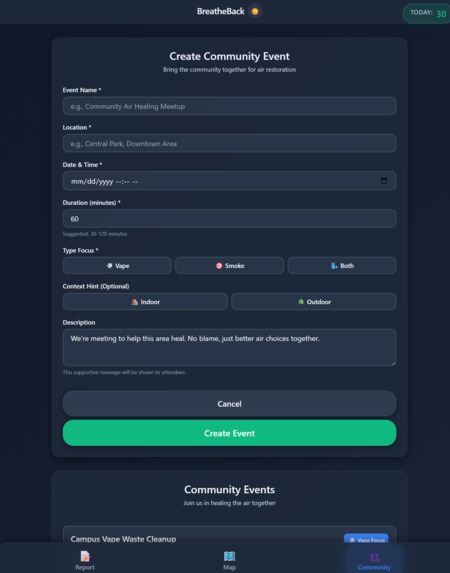
Community Center
-
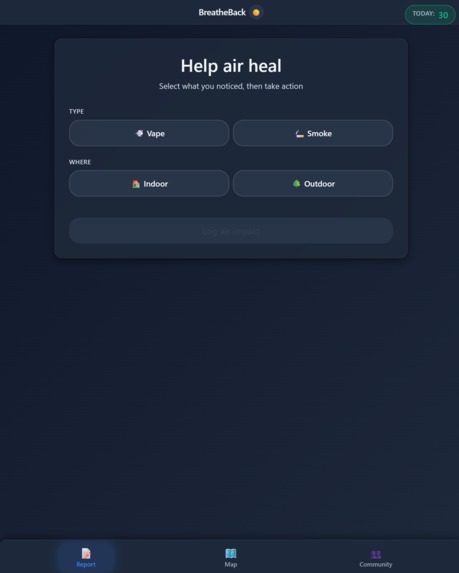
Home
-
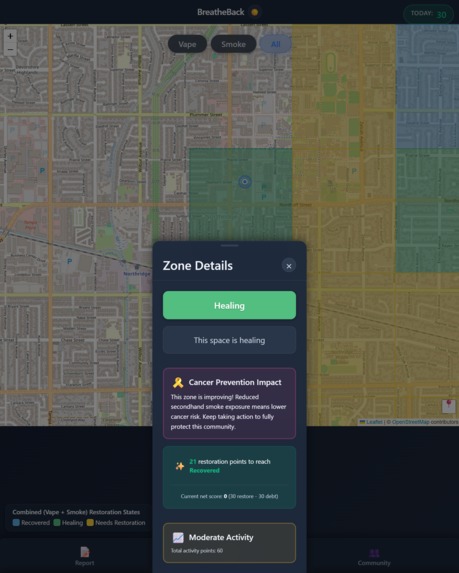
Map
-
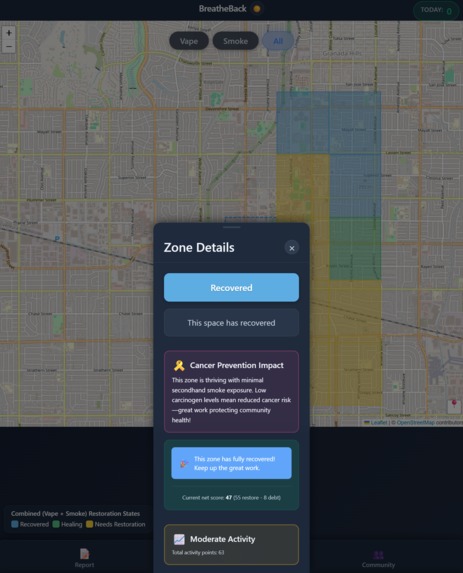
Map
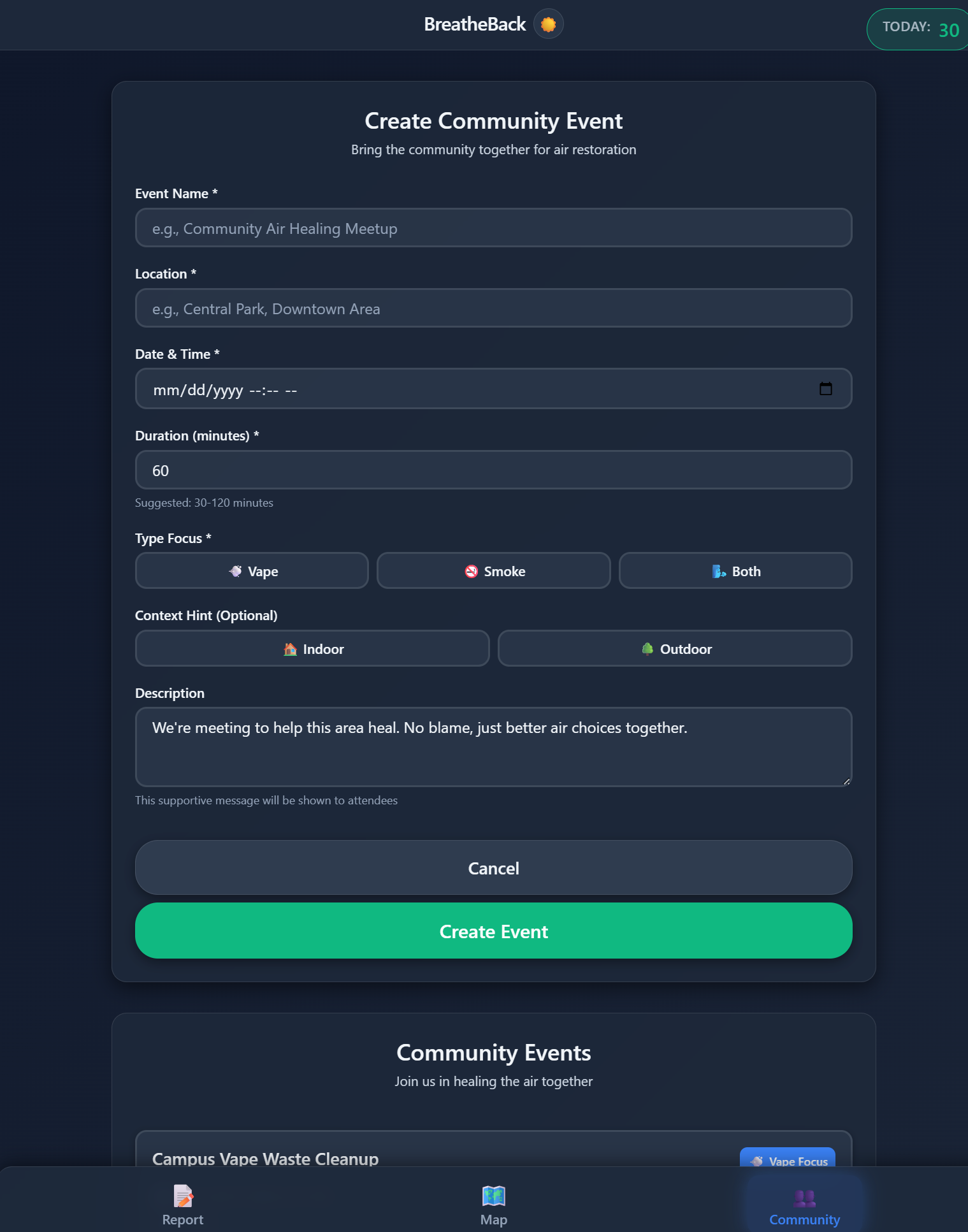
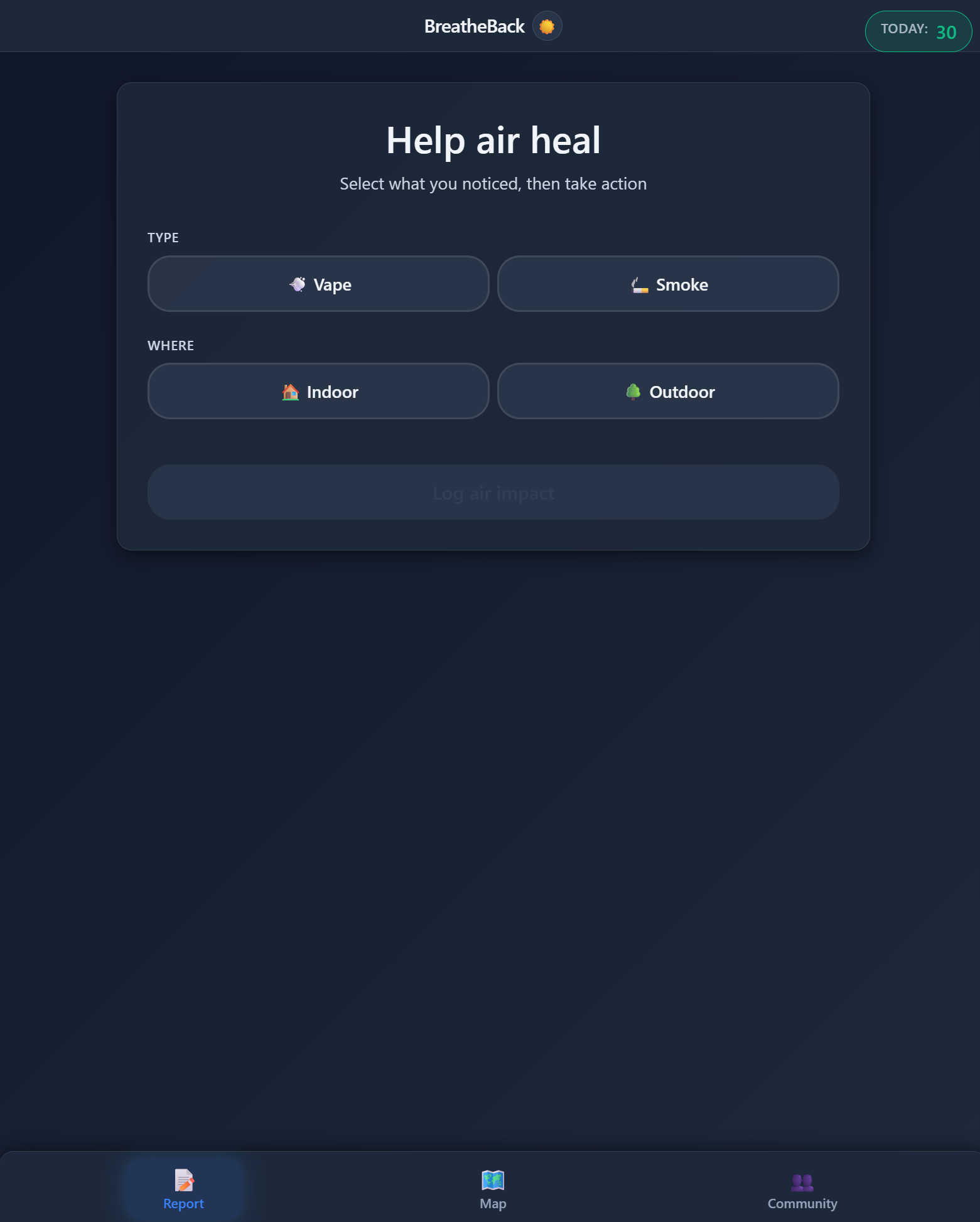
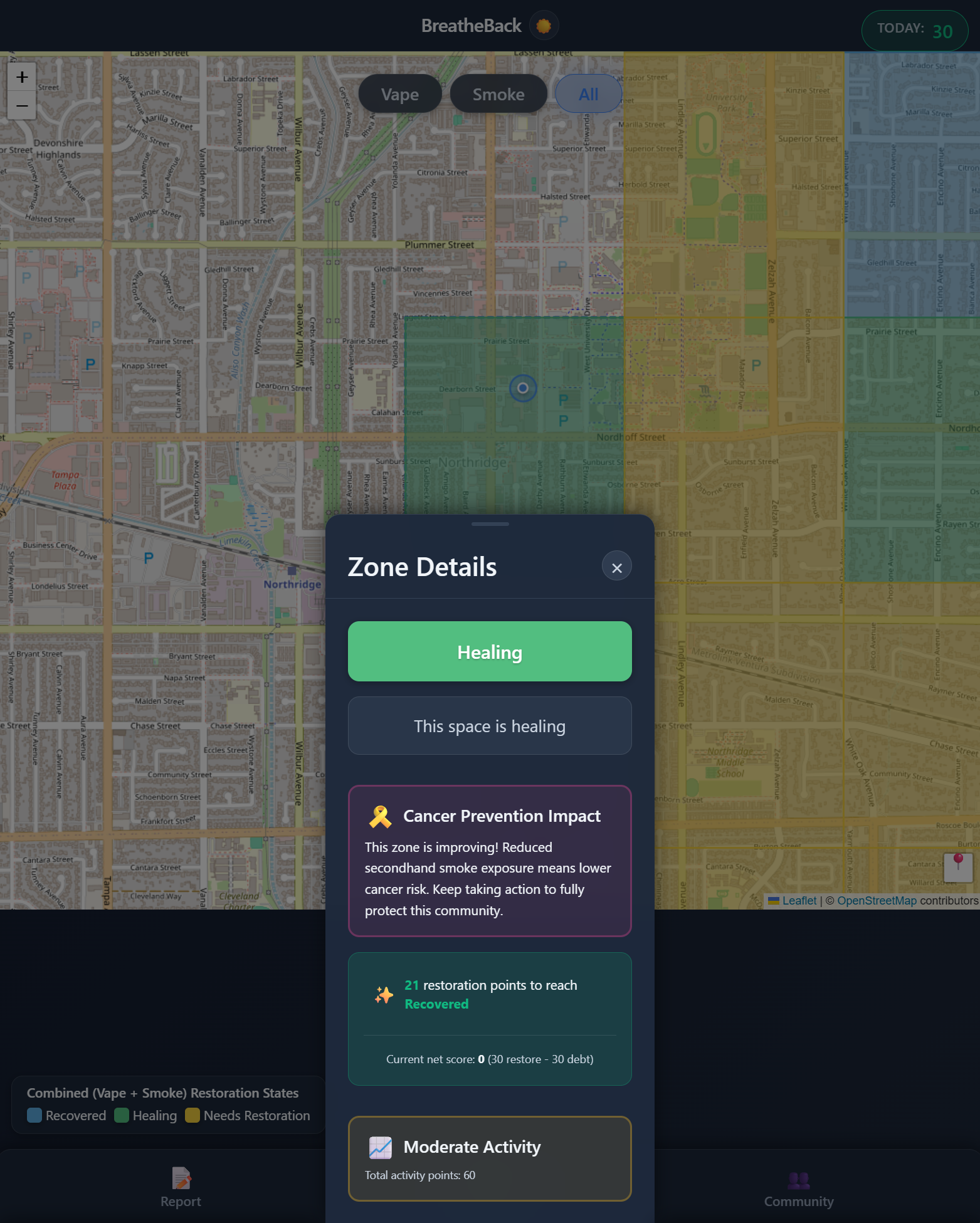
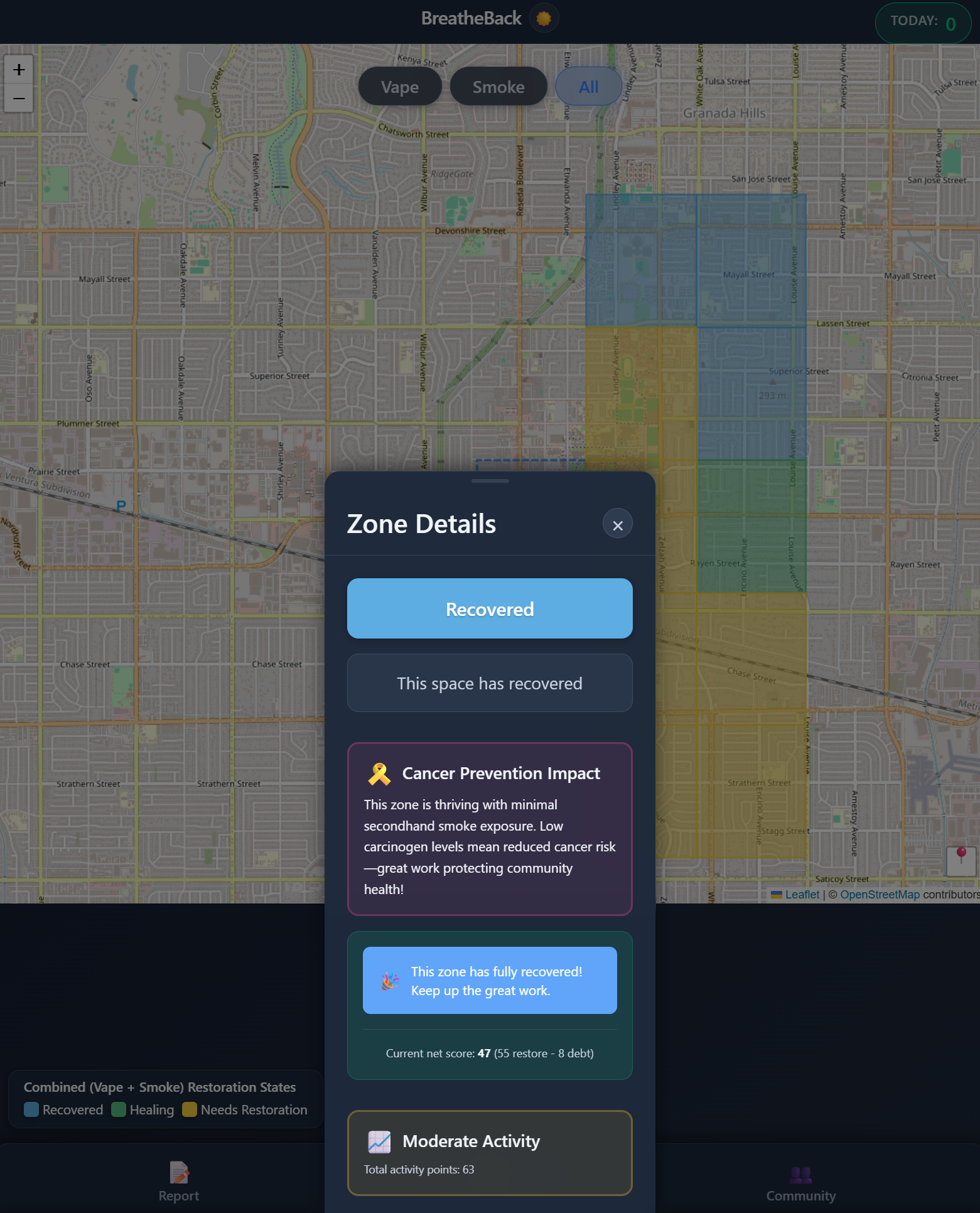
Inspiration
BreatheBack was inspired by my experience working on clinical trial automation early in my career. At TCS, I worked on systems that processed adverse event cases for AstraZeneca - extracting patient data from structured clinical formats, applying medical and drug coding, and evaluating causality for serious events. That work made one thing very clear to me: by the time data enters a clinical database, harm has already happened.
At the same time, environmental factors like secondhand smoke and poor air quality, which are widely recognized in cancer prevention, often remain invisible at the community level. People know these issues exist, but there are very few tools that help them understand where prevention is breaking down or how everyday actions connect to policy gaps.
BreatheBack came from wanting to flip that perspective: instead of focusing on outcomes after harm, what if we could make prevention and restoration visible in shared spaces?
What it does
BreatheBack is a mobile-first web app that visualizes community air restoration rather than harm. Users can log smoke or vape exposure they notice in shared environments, without identifying individuals or exact incidents. The world is divided into grid-based zones, and each zone tracks aggregated exposure signals (“debt”) and community actions (“restoration”).
Zones move through three states:
- Needs Restoration
- Healing
- Recovered
Users are encouraged to take simple, practical restoration actions and earn points as zones improve over time. Instead of marking hotspots or offenders, the app focuses on recovery and collective responsibility.
An optional AI component helps translate zone-level patterns into high-level cancer prevention and policy context. The AI does not diagnose, predict risk, or assess individuals; it only interprets aggregated signals to explain why clean-air environments matter for prevention.
How we built it
TLDR: Python, Flask, JavaScript, HTML, CSS, Leaflet.js, OpenRouter, Gemini Flash.
The backend is built using Python and Flask, with lightweight JSON storage to keep the system transparent and easy to reason about during the hackathon. Each zone tracks smoke and vape signals separately, which was important to avoid oversimplifying different exposure patterns.
The frontend is built with vanilla JavaScript, HTML, and CSS, using Leaflet.js for the interactive map. I intentionally avoided heavy frameworks so I could maintain tight control over state and behavior and move quickly during development.
For AI integration, the app uses OpenRouter with a free Gemini Flash model. AI outputs are tightly constrained with prompt rules and server-side filtering, and the app always falls back to static messaging if AI fails or produces unsafe output. The system works fully even without AI enabled.
Challenges we ran into
The biggest challenge was restraint.
With a background in machine learning and medical imaging research, it was tempting to add predictive models, statistics, or more detailed health explanations. But doing so would have crossed into claims the system couldn’t responsibly support, especially in a cancer policy context.
Another challenge was designing an experience that feels encouraging rather than judgmental. Many health-related tools unintentionally shame users. A lot of effort went into simplifying language, softening visuals, and framing clean air as a shared public good instead of an individual responsibility.
Balancing technical rigor with accessibility for youth audiences was also difficult, especially when dealing with topics related to cancer prevention.
Accomplishments that we're proud of
- Designing a prevention-focused system that avoids individual tracking, diagnosis, or blame
- Building a complete, working end-to-end product within hackathon constraints
- Integrating AI in a disciplined way that adds context without overreach
- Creating a heatmap that visualizes recovery rather than harm
- Maintaining technical credibility while keeping the app approachable and youth-friendly
What we learned
This project reinforced something I’ve learned across both industry and research: good healthcare technology is often about knowing what not to do.
Not every problem needs AI or prediction. Not every dataset needs a model. Sometimes the most impactful tools are the ones that make existing issues visible, interpretable, and actionable - especially for prevention and policy advocacy.
Working on BreatheBack also highlighted how design choices, language, and restraint matter just as much as technical capability in health-adjacent systems.
What's next for BreatheBack
In the future, BreatheBack could be extended to support longer-term pattern analysis, community advocacy dashboards, or partnerships with public health organizations to inform clean-air and ventilation policy discussions.
With additional safeguards, the platform could also support more structured educational content tied to public health guidance, while continuing to avoid diagnosis or individual risk assessment.
At its core, the goal remains the same: to help communities see where prevention is needed and to make cancer prevention more understandable, accessible, and actionable at a systems level.

Log in or sign up for Devpost to join the conversation.