-
-
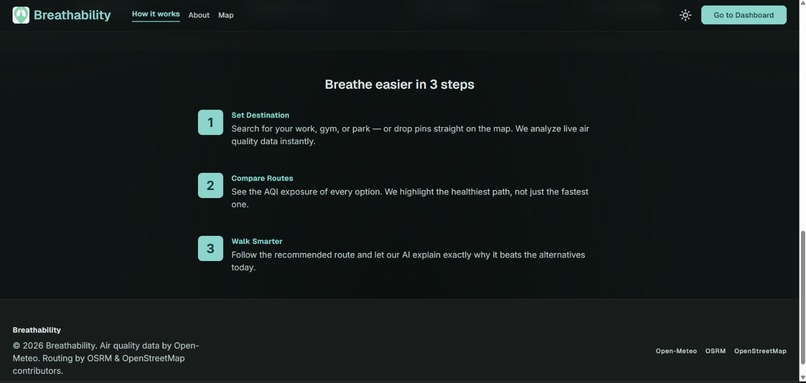
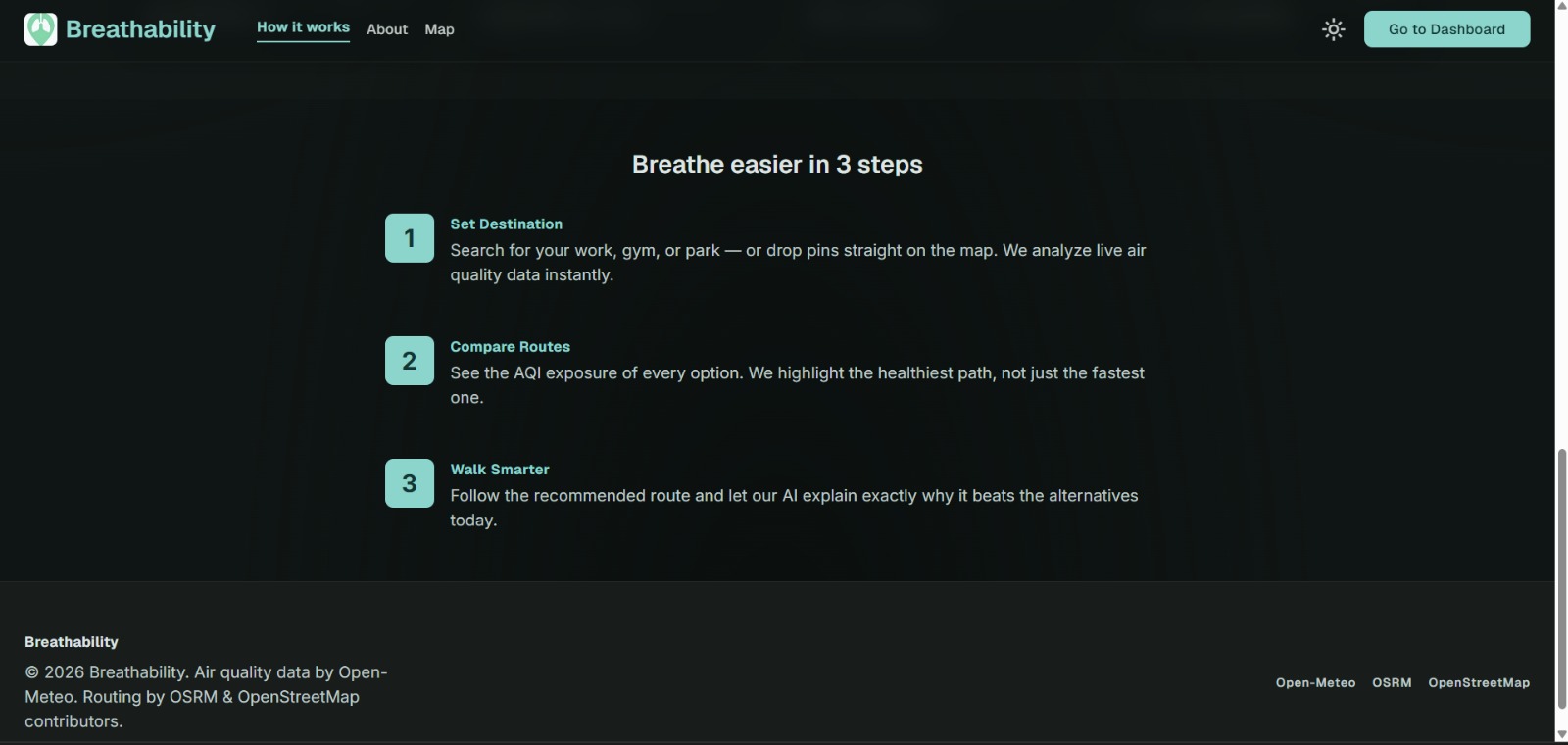
Part of Landing Page
-
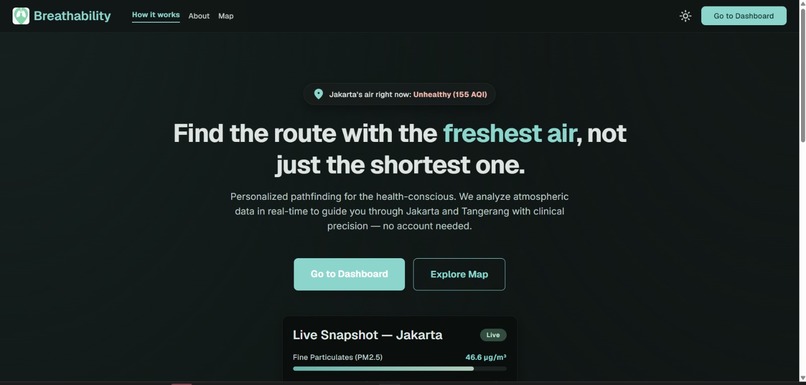
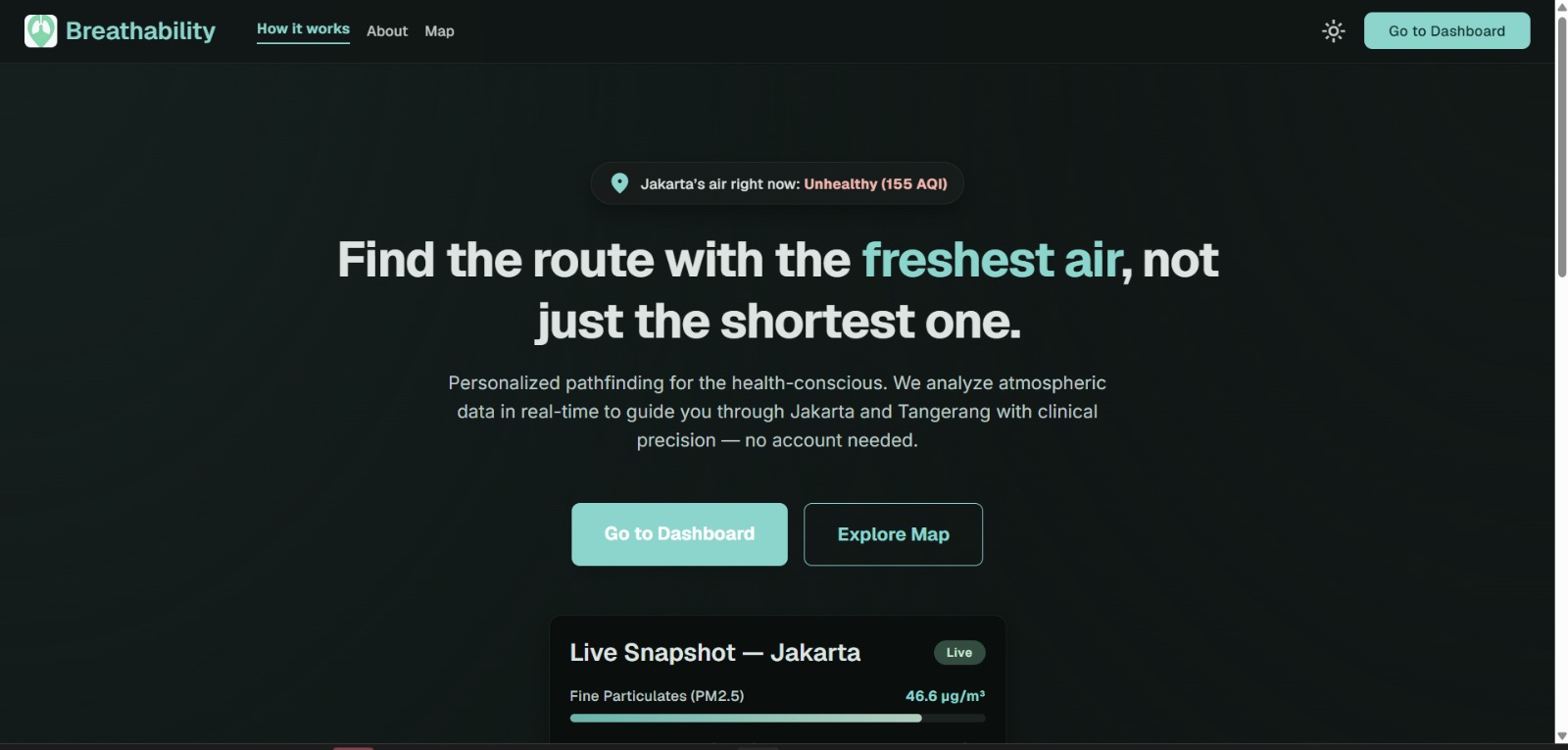
Part of Landing Page
-
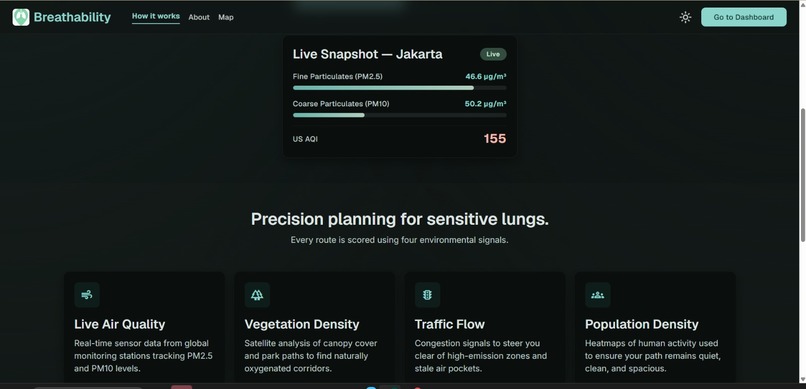
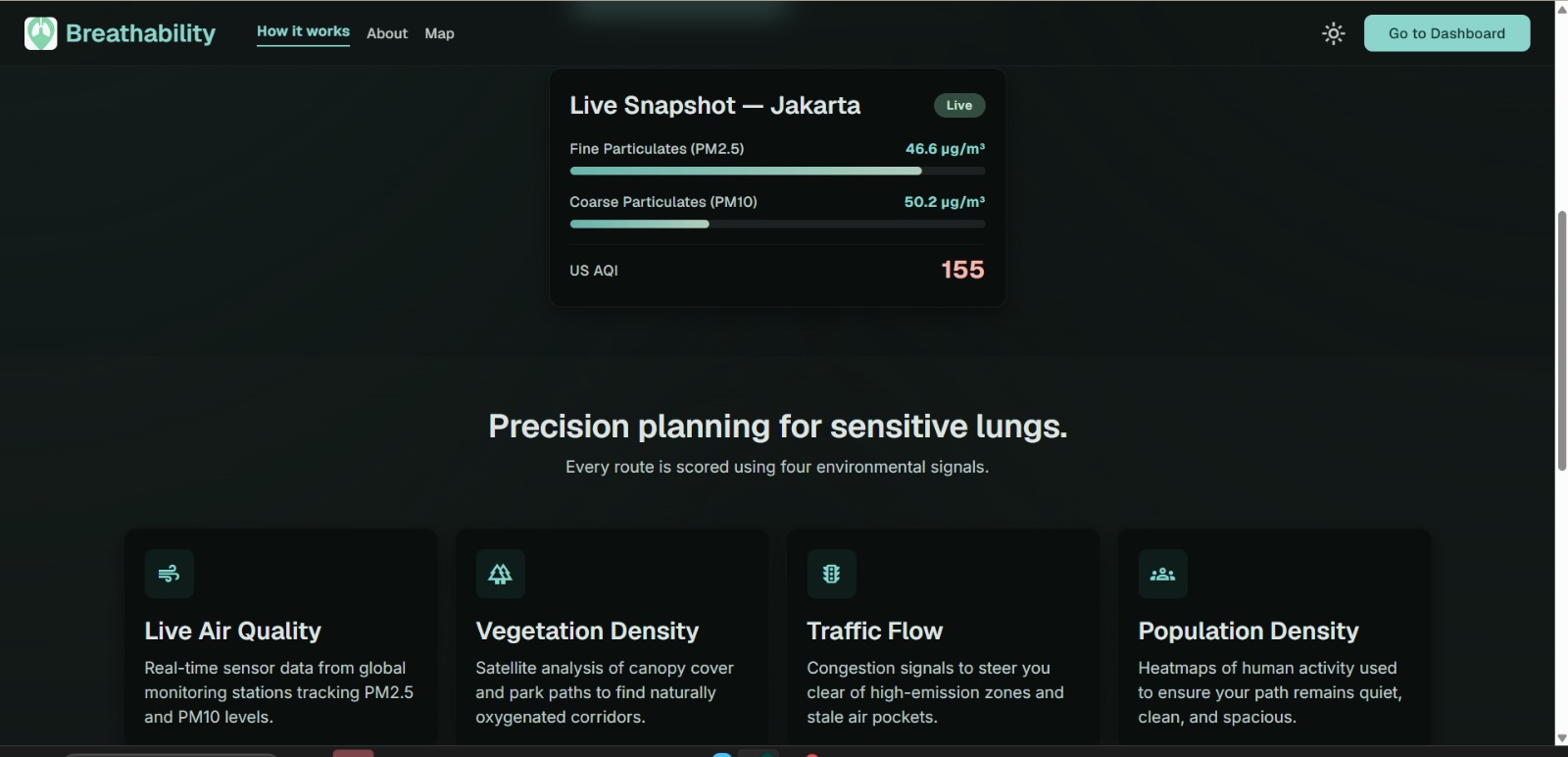
Part of Landing page
-
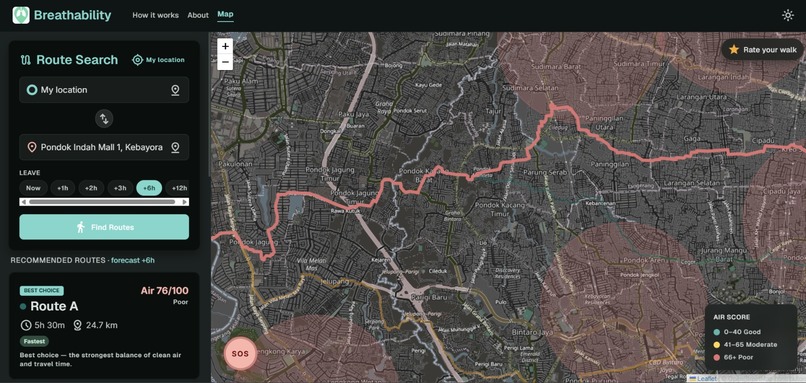
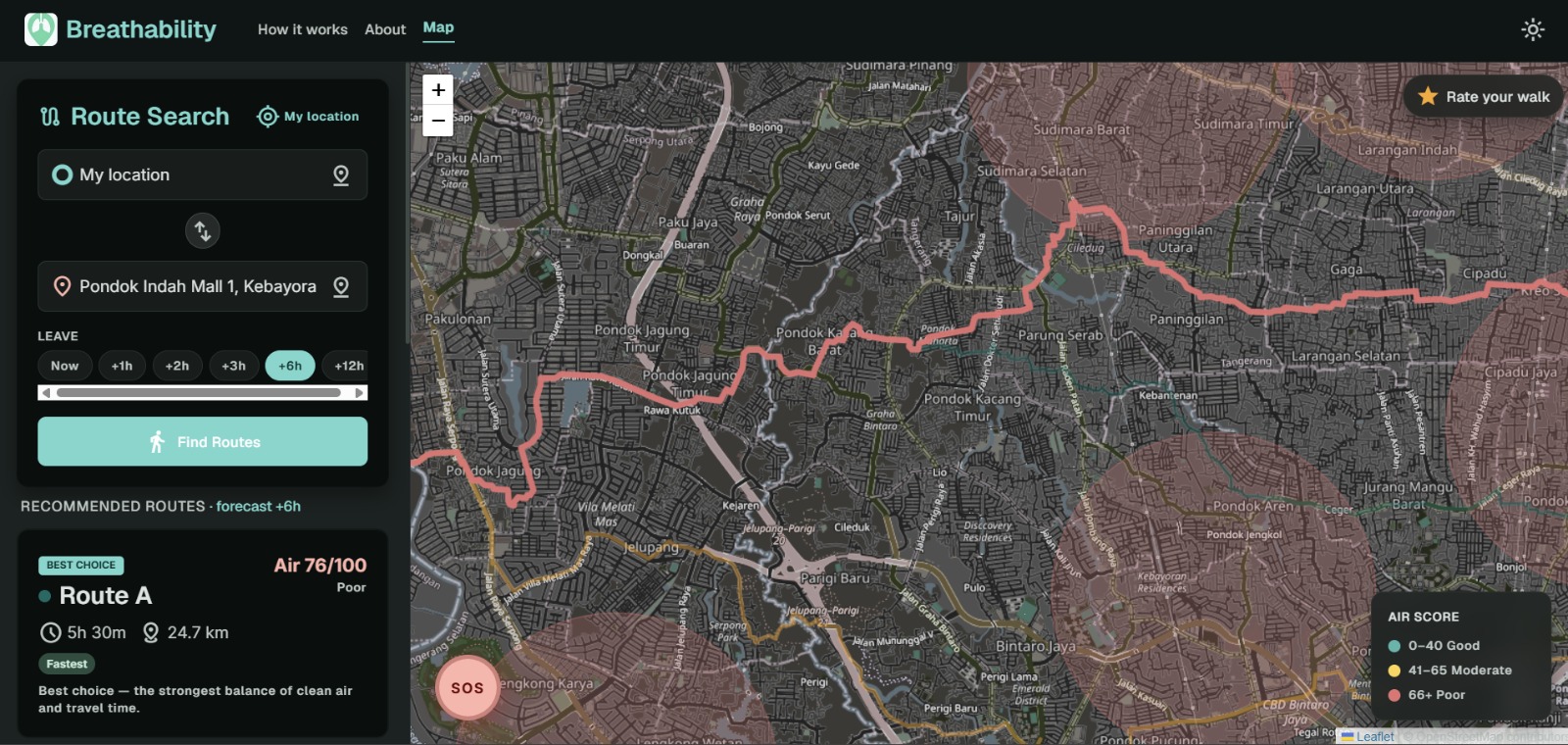
Main dashboard
Inspiration
Our project is heavily inspired by our health conditions of our parents and also some of us as well. One of our mom's and one of our dad's have asthma, and one of our teammate, which is Noby, has Sinusitis, which is why when they want to walk in open air, it is best for them to walk in a clean air quality.
We built BreathAbility to overcome that limitation, turning every walk into a safe, worry-free experience by prioritizing cleaner routes. We didn’t just build an algorithm, we built a way for our loved-ones to to reclaim the outdoors with confidence .
What it does
BreathAbility is the website that helps users to determine and choose a walking route, from a starting location to a destination they desire, with the best Air Quality condition for the users to walk through and fastest route to take.
This website is very useful for people that have breathing issues, especially asthma, and allergies to huge amounts of air pollution, but normal people could also use this website to help them walk in a fresher route. The routes that the Breathability could determine can be from anywhere to anywhere, as long as it is still in the DKI Jakarta province and Tangerang region.
The website has many features that would help users, such as :
- Best Air Quality checker, with an algorithm of counting the Air Quality Index, which considers the type of gas like Fine Particulates (PM2.5) and Coarse Particulates (PM10), which would help the user to reach the destination with best Air Quality.
- 24-hour air quality forecast, with the help of Open-Meteo Air Quality Index (AQI) API that could predict up to 5 days of AQI in many areas.
- AI descriptor that explains about the AQI of the routes that the website gave and why that route is the best to walk on.
- Emergency call, a feature that helps users to contact the nearest hospital and reroute the map in the website when they happen to be in an emergency situation, such as Asthma or other breathing problems.
How we built it
We firstly brainstormed together to develop the idea of this Breathability Website. We planned the app flow and how it will work in practice. Then, we divided task with each other :
- Danish and Bhre -> Designed and code the entirety of the Software app flow and features. We mostly use Claude code with Antigravity IDE to develop the code and algorithms of the website. We also design the UI/UX through Google Stitch that created the raw design and edit it in Figma. We also set up the API’s, which are Open-meteo AQI, OSRM, GroqAPI, and the backend and frontend with Supabase and Vercel, respectively.
- Noby and Nico -> Work on researching the methodology and about how the Breathability would work to determine the best air quality route. We develop the variables and considerations to obtain an accurate AQI of a specific area so the route could be more representative.
Challenges we ran into
The number One challenge we faced was when we were trying to find the air quality index data. We found out the accuracy of most data sources averages out too wide of an area thus giving inaccurate numbers. To solve this issue we decided to incorporate aspects of the environment such as vegetation, traffic, and population density to predict the air quality index of smaller areas and increasing accuracy
Accomplishments that we're proud of
As a team of mostly first time hackathons, we are proud to have transformed a deeply personal challenge into a functional and beneficial solution. Our journey with BreathAbility has been marked by several keystones: We are most proud of successfully grounding our technical work in the real world health needs of our own families and teammates. By designing for respiratory conditions like asthma and sinusitis, we ensured that our tool serves a genuine purpose: We successfully bridged the "Granularity Gap" in environmental data. By building a custom predictive model from data analysis that synthesizes traffic flow, vegetation density, and population metrics, we turned broad, city wide AQI averages into actionable, street-level safety intelligence.
What we learned
As this was our first hackathon experience, the most transformative lesson was realizing that the event is far less about building a perfect, polished product and everything about the velocity of learning and the power of collaborative problem-solving. We learned that the ability to bridge the gap between complex engineering and a compelling, clear narrative is just as vital as the code itself, ultimately turning a high-pressure environment into an invaluable training ground for professional adaptability and team resilience.
What's next for Breathability
The next step for breathability is to decrease the margin of error on the current predictions, broaden the locational coverage for breathability, and add locational based warnings for allergens.
Built With
- antigravityide
- claude
- figma
- googlestitch
- groqapi
- leaflet.js
- next.js
- open-meteo-aqi-api
- osrmapi
- supabase
- vercel


Log in or sign up for Devpost to join the conversation.