-
-
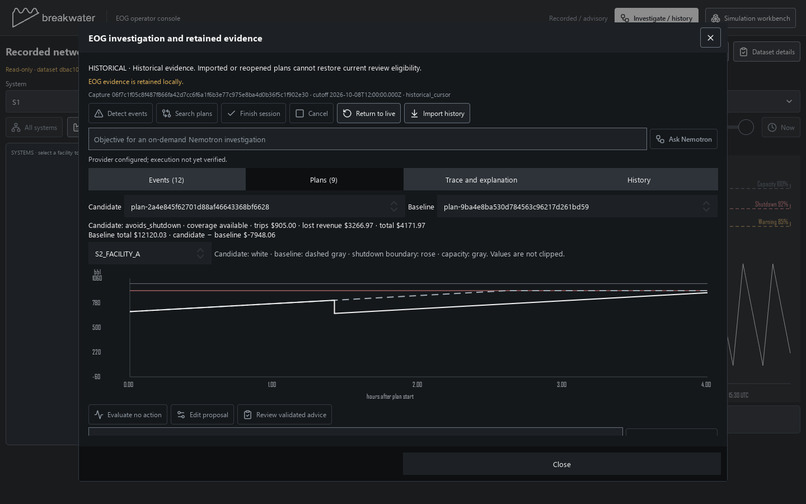
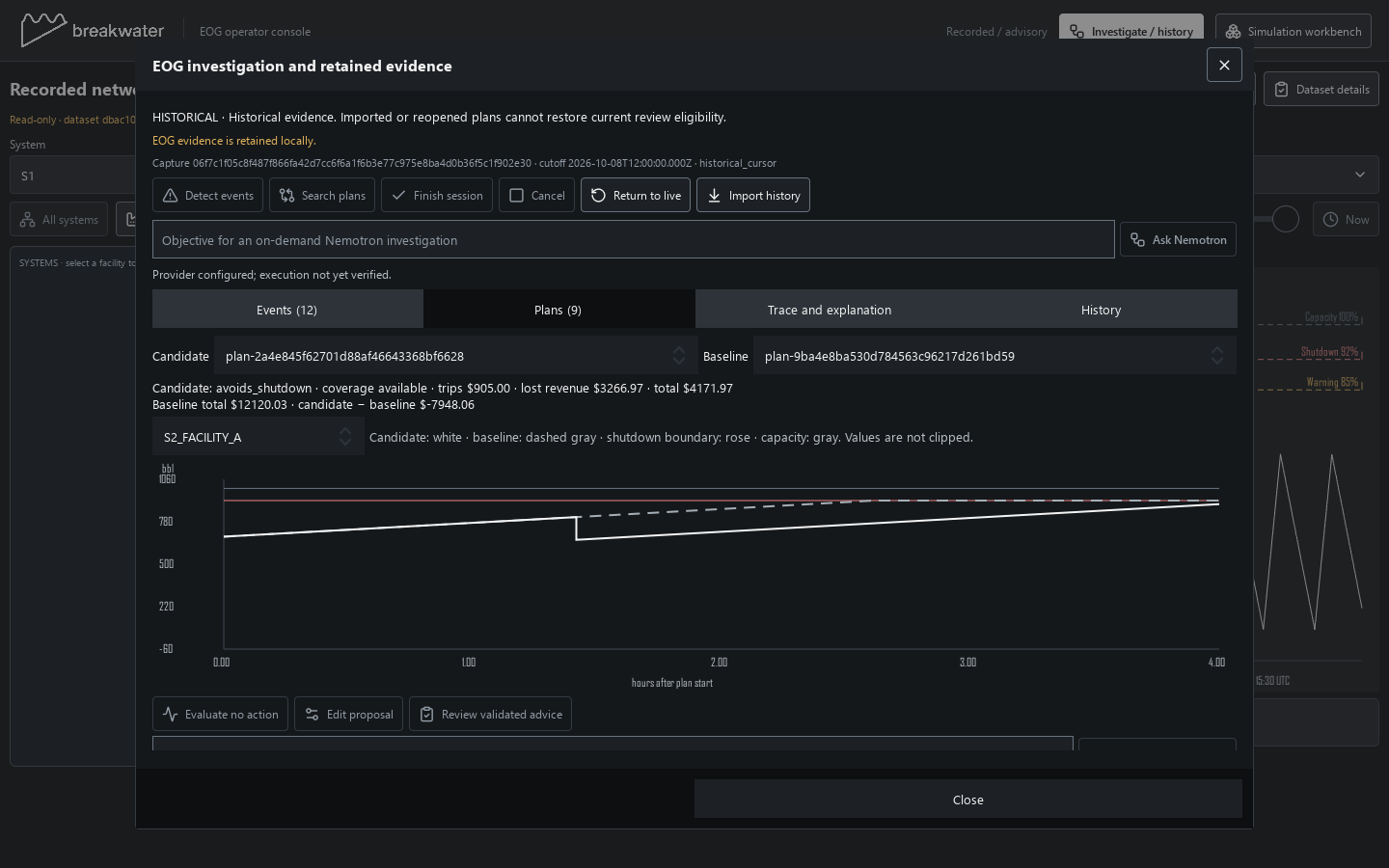
Historical hosted result: modeled $12,120.03 to $4,171.97; independently validated. Bounded, incomplete search; no action authority.
-
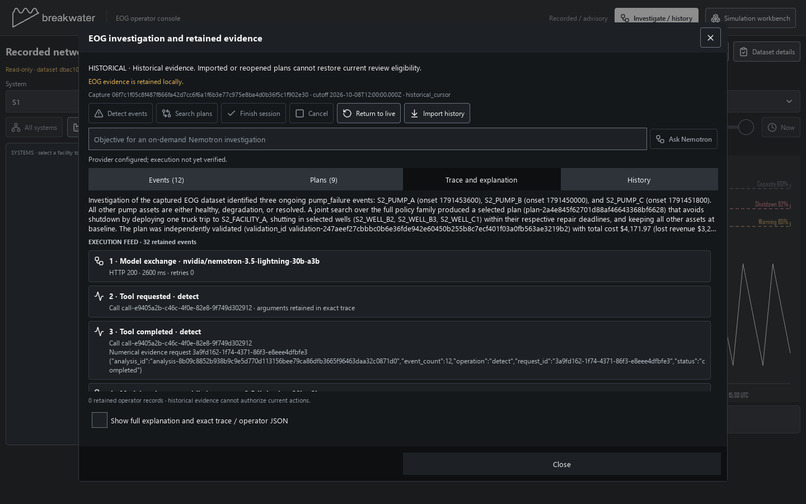
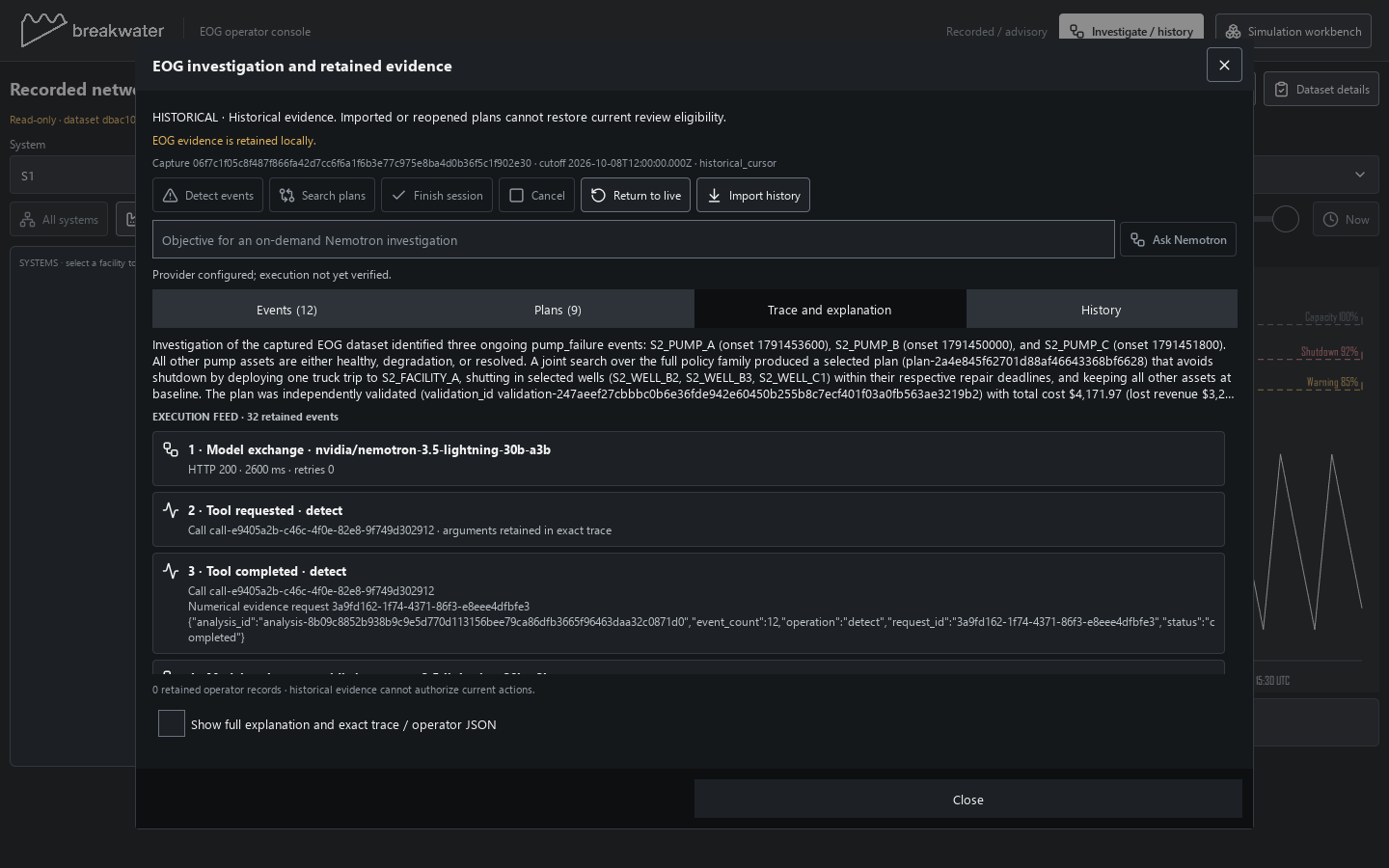
Historical Nemotron trace: genuine model-issued tools, matching numerical results and sanitized request metadata.
-
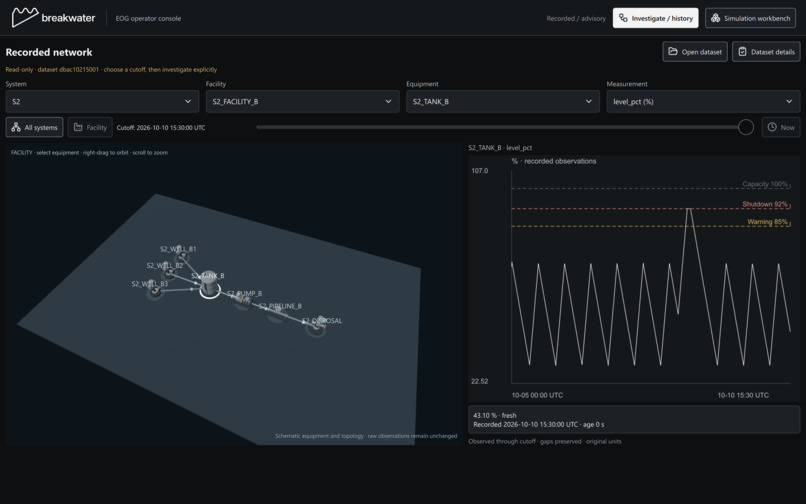
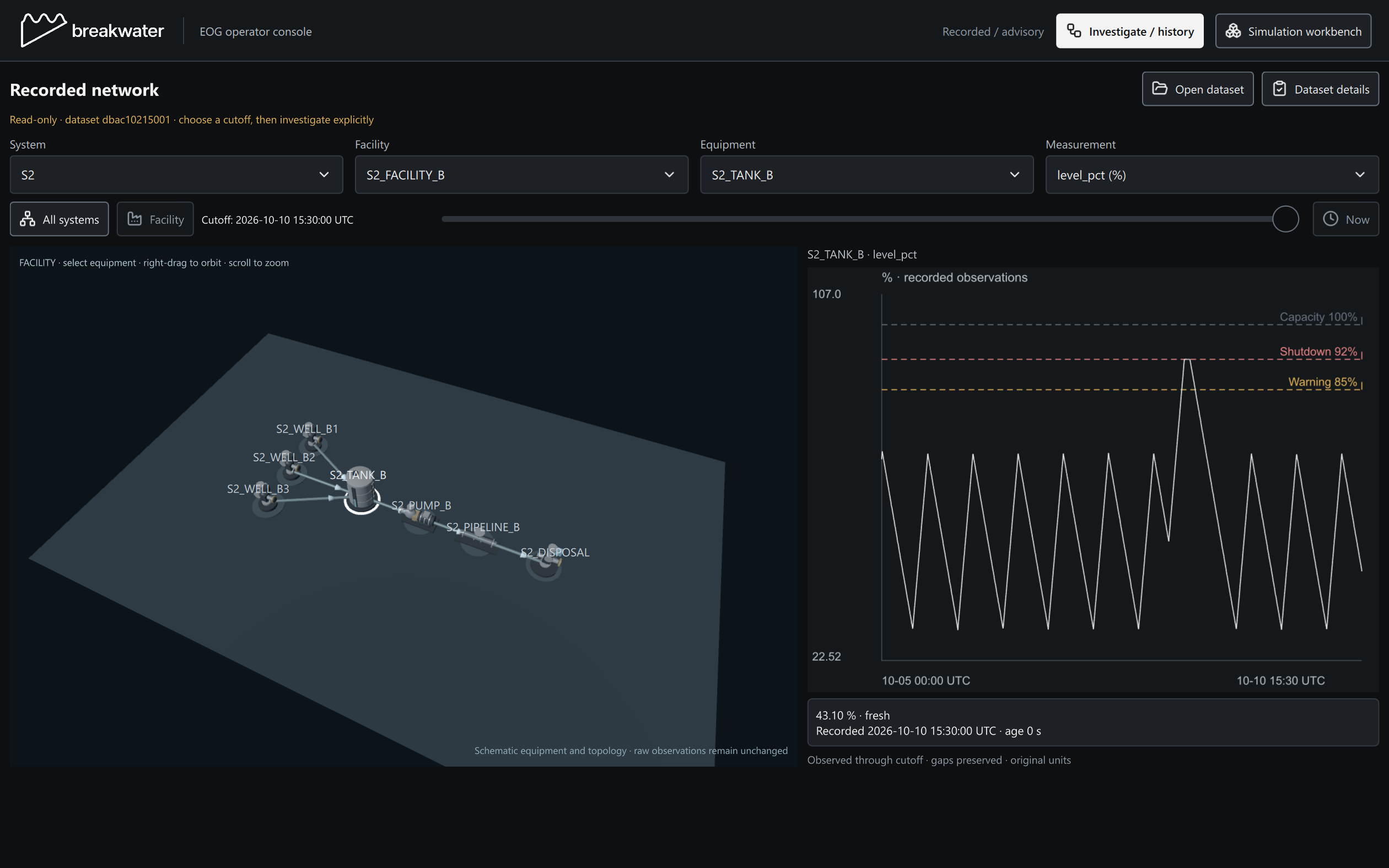
Facility S2_B: wells, tank, pump and pipeline alongside recorded level observations and operating thresholds.
-
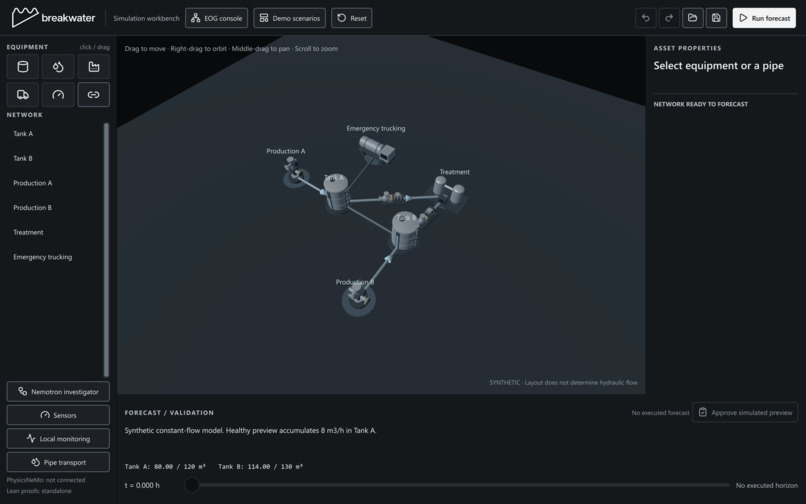
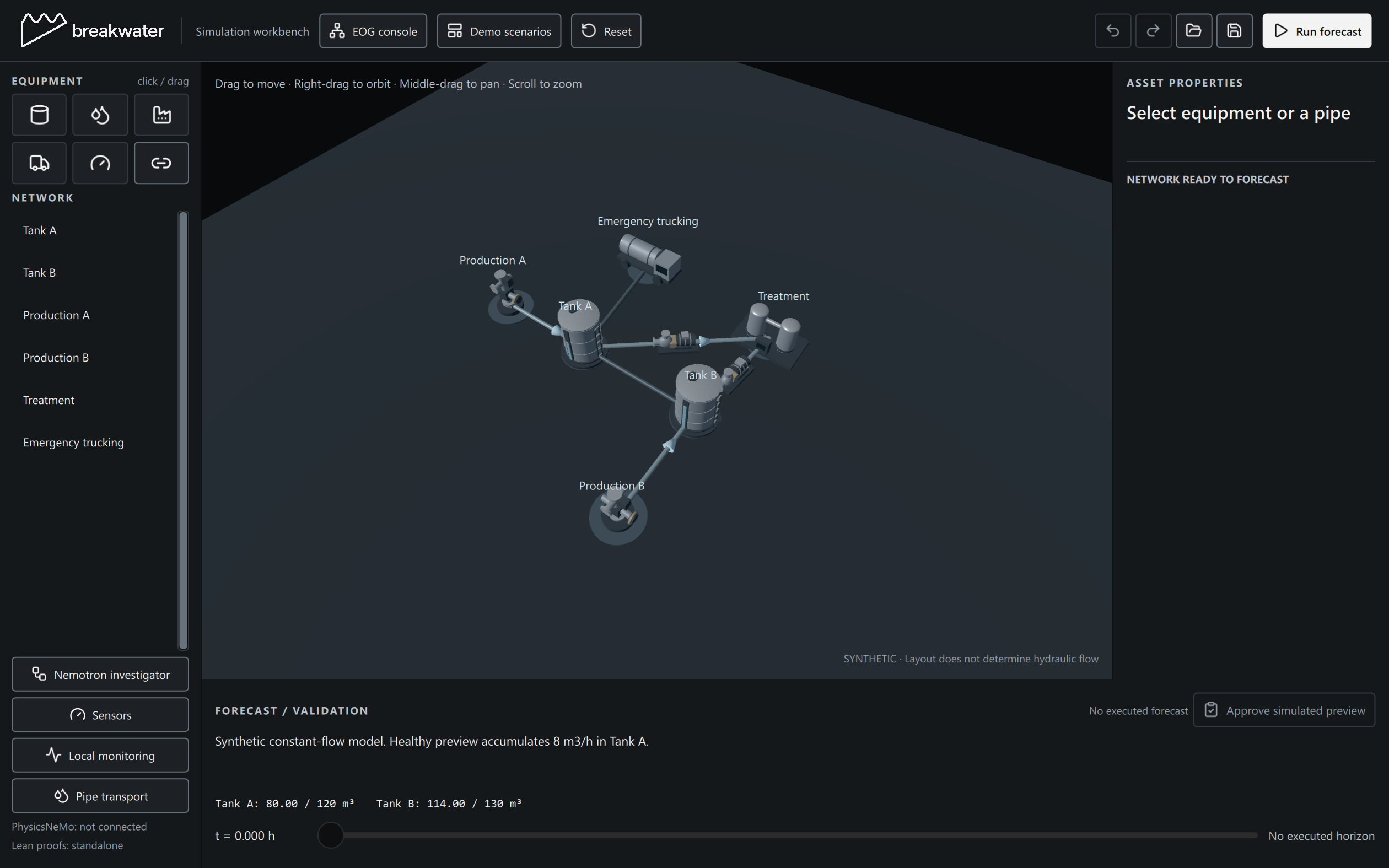
Modular synthetic workbench: arrange sources, tanks, pumps, treatment and trucking, then run native forecasts.
-
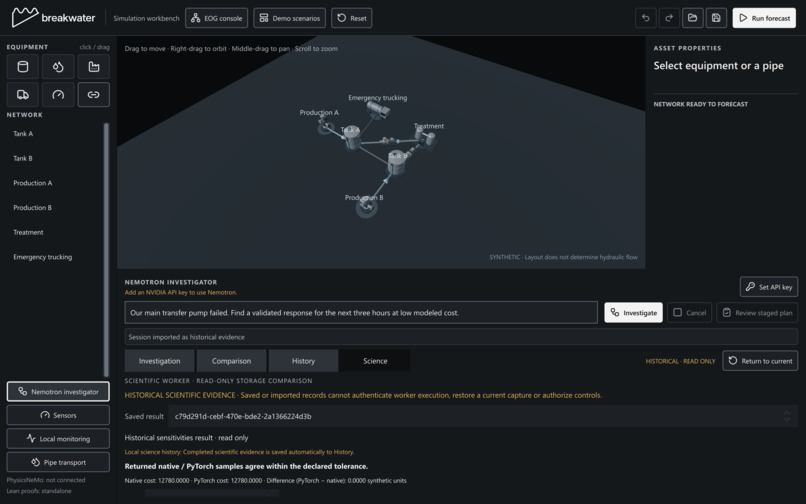
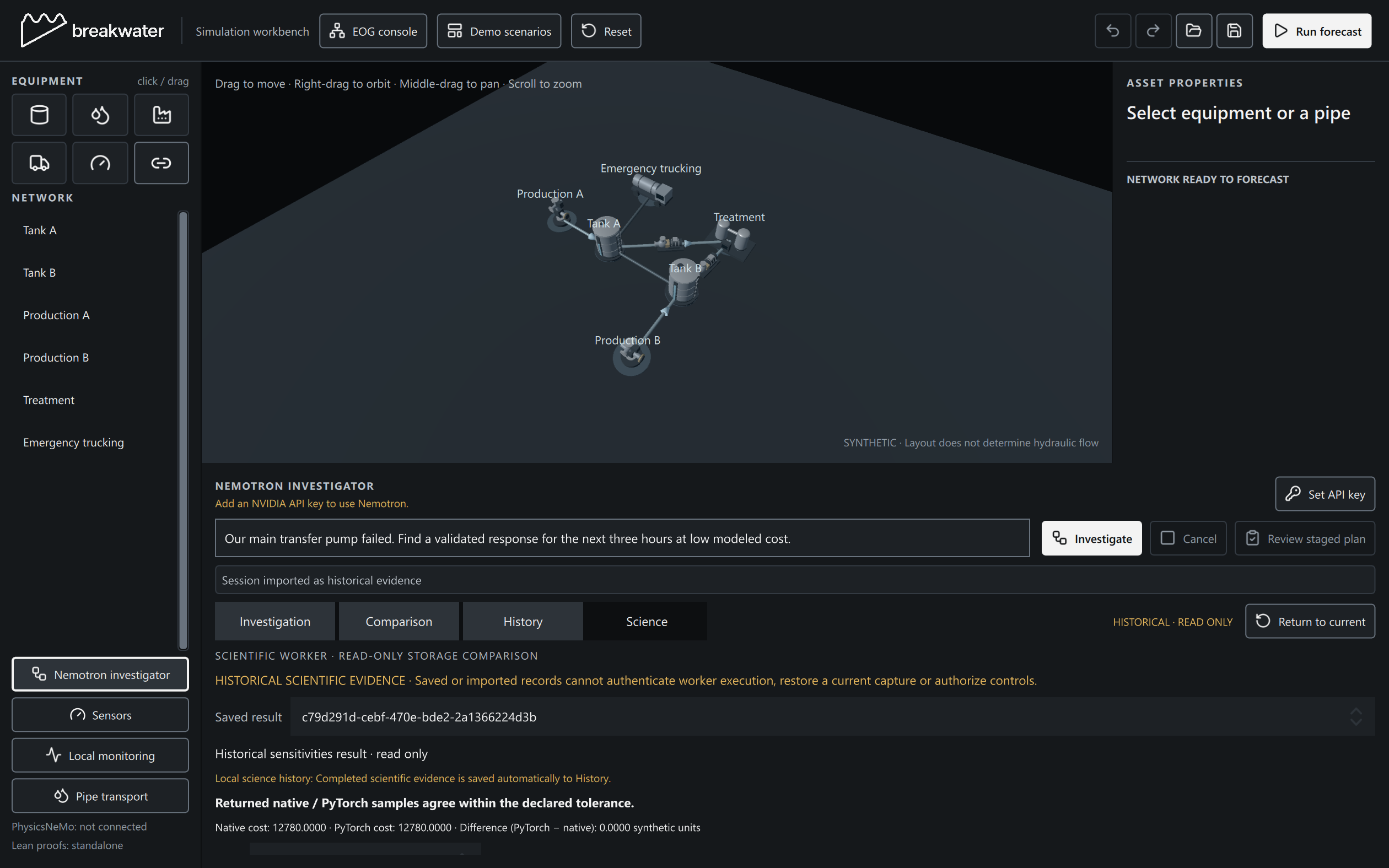
Historical CPU PyTorch sensitivities versus native storage calculations; zero displayed cost difference in this saved example.
-
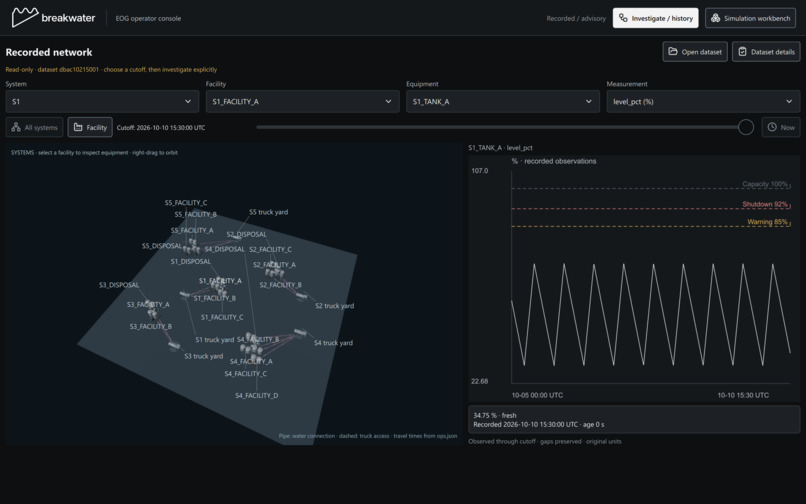
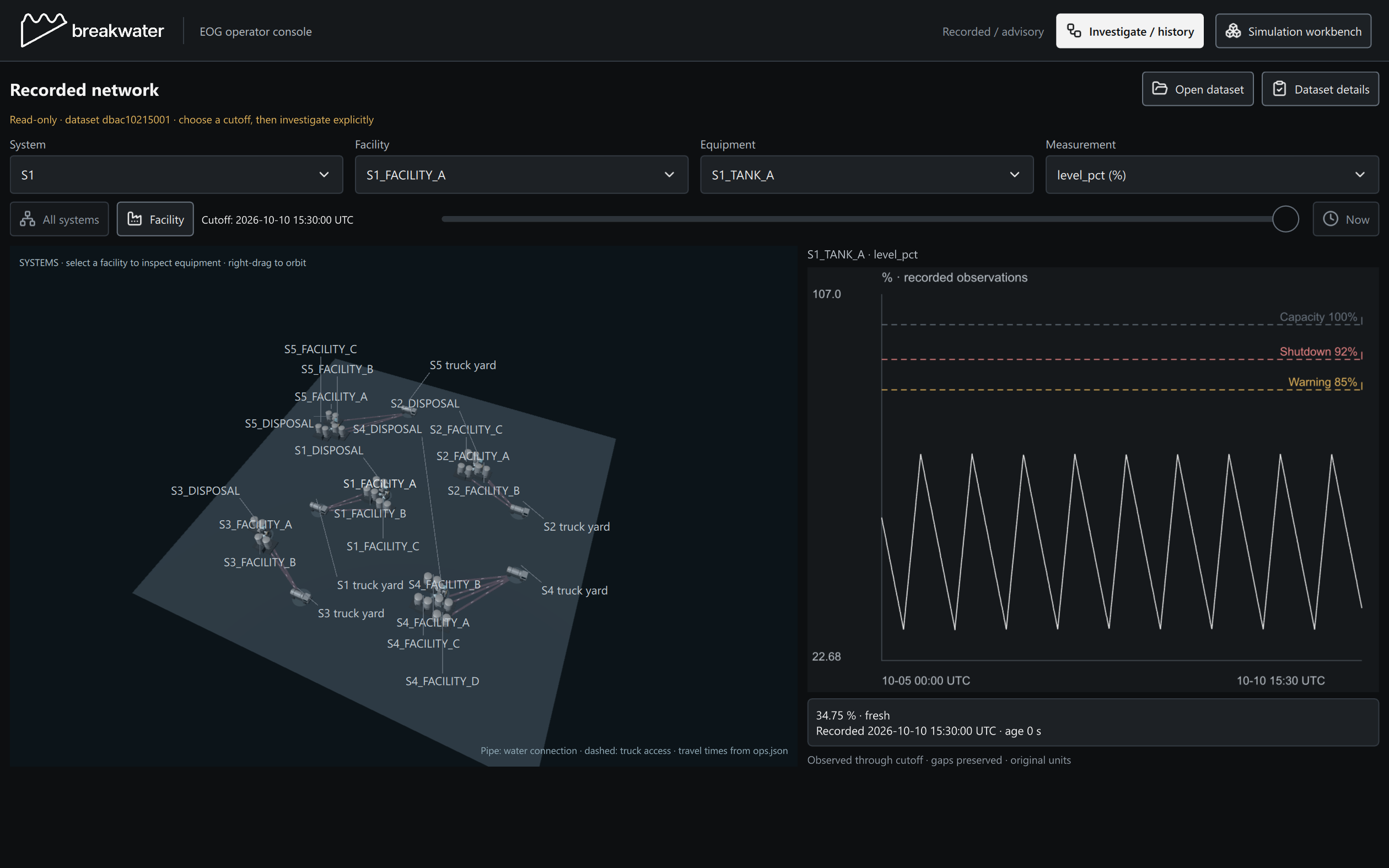
Recorded EOG network: five systems, facility relationships and original measurements at a selected cutoff.
Inspiration
A failed water-handling pump can turn a manageable incident into an expensive production shutdown. An operator needs more than a warning: which equipment is affected, how long remains, what a response costs, and what evidence supports it. We built Breakwater to make those decisions inspectable.
What it does
Breakwater has two connected but distinct workspaces. The EOG console imports the challenge's three files (network.json, ops.json and telemetry.csv) and builds a dataset-driven 3D network with selectable equipment and measurement trends. Its analysis uses a fixed causal cutoff and preserves recorded readings. It detects incident evidence, estimates shutdown exposure, evaluates candidate responses and displays trajectories, costs, constraints and limitations.
The modular simulation workbench lets users create and edit synthetic networks of sources, tanks, routes, pumps, treatment and trucking capacity. Native forecasts show the consequences of accepted numerical edits. The workbench remains separate from the recorded EOG data.
How we use Nemotron
NVIDIA Nemotron 3.5 Lightning coordinates an on-demand investigation through bounded tools. It navigates the imported network structure, requests relevant observations and chooses numerical detector, search, evaluation and validation calls. Its returned plan and event references must match retained evidence.
Native calculations supply costs and constraints. A separately implemented validator recomputes the exact plan before advisory review becomes available. The desktop retains tool order, arguments, numerical results and sanitized request metadata in local history. Imported or reopened evidence is clearly historical and cannot restore current approval. EOG review records advice viewed; it never dispatches trucks or controls wells.
How we built it
The application is a native C++20/Qt Quick desktop with a schematic 3D view, strict shared contracts, an asynchronous Python process boundary and SQLite evidence retention. Lucas focused on the desktop, model orchestration, contracts, history and integration. Ethan focused on the numerical models, scientific methods and independently computed validation.
The separate Science workflow uses PyTorch for differentiable comparisons and selected-control sensitivities, alongside native finite-volume transport references. Standalone Lean 4/Mathlib proofs check selected conservation and update identities. Experimental PhysicsNeMo work remains separate from the operational forecast path; the desktop does not claim arbitrary-network learned inference or formal certification of the complete physical system.
We connected the actual hosted model to executable tools rather than treating model prose as a numerical result. Earlier live rehearsals retained genuine tool calls and independently validated recommendations, including a renamed network with a facility branch removed. Those were derived practice inputs, not independent held-out accuracy evidence.
Challenges we ran into
Correctness spans several boundaries: historical cutoffs must exclude future readings, noisy or missing evidence must remain explicit, plan IDs and hashes must stay bound to one capture, and shared truck schedules must respect inventory and repair deadlines. We also had to make model output inspectable and reject malformed or ungrounded final responses without granting authority.
Accomplishments that we are proud of
The desktop brings the recorded network, original measurements, model-selected investigation steps and numerical evidence into one workflow. It preserves the editable sandbox while making stale state, rejected edits and historical evidence visible. Human review remains explicit.
In one completed installed hosted investigation, Nemotron requested bounded joint search and then separate exact validation. The retained modeled cost changed from $12,120.03 for no action to $4,171.97 for a mixed response using one truck trip and three well shut-ins, with a validated modeled outcome that avoided shutdown. The search compared no-action, truck-only, well-only and mixed candidates. It stopped at 100 candidates and reported best_found, incomplete search and 26 numerically unavailable candidates. This is one recorded synthetic example, not a guarantee of the globally cheapest continuous plan.
What we learned
Useful agentic software needs precise evidence boundaries and clear failure states. A plausible explanation is not a numerical result, and a successful simulation is only as reliable as its assumptions. Separating prediction, validation and human review made the workflow easier to inspect and safer to demonstrate.
What is next
We want broader unseen-network evaluation, better incident timing and uncertainty assessment, and a separately qualified stateful simulation workflow. Current models are simplified; inspection timeliness and physical accuracy remain areas for evaluation. Generic synthetic monitoring is separate from the recorded EOG analysis; real hardware integration and automatic sensor-to-forecast workflows are future work.
Run it
The public repository contains the Windows build/setup instructions and the source for both workspaces. Configure the local Python worker and NVIDIA credentials locally, then open an EOG folder containing the three required input files. The sandbox can be used independently of hosted inference.


