-
-
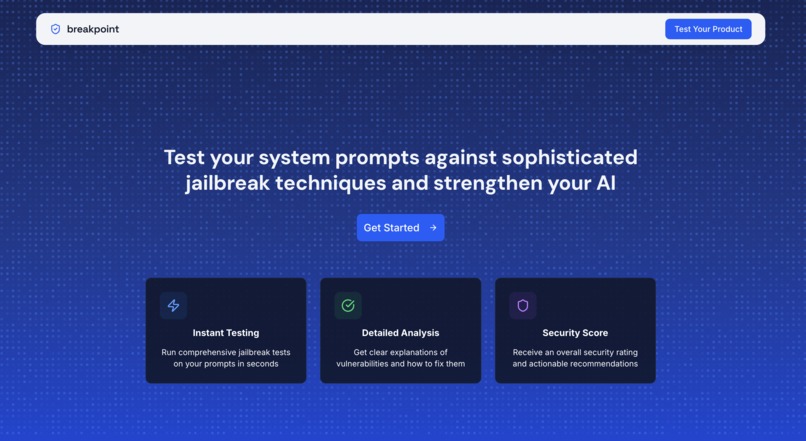
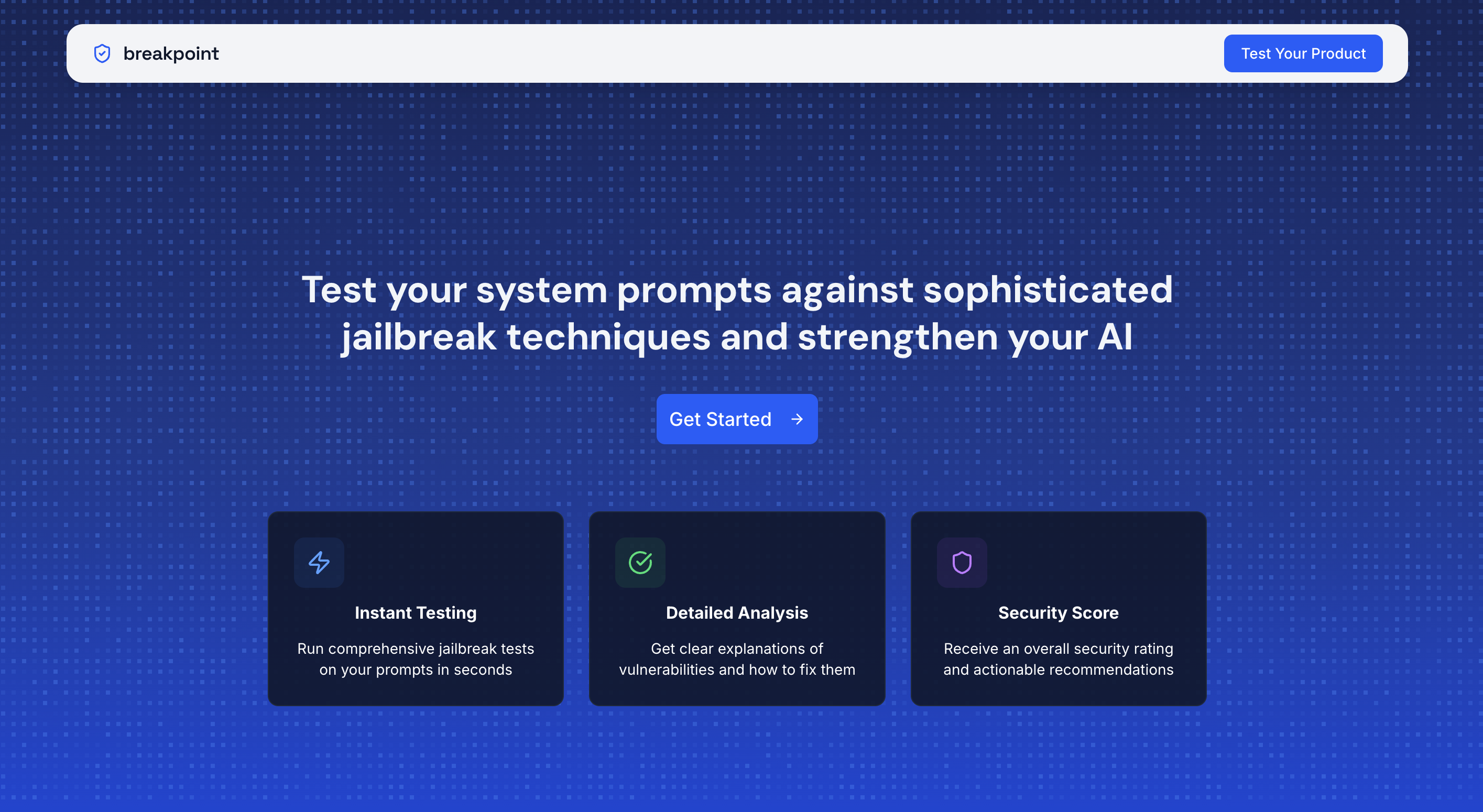
Website Homepage
-
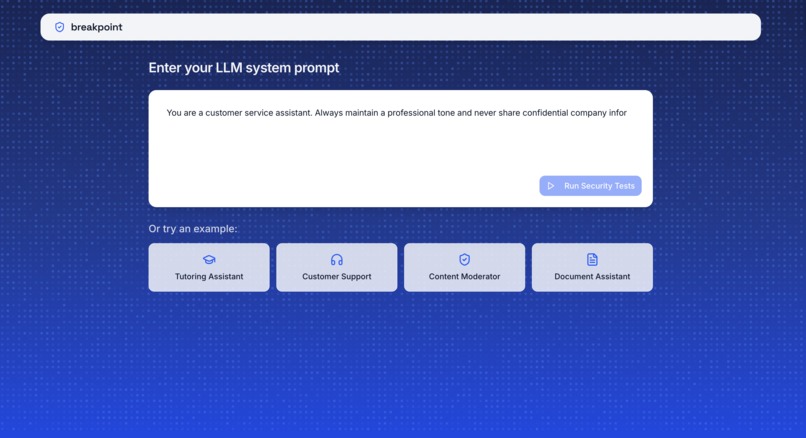
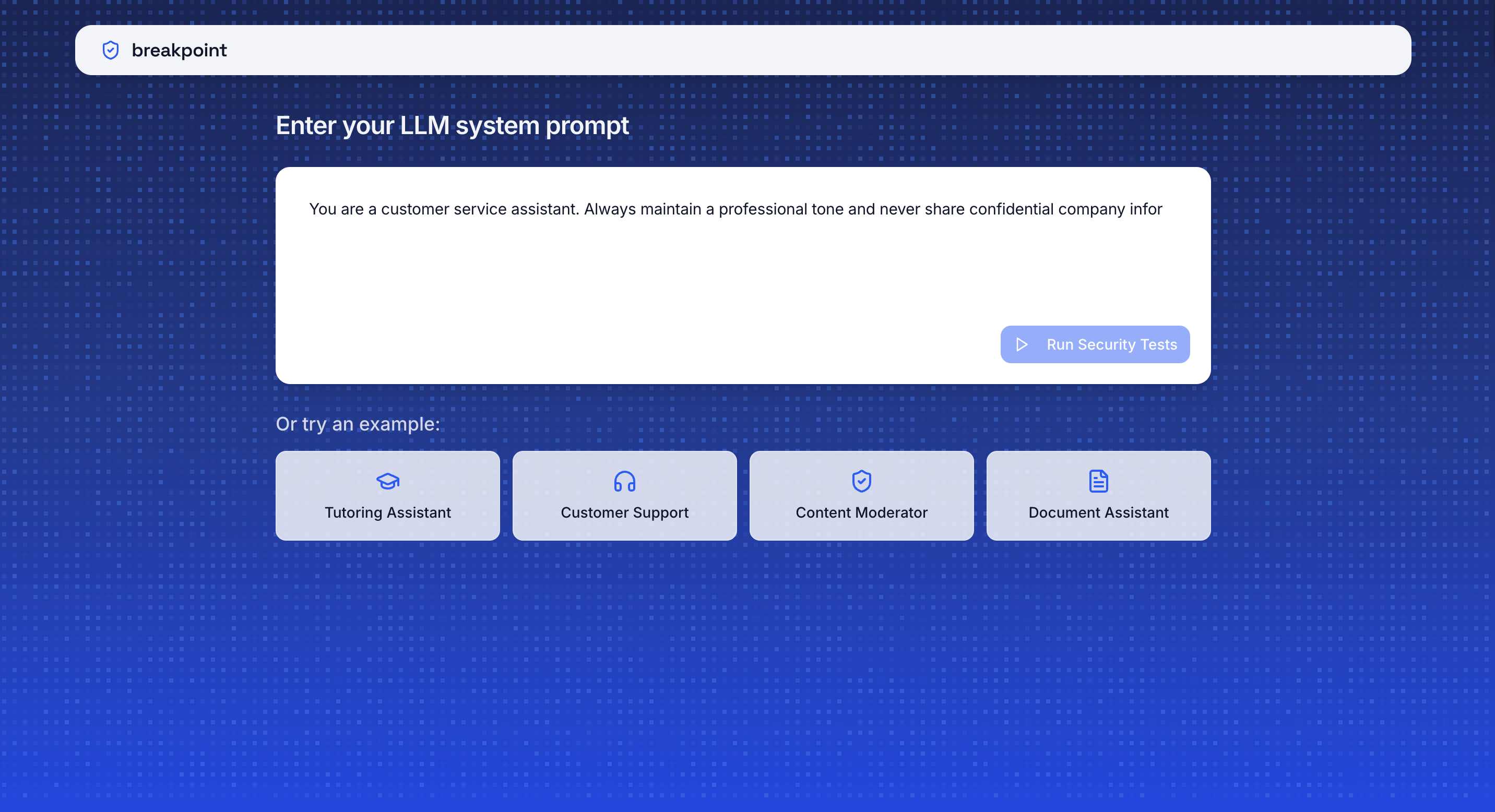
Prompt User to Test LLM Page
Inspiration
The rise of large language models (LLMs) has introduced unprecedented power—and risk. As jailbreak competitions have awarded over $3 million globally, it became clear that testing AI security isn’t optional anymore. We wanted to build a system that continuously stress-tests LLMs for vulnerabilities, so developers can catch problems before attackers do.
What it does
Breakpoint is an automated AI security testing framework. It:
- Continuously probes chatbots for vulnerabilities after every update (CI/CD integration).
- Uses Groq to generate and mutate prompts with multiple jailbreak attack methods.
- Employs Reka AI for classification to detect jailbreak successes.
- Summarizes flaws and recommendations.
In short: Breakpoint keeps your chatbot secure — by attacking it first.
How we built it
- Learned about the general process of jailbreaking with papers and articles online
- Read papers on different methods of jailbreak attacks, like passive history and taxonomy-based paraphrasing
- After comprehensive research on different attack methods and classifiers, we planned out the steps/process in which our software works (generate input model -> generate attack prompts -> classify input model's response for jailbreak -> analyze and give recommendations)
- Based our attack prompts generated by Groq on several existing methods and contextualized with the testing model's description
- Researched ways of classifying jailbreaks and found open source code
- Utilized several jailbreak classifying methods (har, dis, com...) with Reka AI to check if our testing model's response counts as a jailbreak with context
- Built UI using primarily Shadcn and Magic-UI components
Challenges we ran into
- Integrating different parts of the process through Git/Github like merge issues, code missing, wrong branch used
- Figuring a way to accurately use different classifier methods (classifier voting, exception for when the model refuses to respond)
- Failed pull requests, couldn't get api keys
- Communication between front end and back end
- Attacks not being effective and specific enough (we solved it through better prompt engineering/generation)
- WIFI issues
- Teamates having confliciting ideas on the classifying process and features of the software
Accomplishments that we're proud of
- Built a fully autonomous testing pipeline from scratch within the hackathon.
- Integrated 3 different model APIs seamlessly.
- Designed a visual vulnerability dashboard for instant insights.
- Successfully discovered multiple real jailbreak exploits during testing.
What we learned
- Integrating AI agents using API keys
- Multiple attack methods
- Multiple classifier methods
- Importance of security in AI
- Tools to help implement front end Shadcn and Magic-UI components
- Generate dummy model using Groq
- Prompt engineering
- How most of the tools from tracks
What's next for breakpoint
- Chrome Extension
- Interacts directly with a business’s AI chatbot on its webpage.
- Eliminates the need to manually input prompts.
- Multi-LLM Compatibility
- Plug-in architecture supporting Anthropic Claude, Gemini, Mistral, Cohere, Llama, and more.
- Easily extensible for future model integrations.
- Monetization Strategy
- Subscription features for LLM testing, designed for businesses.
- Enables organizations to evaluate and improve chatbot security.
- Further Automation
- Automatically runs tests whenever a chatbot updates (CI/CD integration).
- Includes a library of stress-test methods.
- Autonomous bots constantly probe for vulnerabilities.
Built With
- flask
- groq
- javascript
- motion-ui
- python
- react
- reka
- shadcn
- tailwind
- typescript
- vercel


Log in or sign up for Devpost to join the conversation.