Inspiration
Most real-world failures don’t happen because of one big mistake — they happen because of many small, invisible decisions interacting in unexpected ways.
We noticed this everywhere: college timetables collapsing when one teacher is late, queues exploding when one resource is removed, systems that look stable until a tiny change causes everything to break. Existing tools focus on optimization and success, but rarely help people understand failure.
Breakpoint was inspired by a simple question:
What if we could safely break systems on purpose and learn from how they collapse?
What it does
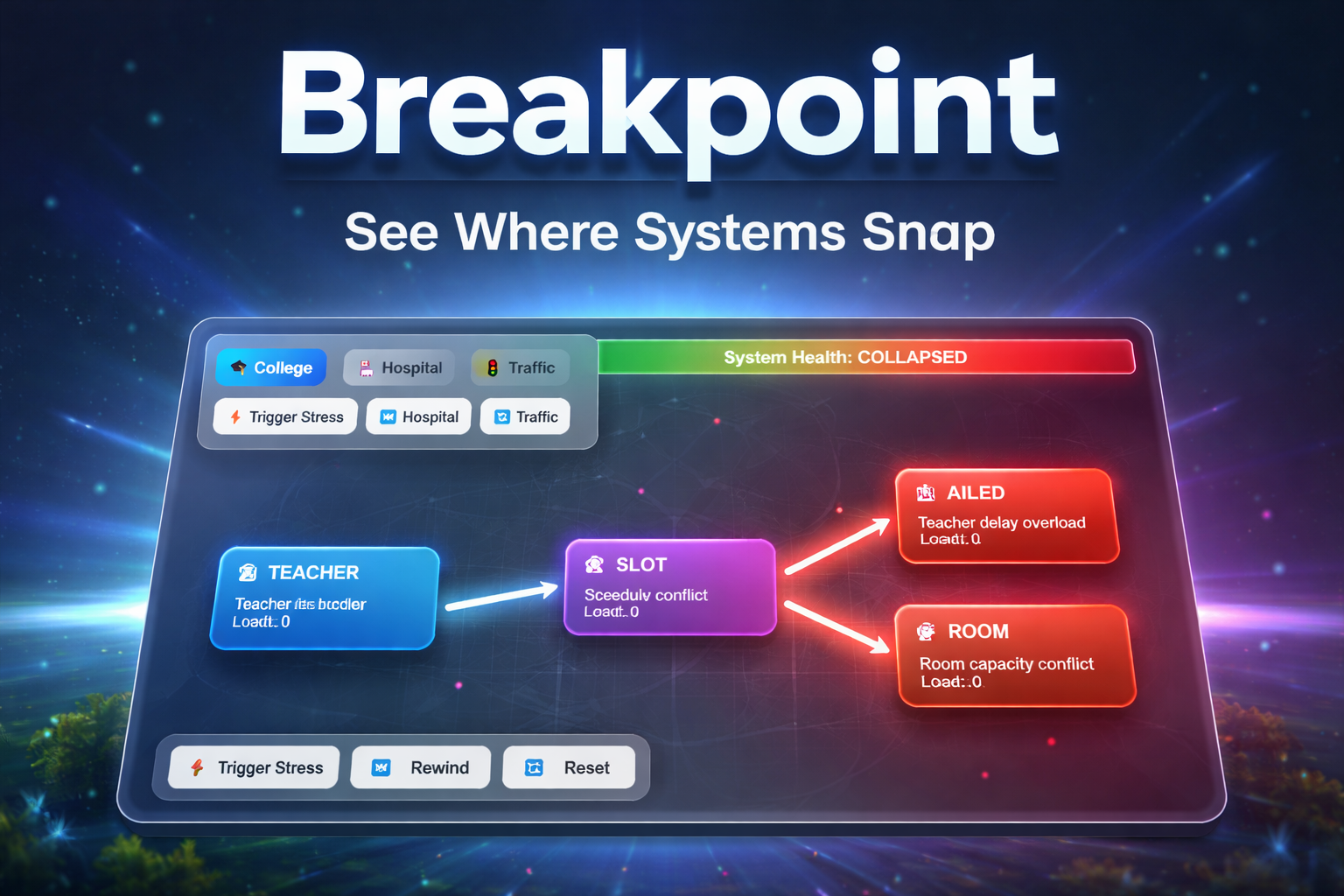
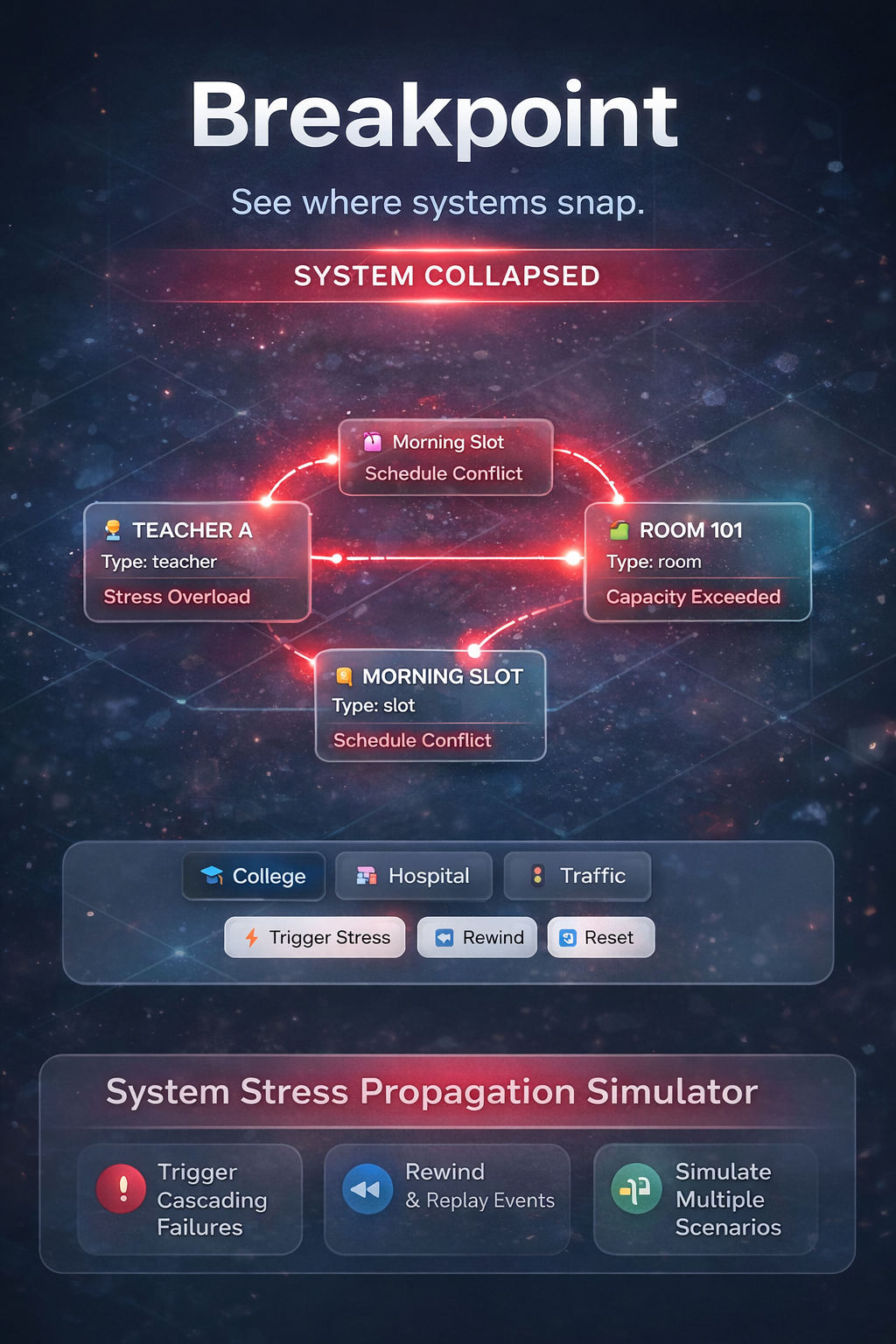
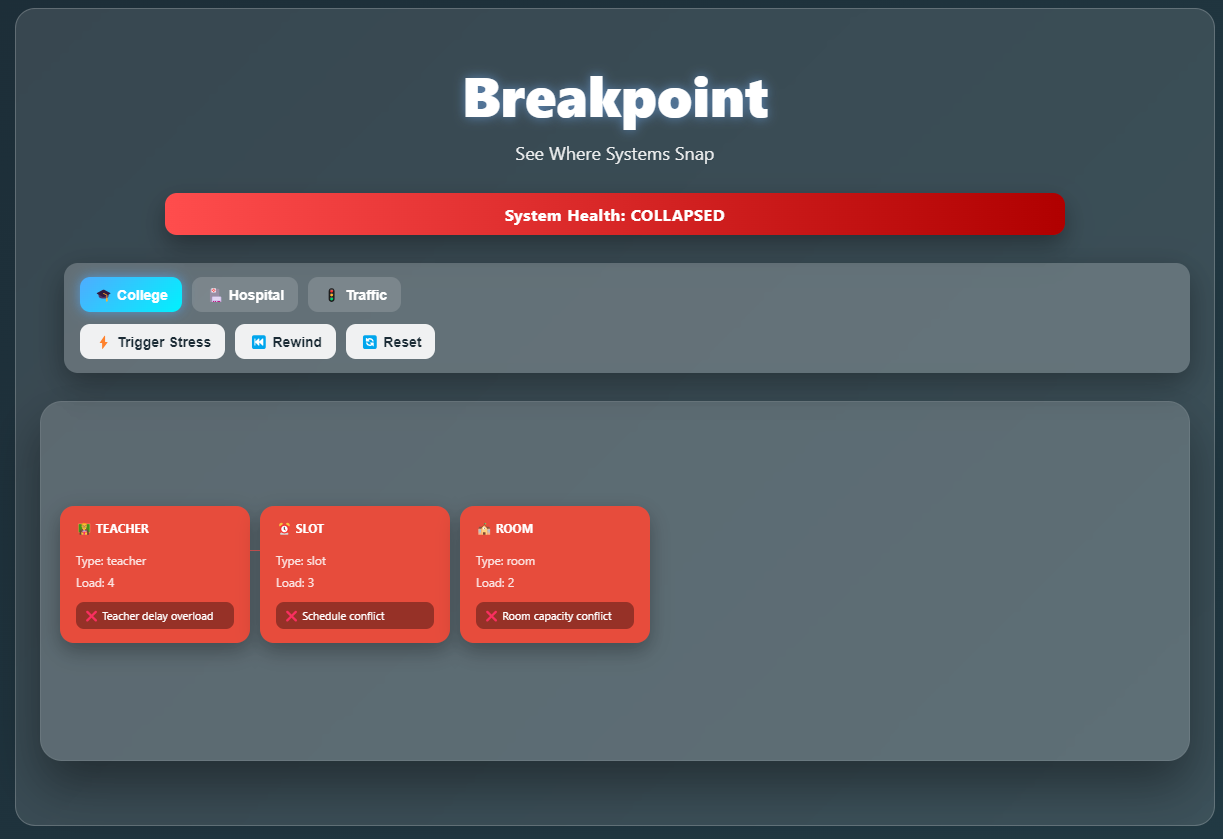
Breakpoint is an interactive playground that lets users intentionally stress real-world systems and visually observe how and where they fail.
Users can:
- Modify system components (delay, remove, or overload them)
- Trigger cascading effects across connected elements
- See bottlenecks, conflicts, and fragile dependencies emerge in real time
- Rewind actions and explore alternate failure paths
Instead of predicting outcomes, Breakpoint reveals cause–effect relationships through direct interaction.
How we built it
Breakpoint is built as a real-time simulation engine backed by a dependency graph.
- Each system is modeled as interconnected nodes (resources, people, time slots)
- Rules define how stress propagates from one node to another
- The frontend visualizes conflicts, bottlenecks, and collapse points dynamically
- Animations and color cues highlight where the system becomes unstable
The focus was on clarity and interaction, not heavy AI or black-box predictions.
Challenges we ran into
- Designing failure logic that feels realistic but stays understandable
- Preventing visual overload while still showing complex cascades
- Balancing simulation accuracy with real-time performance
- Deciding how much control to give users without breaking the learning experience
Each challenge forced us to simplify without losing meaning.
Accomplishments that we're proud of
- Building a failure-first system instead of a success-focused tool
- Creating an experience judges can interact with, not just observe
- Making complex system behavior understandable within seconds
- Designing something that feels useful beyond a hackathon demo
What we learned
- Small changes often matter more than large optimizations
- Visual causality is more powerful than numerical explanations
- Interactive learning creates stronger understanding than static analysis
- Systems thinking can be taught by letting people explore failure safely
What's next for Breakpoint
- Support for more real-world scenarios (hospitals, traffic, supply chains)
- Collaborative mode to explore failures with multiple users
- Scenario presets for education and training
- Data-driven tuning using real operational datasets
Our long-term goal is to make Breakpoint a tool for learning, planning, and resilience — not just simulation.
Built With
- framer
- graph-based-simulation
- html5
- motion
- react
- typescript


Log in or sign up for Devpost to join the conversation.