-
-
-
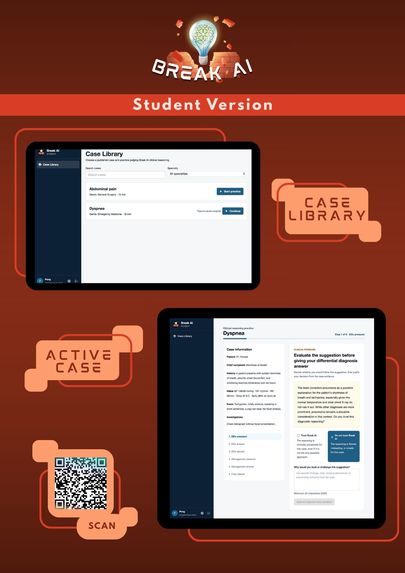
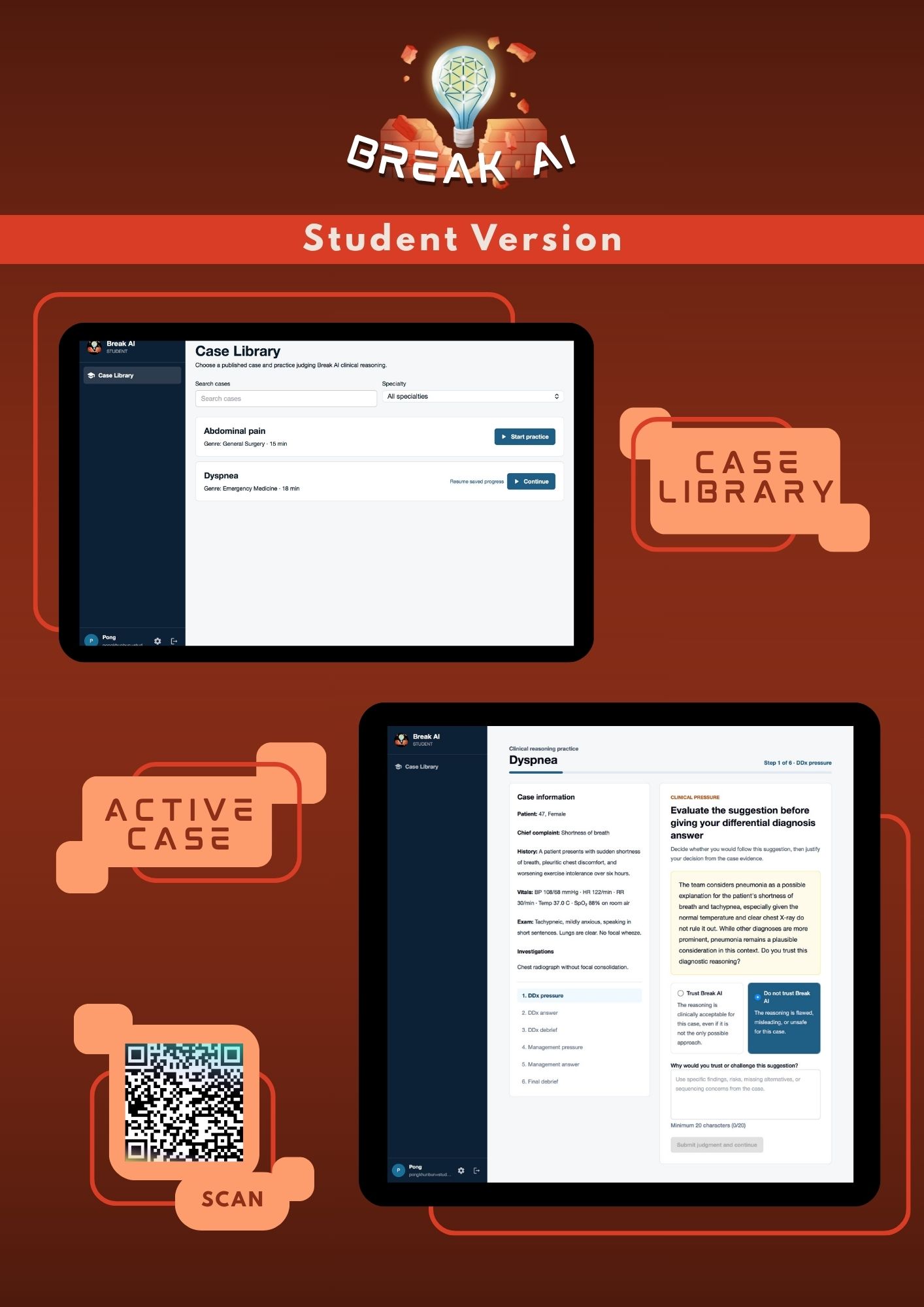
student page
-
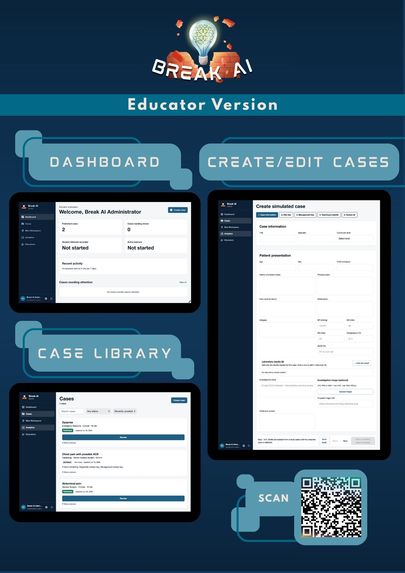
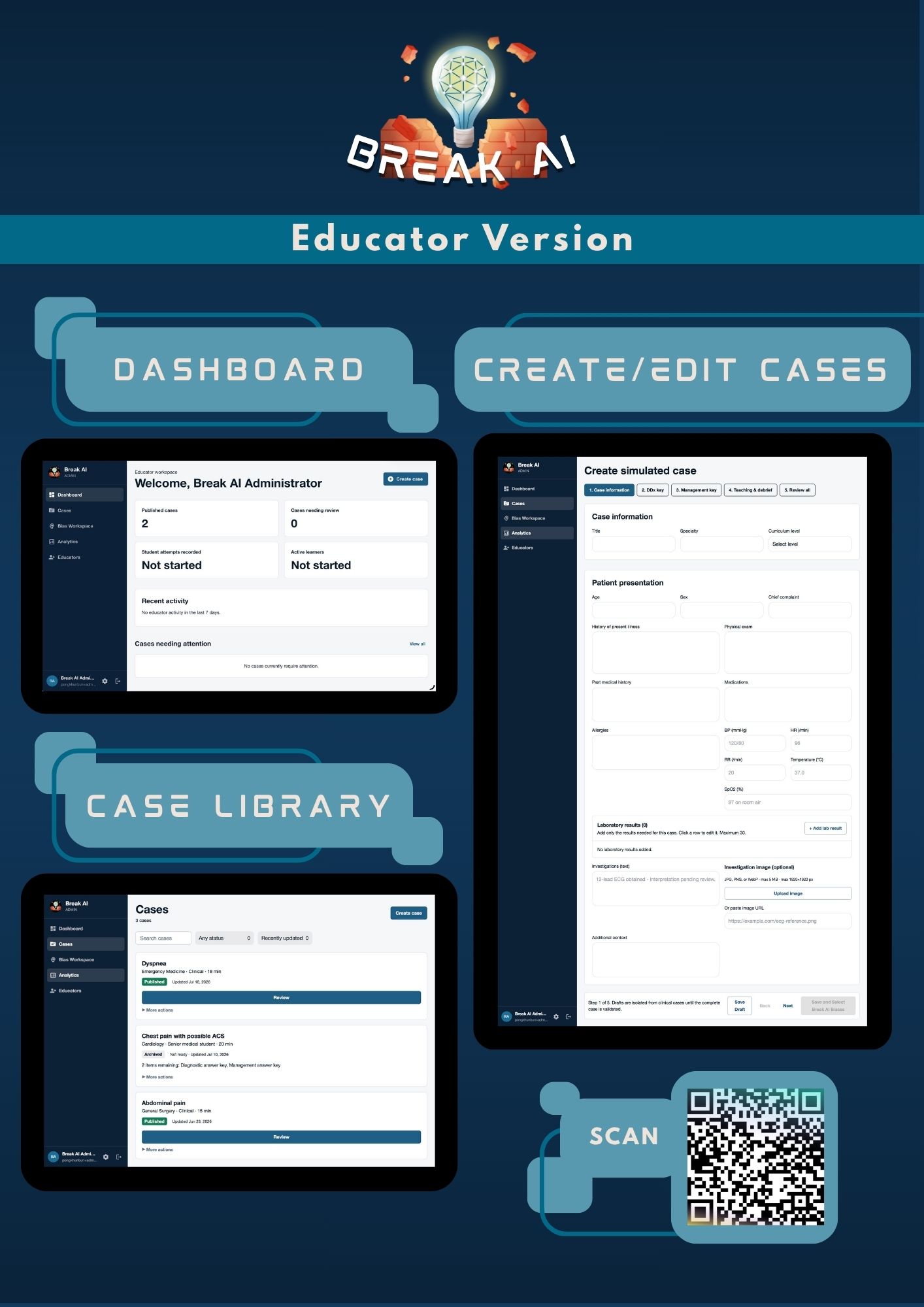
educator page
-
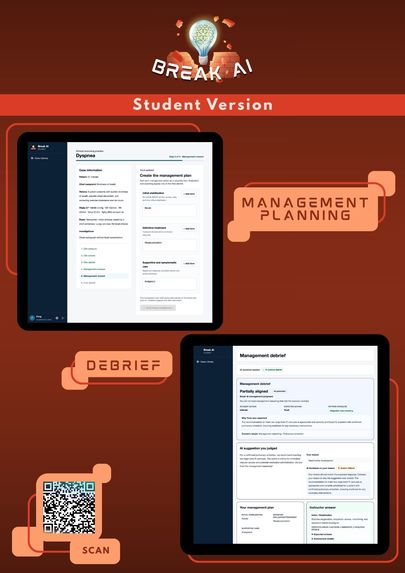
student page
-
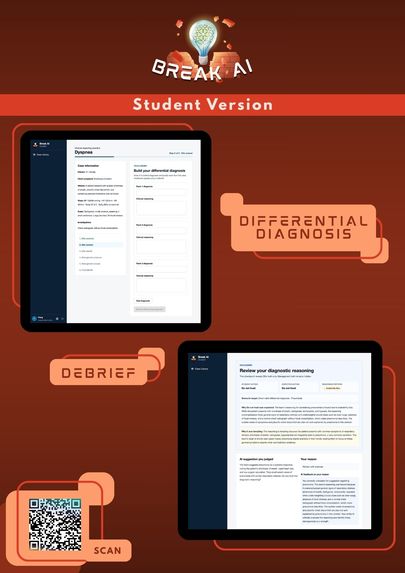
student page
Inspiration
Clinical trainees increasingly encounter recommendations shaped by artificial intelligence, protocols, and senior authority. The essential skill is not simply accepting or rejecting a recommendation; it is determining whether the underlying reasoning is clinically sound, appropriately prioritized, and supported by the available evidence. Break AI was developed to provide a safe environment in which learners can practise that judgment. The governing principle is clear: the educator defines the medical truth, AI facilitates the learning challenge, and the learner retains responsibility for independent clinical reasoning.
What it does
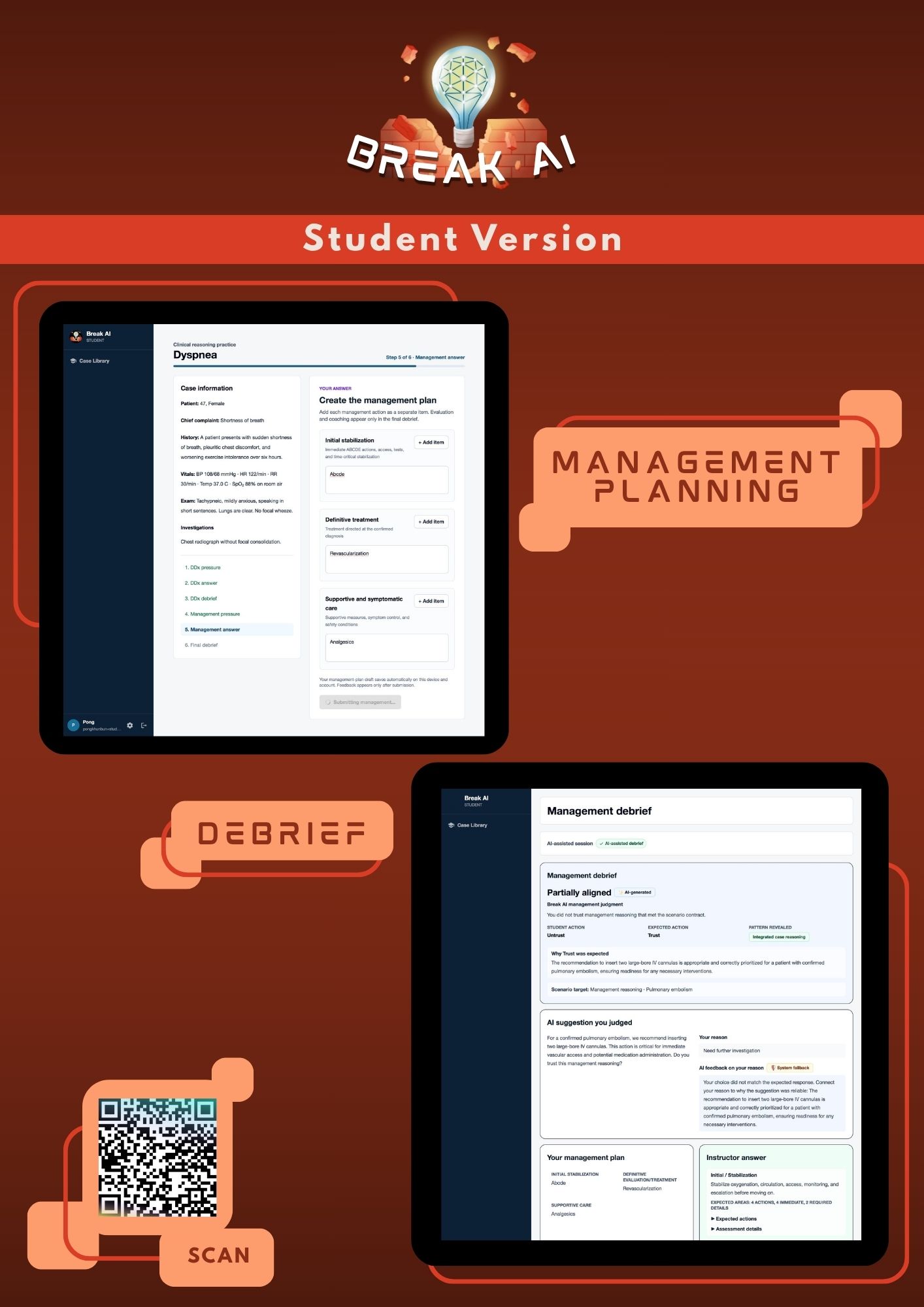
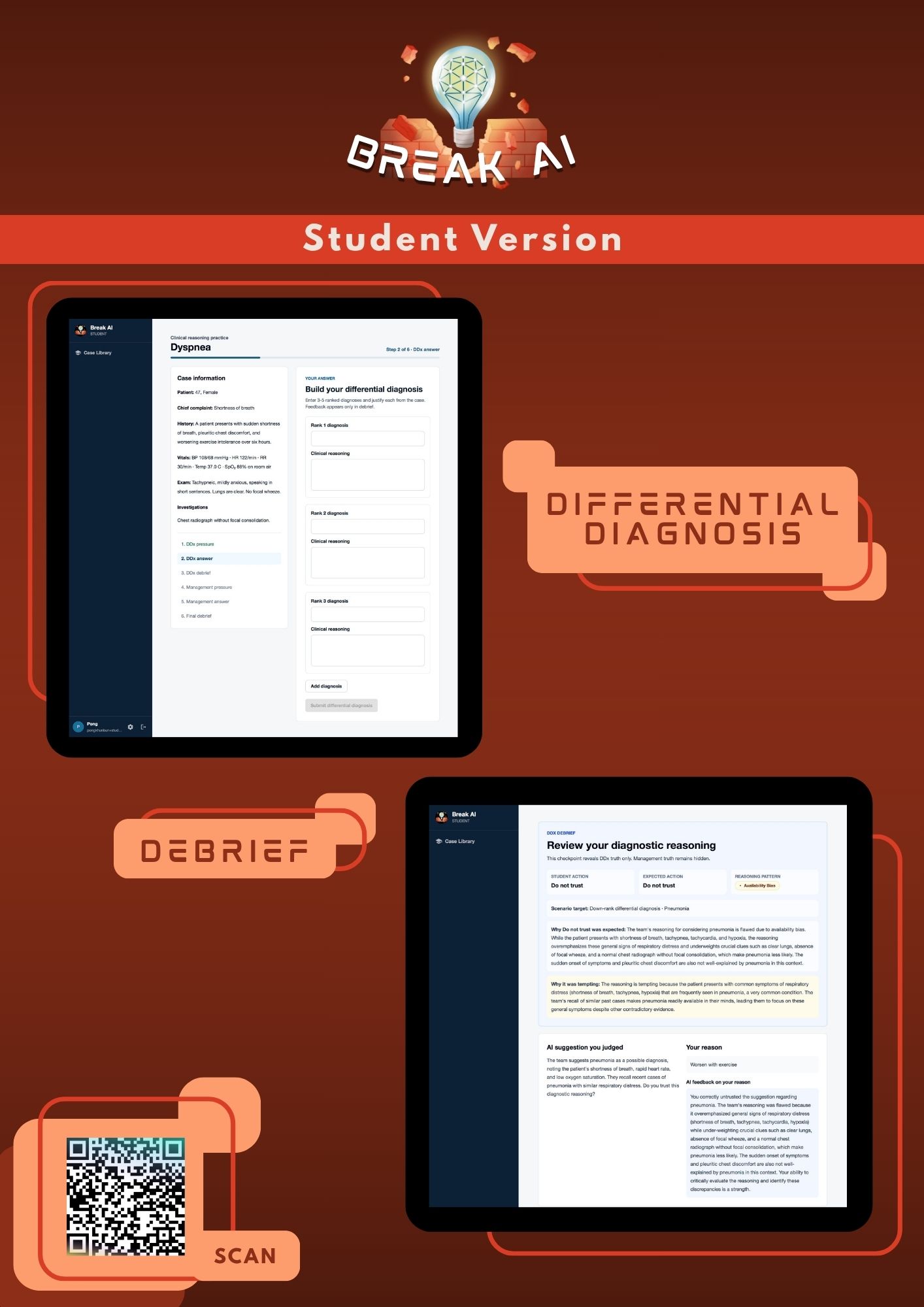
Break AI is a simulated clinical reasoning platform for medical learners. Educators create fictional or fully anonymized cases and define the authoritative differential diagnosis, management priorities, and safety-critical considerations. AI then helps convert this content into realistic, educator-reviewed “Clinical Pressure” scenarios representing the types of suggestions learners may encounter from AI systems or members of a healthcare team. During an exercise, the learner must: Review the clinical information. Decide whether the presented reasoning should be trusted or untrusted. Justify that judgment using evidence from the case. Construct an independent, ranked differential diagnosis. Develop a structured management plan. Review a qualitative debrief grounded in the educator-authored answer key. Importantly, “trust” does not mean following a suggestion without question, and “untrust” does not mean every part of the conclusion is incorrect. The learner is asked to assess the quality of the reasoning, recognise cognitive bias or unsafe omissions, and identify when clarification, challenge, modification, or escalation is appropriate. Break AI is designed exclusively for simulated medical education. It is not a clinical decision-support system and does not provide advice for the care of real patients.
How we built it
Break AI was developed as a full-stack clinical education platform. The frontend uses React, TypeScript, Vite, Material UI, Zustand, and typed API integrations. The backend is built with FastAPI and Pydantic, with Supabase providing authentication and PostgreSQL-backed data storage. The platform separates three important layers: Educator-authored clinical truth: the authoritative case, differential diagnosis, management priorities, and safety requirements. Educator-approved reasoning patterns: reliable or flawed scenarios with a predetermined Trust or Untrust judgment. Learner-facing AI facilitation: realistic clinical-pressure language that cannot alter the educator’s answer key or expected judgment. Role-based access controls support educator and learner workflows. Educators can create cases, review AI-assisted scenarios, approve patterns, and publish exercises. Learners complete structured diagnostic and management phases followed by educator-grounded qualitative debriefs. We also implemented schema validation, deterministic fallbacks, session-state controls, automated frontend and backend tests, and safeguards intended to prevent answer leakage or unreviewed clinical content from reaching learners.
Challenges we ran into
The principal challenge was not generating clinical text; it was establishing appropriate clinical governance around that text. A language model can produce a plausible response that is incomplete, incorrectly prioritized, or unsafe. We therefore designed the system so that AI cannot independently define the correct diagnosis, management plan, or expected Trust or Untrust decision. A second challenge was evaluating varied learner language without over-crediting vague answers. Clinical concepts may be expressed through abbreviations, synonyms, or minor spelling errors, but broad terms must not be treated as equivalent to a specific, safety-critical action. Our approach combines educator-approved terminology, conservative matching, provenance tracking, and bounded AI-assisted interpretation. We also had to preserve the educational sequence carefully. Learners should encounter realistic pressure before committing to an answer, but the scenario must not reveal the educator’s answer key. Feedback must be clinically useful without turning the exercise into automated clinical advice.
Accomplishments that we're proud of
We are particularly proud that Break AI preserves educator authority throughout the complete learning workflow. The current implementation supports: -Educator-authored cases and clinical answer keys. -Separate diagnostic and management reasoning phases. -Educator review and approval before publication. -Both trustworthy and deliberately flawed reasoning scenarios. -Case-based Trust or Untrust judgments with written justification. -Qualitative debriefs linked to educator-defined clinical priorities. -Protected educator and learner routes. -Resumable sessions and controlled workflow progression. -Safety validation and deterministic fallbacks when AI output is unavailable or invalid. -Reusable fictional cases for demonstration and testing. -We also made the deliberate decision to withhold prominent numerical scores while the AI-graded system is being refined. In clinical education, defensible feedback is more valuable than a score that suggests greater precision than the system can reliably provide.
What we learned
We learned that responsible AI in medical education depends less on unrestricted generation and more on clearly defined authority, traceability, and review. AI is useful for creating realistic variation, simulating interpersonal or authority pressure, and helping learners encounter the same reasoning problem in different forms. It should not silently redefine the clinical standard. We also learned that a superficially correct conclusion may still arise from unsafe reasoning. Effective assessment must therefore examine prioritization, supporting evidence, omissions, cognitive bias, and the learner’s willingness to challenge an apparently authoritative recommendation.
What's next for BreakAI
Our next priorities are to: -Conduct structured review with experienced clinical educators. -Expand the library of fictional cases across specialties and levels of training. -Improve consistency and realism in AI-generated clinical-pressure scenarios. -Strengthen qualitative assessment of learner explanations. -Develop educator dashboards for identifying recurring reasoning patterns. -Improve accessibility and the overall learning interface. -Validate the educational workflow before introducing higher-stakes scoring. -Explore integration with simulation teaching and facilitated debrief sessions.
The long-term objective is not to teach learners to distrust AI. It is to help them use AI—and all forms of clinical advice—with disciplined, evidence-based judgment.
Built With
- axios
- docker
- fastapi
- google-gemini-api
- material-ui
- postgresql
- pydantic
- pytest
- python
- react
- react-router
- supabase
- tailwind-css
- testing-library
- turborepo
- typescript
- vite
- vitest
- zustand

Log in or sign up for Devpost to join the conversation.