-
-
image
Inspiration
What if a social post belonged to a place instead of disappearing into a feed? I first imagined this idea in 2017. In 2026, I built BREAK THE FRAME to explore photographic presence and social storytelling inside a real-world panorama.
What it does
The working desktop prototype lets users explore a photographed Barcelona location, upload a photo or a short video, choose a position and size, and add a separately scalable translucent comment card. Posts persist in the same browser. Public, friends and private roles demonstrate visibility choices locally.
Optional server-side Meta Model API image editing prepares a green-screen portrait; local chroma key produces a cutout for visual review. The result is a 2.5D photographic presence, not a reconstructed volumetric person.
How we built it
The application uses JavaScript, HTML, CSS, Three.js, WebXR and a server-side Worker. A licensed historical Barcelona photograph supplies the cylindrical panorama. Browser storage holds local posts; API credentials stay server-side.
An experimental WebXR path implements tracked hands, ray-and-pinch menu selection, sample-photo creation, bounded resizing, placement and confirmation. Automated checks cover API validation, provider failure handling, pinch behavior and simulated XR interactions. These checks do not establish physical headset usability; end-to-end headset validation remains pending.
Challenges and lessons
Placement must remain understandable as the viewpoint changes. Person and comment-card sizing need independent controls so text stays readable. We also distinguish simulated visibility from real authorization, and a photographic billboard from true 3D capture.
What is implemented and what comes next
Implemented: desktop panorama exploration, photographic placement, comment sizing, local persistence, short-video upload, optional Meta image preparation and experimental hands-based WebXR controls.
Next: validate every interaction seated on a Meta headset or equivalent XR simulator, record genuine XR demo footage, and evaluate comfort and accessibility. Production accounts, shared multiuser storage, enforced permissions and moderation are further work.
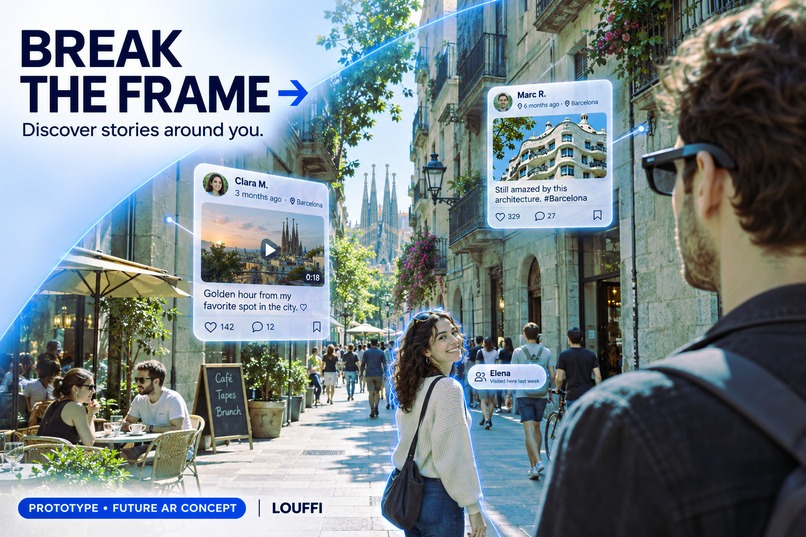
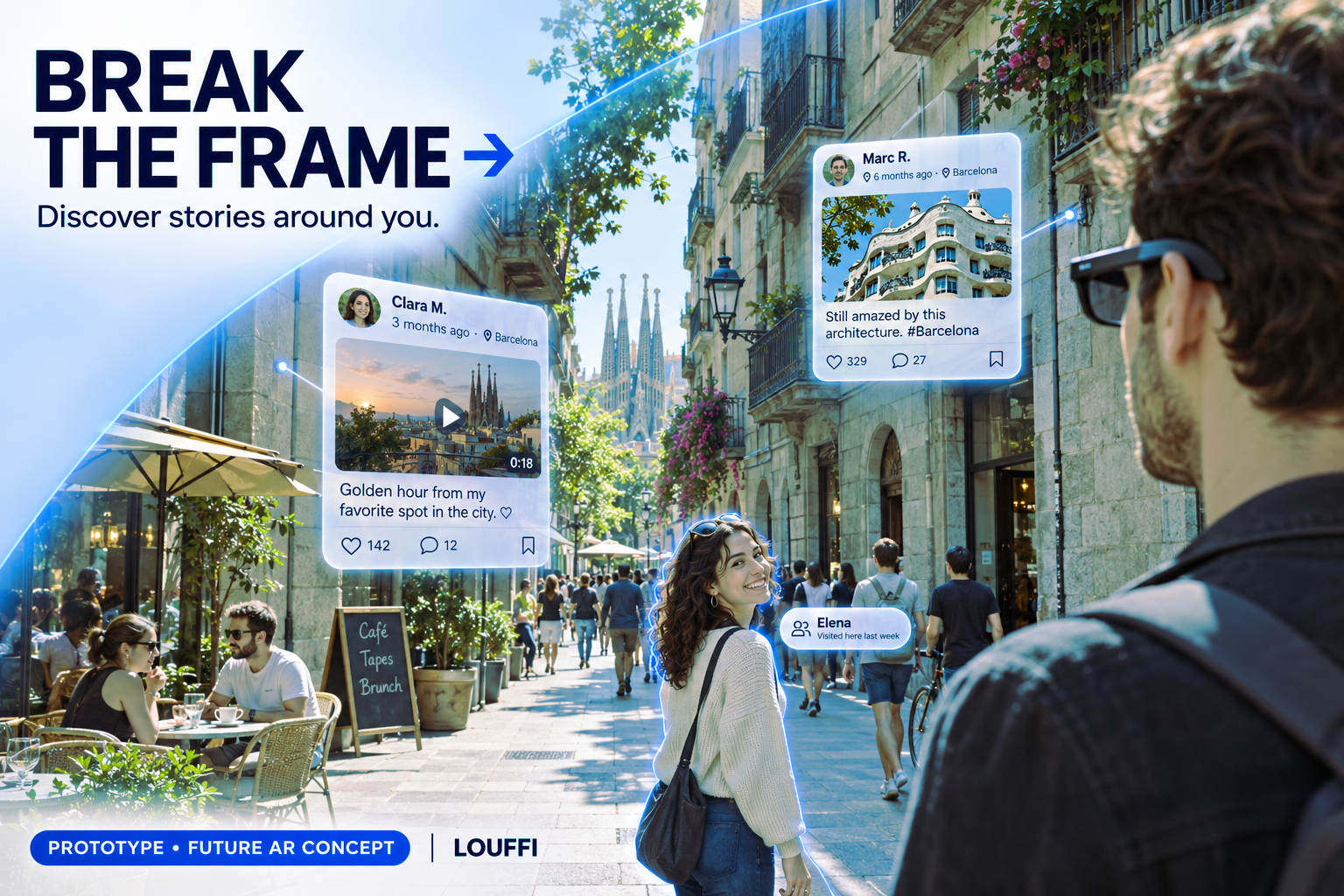
The longer-term vision is outdoor AR: through compatible future display-equipped glasses, people could discover location-anchored memories, moving video posts and opt-in nearby notifications while the physical street stays ordinary. This is a future concept, not a currently shipped glasses integration. AI-generated ten-second video creation is also future work, subject to a suitable provider service.
Review status
This is an independent prototype. The hosted review build and complete source repository are publicly accessible. Open the demo without an author account, or clone https://github.com/salahlouffidi/break-the-frame and run npm run dev with Node.js 20.6+. All panorama and vendor assets are included. Paid AI preparation is disabled on the public review build; reviewers can enable the optional integration locally with their own credentials using .env.example. The presentation includes desktop demonstrations and clearly identified future-concept imagery; it does not replace the competition's required headset or XR-simulator footage. Application code has an MIT license, with separate third-party asset notices.
Built With
- cloudflare-workers
- css3
- html5
- javascript
- meta-model-api
- three.js
- webxr
