-
-
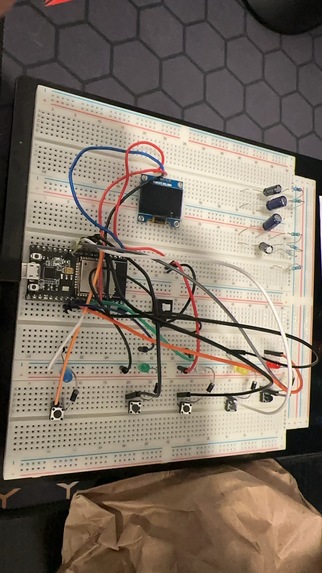
overview of the circuit
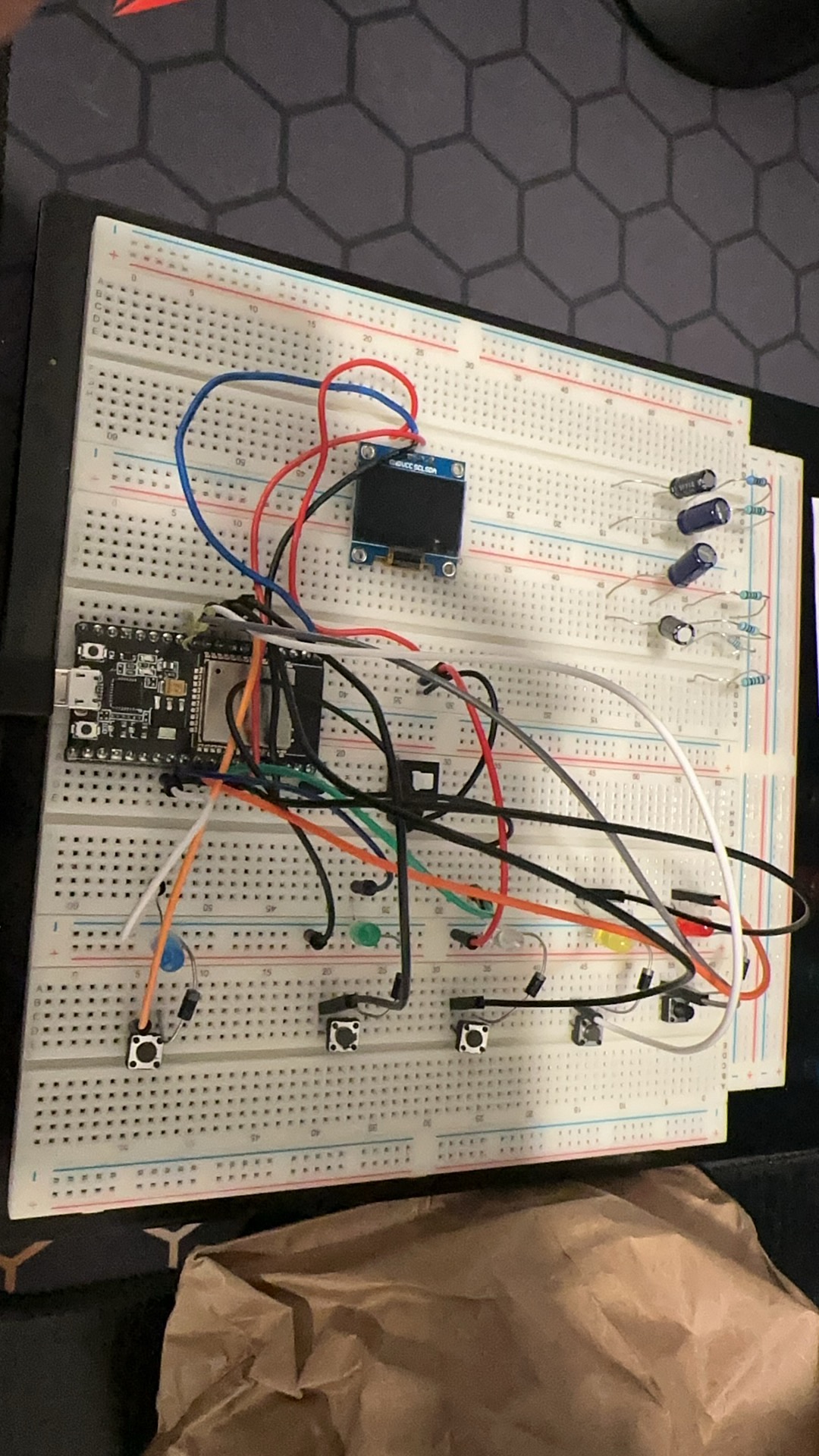
Inspiration
This project was inspired by the classic Whack-a-Mole game. I wanted to bring that fun, interactive experience to a simple hardware project by using an ESP32 board to control an LED. The idea was to have the LED light up randomly, challenging players to press a button quickly to turn it off.
What it does
The game consist of LEDs lights up randomly, challenging players to press a button in time to turn it off. A success animation and defeat animation are displayed in OLED to increase playability and clarity.
How we built it
By controlling GPIO pins on the ESP32 for OLED screens, lights, and buttons, the esp32 board can coordinate the game logic within the components. A random time algorithm is used to lighten up a random LED. The OLED screen is coded to display +1 point animation when the correct button is detected pressed, or defeat animation when wrong buttons or no buttons are pressed. The game has an enable function designed using short circuits, when the game is closed, the switch connects pins to ground and the OLED, LED are not displaying.
Challenges we ran into
The project presented several challenges. Since the group is new to hardware programming, learning about pin controls on the esp32 board is challenging. Unstable circuit connections initially caused unreliable LED behaviour, which I solved by improving the wiring. Finally, the starting mechanism is attempted both in hardware and software. Many proposals are discussed, and eventually the hardware method of shorting the circuit is used.
Accomplishments that we're proud of
We achieved full understanding of the circuit, esp32 board pin assignments and the usage of OLED. The team demonstrated efficient teamwork, cooperation skills and eagerness in pursuing effective solutions for problems.
What we learned
Working on Break Down deepened our understanding of embedded systems and hardware-software integration. We learned to control the ESP32's GPIO pins and its connecting hardware modules, and design a responsive random timing algorithm. Tackling hardware connectivity issues and optimizing for real-time performance improved our troubleshooting and technical skills.
What's next for Break Down
Next, we plan to enhance the gameplay experience and expand the project’s capabilities. Our future goals include integrating additional sensors to enrich interactivity and refining the game logic for smoother performance such as better pressure sensor for button press, animations, score and timer, and vibration response.
Built With
- c++
- narduino


Log in or sign up for Devpost to join the conversation.