-
-
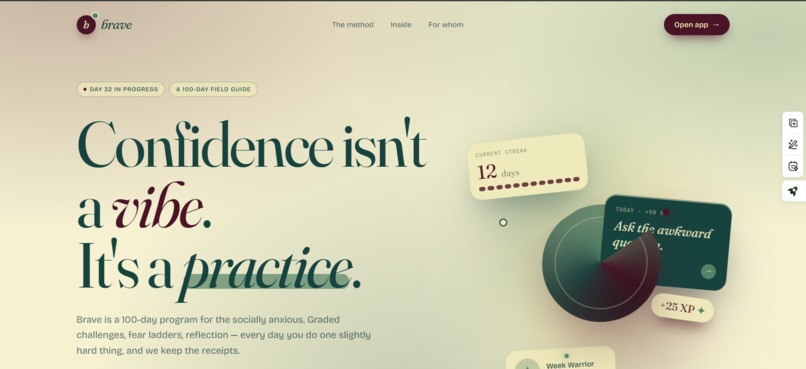
Landing Page
-
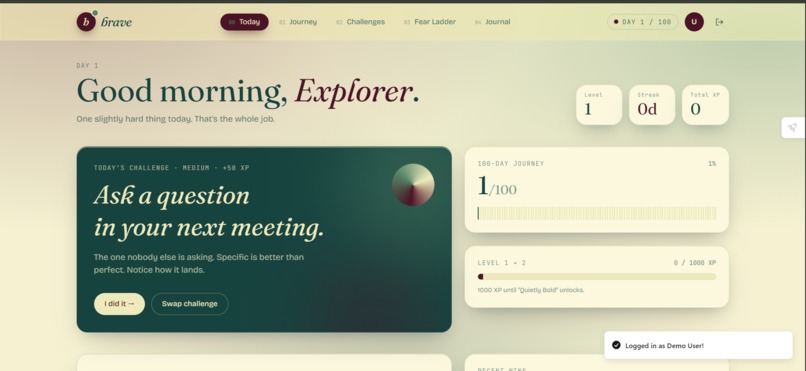
Dashboard
-
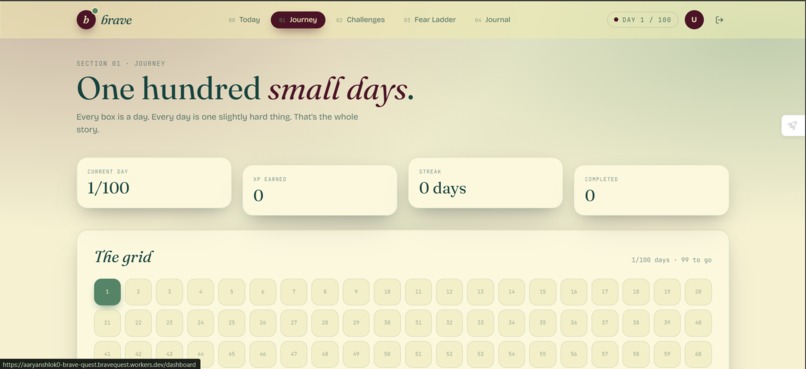
Tracker for 100 days
-
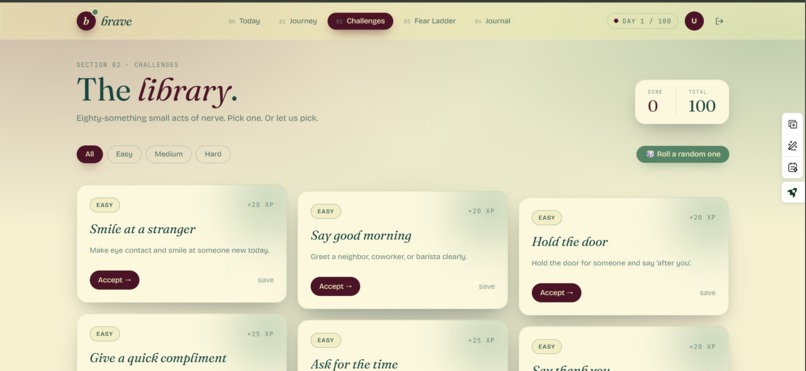
Challenges
-
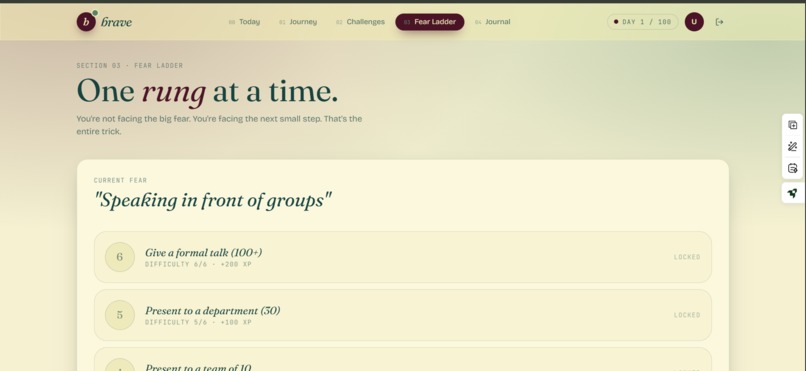
Fear Ladder
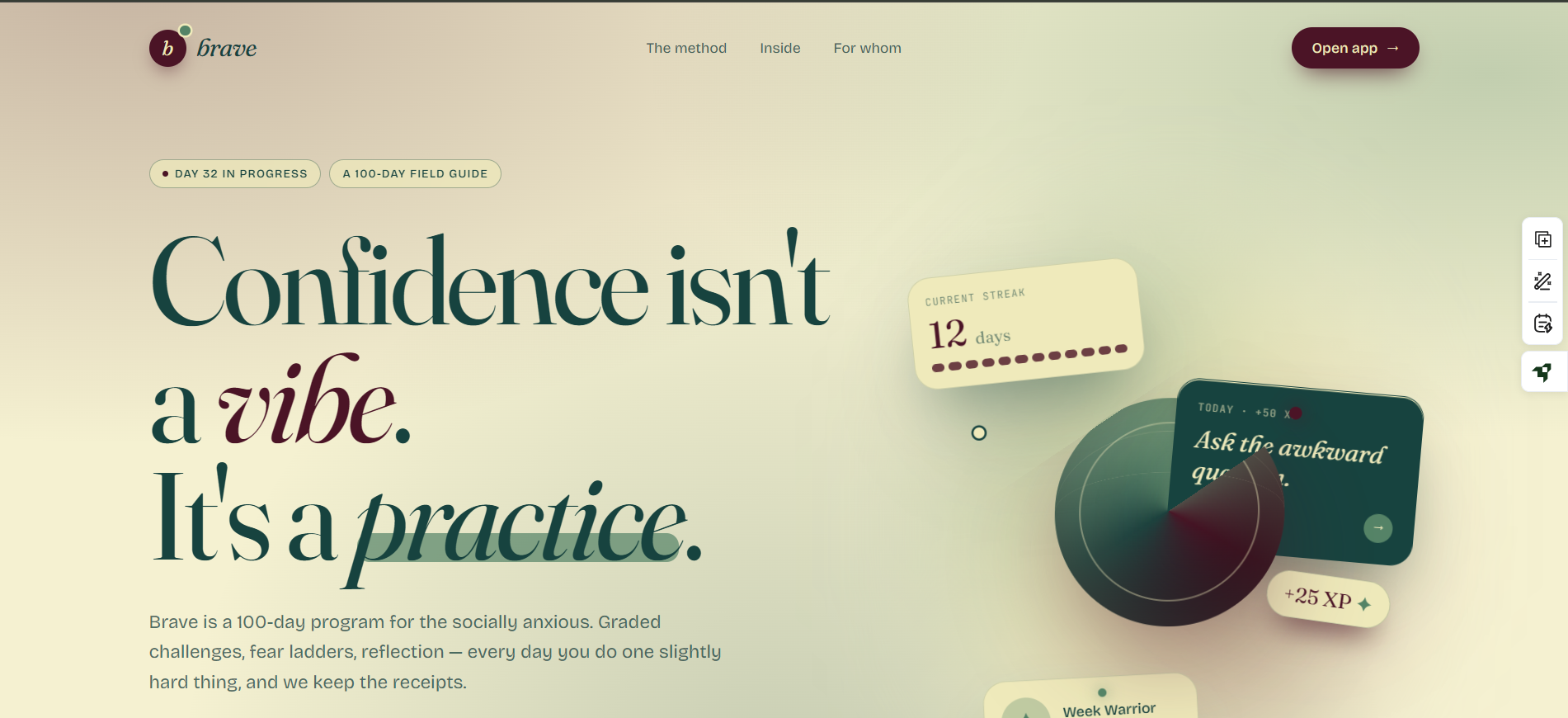
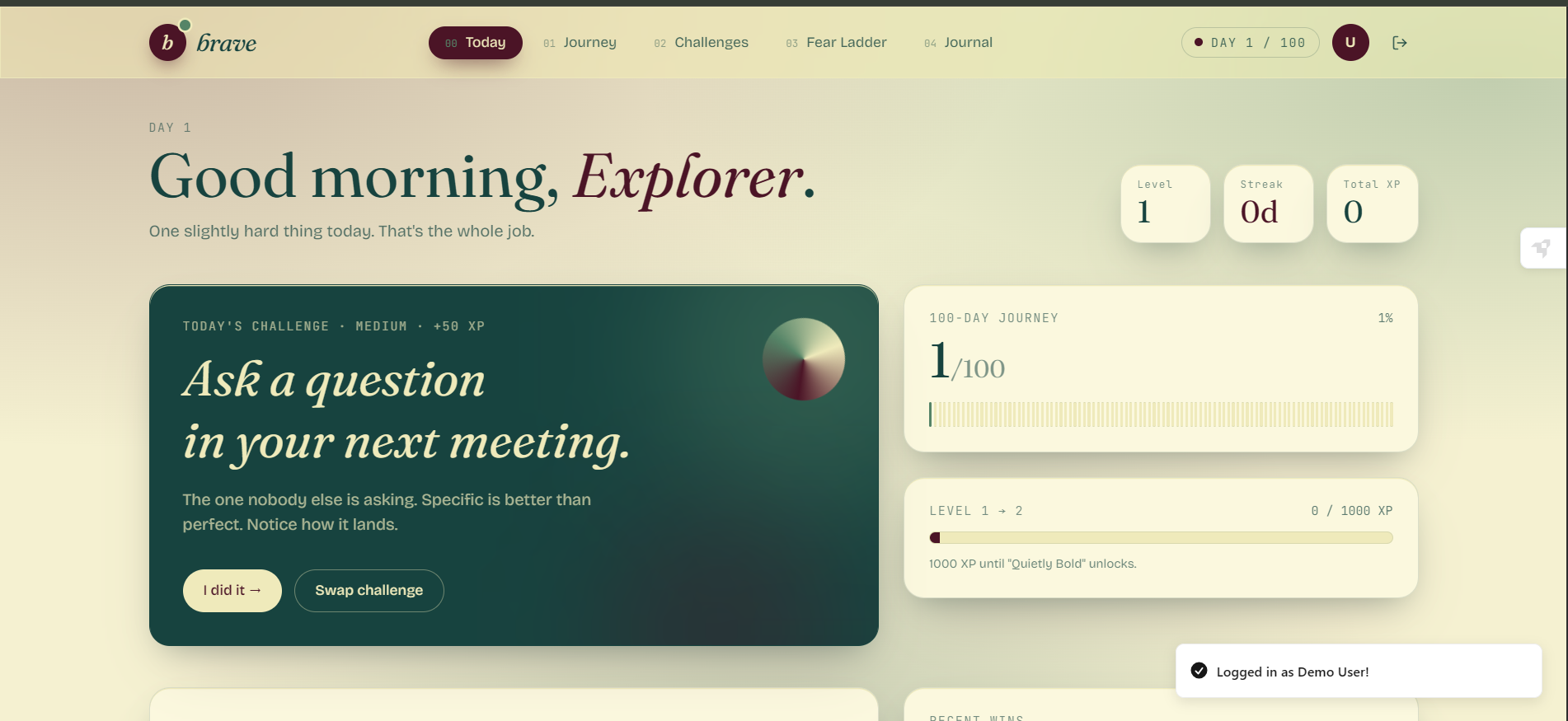
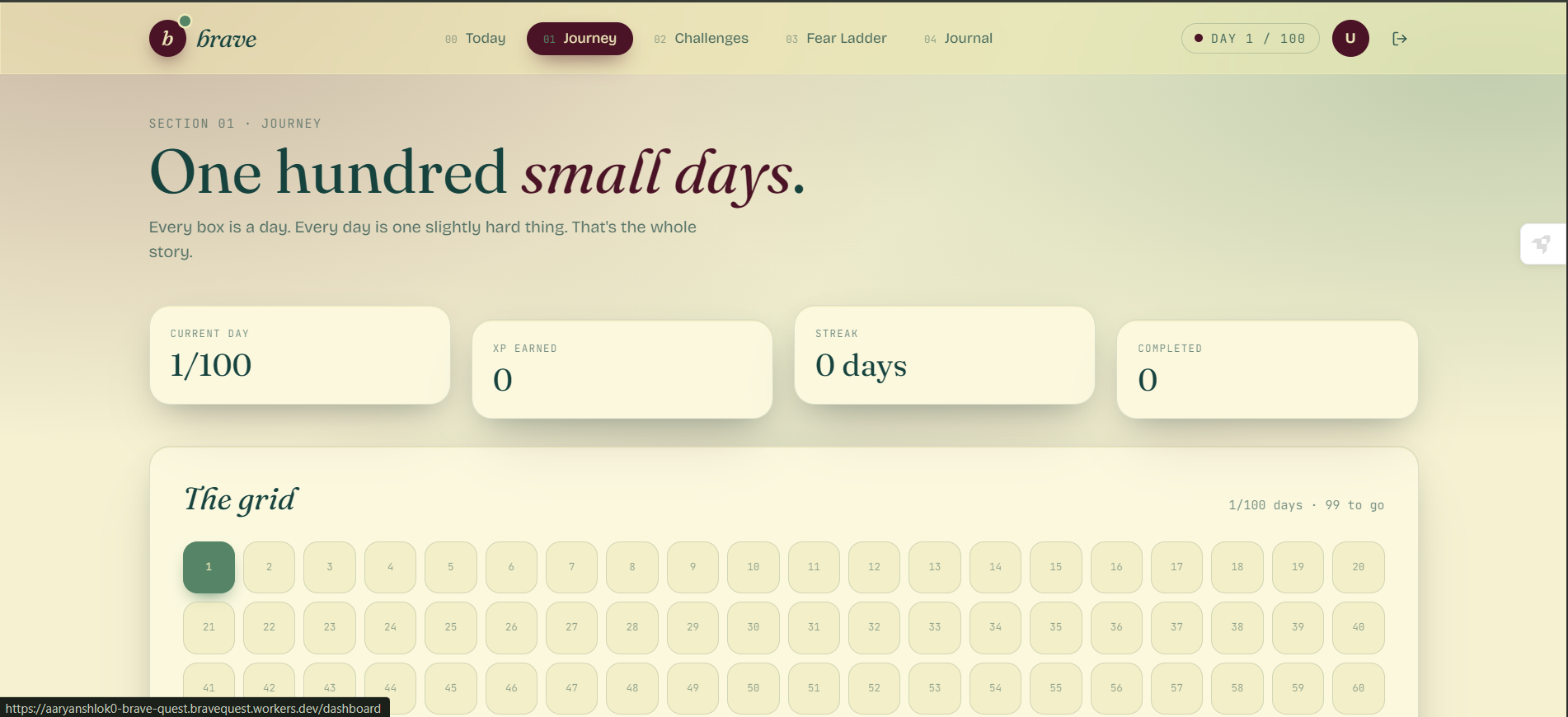
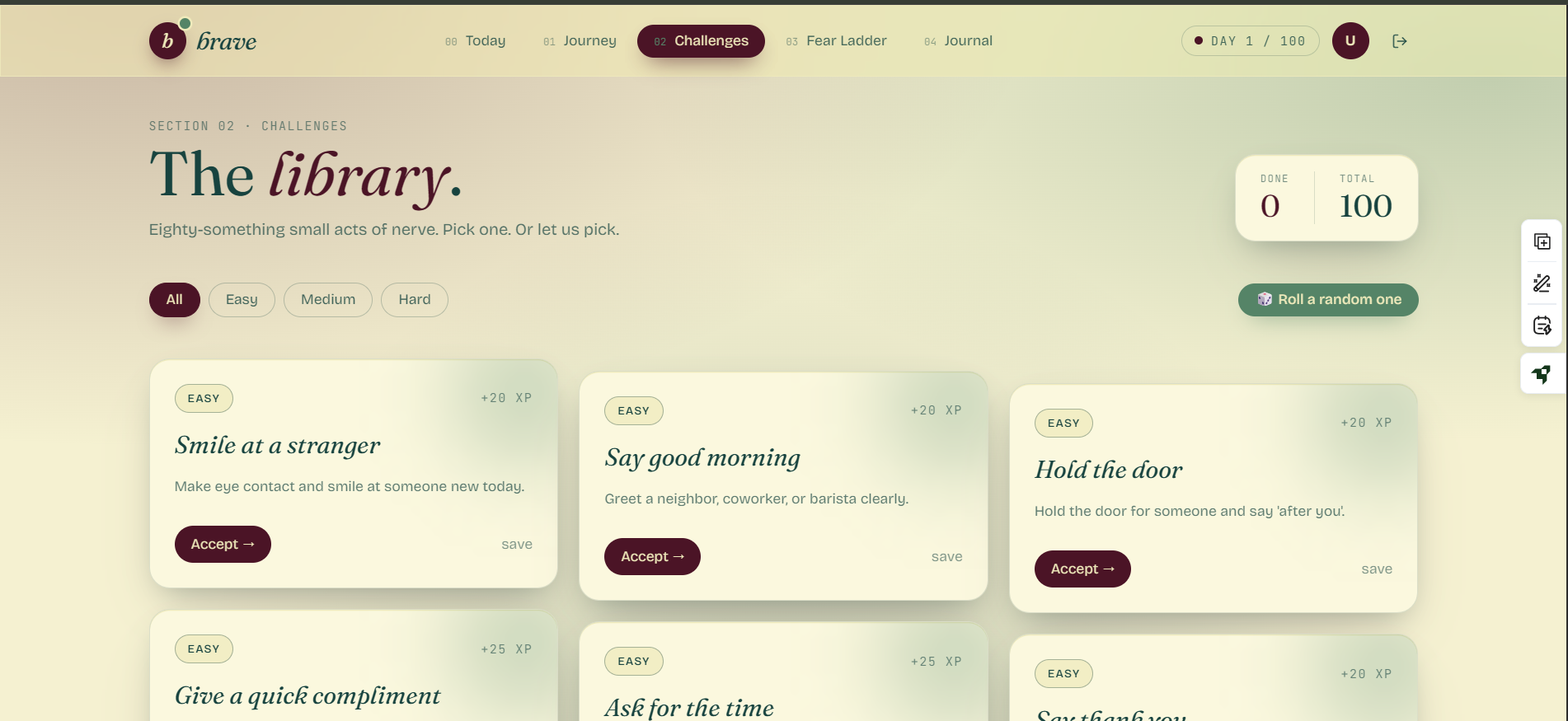
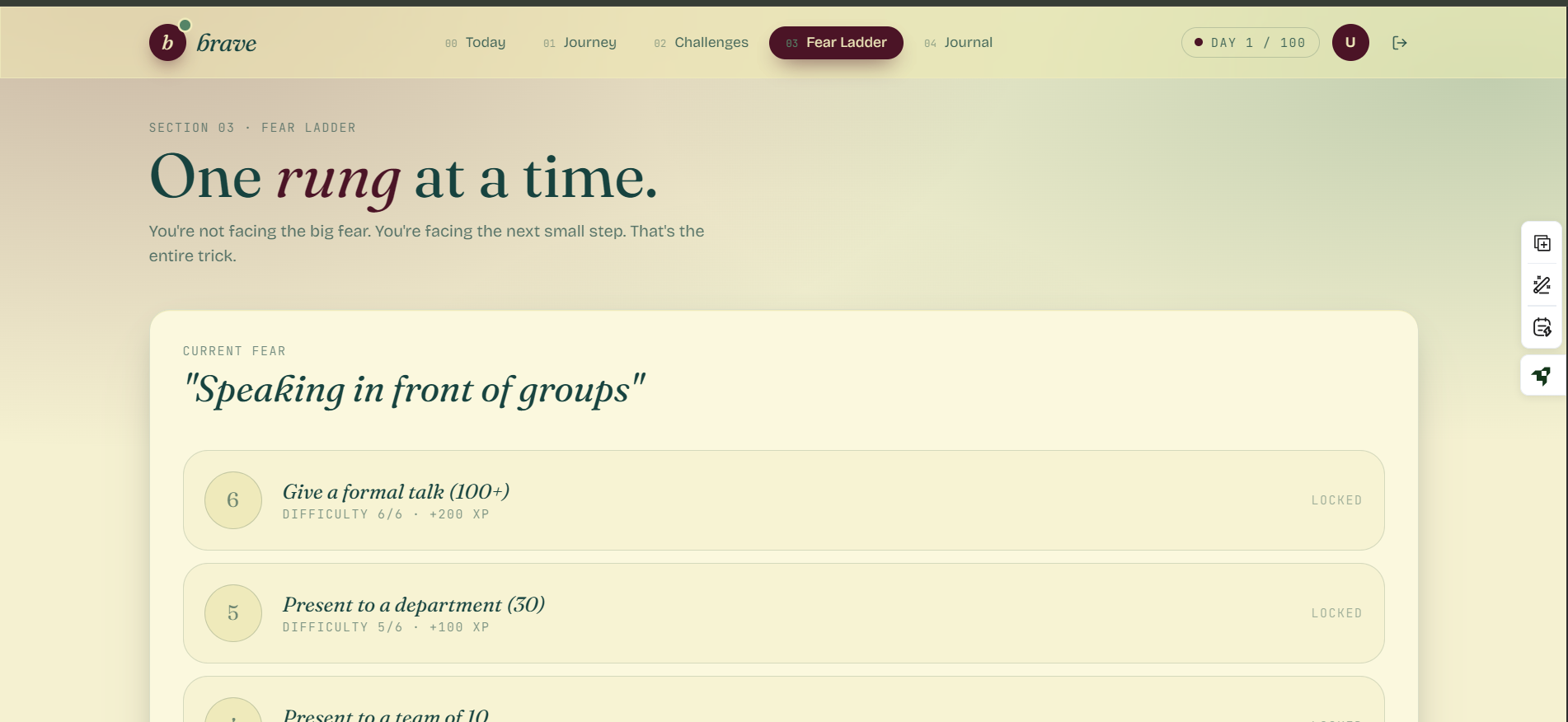
BraveQuest – Our Journey
Inspiration
BraveQuest was inspired by a simple observation: millions of people struggle with social anxiety, low confidence, and the fear of being judged, yet most existing solutions focus only on motivation rather than consistent action.
Many students avoid participating in competitions, presentations, networking events, or even simple conversations because of self-doubt. We wanted to create something that could help users build confidence gradually instead of expecting instant transformation.
Rather than offering generic advice, we envisioned an AI-powered companion that guides users through small, achievable challenges every day. The goal is to help people step outside their comfort zone one step at a time while tracking meaningful personal growth.
What We Built
BraveQuest is an AI-powered confidence-building platform designed to help users overcome social anxiety and develop stronger communication skills through personalized daily challenges.
Some of its core features include:
- 🎯 Personalized confidence-building roadmap
- 🤖 AI mentor that adapts challenges to the user's progress
- 📅 100-Day Confidence Quest
- 📈 Progress tracking with streaks and achievements
- 📝 Reflection journal for self-analysis
- 🧘 Guided breathing and mindfulness exercises
- 💬 Motivational insights and encouragement
- 🏆 Gamified rewards that keep users engaged
Instead of asking users to make huge life changes, BraveQuest focuses on consistent incremental improvement.
How We Built It
Our development process followed these stages:
- Problem Research
- Studied common causes of social anxiety and confidence issues.
- Identified recurring themes such as fear of judgment, lack of exposure, and inconsistent practice.
- User Journey Design
- Mapped the entire user experience from onboarding to long-term habit formation.
- Focused on reducing friction and making daily participation effortless.
- UI/UX Design
- Designed a calm and encouraging interface using modern web technologies.
- Used gamification principles to improve user retention.
- AI Integration
- Designed prompts that generate personalized challenges based on user progress.
- Created adaptive recommendations instead of fixed task lists.
- Progress System
- Built a quest-based progression model with milestones, achievements, and daily streaks.
Challenges We Faced
Finding the Right Scope
Confidence building is an extremely broad topic.
Initially, we wanted to include numerous features such as community interaction, simulations, voice coaching, and personalized therapy-like conversations. During development, we realized that trying to build everything would reduce the quality of the core experience.
We narrowed our focus to helping users build confidence through structured daily action.
Designing Meaningful AI Responses
Generating useful challenges was more difficult than expected.
The AI needed to recommend tasks that were:
- achievable,
- personalized,
- progressively more difficult,
- encouraging instead of overwhelming.
Balancing these requirements required multiple iterations of prompt engineering.
Creating Long-Term Engagement
One of the biggest risks was that users might stop using the app after only a few days.
To address this, we incorporated:
- daily streaks,
- achievement badges,
- progress visualization,
- milestone celebrations,
- adaptive challenges.
These features encourage users to return consistently.
Balancing Simplicity and Functionality
Adding too many features made the interface feel overwhelming.
We repeatedly simplified the design to ensure that users could immediately understand what to do next without unnecessary complexity.
What We Learned
Working on BraveQuest taught us lessons beyond software development.
User-Centered Design
A technically impressive product is not necessarily useful. Understanding the user's emotional journey was just as important as implementing features.
Prompt Engineering
Building an AI-driven application required careful prompt design. Small prompt changes significantly affected the quality and usefulness of generated responses.
Product Prioritization
Hackathons have limited time. We learned that delivering a polished core experience is more valuable than building many incomplete features.
Team Collaboration
Breaking the project into research, design, frontend, AI integration, and testing allowed us to move much faster while keeping the overall vision aligned.
Future Improvements
BraveQuest has significant room for growth. Some planned enhancements include:
- Voice-based AI confidence coach
- Real-life conversation simulations
- AI-powered public speaking practice
- Community support groups
- Wearable integration for stress monitoring
- Personalized long-term confidence analytics
- Professional therapist and counselor integration
- Regional language support
- Accessibility improvements
- Mobile application for Android and iOS
Measuring Growth
One way to think about confidence growth is through consistent practice rather than dramatic breakthroughs.
If each completed challenge contributes a small improvement ( \Delta c ), then after ( n ) successful challenges, the user's overall confidence can be approximated as
[ C_n = C_0 + \sum_{i=1}^{n}\Delta c_i, ]
where:
- (C_0) is the initial confidence level,
- (\Delta c_i) is the confidence gained from completing the (i^{th}) challenge.
This illustrates the core philosophy behind BraveQuest: meaningful personal growth comes from many small, consistent steps rather than a single transformative event.
Conclusion
BraveQuest is more than a productivity or self-improvement app—it is an AI-powered companion designed to help people gradually overcome fear, build confidence, and unlock opportunities they might otherwise avoid.
Through personalized guidance, daily challenges, and positive reinforcement, the platform encourages users to take one small courageous step every day. While there is still much to improve, this project demonstrated how generative AI can be used not only to answer questions, but also to support meaningful personal development and lasting behavioral change.
AI Integration
BraveQuest leverages AI to create a more personalized and engaging self-improvement experience. AI is used to recommend personalized confidence-building challenges based on a user's progress, interests, and completed activities, helping users gradually step outside their comfort zone at a pace suited to them.
The platform also uses AI to provide motivational feedback and personalized encouragement, making the journey feel more supportive and engaging. These recommendations help users build confidence through consistent, achievable actions.
As college students still learning software development, we also leveraged AI coding assistants to help implement certain parts of the application. We carefully reviewed, understood, modified, and integrated the generated code into our project rather than relying on it blindly, allowing us to learn while accelerating development.
Built With
- css
- html
- javscript
- react.js
- supabase
- typescript


Log in or sign up for Devpost to join the conversation.