Inspiration
Launching a product today requires much more than writing a few lines of copy. Founders, creators, and small teams often need strategy, messaging, visuals, and promotional assets all at once, but most AI tools still work in fragmented, text-only steps. We wanted to build an agent that feels more like a creative partner than a chatbot — one that can take a simple product brief and turn it into a launch-ready multimodal campaign.
What it does
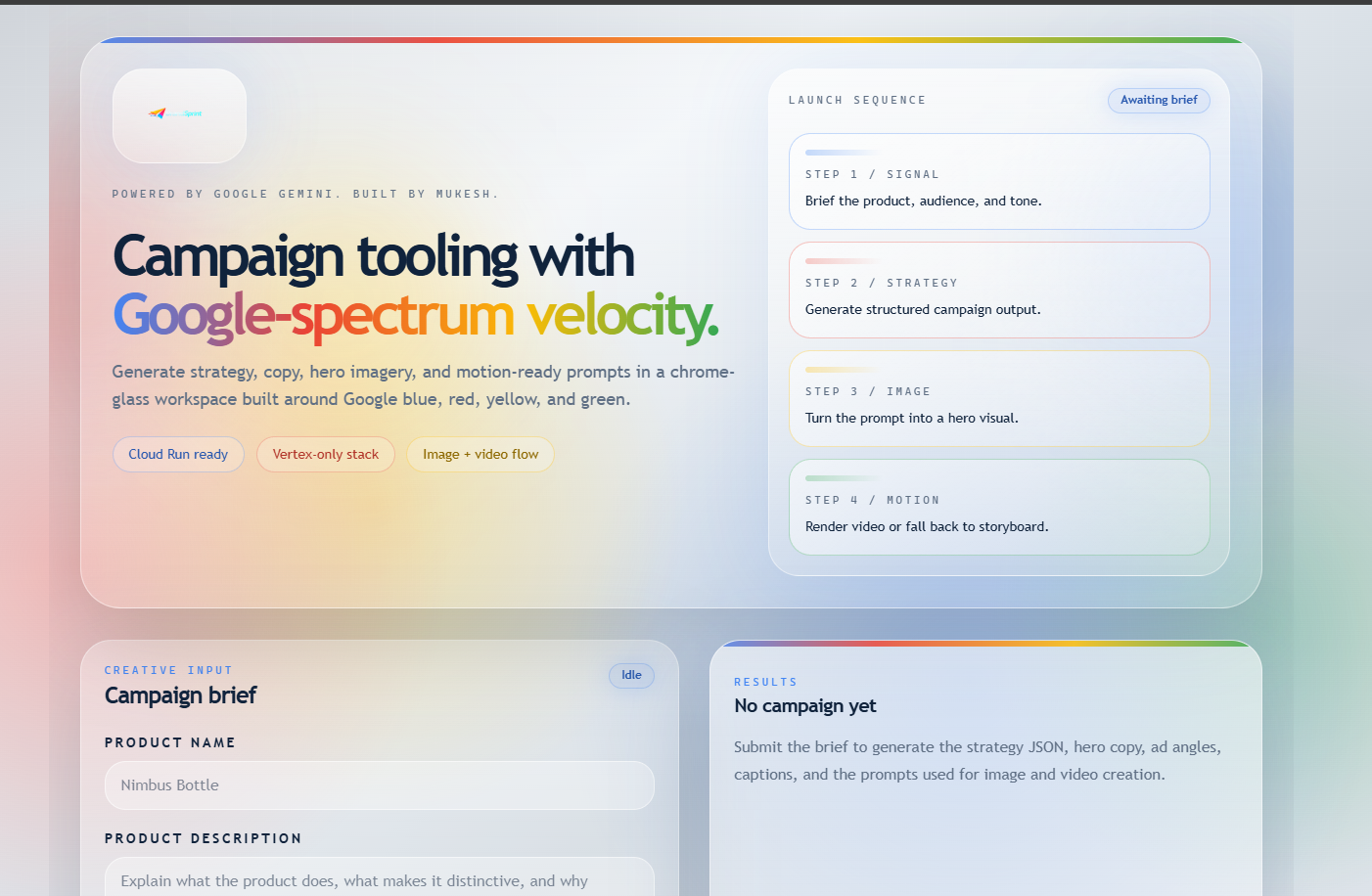
BrandSprint is an AI-powered multimodal campaign builder that transforms a product brief into a complete marketing launch package. Users enter a product name, description, audience, tone, and optionally upload a reference image. The app then generates a structured campaign strategy, hero messaging, ad angles, social captions, visual concepts, and promo ideas in one streamlined workflow. Instead of switching between multiple tools, users get a cohesive brand campaign from a single input.
How we built it
We built BrandSprint as a full-stack web app using Next.js and TypeScript for the frontend and backend, with a clean UI designed for fast iteration and usability. The app is hosted on Google Cloud Run and uses Vertex AI for multimodal generation. We used Gemini for structured campaign outputs and creative content generation, and designed the system so campaign strategy, copy, image prompts, and promotional concepts are generated in a consistent, reusable flow. The architecture was intentionally kept minimal so the product remains lightweight, scalable, and easy to extend.
Challenges we ran into
One of the biggest challenges was balancing ambition with simplicity. We wanted BrandSprint to feel like a next-generation creative agent, but we also needed to keep the product focused and technically reliable. Another challenge was designing prompts and output structures that produce marketing content that is both creative and usable, rather than generic AI filler. We also had to think carefully about how to gracefully handle multimodal generation so the experience stays smooth even when some outputs, such as video, may require fallback logic.
Accomplishments that we're proud of
We’re proud that BrandSprint goes beyond simple text generation and moves toward a more complete creative workflow. Instead of producing isolated outputs, it creates a connected campaign system with strategy, messaging, and media concepts aligned around the same brand brief. We’re also proud of keeping the architecture lean by using a minimal Google Cloud setup while still delivering a polished multimodal experience. Most importantly, we built something that feels practical for real founders, marketers, and creators.
What we learned
We learned that the real value of multimodal AI is not just generating more content, but generating the right set of connected assets in context. We also learned that structured outputs are critical when building AI tools for professional workflows, especially when users need reliable, reusable campaign assets rather than raw creative experiments. On the product side, we learned that simplicity in architecture and user experience can make an AI application much stronger and more scalable.
What's next for BrandSprint
Next, we want to evolve BrandSprint from a campaign generator into a true AI creative director. That means adding richer multimodal outputs such as generated visuals and short promo videos, improving brand consistency across assets, and enabling users to generate campaign variations for different platforms and audiences. We also see strong potential for features like collaborative workspaces, reusable brand kits, exportable launch packs, and deeper support for startups, ecommerce brands, and solo creators launching products globally.
Built With
- and-iam/service-accounts-for-adc.-databases-and-storage:-none.-no-firebase
- and-zod.-platform-and-deployment:-google-cloud-run-with-docker.-ai-stack:-vertex-ai-only
- artifact-registry
- browser-side
- cloud
- cloud-build
- cloud-sql
- firestore
- localstorage
- next.js-app-router
- node.js
- persistence:
- pub/sub
- react
- storage.
- tailwind-css
- typescript
- using-the-official-@google/genai-node-sdk-with-gemini-text/image-models-and-veo-video-generation-with-fallback-handling.-cloud-services-used:-cloud-run
- vertex-ai

Log in or sign up for Devpost to join the conversation.