-
-
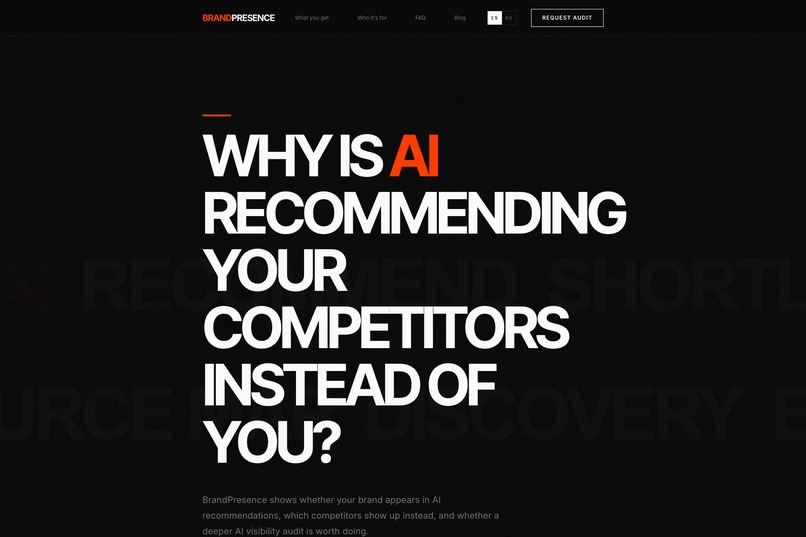
BrandPresence hero section / Landing page
-
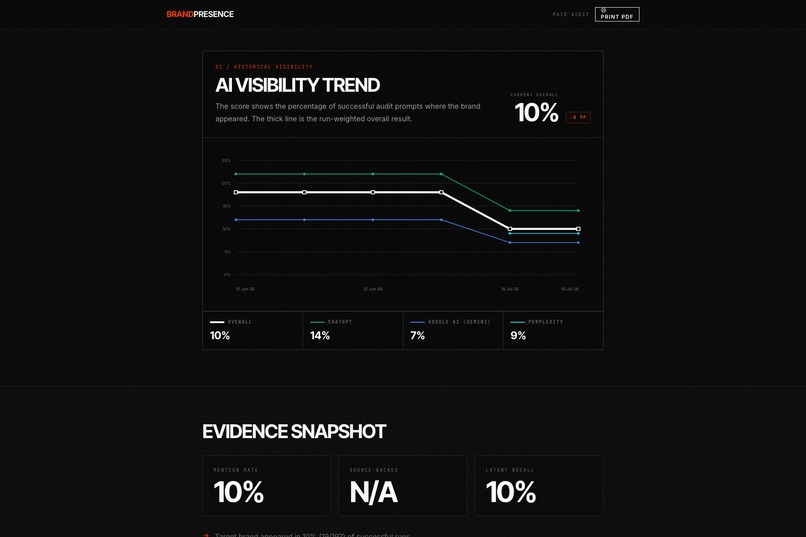
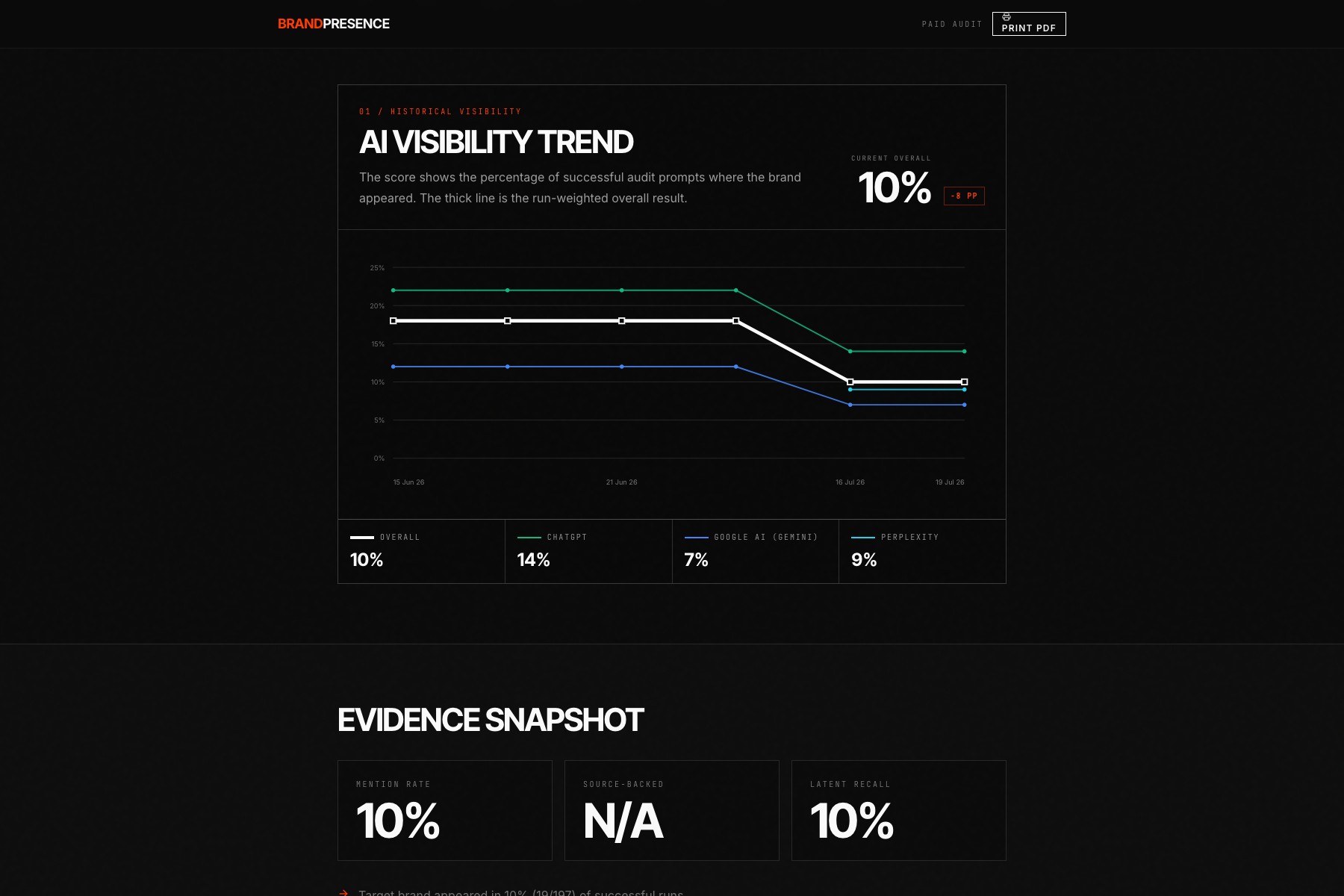
Visibility trend
-
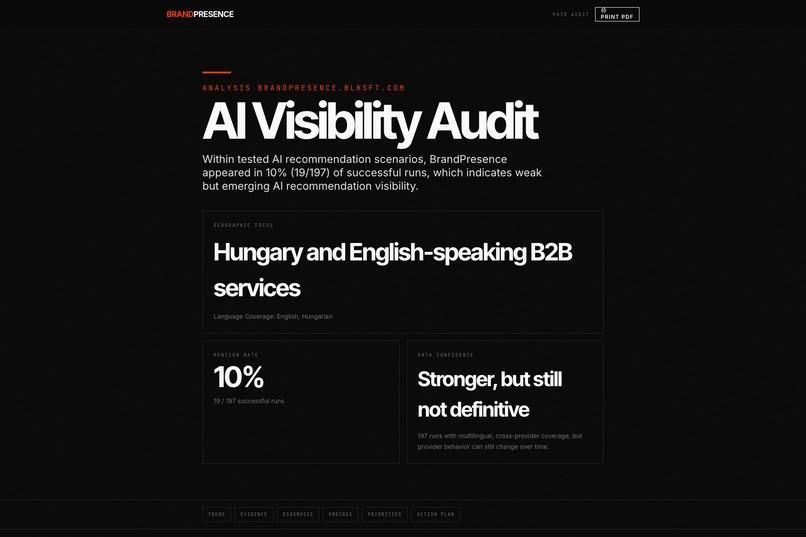
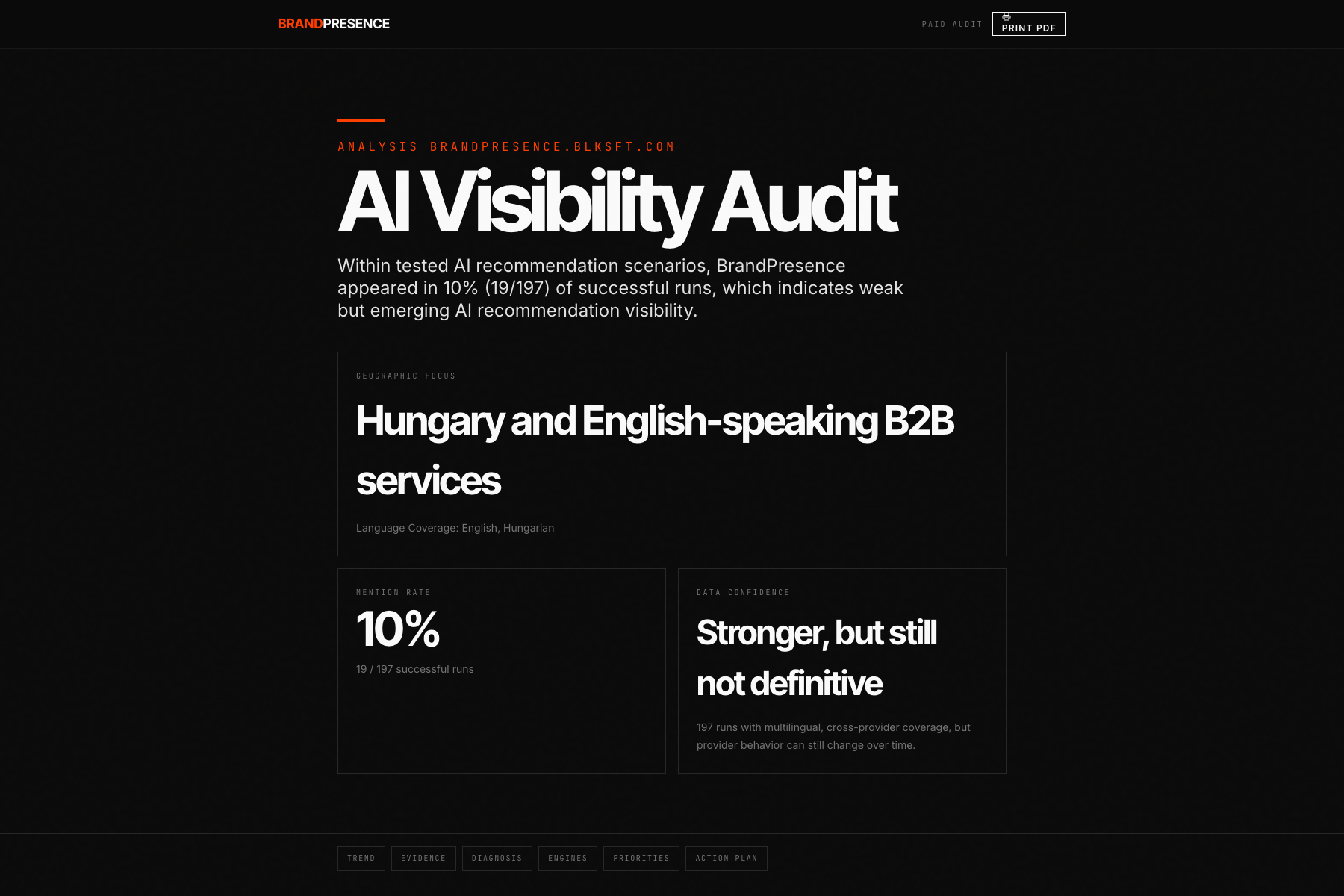
Audit overview
-
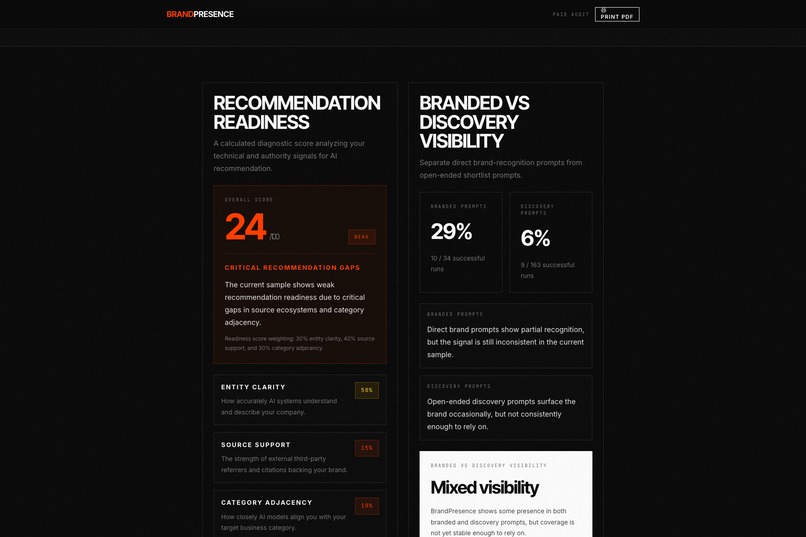
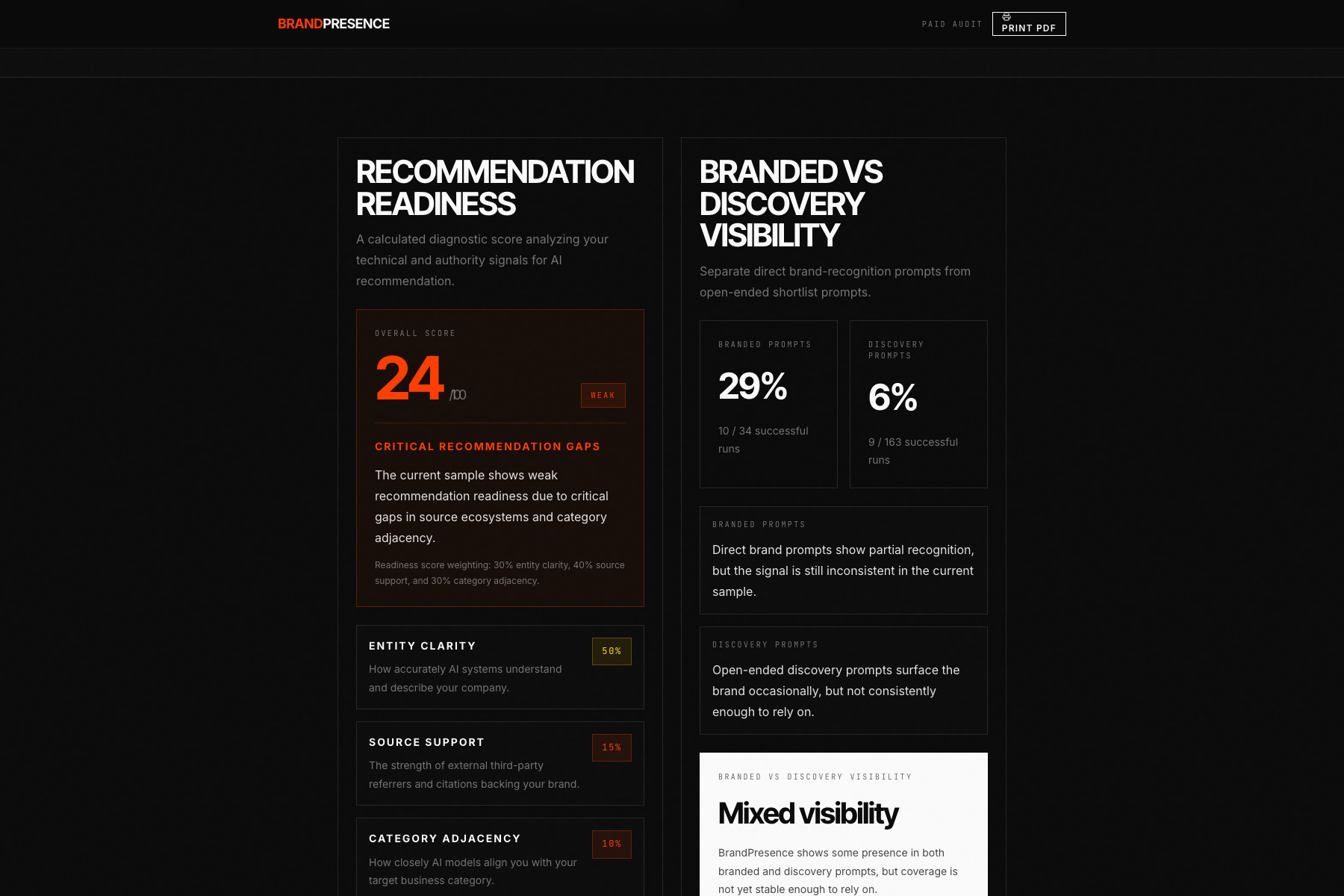
Recommendation readiness
-
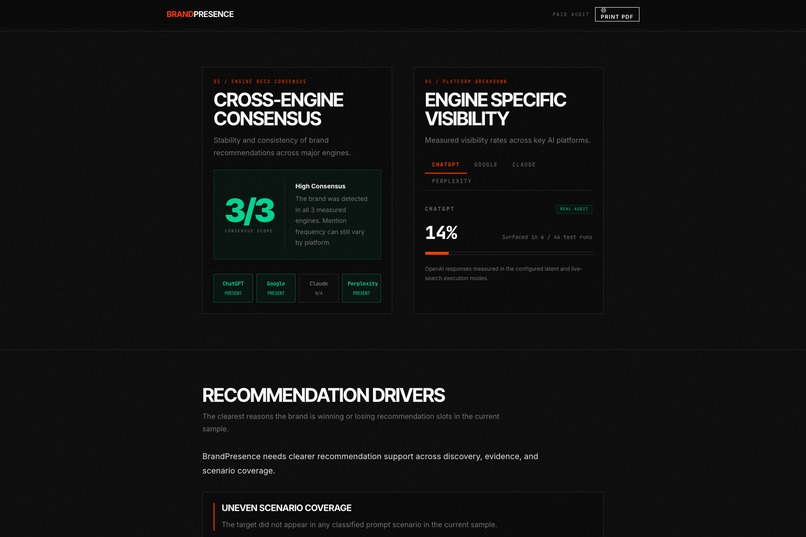
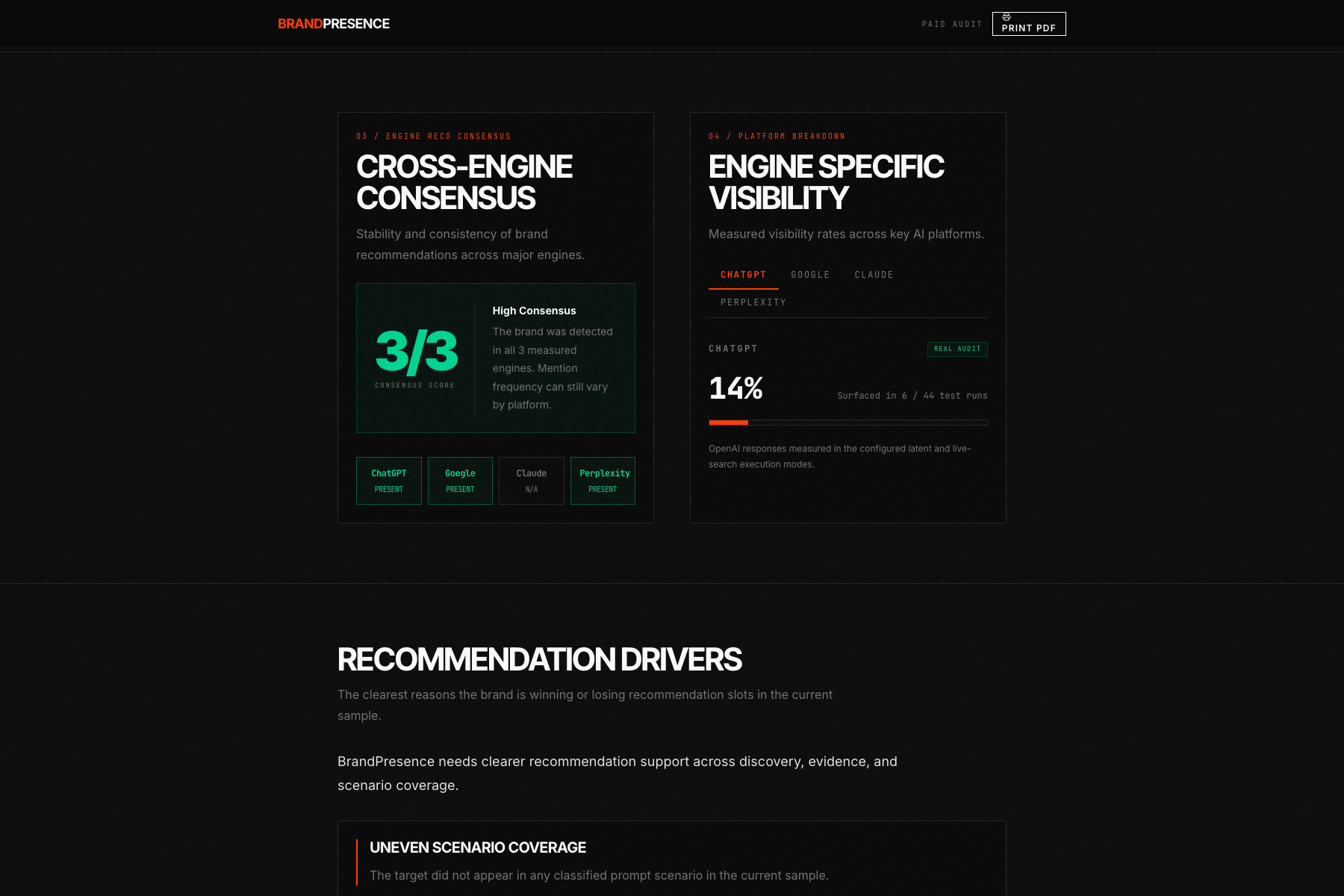
Engine consensus
-
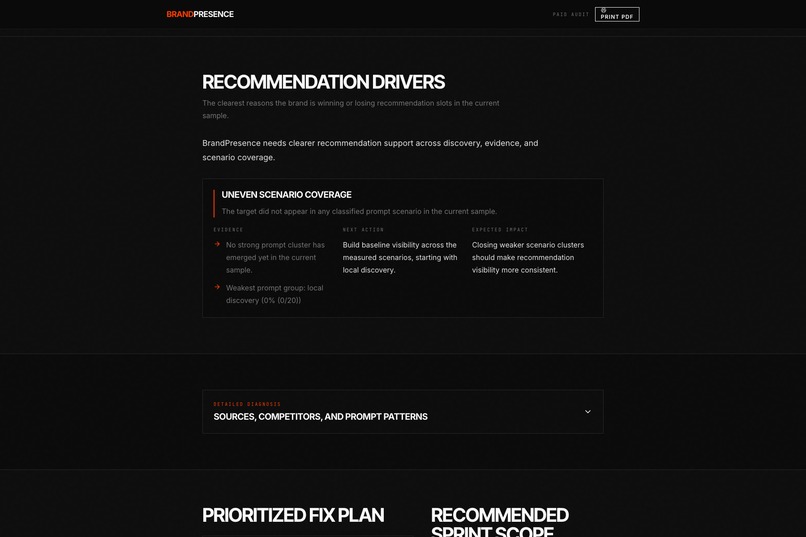
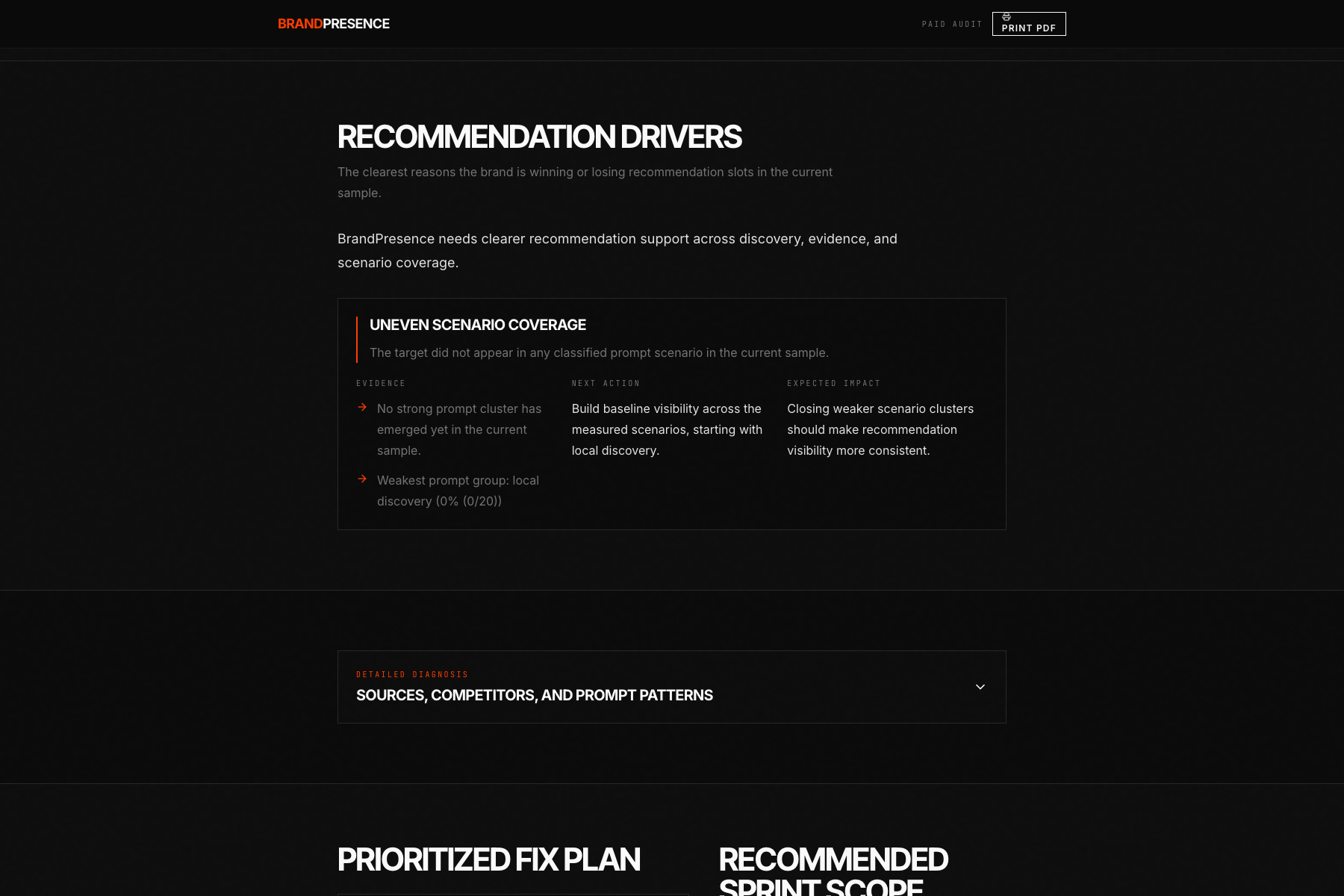
Recommendation drivers
-
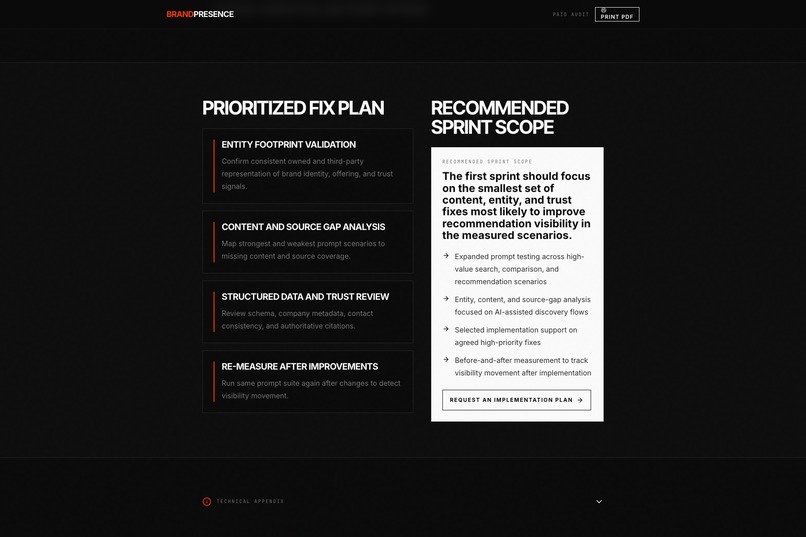
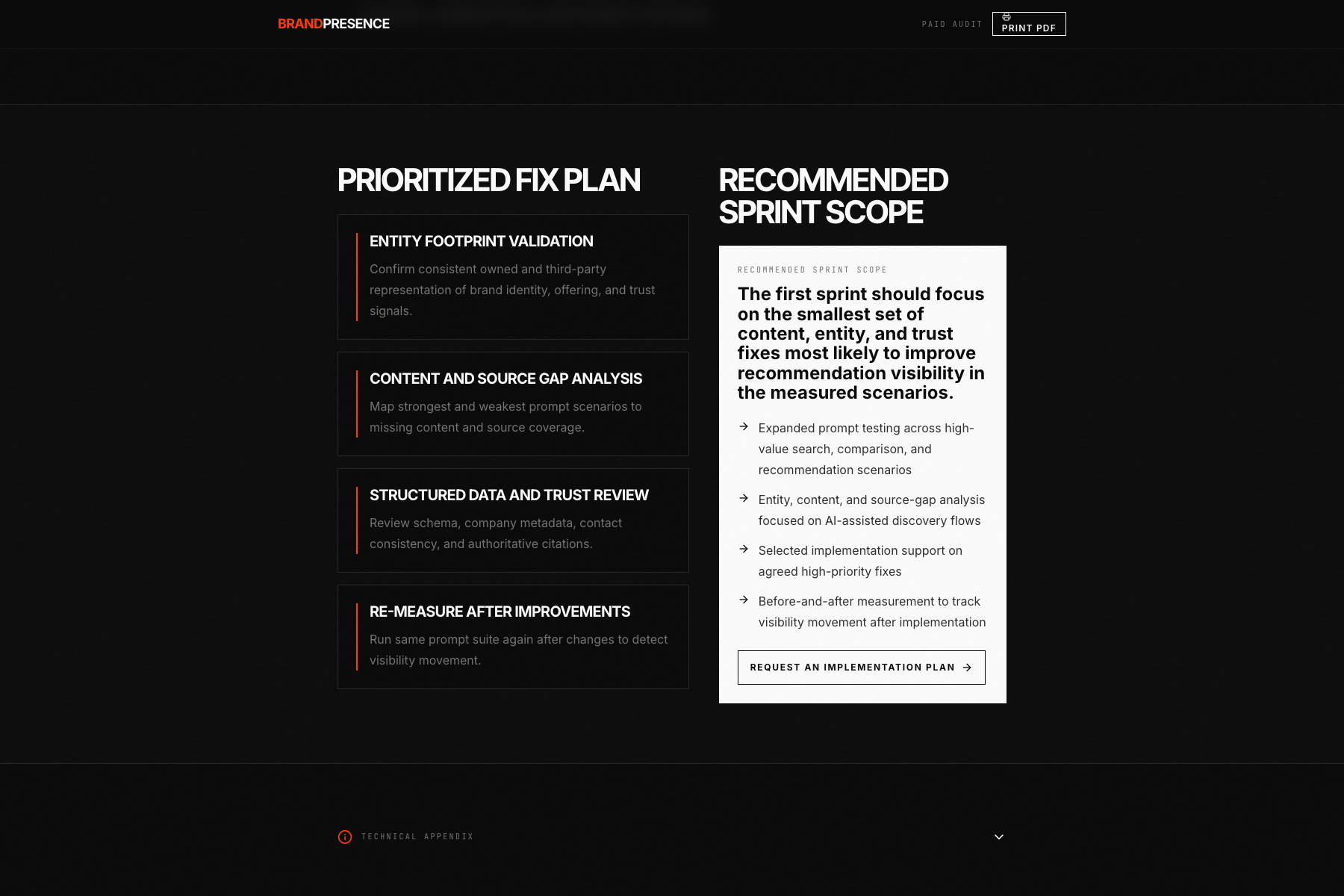
Prioritized fix plan
Inspiration
It all started with finding myself relying on ChatGPT with even smaller queries like suggest activities around me with my kids or car repair services near me. The way I see it, search is changing from a list of links into a synthesized answer. A company can rank well in traditional search and still disappear when a buyer asks ChatGPT, Gemini, or Perplexity which provider to choose.
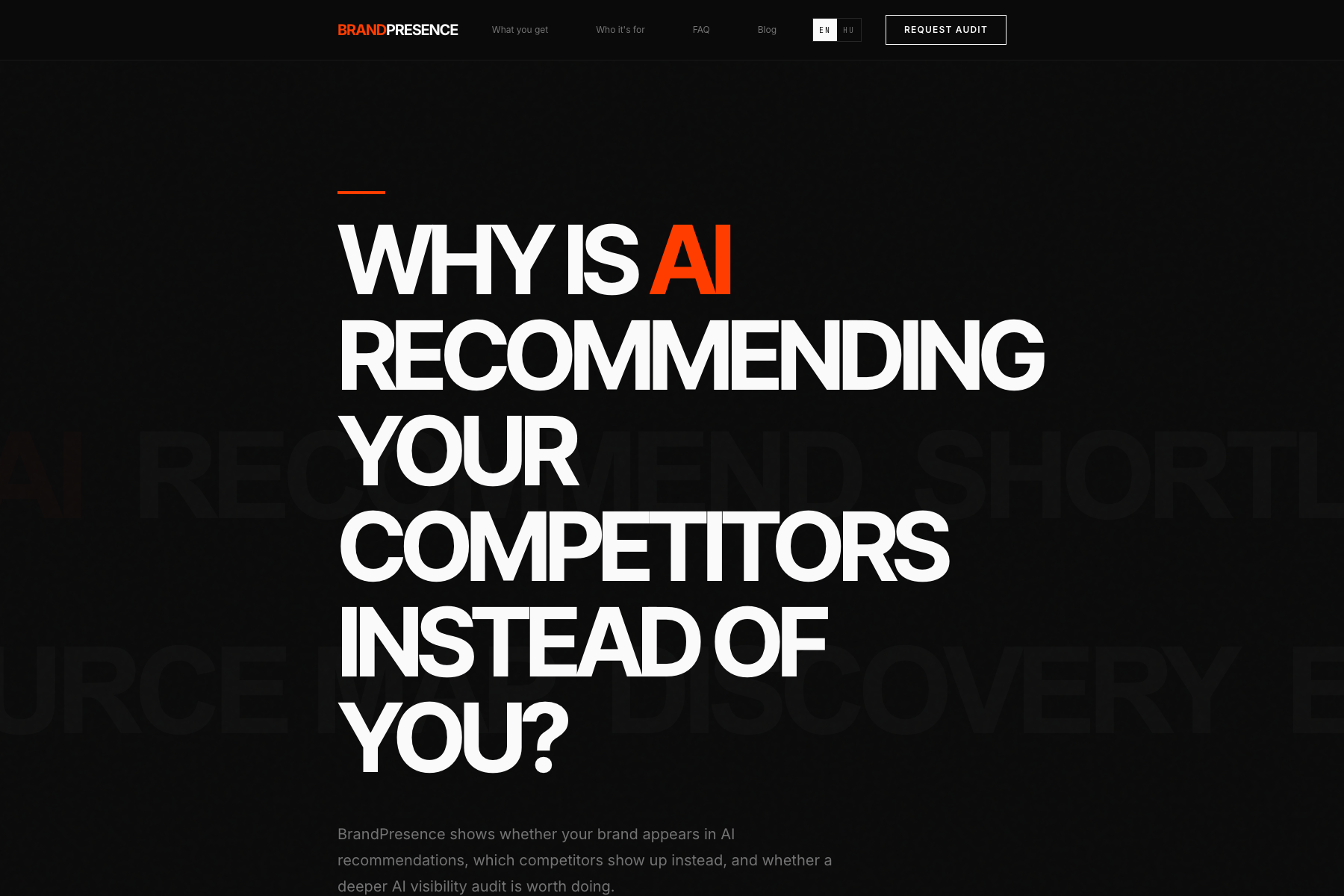
Most existing tools reduce this problem to a single visibility score or a collection of screenshots. BrandPresence was inspired by a more practical question: Why is an AI assistant recommending a competitor, what evidence influenced that answer, and what should the business fix next?
What it does
BrandPresence measures how accurately and consistently AI systems understand, cite, compare, and recommend a company.
Each audit runs localized, market-specific prompts across OpenAI, Gemini, and Perplexity. It captures the complete answers, cited sources, domains, model information, token usage, and execution context.
The results are then transformed into a secure, client-facing report that gives you the following answers:
- Branded awareness versus unbranded discovery
- Recommendation readiness and historical movement
- Competitor share of voice
- Agreement and disagreement across AI providers
- The sources influencing recommendations
- Content, authority, and evidence gaps
- A prioritized action plan
How we built it
BrandPresence is a TypeScript monorepo built with Next.js, React, Tailwind CSS, Prisma, PostgreSQL, and provider-specific AI integrations.
GPT-5.6 is the default OpenAI audit model. BrandPresence calls it through the OpenAI Responses API and enables web search for grounded prompts. The integration records citations, source domains, model snapshots, token usage, latency, and the complete request and response for later analysis.
A shared execution pipeline normalizes results from OpenAI, Gemini, and Perplexity. Deterministic parsing and scoring then separate branded familiarity from unbranded recommendation performance, identify competitors, measure provider consensus, and generate historical trends.
The report viewer adds localized English and Hungarian output, responsive visualizations, protected report access, and secure delivery - protecting client data - suitable for real client audits.
Codex with GPT-5.5 and GPT-5.6 supported development across the monorepo. It helped greatly with brainstorming, shaping the architecture, implement and debug provider integrations, improve prompt concurrency, build the scoring and reporting workflow, add tests and localization, diagnose deployment problems, refine the marketing experience, and - lastly :) - produce the Build Week submission media.
Challenges we ran into
The first major challenge was making different AI providers comparable. Each provider handles grounding, citations, sampling parameters, and source metadata differently. Their responses are also nondeterministic, so a single answer cannot be treated as a reliable ranking.
Performance introduced another challenge. A useful audit requires many prompts across several providers, markets, and intent categories. The execution pipeline needed controlled concurrency without losing traceability or making failures difficult to diagnose.
Turning dense audit data into a useful report was another challenge. Raw answers and charts are not enough for a business decision. The report needed to explain why competitors were winning, which evidence was missing, and which changes should happen first.
Secure report delivery also exposed differences between local Node.js execution and the deployed Next.js and Cloudflare environment, particularly around Prisma, background work, and protected report access.
Accomplishments that we're proud of
BrandPresence now works as an end-to-end audit system rather than a static prototype.
The showcased report consolidates 197 prompt runs across OpenAI, Gemini, and Perplexity into one coherent diagnosis. It includes historical measurement, provider consensus, competitor analysis, source evidence, recommendation drivers, and a prioritized fix plan.
The project also preserves the evidence behind every conclusion. Findings can be traced back to the original prompt, provider response, citation, and execution context.
The output is understandable outside the engineering team. It turns complex, inconsistent AI responses into a report that a founder or marketing team can use to decide what to improve next.
What we learned
AI visibility is far from being a single ranking. Branded awareness, unbranded discovery, factual accuracy, citations, and recommendations are different signals and need to be measured separately.
Disagreement between providers is useful evidence. It can reveal weak positioning, inconsistent public information, or a lack of authoritative sources.
The project also reinforced the importance of traceability. AI-generated analysis becomes much more valuable when every conclusion can be connected to stored evidence.
Codex was most effective when working against real reports, browser output, logs, tests, and repository instructions. That evidence-driven workflow made it possible to iterate quickly without treating generated code as automatically correct.
What's next for BrandPresence
The next step is turning audits into continuous monitoring.
Planned improvements include scheduled reruns, change alerts, stronger market and language benchmarks, additional AI providers, self-service onboarding, and clearer measurement of whether recommended fixes improve visibility over time.
BrandPresence will also connect findings more directly to implementation workflows, helping teams move from “Why are competitors being recommended?” to “What should change this week, and did it work?”
Built With
- cloudflare
- framer-motion
- gemini-api
- gmail
- google-places
- google-spreadsheets
- gpt-5
- next.js
- node.js
- openai
- opennext
- perplexity-api
- postgresql
- prisma
- react
- tailwind
- typescript
- vitest
- zod

Log in or sign up for Devpost to join the conversation.