Inspiration
We started out wanting to build something for small businesses and small teams of technical founders. When we looked at where they struggle, the answer was digital marketing. It is too much work for a team with no marketer. Someone has to keep the brand consistent, brief creators, watch every video, and catch the missing #ad tag or the health claim the brand can't make.
Most of the tools we found are built for marketing teams and priced for them. A founder who is also the engineer and the support desk can't afford them and doesn't have time to learn them.
So we built the part a small team can't do by hand. Brandloop reads the brand's website to learn its rules, checks each creator video against them, fixes what it can, and keeps a record of the check. We think of it as pull requests for creator content.
What it does
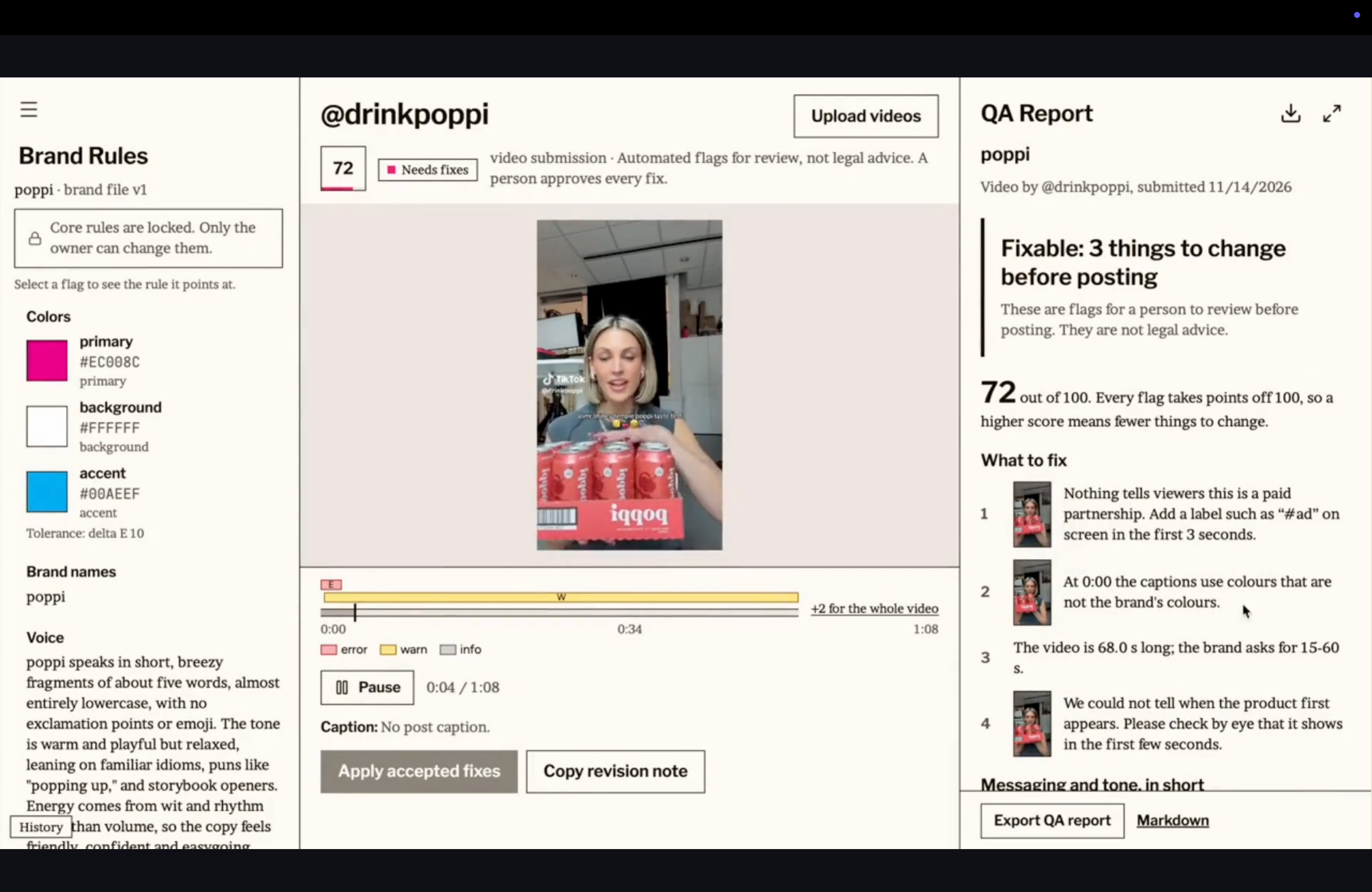
Brandloop checks each creator video against two things: compliance rules and the brand's own rules.
- Disclosure: it looks for #ad, "paid partnership" or "sponsored" in the speech, the on-screen text and the caption. On screen, it measures when the tag appears, how long it stays, how big it is and its contrast.
- Claims: each brand picks a category (supplements, beverage, skincare, food). Banned-claim patterns run over everything said and shown, and each hit lands on the timeline at the second it happens.
- Brand: colors, logo, voice and never-say phrases, from a brand file built by reading the brand's website.
- Fixes: accept a fix like a code diff and Brandloop edits the video: adds the #ad badge, redoes captions in the brand's font, moves the product shot earlier.
- QA report: a PDF with every finding, every decision, the brand-file version and a checksum of the fixed file.
- Pulse: collects public comments and flags when viewers ask "is this an ad?", dispute a claim, or post in coordination.
- Brand kit: posters, logo files and print pieces generated from the brand file with no AI.
Compliance flags are for a person to review. They are not legal advice.
How we built it
The backend is FastAPI on Python 3.12 with SQLite. The frontend is React, TypeScript and Tailwind.
A video review pulls two frames a second with ffmpeg, transcribes the audio locally with Whisper, and reads on-screen text with OCR. Rules then run over the transcript, the text and the frames. No AI model decides a finding. The score is computed from the findings:
$$ \text{score} = \max(0,\ 100 - 15e - 6w - i) $$
where \(e\), \(w\) and \(i\) are the counts of errors, warnings and info notes.
Fixes are ffmpeg edits with overlays rendered in Pillow. The fixed file is reviewed again with the same rules, so the report shows the score before and after.
Pulse scores sentiment locally, finds terms spiking against the previous four weeks, clusters topics, and builds a reply graph that it splits into communities with Louvain. Coordinated accounts are found with MinHash and confirmed with exact Jaccard similarity.
AI is used for writing only: the voice summary, creator scripts, and a planning agent built on LangChain deepagents with a Tavily search tool. To pick the script model we built Script Bench. Seven cheap models wrote scripts for the same briefs. Claude judged pairs blind, in both orders, and deterministic rules scored the pass rate. GLM 5.3 Flash won with a 91% win rate and a 100% rule pass rate, at about $0.48 per 1,000 scripts.
We tested the whole flow on Poppi: onboarded from its website, logo and four can photos, then reviewed ten public creator videos.
Challenges we ran into
- Our own fix failed our own check. The #ad badge we added wasn't detected on re-review because the OCR read it upside down. We fixed the reader and changed the badge to a color pair with contrast to spare.
- Onboarding picked the wrong logo. The first extraction of the Poppi site chose a retailer's logo and fonts that were only CSS aliases. We rewrote it to read the site's own font files and rank logo candidates.
- Speed for a live demo. Reviewing ten videos from scratch took too long to film. We cache frames, transcripts and OCR by the video file's hash. Rules and scores are always computed fresh.
Accomplishments that we're proud of
These are the parts we didn't find in the other tools we researched.
- It edits the creator's video. Accept a fix and Brandloop re-cuts the file with ffmpeg: it adds the #ad badge, redoes the captions in the brand's font and colors, and moves the product shot to the start. The fixed file then goes back through the same rules that flagged it.
- One disclosure check across three places, with measurements. It looks for the tag in the speech, the on-screen text and the caption. On screen it measures the time it appears, how long it stays, its height and its contrast, so a tag that is present but too small is still caught.
- Health claims pinned to the second. Category rule packs run over every word said and shown, and each hit sits on the timeline where it happened, with the rule it broke.
- A report tied to one exact file. The QA report carries every finding, every decision, the brand-file version and a SHA-256 checksum of the fixed video.
- A brand kit with no AI in the path. Posters, logo files and print pieces are rendered from the brand file, so the same file gives the same output every time.
What we learned
- Most of the product needed no AI. Findings, scores, fixes, the report, the brand kit and all of Pulse are computed with rules, measurements and local models. That made every result repeatable and explainable. We kept AI for writing, where a second draft costs nothing.
- Deepagents works best when the tools set the limits. Our agent plans a week with a todo list and hands work to four subagents: one listens, one proposes playbook changes, one writes briefs and scripts, one reviews submissions. We learned to keep it safe through what the tools can do. No tool can accept a change or edit the brand's core rules, so no prompt can make it. We also learned to return short summaries from tools, since raw dumps filled the context fast.
- An LLM judge needs its own checks. We had Claude compare scripts in pairs with the model names hidden, and we judged each pair in both orders. When the two verdicts disagreed we counted a tie, which removed the bias toward whichever script came first. Claude was never an entrant, so it never graded its own writing. A rule-based pass rate sat beside the judge's score, so one opinion never decided the result.
What's next for Brandloop
- Find the first ten brands. Small DTC brands in supplements, drinks, skincare and food that already work with creators. We'll start with founders we can reach directly and ask them to run their next campaign through it.
- Host it. Today it runs on a laptop. A hosted version removes the setup that a non-technical founder won't do.
- Go where the videos already are. Creators submit through a link today. Next is connecting to the platforms brands already use to hire creators, so videos arrive without an upload step.
- Better evals. Measure precision and recall on a larger set of hand-labeled videos, report compliance rules separately, and have people check the LLM judge's picks.
Built With
- apple-vision
- claude
- deepagents
- fastapi
- faster-whisper
- ffmpeg
- hugging-face
- langchain
- networkx
- opencv
- pillow
- playwright
- python
- pytorch
- react
- scikit-learn
- sqlite
- tailwindcss
- tavily
- typescript
- vite
- youtube-data-api
