-
-
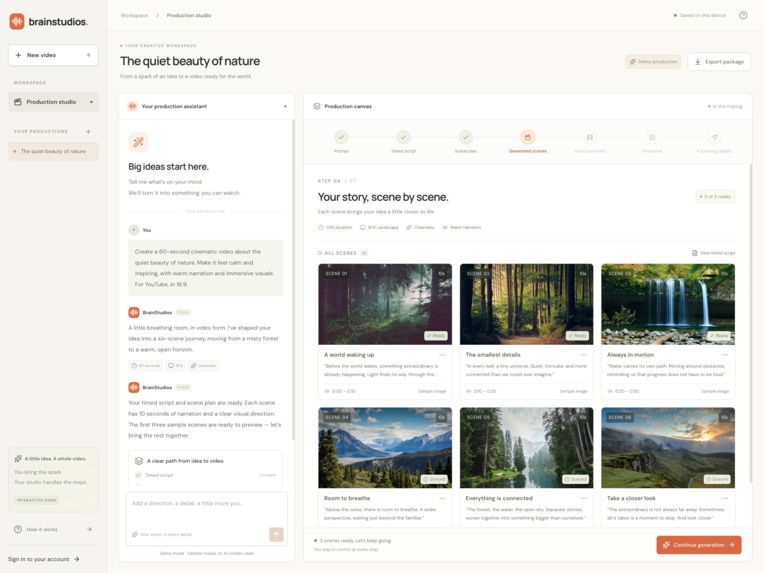
Preview
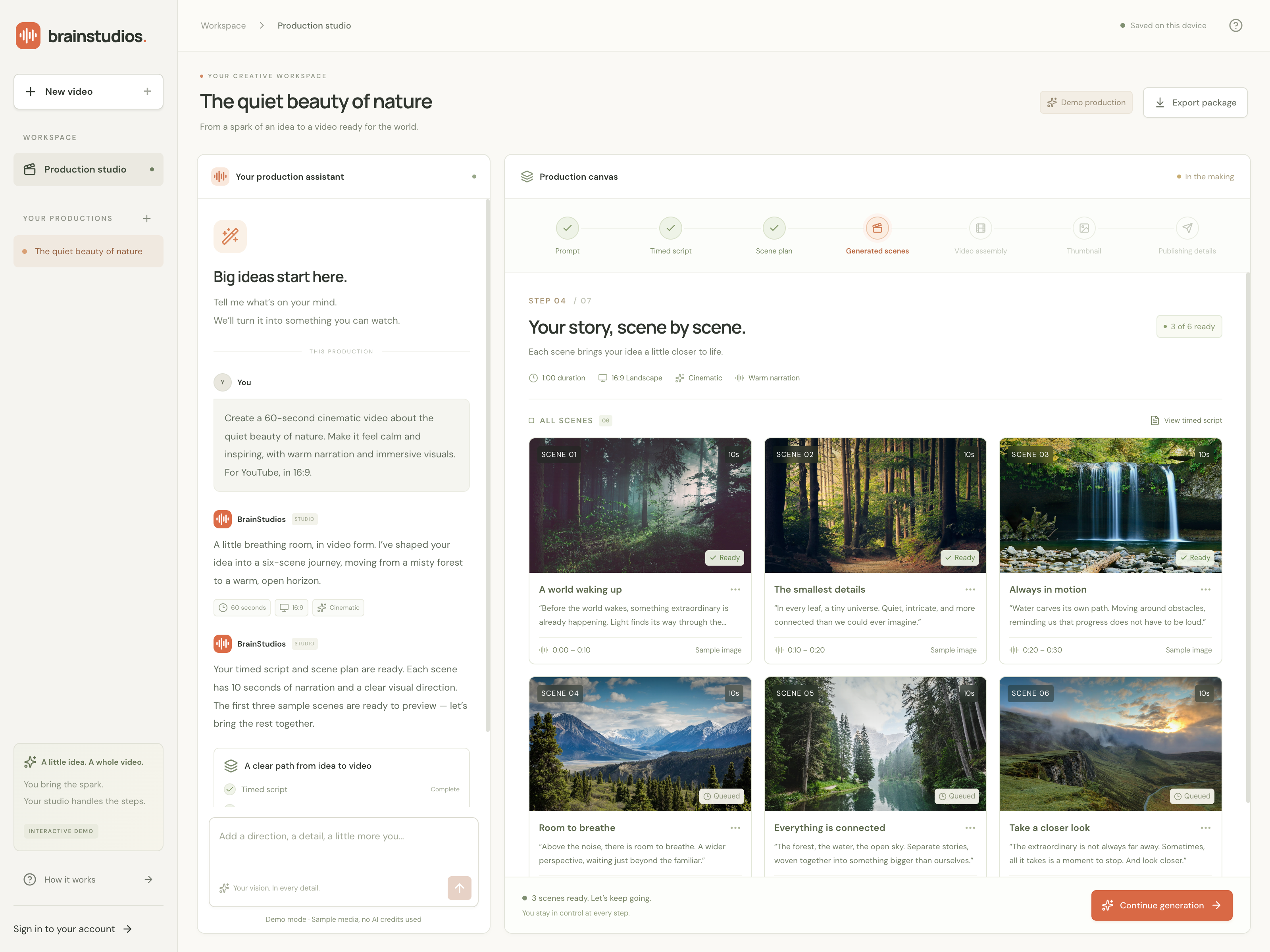
Inspiration
AI video generation has become incredibly powerful, but creating a complete video still means jumping between different tools. You might use one tool to write the script, another to plan scenes, another to generate clips, an editor to assemble them, and yet another tool to create thumbnails and publishing content.
That made me think: what if these tools behaved more like an actual production team?
BrainStudios was built around that idea — an agentic AI production team where you provide the creative brief and specialized agents coordinate the production from idea to finished video.
What it does
BrainStudios turns a single creative prompt into a structured video-production workflow:
Prompt → Timed Script → Scene Plan → Generated Scenes → Video Assembly → Thumbnail → Publishing Details
A Producer agent coordinates specialized agents throughout the process.
The Script Writer creates timestamped narration based on the requested video length. The Scene Director transforms that narration into visual direction, including subjects, environments, actions, camera movement, continuity, and generation prompts.
The Visual Generator then generates individual scenes using Veo. Each scene is handled independently, so a failed or changed scene can be regenerated without restarting the entire production.
Once the scenes are ready, the Editor assembles them into a final MP4. BrainStudios then generates thumbnail options and uses a Publishing Assistant to prepare a title, description, and tags.
The user remains in control throughout the workflow and can review and edit the script, scene direction, generated scenes, thumbnail, and publishing details.
How I built it
BrainStudios uses Google's Agent Development Kit (ADK) to orchestrate the production team. A Producer coordinates specialist agents using ADK's agent primitives rather than treating the entire production as one large AI request.
Gemini through Vertex AI powers the reasoning-heavy stages, including script writing, scene direction, thumbnail planning, publishing metadata, and Producer interactions.
Veo generates the actual video scenes. Scene generation is asynchronous and durable: provider operation IDs and production state are persisted so generation can continue across browser refreshes and server restarts.
Generated media is stored in Cloudflare R2, while PostgreSQL stores productions, jobs, revisions, and workflow state. FFmpeg normalizes and assembles the generated clips into the final video.
Clerk handles authentication and production ownership.
The application was built and deployed using Replit, and BrainStudios is being submitted to the Replit partner track.
Challenges
One of the biggest challenges was making the experience truly agentic without making it unpredictable.
Video generation can take significantly longer than a normal API request, so BrainStudios could not simply wait for every Veo request inside a single HTTP request. I built the workflow around durable jobs and persisted provider operation IDs so generation can be resumed safely.
Another challenge was regeneration. If one scene fails or the user changes its direction, regenerating the entire video would waste both time and generation costs. BrainStudios therefore tracks scenes independently and preserves completed clips whenever possible while invalidating only the outputs that depend on the changed scene.
Maintaining continuity was another interesting problem. Narration alone is not a good video-generation prompt, so the Scene Director acts as the bridge between storytelling and generation. It converts what is being said into what the viewer should actually see.
What I learned
Building BrainStudios changed how I think about AI agents.
I learned that useful agentic systems are not simply collections of AI prompts. The agents need clear responsibilities, structured handoffs, durable state, and deterministic checkpoints around actions that have real cost or take significant time.
I also learned a lot about combining Google's ADK with Gemini and long-running generative-media workflows such as Veo. Separating agent reasoning from durable application state made the system much more resilient and easier to understand.
What's next
BrainStudios currently focuses on making the core production pipeline reliable.
The next steps would be adding generated voiceover and captions, stronger character and visual continuity across scenes, more advanced editing capabilities, additional production styles, collaborative workflows, and direct publishing integrations.
The long-term goal is simple: make creating a video feel less like operating several disconnected AI tools and more like working with an AI production team.


Log in or sign up for Devpost to join the conversation.