-
-
Evidence Cards
-
Insights
-
A-HA MODE
-
Briefing


Inspiration
I built BrainLens for a simple reason: too many great ideas die inside unread papers.
Opening a dense academic PDF often means pushing through pages of jargon and spending hours decoding it. For students, professors, and researchers, that time cost isn’t just annoying — it delays progress.
BrainLens is my attempt to change that moment. It’s a research copilot designed to turn complexity into momentum: a visual, navigable interface that helps you grasp the core claims, connect them to evidence, and quickly reach the Aha! that unlocks what to do next. Because the real goal isn’t just understanding — it’s moving from clarity to action, so people can spend less time decoding PDFs and more time creating real scientific value.
What it does
BrainLens is a research copilot that turns dense academic PDFs into outputs you can actually use:
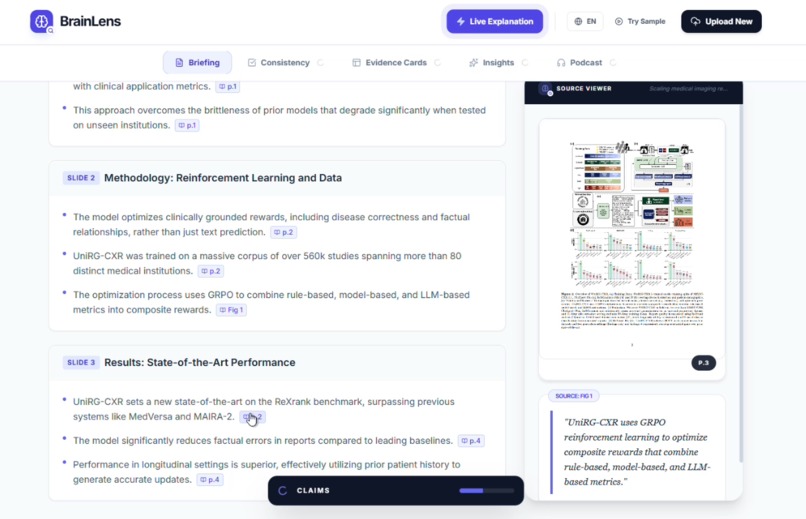
- Briefing (fast map of the paper): a structured overview of the paper’s goal, method, and key results so you get value in minutes, not hours.
- Consistency checks: extracts important claims and verifies whether the surrounding context in the paper supports them (helpful for catching overstatements and missing assumptions).
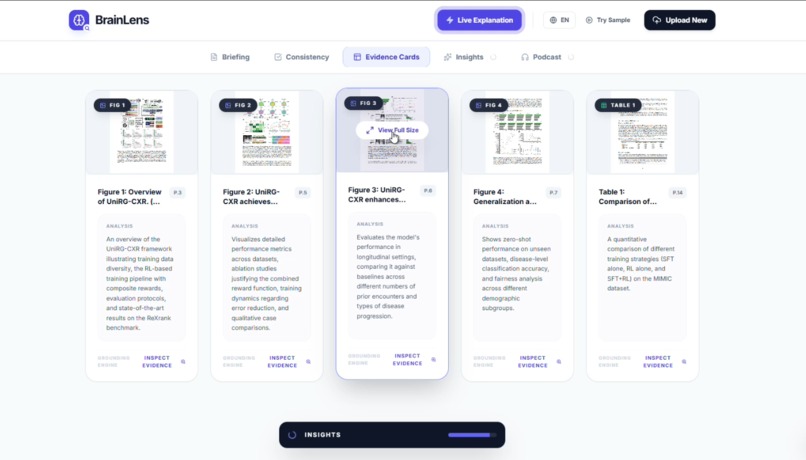
- Evidence Cards: surfaces figures/tables, makes them readable, and explains why they matter — so evidence becomes visual and navigable, not buried.
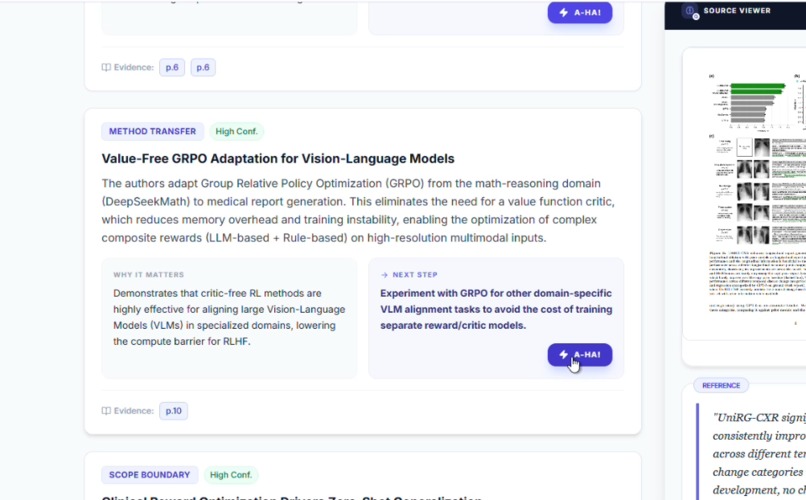
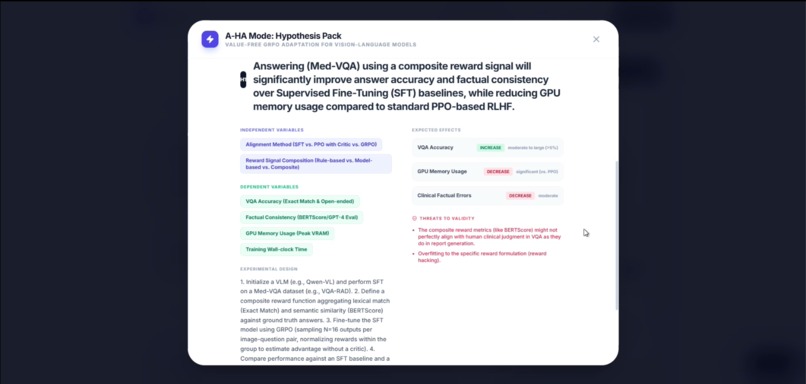
- Insights + Aha Mode: generates hypotheses, implications, and next experiments to run, so you leave with a direction — not just a summary.
- Citations everywhere: ideas are tied back to the source so you can jump from an insight to the exact page context.
How we built it
Vite + React + TypeScript
- A structured pipeline processes an uploaded PDF and produces multiple views (Briefing → Consistency → Evidence → Insights/Podcast).
- Each step returns structured JSON (with page references) that the UI renders into cards and sections.
- The UI is intentionally visual-first: quick scanning, clickable navigation, and “show me the evidence” flows.
- Gemini 3 powers the multimodal reasoning (understanding text + figures), enabling the system to connect claims, evidence, and experiment plans.
Challenges we ran into
- Grounding vs. speed: balancing a fast demo experience with traceability and structured outputs.
- Consistency-check reliability: designing prompts/logic that flag weak support without becoming overly conservative.
- Evidence readability: making figures/tables scannable in a way that feels visual and truly useful (not just “extracted”).
- Hackathon constraints: shipping an end-to-end experience quickly while keeping the pipeline modular.
Accomplishments that we're proud of
- Built a multi-view research experience (briefing, claim checking, evidence visualization, and hypothesis/experiment generation) that feels cohesive.
- Created Evidence Cards that make figures/tables understandable and relevant — the moment papers start feeling visual.
- Designed an Aha Mode flow that pushes beyond summarization into actionable next steps.
- Delivered a demo-friendly product that makes people say: “Wait… I actually understand this paper now.”
What we learned
- The biggest unlock isn’t “better summaries” — it’s making research navigable: claims → evidence → implications → next experiments.
- Grounding isn’t optional. If you want trust, you need clear sourcing and traceability back to the paper.
- UX matters as much as intelligence. A great model with a confusing interface still feels slow and unusable.
- Structuring the output (cards, steps, citations) is what turns raw model text into a real product.
What's next for BrainLens
- Backend proxy for Gemini calls (key protection + caching + rate limiting + retries)
- Stronger grounding: more explicit citation snippets + tighter page linking for every claim/evidence item
- Richer evidence parsing: improved figure/table interpretation and cross-references inside the paper
- Insight quality upgrades: better ranking, deduplication, and “related insights” clustering
- Export & collaboration: export a structured report (PDF/MD) and shareable experiment plans
- Multi-PDF comparison: compare multiple PDFs to surface convergences, contradictions, and complementary evidence across papers

Log in or sign up for Devpost to join the conversation.