-
-
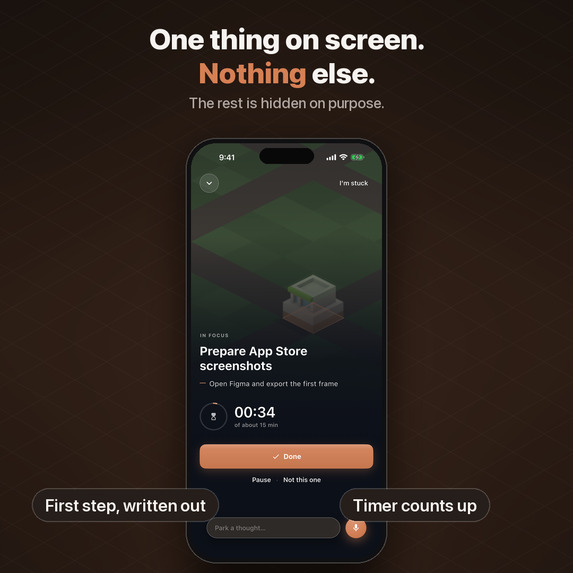
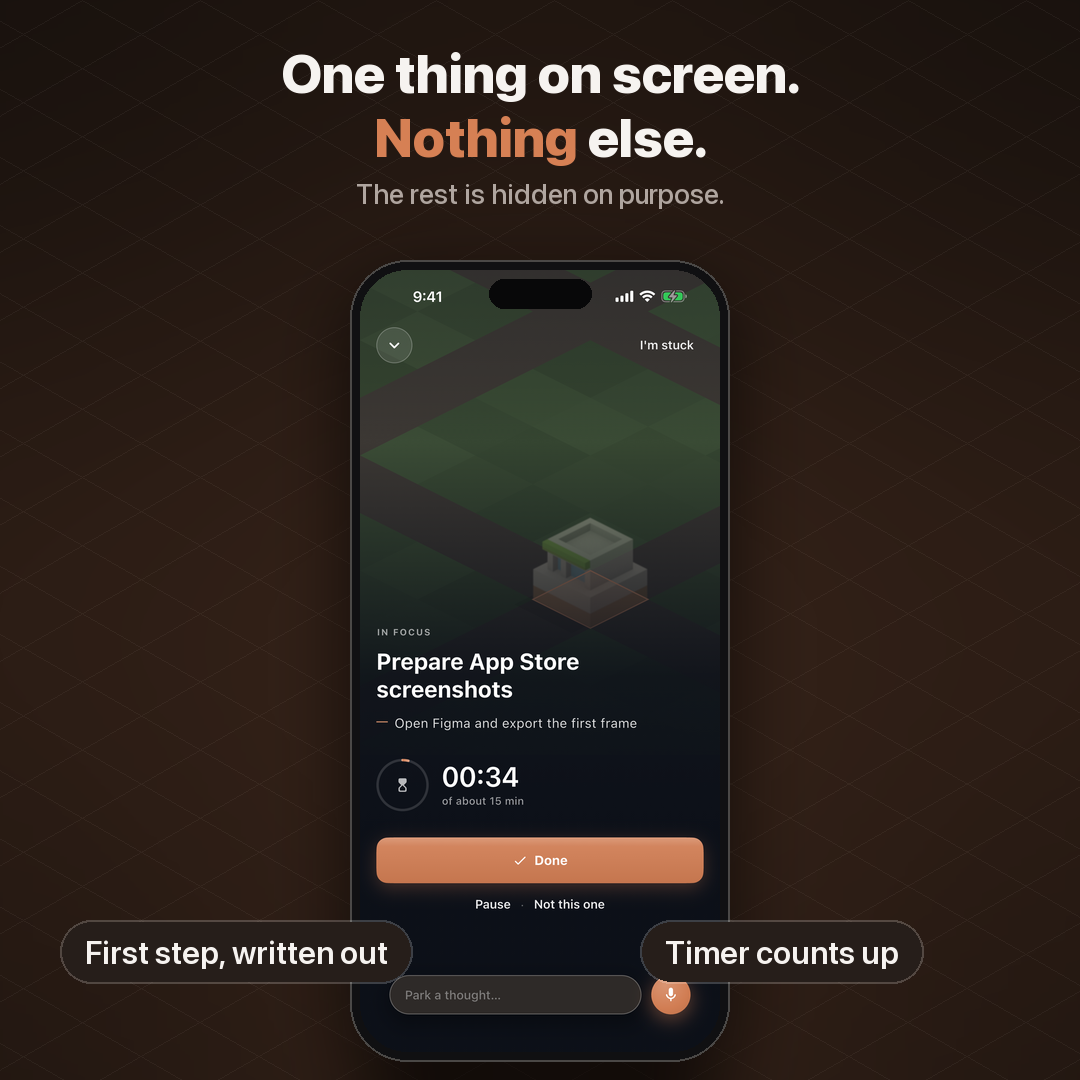
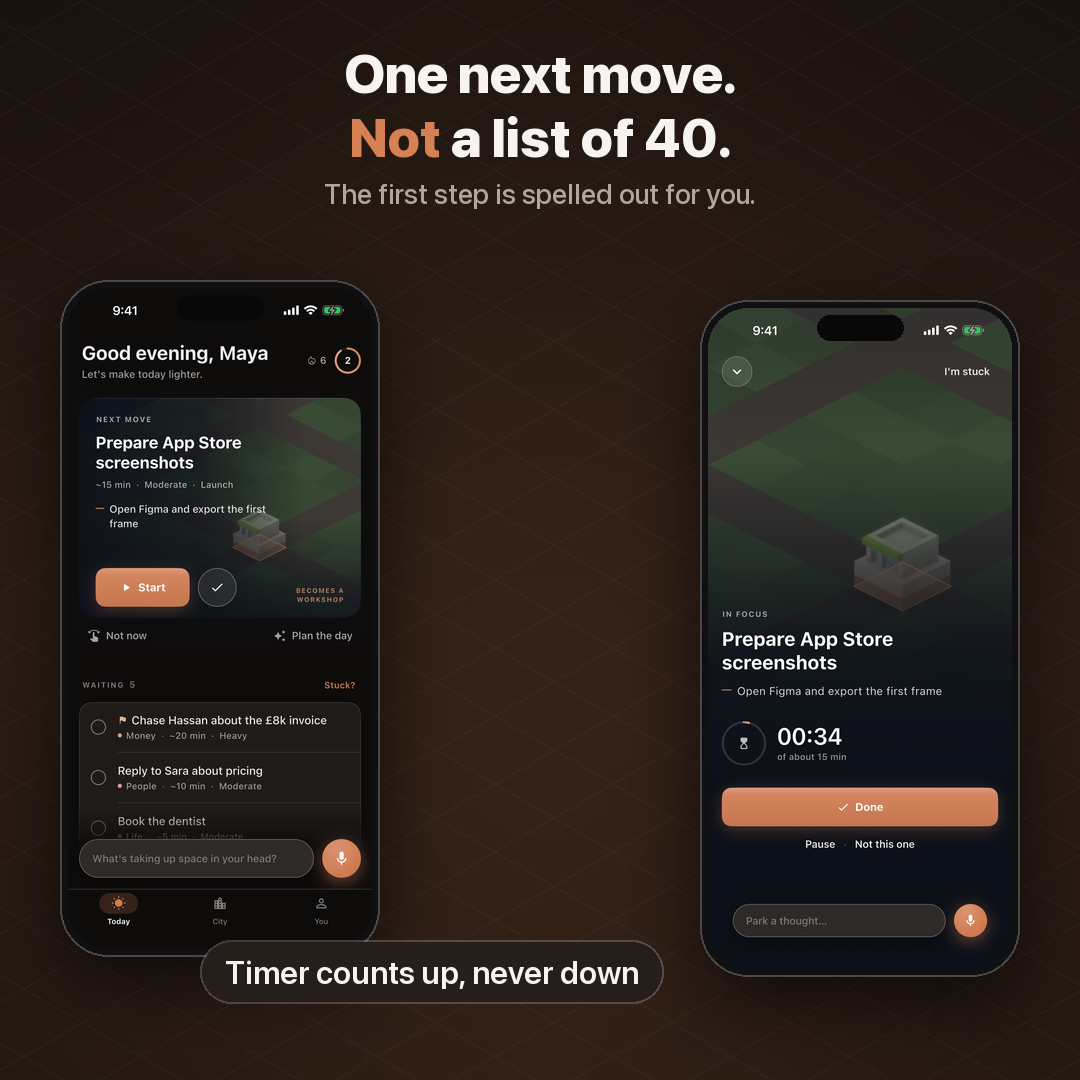
One thing on screen nothing else
-
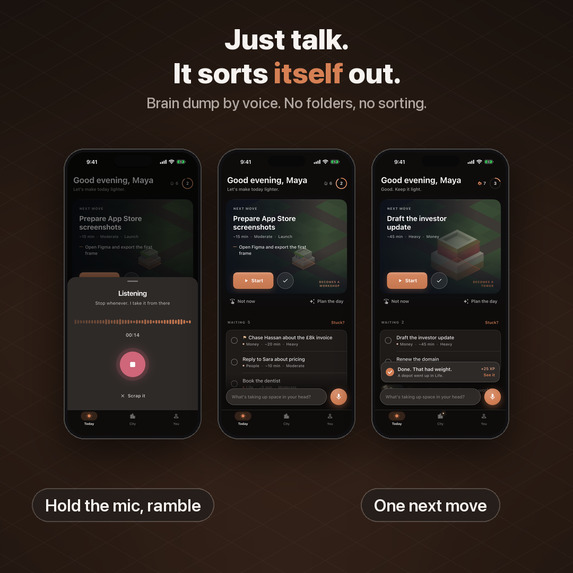
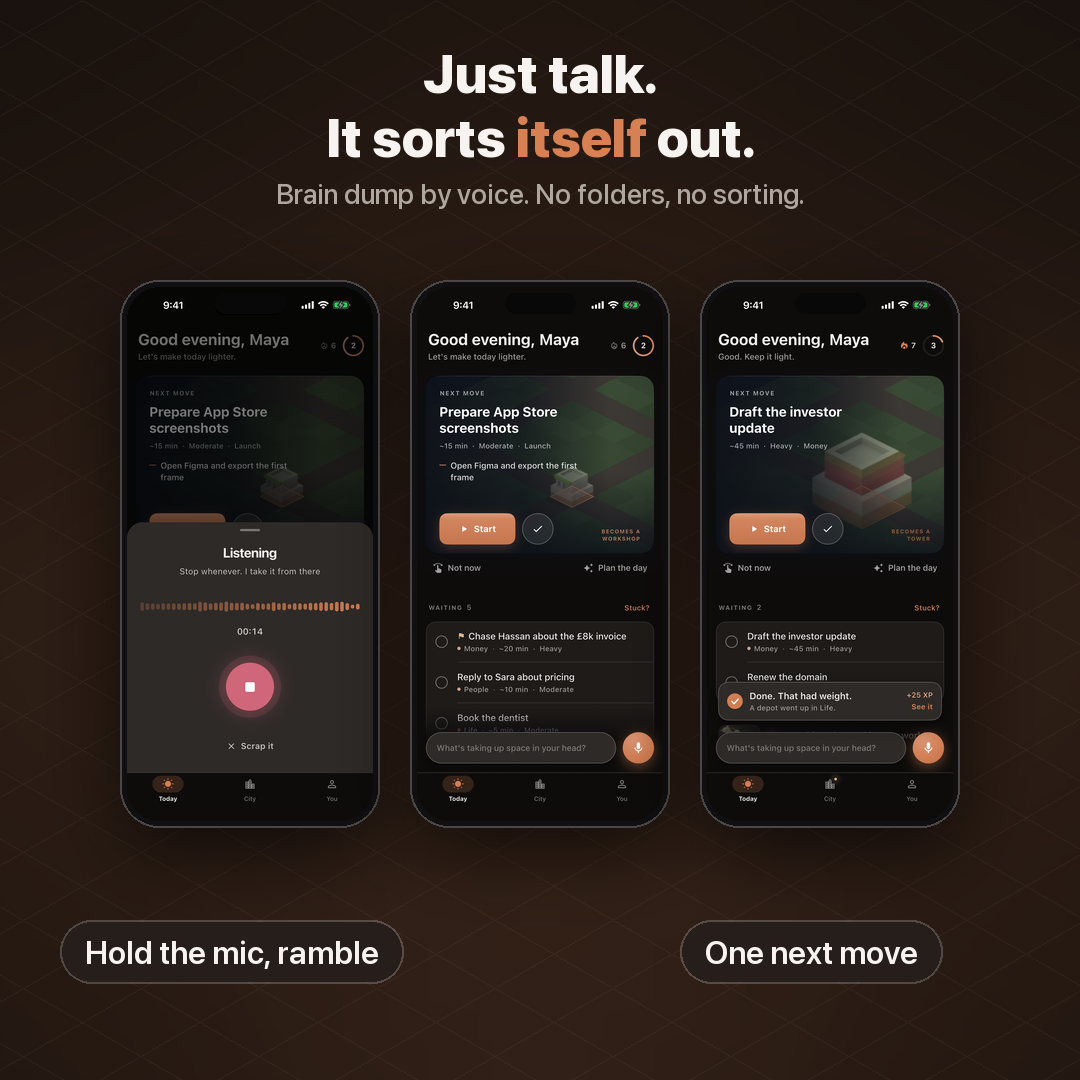
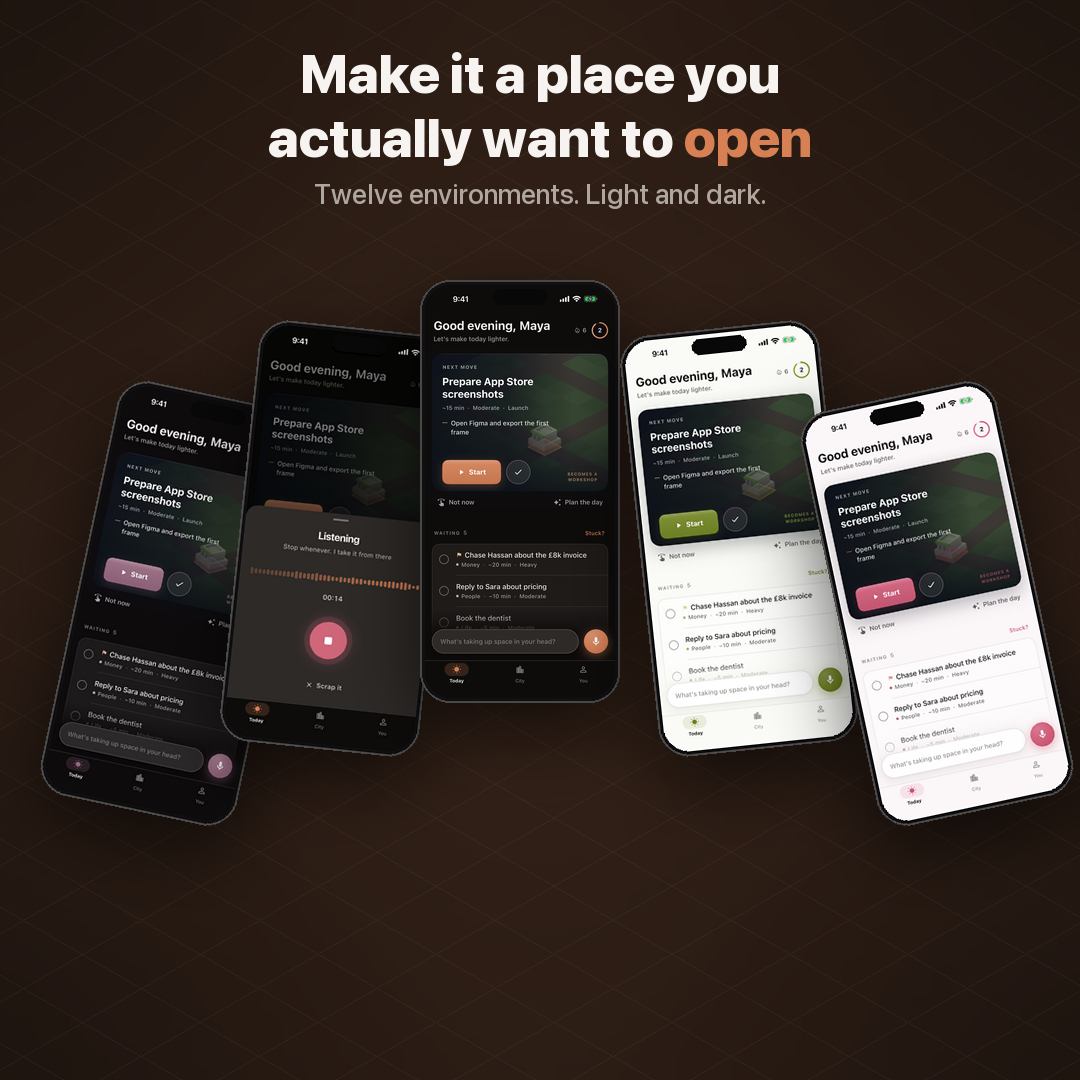
Just record and it will sort your tasks.
-
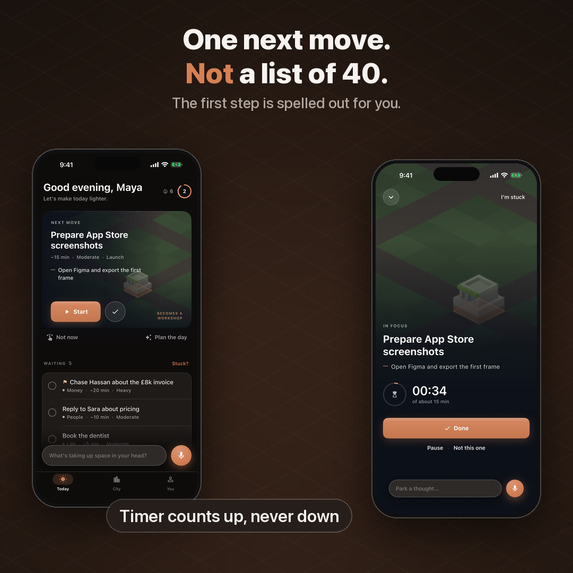
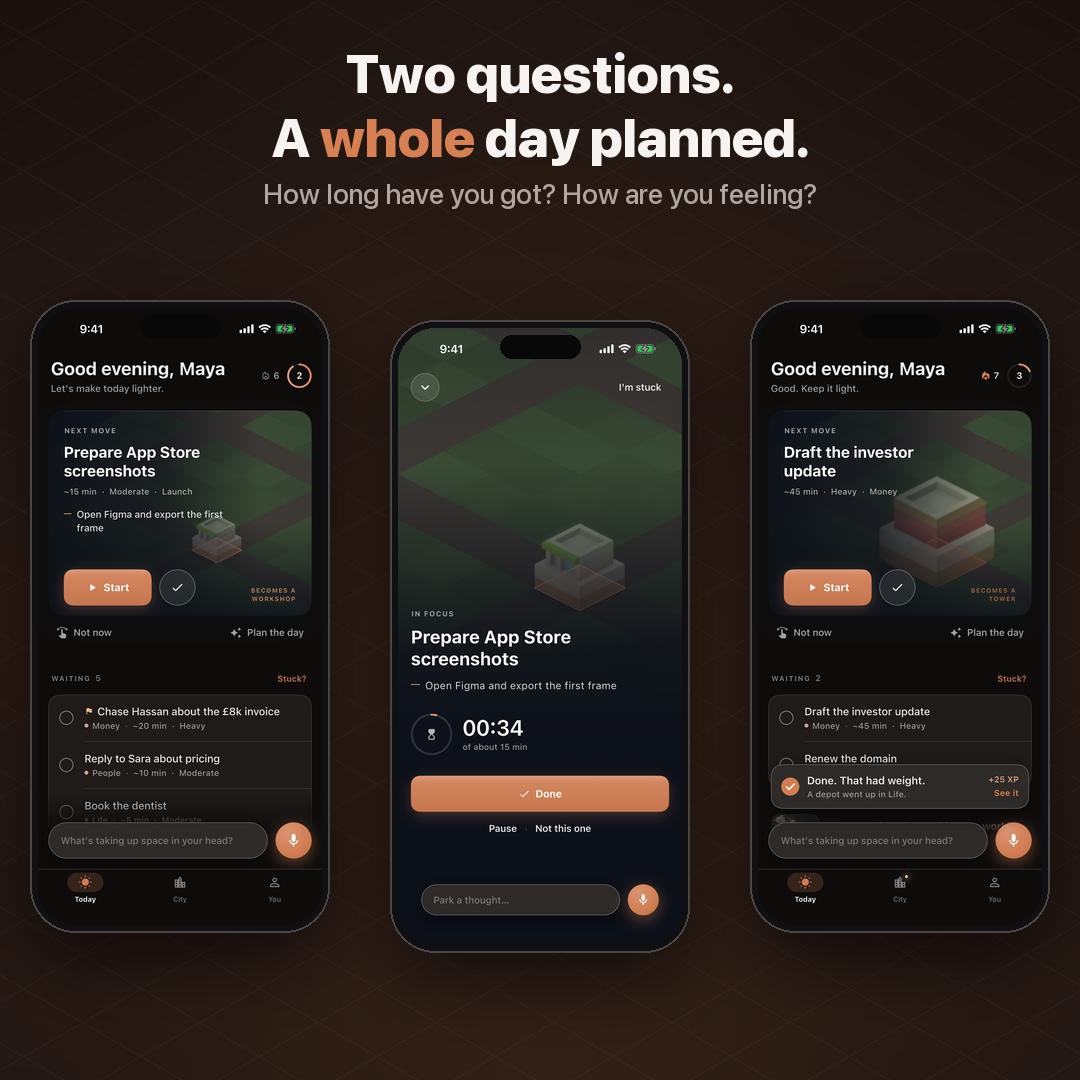
One nesxt move only not list of 40 tabs
-
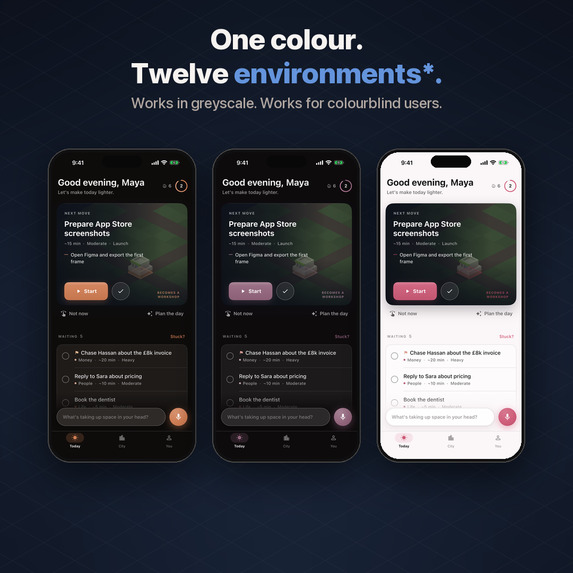
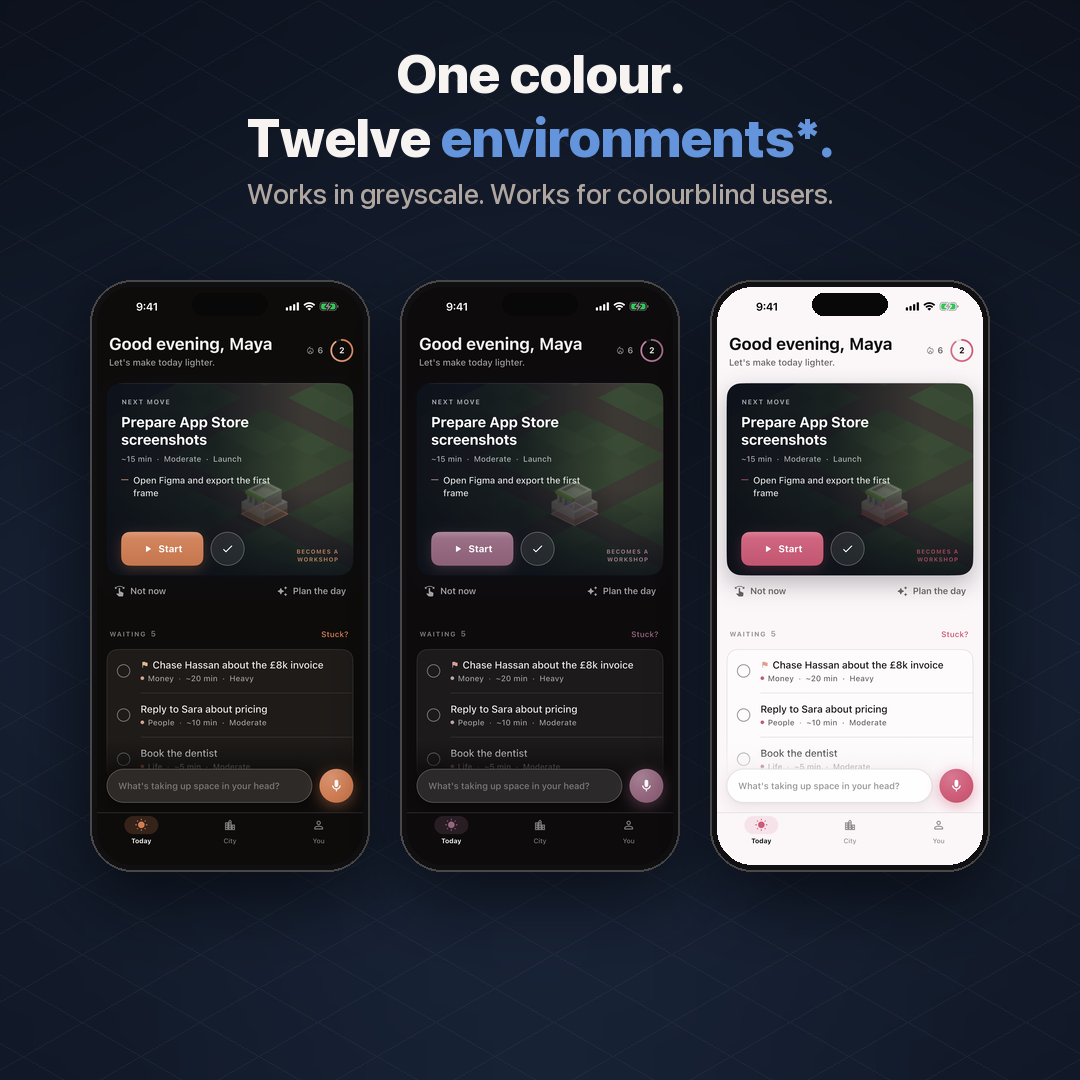
Twelve environments
-
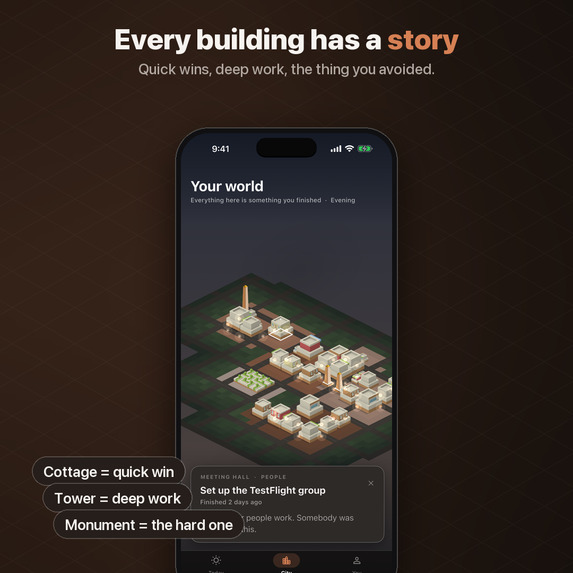
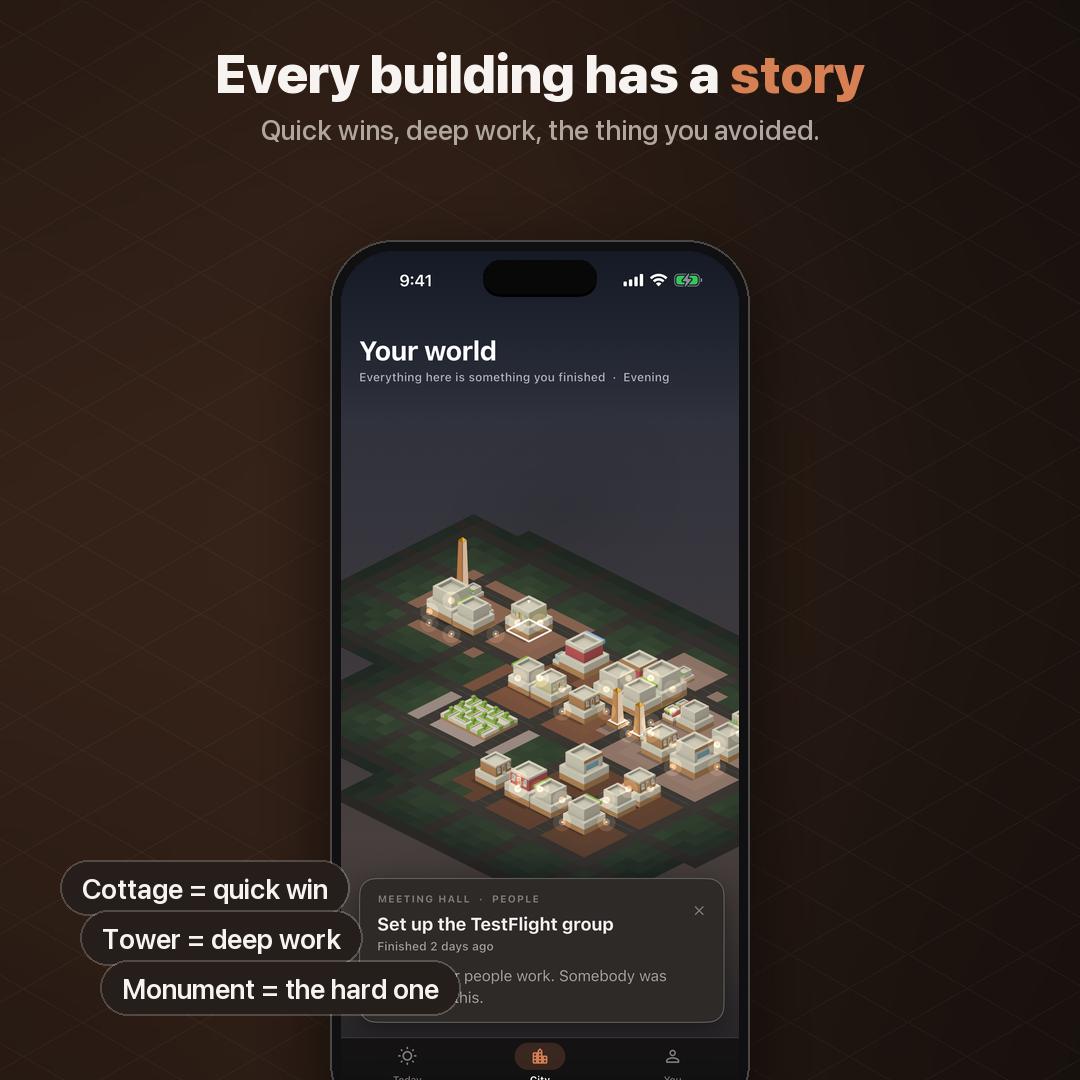
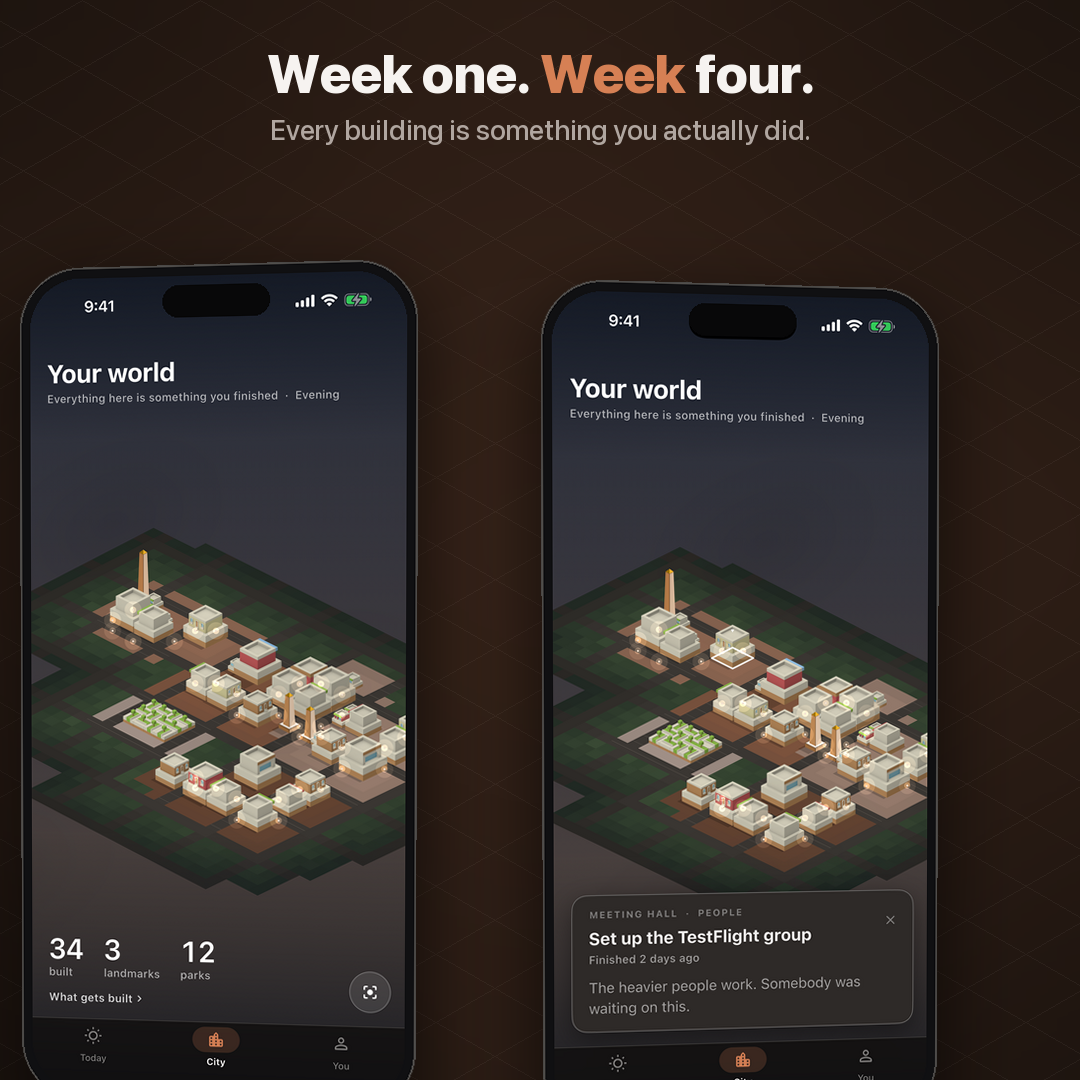
Every building has a story
-
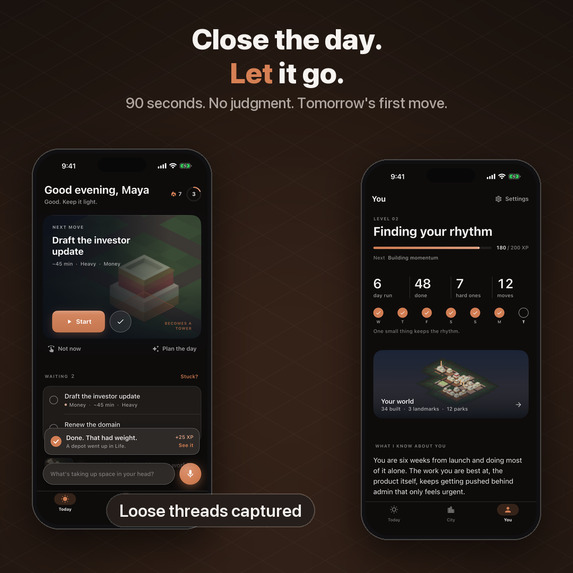
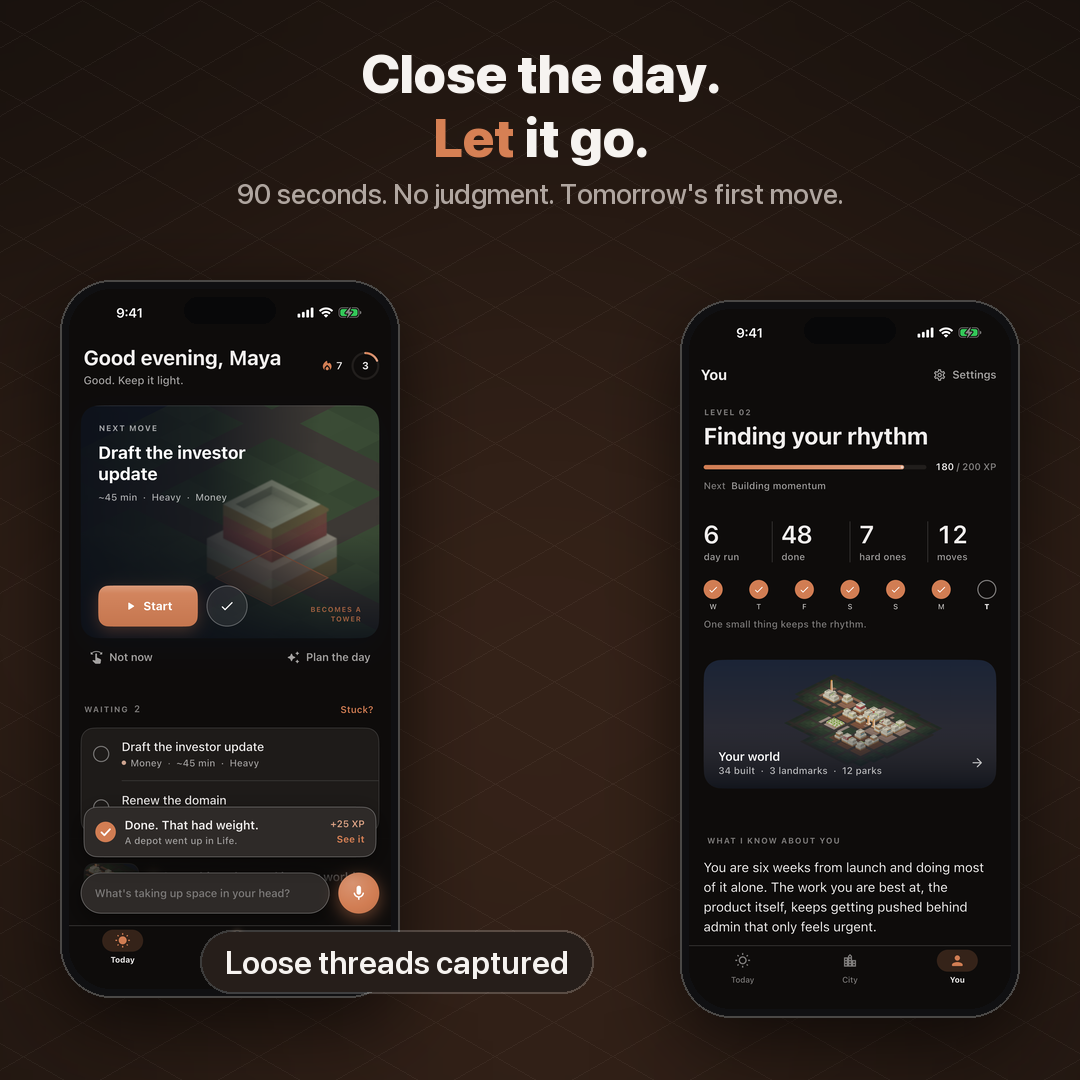
Choose the day and let it go
-
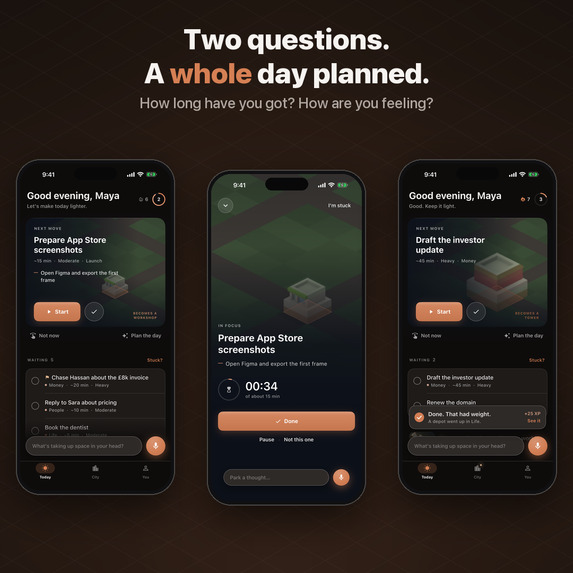
2 questions a whole day planned
-
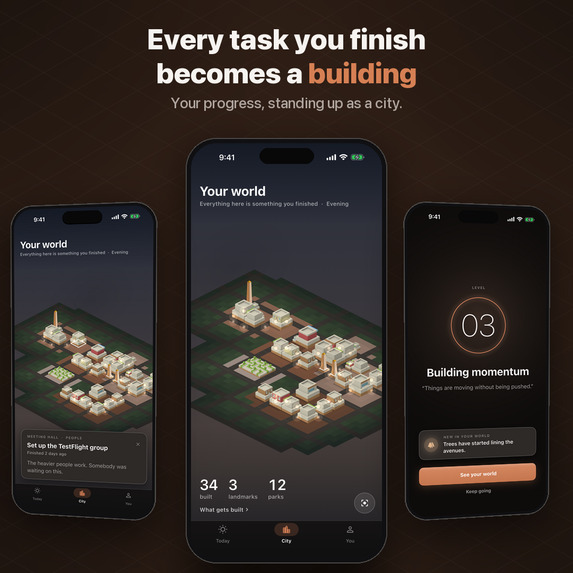
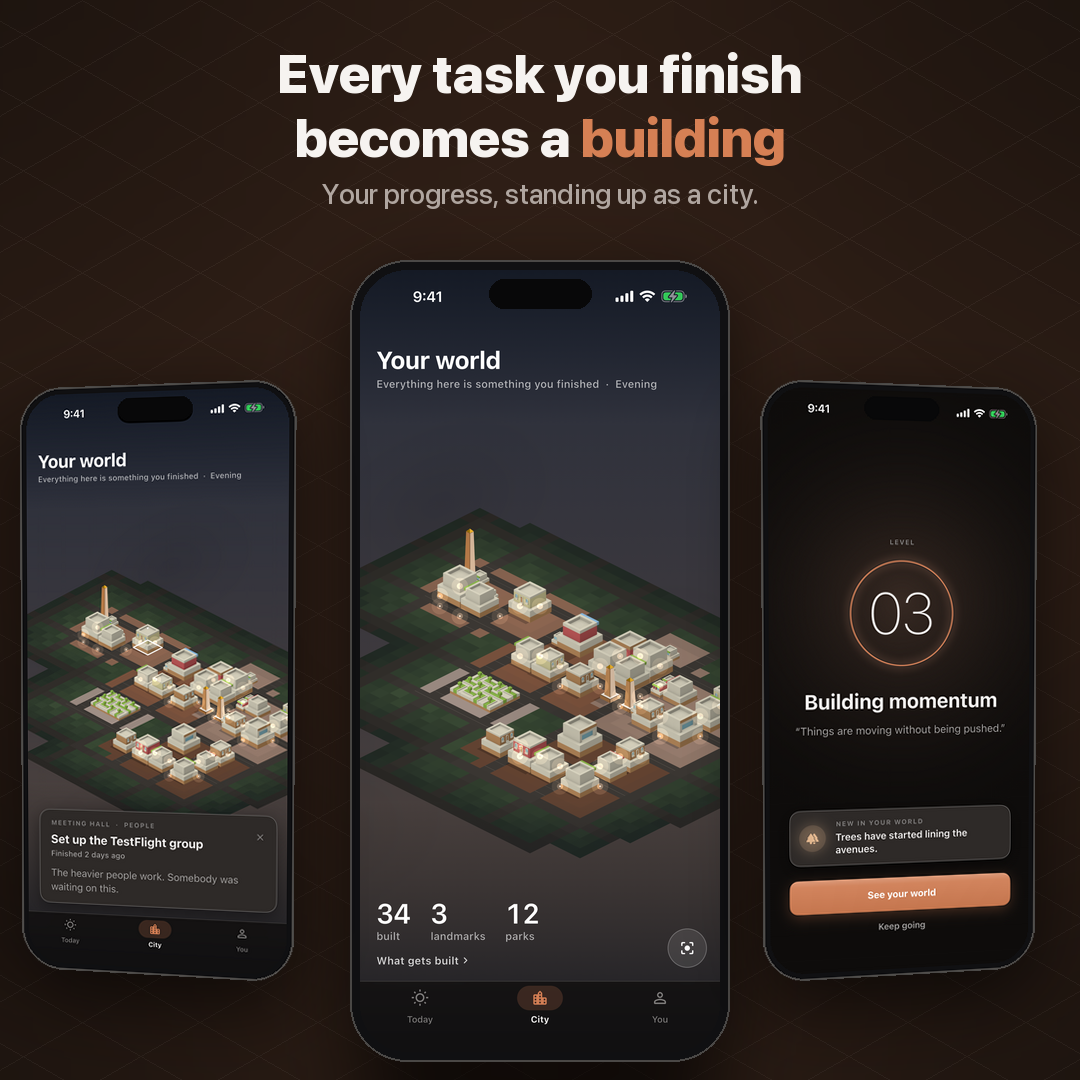
Every task you finish becomes a building
-
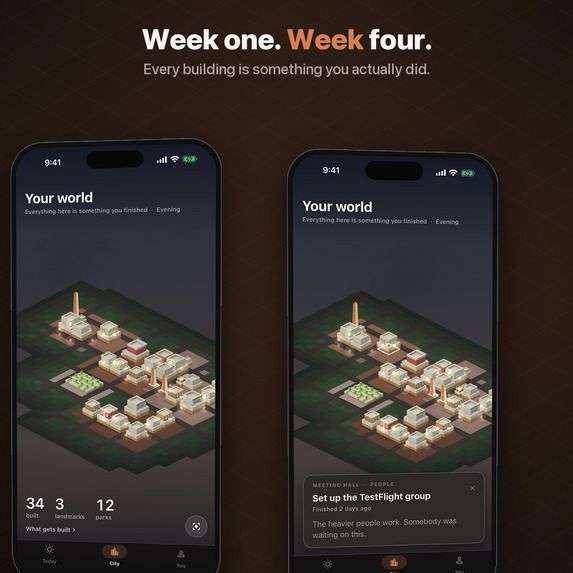
See real progress
-
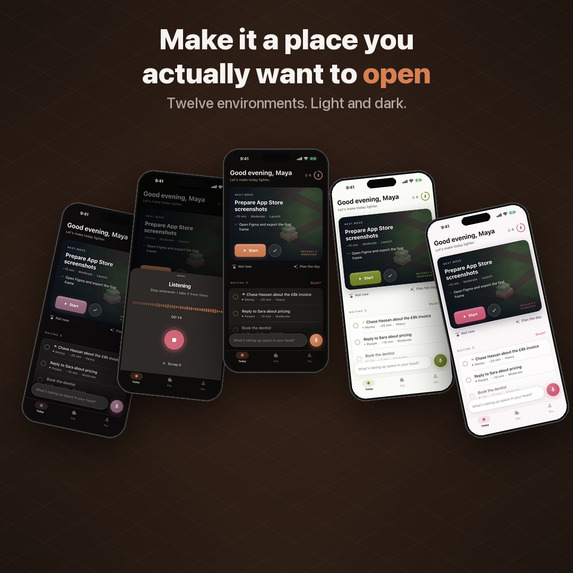
Making it place you actually want to open
Inspiration
Running a company with ADHD is expensive in a way nobody sees. The hard part isn't doing the work — it's holding the whole system in your head, deciding what matters today, and actually getting started.
Every productivity tool we tried made this worse. They each demanded more decisions up front — pick a bucket, set a priority, choose a due date — which is exactly the tax an ADHD brain can't pay. So the task never gets captured, the app gets closed, and nothing is organised.
We wanted the opposite: an app you just talk to, that takes all the organising off you. You ramble for two minutes; it hands back an ordered, startable day.
What it does
You talk about your life, your goals, and everything on your plate. BrainHD transcribes it and builds a working model of you — your goals, constraints, energy patterns, the people and projects in your world, and what you've been avoiding. From then on:
- Capture is one tap, zero decisions. Say "call Mike about the demo" and it comes back filed in the right area, sized by effort, prioritised against your real goals, and with a first physical step small enough to actually start.
- It screens for ADHD. A 20-question check whose clusters and counting rule follow the DSM-5 criteria — shown as a screening tool, never a diagnosis — and the result only tunes how hard the app pushes you.
- It plans your day from two questions (how long, how you're doing), and deliberately fills at most 70% of your time — so you finish early and come back tomorrow instead of failing and quitting.
- It rescues you when you freeze. A "Stuck?" ladder asks for one tap at a time: regulate → shrink the task → a 5-minute contract → or permission to stop.
- Finishing feels like something. Every completed task builds a building on an isometric world. Three months of work you can't remember doing looks, from above, like a city.
How we built it
- Client: Flutter (Riverpod + go_router) — one codebase on iOS, Android and macOS.
- Backend: Firebase Cloud Functions (TypeScript), built on one hard rule — a founder with ADHD will not wait. So the app never awaits a network call; it only ever writes a Firestore document, and every AI job runs as a server-side trigger. The write lands in local cache on the same frame as the tap (instant UI), and the trigger runs on Google's infrastructure even after the app is closed (durable).
- AI: OpenAI for speech-to-text and translation; Anthropic's Claude for the analysis, with structured outputs validated by Zod so responses match an exact schema. The founder context is sent as a cached system block to cut cost on repeat captures.
- Trust: XP, streaks and the synthesised context are all server-written and read-only on the client, enforced by Firestore rules. API keys live in Secret Manager and never touch the app bundle.
The processing pipeline is simply:
$$ \text{voice} \;\xrightarrow{\text{OpenAI STT}}\; \text{transcript} \;\xrightarrow{\text{translate}}\; \text{English} \;\xrightarrow{\text{Claude}}\; \text{structured context} \rightarrow \text{tasks} $$
And XP is scored by executive effort, not clock time — a dreaded 10-minute call costs more than an hour of formatting:
$$ \text{XP} = w_{\text{effort}} \cdot f_{\text{difficulty}} + b_{\text{avoided}} $$
where $b_{\text{avoided}}$ is a large bonus for finally doing the task you'd been dodging.
Challenges we ran into
- Making it feel instant for a user who closes the app the second they stop talking — solved by writing first and processing in triggers, never awaiting.
- Real speech is messy. We had to handle pause-and-resume mid-recording, non-English dumps (translated before analysis), and proper nouns — which speech-to-text reliably gets wrong — surfaced for one-tap correction and then remembered, so the same name is never asked about twice.
- A reward loop without shame. No overdue-red, no guilt copy, no badges that climb while you're away. Shame is the emotion that makes a founder close the app for good.
What we learned
The best accessibility features for ADHD look like tiny UX details — plans that underfill, "in a bit" counting as a real answer, a rescue ladder that actually ends — but they are the real product, not polish. And an AI app wins by removing decisions, not by bolting on a chatbot.
What's next
Device-level polish (home-screen widgets, lock-screen check-ins), a shared "team brain" for co-founders, and a validated clinical pathway for the screening flow.## Inspiration
What it does
How we built it
Challenges we ran into
Accomplishments that we're proud of
What we learned
What's next for BrainHD · ADHD Planner
Built With
- anthropic-claude
- cloud-firestore
- dart
- firebase
- firebase-functions
- flutter
- openai
- riverpod
- typescript
- whisper
- zod

Log in or sign up for Devpost to join the conversation.