-
-
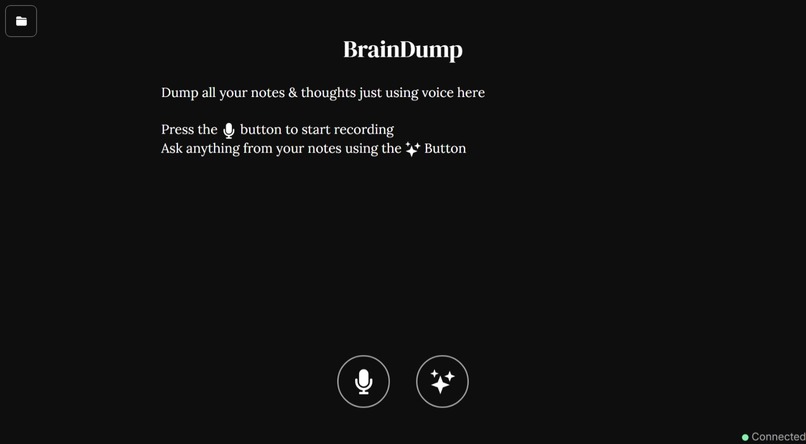
HomePage
Inspiration
Braindump was inspired by the need for a tool that helps people capture and organize thoughts, ideas, and important information effortlessly. In our busy lives, valuable insights and notes can often be lost or forgotten, leading to scattered knowledge. Braindump aims to solve this by providing a seamless way to record, transcribe, and store spoken thoughts as searchable notes, empowering users to retain and revisit important information whenever needed. What it does
Braindump records your spoken words, transcribes them into text, and securely stores them for easy reference. It includes a powerful search function, allowing users to quickly find specific information within their notes. This makes Braindump a useful tool for capturing ideas, organizing thoughts, and improving overall productivity. How we built it
Braindump was developed with a combination of modern web and AI technologies:
Next.js powers the frontend, providing a fast, intuitive user interface.
IndexedDB is used for client-side storage, allowing users to access notes offline and enhancing app performance.
MongoDB serves as the database for centralized storage, ensuring scalability and reliable data management.
FastAPI was chosen for the backend, efficiently handling API requests and providing high performance.
LangChain simplifies and optimizes natural language processing workflows, enhancing the transcription and search functionalities.
Gemini provides the language model capabilities, delivering accurate transcription from voice to text.
Challenges we ran into
Several challenges emerged during Braindump’s development:
Achieving high transcription accuracy was difficult, especially given the variability in accents and speaking speeds.
Managing efficient storage and retrieval of notes was technically demanding, particularly when supporting both local and server storage.
Data synchronization between client storage (IndexedDB) and server storage (MongoDB) presented complexities, especially for offline use.
Ensuring real-time performance required optimization across both frontend and backend processes to prevent lag during transcription.
Accomplishments that we're proud of
We’re particularly proud of:
Achieving accurate real-time transcription, making Braindump a reliable tool for capturing spoken ideas and thoughts.
Implementing seamless search functionality, allowing users to locate specific information within their notes quickly and efficiently.
Supporting offline functionality through IndexedDB, enabling users to record and review notes without internet access.
Creating an intuitive and user-friendly interface, making Braindump accessible and appealing to users of all backgrounds.
What we learned
This project provided valuable insights into:
Speech-to-text technology, including real-time audio processing and natural language processing techniques.
Database management and synchronization, particularly in handling client-server data sync for consistent data integrity and availability.
Working with modern tech stacks like Next.js, FastAPI, and LangChain, each of which brought unique strengths to the project.
The importance of user-centric design, as we focused on building an interface that combines simplicity with powerful functionality.
What's next for Braindump
Our future plans for Braindump include:
Expanding language support to make Braindump accessible to a broader, global audience.
Integrating AI-powered summarization to condense notes, making it easier for users to quickly review key points.
Adding voice command features to enable users to control recording, saving, and searching through voice alone.
Enhancing cross-device syncing to allow users seamless access to their notes across multiple devices.
Built With
- deepgram
- fastapi
- google-gemini
- langchain
- mongodb
- nextjs
- python
- render
- typescript
- vercel

Log in or sign up for Devpost to join the conversation.