Inspiration
Every new agency, software provider, or AI tool asks a merchant to explain the business from scratch. Products, policies, catalog quirks, customer objections, brand voice, edge cases, and strategic priorities all get repeated over and over again. That setup work is slow, messy, and usually trapped in one operator’s head.
We kept coming back to the same pain point: merchants can spend tens or even hundreds of hours getting new vendors properly onboarded before the output becomes useful. As more of those vendors become AI-driven, bad or stale context does not just waste time, it creates bad recommendations and bad autonomous actions.
We built Brainbox to give e-commerce brands a company brain they can keep for themselves, then instantly share with every vendor, tool, and AI system they work with.
What it does
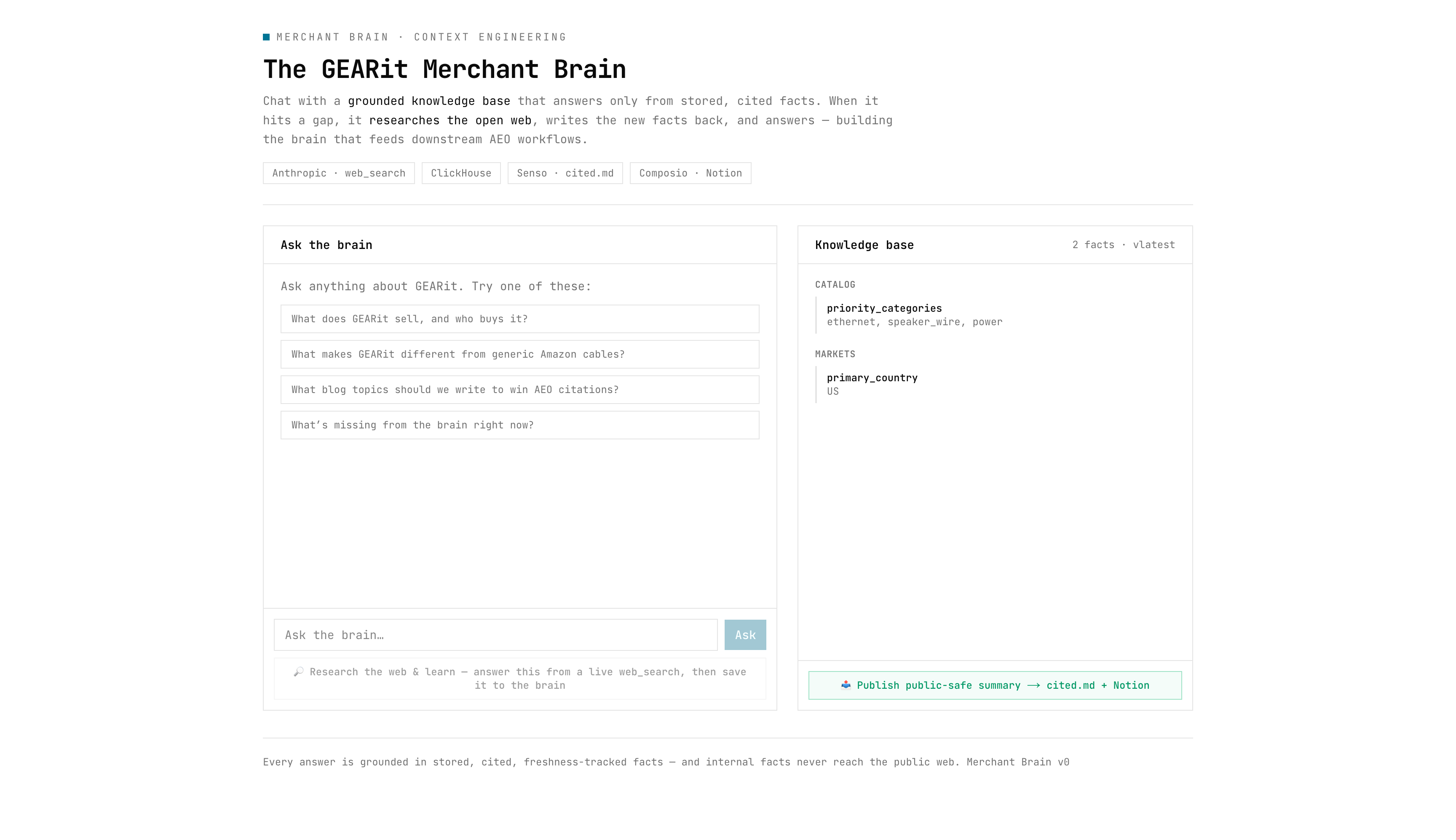
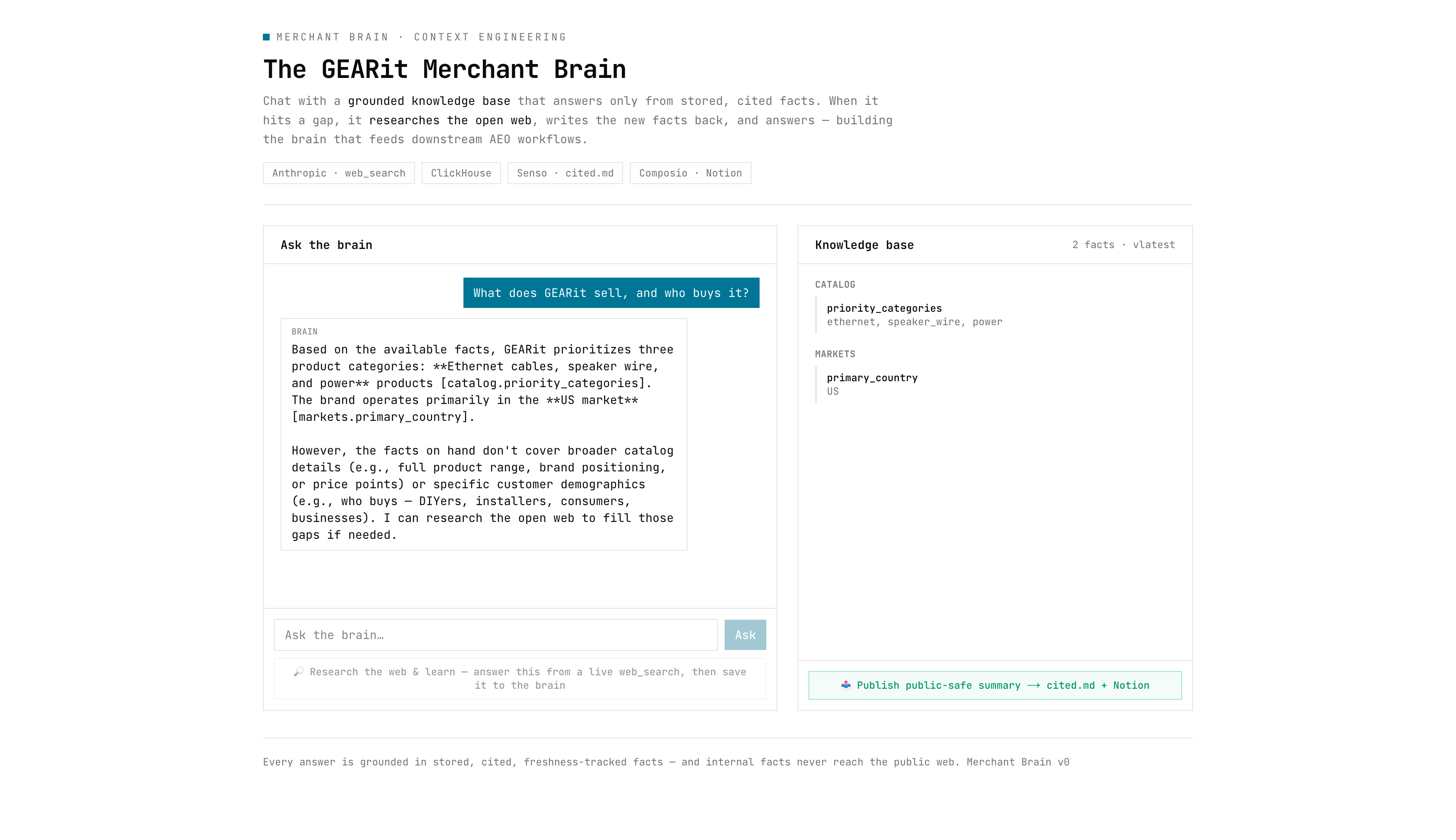
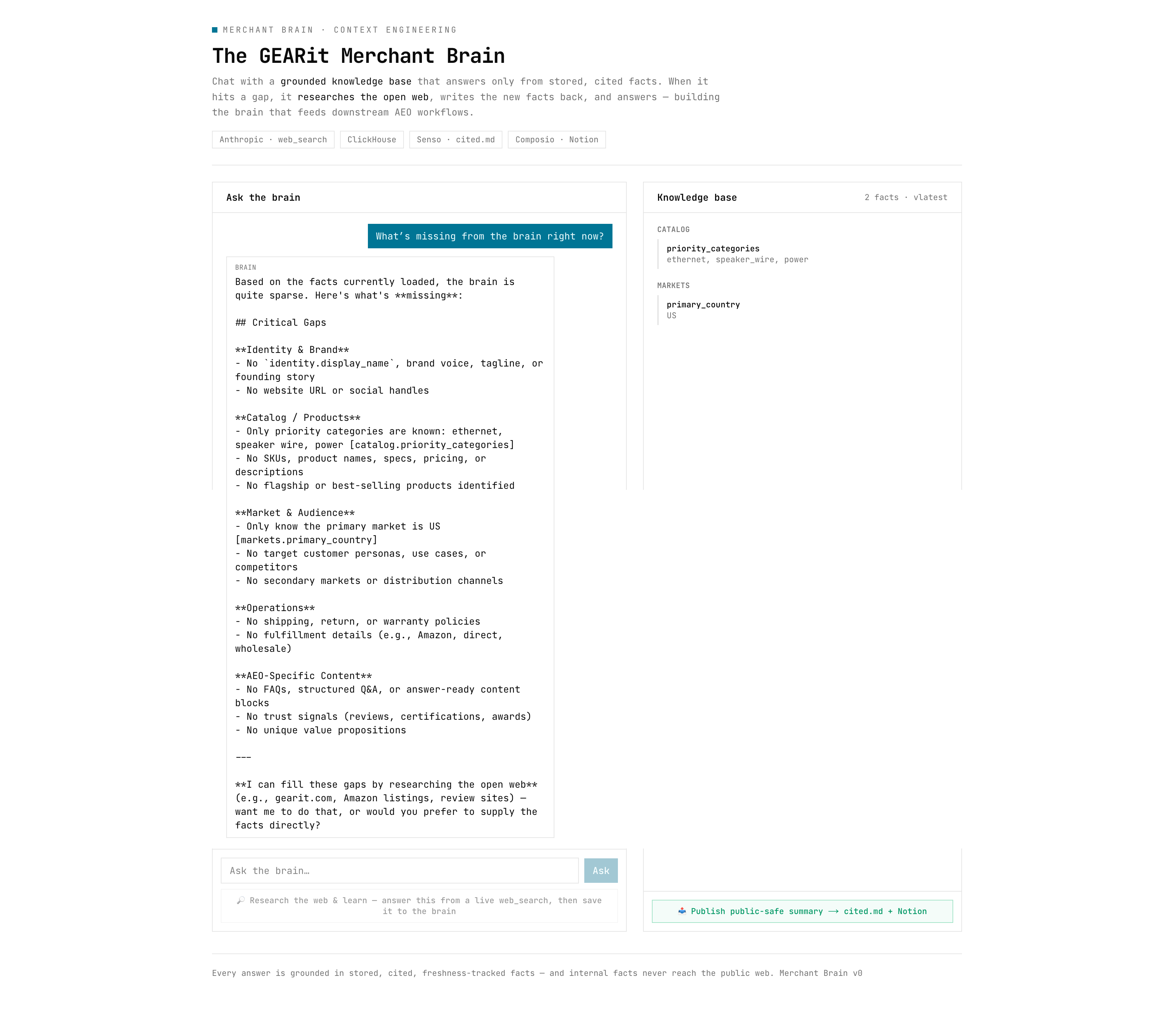
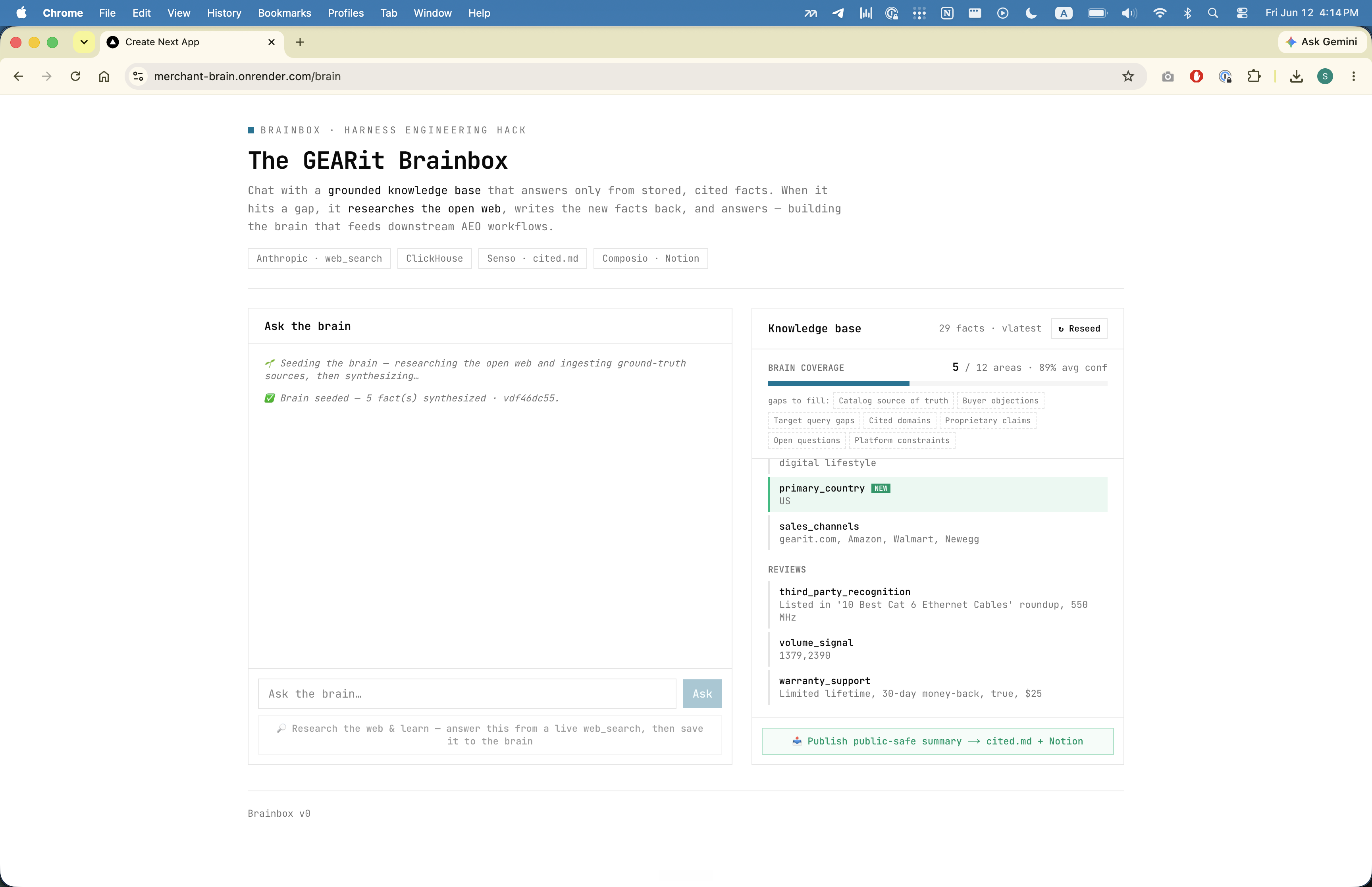
Brainbox is a vendor-ready company context layer for e-commerce brands. It ingests merchant data and workflow artifacts, extracts structured observations, detects contradictions, and turns scattered business knowledge into a live, evidence-backed source of truth.
Instead of forcing every downstream workflow to rebuild context from scratch, Brainbox generates purpose-specific context bundles for things like content generation, citation analysis, schema optimization, and catalog or feed workflows. Every important claim keeps a trace back to its source, so operators can see what changed, why it changed, and whether a fact is fresh, stale, conflicted, or operator-locked.
In practice, that means merchants can package their context once, keep it updated over time, and hand the right version to every external partner or AI system immediately.
How we built it
We built Brainbox as a Next.js application with a structured merchant memory system behind it.
At a product level, Brainbox has two core layers:
- An evidence layer that stores source artifacts and workflow outputs.
- A canonical brain layer that turns those inputs into structured merchant facts with provenance, freshness, confidence, and conflict handling.
At the technical level, we used Anthropic for reasoning and structured extraction, ClickHouse for merchant memory and event history, Composio for external tool connectivity, and Senso/cited.md for grounded, source-linked outputs. We deployed the app on Render.
For the hackathon demo, we focused on the core loop:
• ingest merchant source artifacts • extract structured observations • update the canonical company brain • detect and surface conflicts • resolve important decisions with operator review • generate a workflow-specific context bundle • publish a grounded output with source traceability
Challenges we ran into
The hardest part was not summarization, it was truth maintenance. Merchant context changes constantly, and different sources often disagree with each other. A website crawl, a catalog export, and an operator decision log can all tell slightly different stories.
That forced us to solve for provenance, freshness, conflict handling, and operator review instead of building a generic memory blob. We also had to keep the system useful for downstream workflows, rather than just generating a nice-looking summary.
Accomplishments that we're proud of
We are proud that Brainbox feels like a real product, not just a hackathon wrapper around an LLM. The system maintains structured merchant knowledge, preserves source traceability, surfaces contradictions, and produces context bundles that downstream workflows can actually use.
We are also proud that the project reframes a very real operational pain point: every AI vendor wants to be the brain, but merchants need a brain they own themselves.
What we learned
We learned that context is not just a prompt problem, it is a systems problem. If merchant knowledge is fragmented, stale, or unverified, every downstream AI workflow becomes less reliable. We also learned that the most valuable memory systems are not the ones that remember the most. They are the ones that know what is current, what is contested, and what should never be overwritten silently.
What's next for Brainbox
Next, we want to expand Brainbox from a hackathon demo into a full merchant context infrastructure layer. That means deeper source ingestion, richer live connectors, better operator review flows, more workflow-specific context bundles, and broader support for the agencies, software vendors, and AI systems merchants use every day.
Longer term, we think Brainbox can become the operational source of truth that sits underneath every AI-driven workflow in e-commerce.
Built With
- anthropic
- clickhouse
- composio
- next.js
- notion
- react
- render
- senso/cited.md
- tailwind-css
- typescript

Log in or sign up for Devpost to join the conversation.