Inspiration
We recognized that many aspiring entrepreneurs and innovators struggle to fully develop and validate their ideas. Often, people have great initial concepts but lack a structured way to explore them from multiple critical angles — technical feasibility, market fit, business viability, and risk assessment. We wanted to create an AI-powered tool that helps users think through their ideas comprehensively by simulating expert perspectives.
What it does
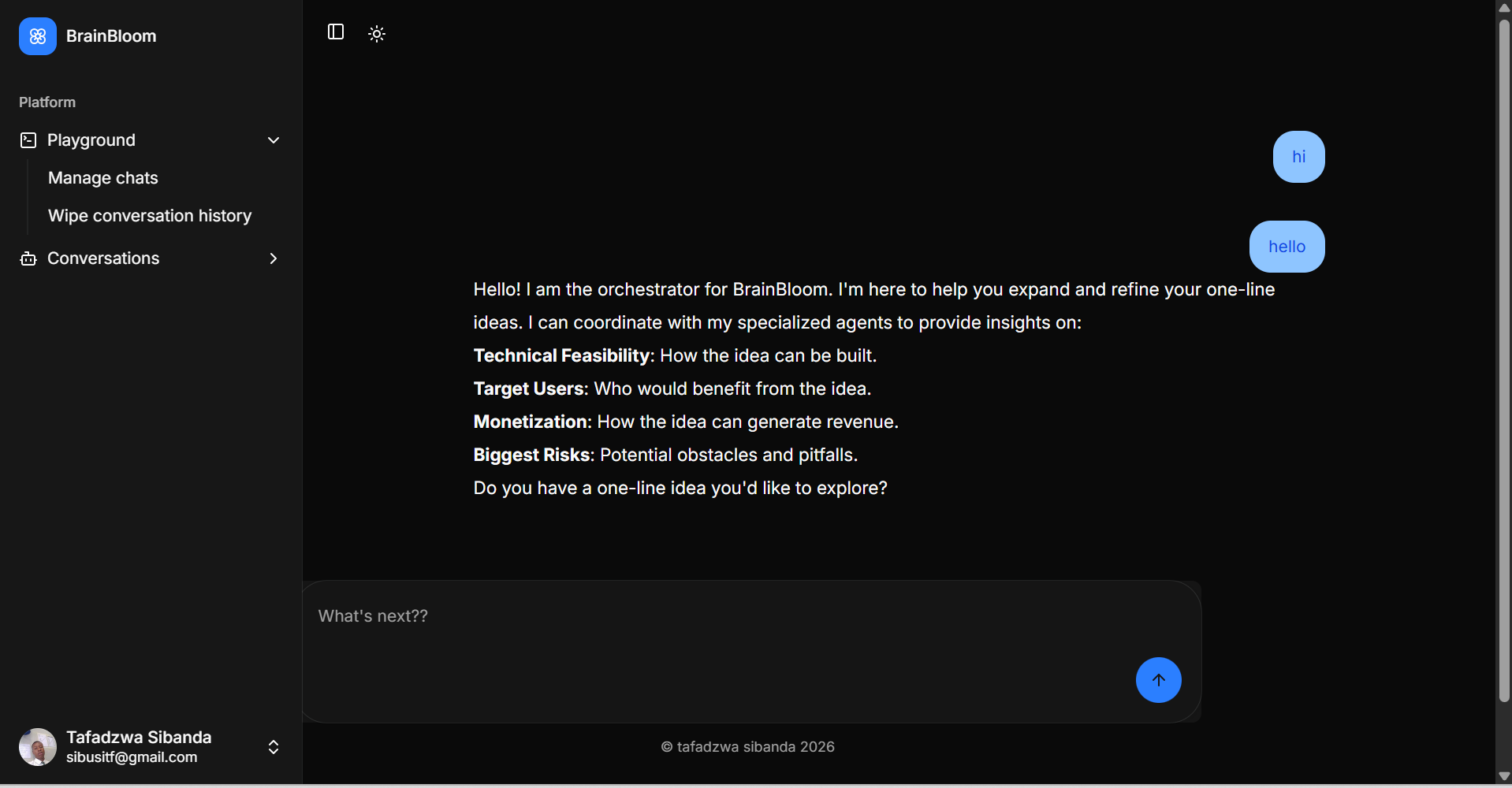
BrainBloom is an AI-powered idea expansion agent that helps users develop and validate their concepts by analyzing them from five different expert perspectives. When users input an idea, the system:
- Assesses technical feasibility — can this idea actually be built?
- Identifies the target user/market — who would want this solution?
- Explores monetization strategies — how can this create value and generate revenue?
- Analyzes biggest risks and challenges — what could go wrong?
- Synthesizes all perspectives through an orchestrator agent for comprehensive feedback
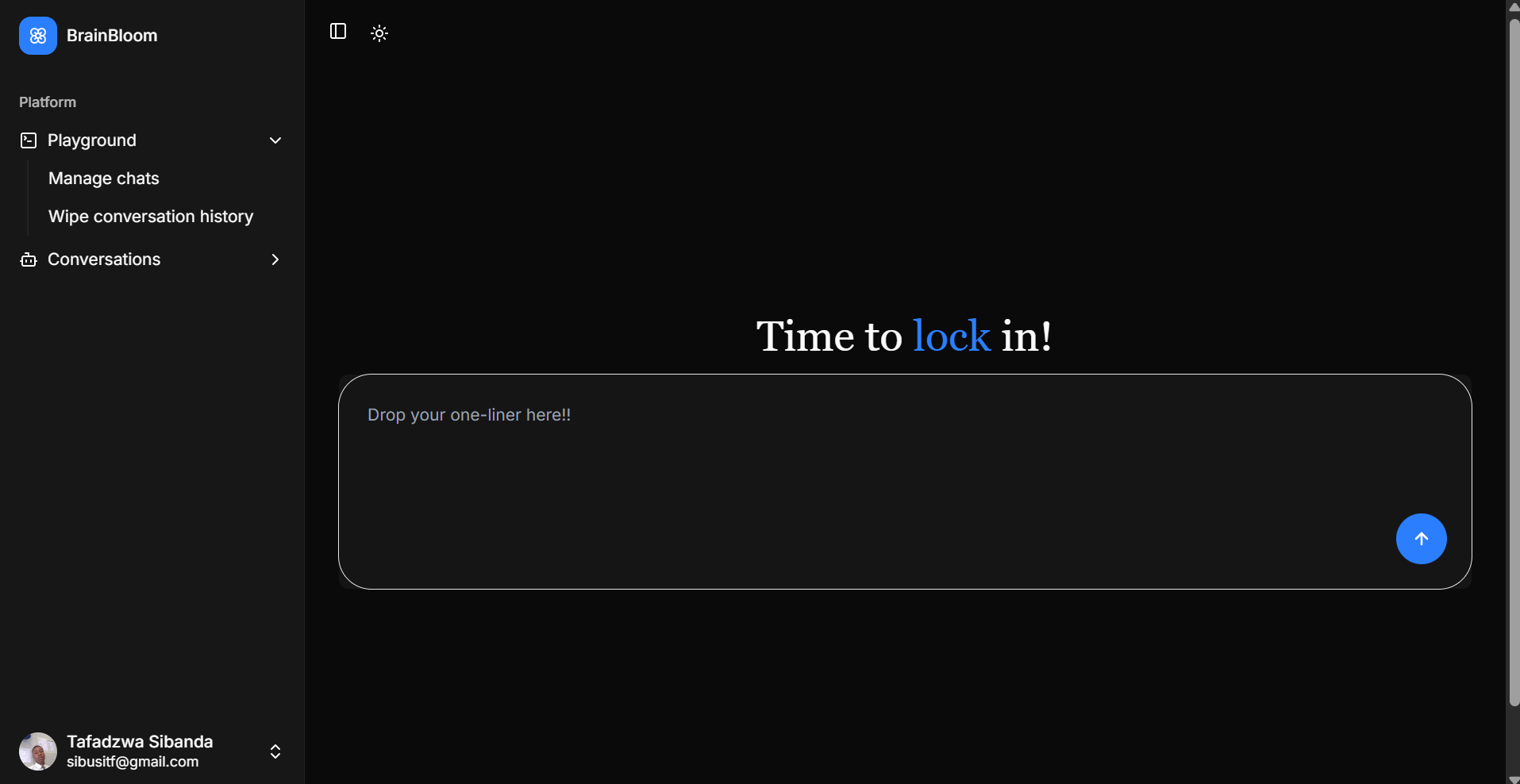
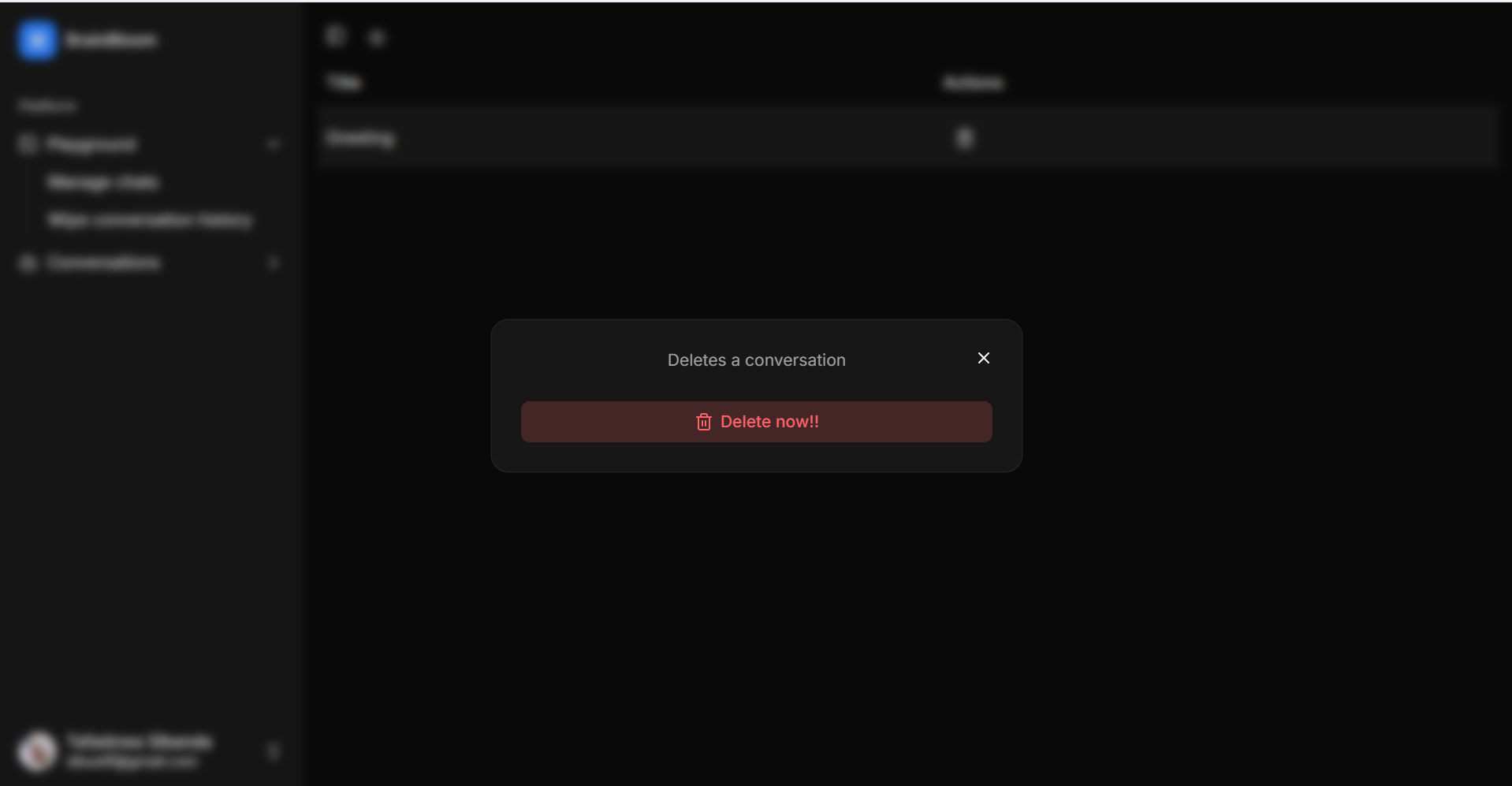
The application provides a conversational chat interface where users can iteratively refine and explore their ideas with AI-powered insights.
How we built it
Backend:
- Multi-agent architecture using LlamaIndex with specialized ReAct agents
- Google GenAI as the LLM backbone
- FastAPI server for the agent workflow engine
- SQLite for conversation history and memory persistence
- Each agent has specific system prompts optimized for its domain
Frontend:
- Next.js 16 with TypeScript for a modern, responsive UI
- React for component-based architecture
- Tailwind CSS for styling with custom theming
- Better Auth for user authentication
- Drizzle ORM with Neon serverless database for persistent data storage
- Real-time chat interface with markdown support
Infrastructure:
- Modular design separating agent logic, tools, and prompts
- User session management to track conversation history
- Responsive design for desktop and mobile
Challenges we ran into
- Multi-agent coordination — Designing the agent handoff system where the orchestrator agent efficiently delegates to specialists without creating circular loops
- Context preservation — Maintaining conversation context across multiple agent interactions while keeping responses relevant and concise
- LLM consistency — Ensuring each specialized agent stays focused on its domain while providing actionable insights
- Frontend-backend integration — Managing real-time communication and streaming responses from the FastAPI backend to the Next.js frontend
- Database schema design — Structuring the database to efficiently store ideas, conversations, and multi-perspective analyses
- User authentication — Implementing secure user sessions while maintaining agent session isolation
Accomplishments that we're proud of
- Elegant multi-agent architecture — Built a clean handoff system where 5 specialized agents collaborate to analyze ideas comprehensively
- Intelligent prompt engineering — Crafted domain-specific prompts that make each agent an expert in its field
- Full-stack integration — Successfully connected a sophisticated Python backend with a modern Next.js frontend
- User-friendly interface — Created an intuitive chat-based UX that makes complex idea analysis feel natural and conversational
- Scalable design — Architected the system to easily add new specialized agents or tools without refactoring core logic
- Production-ready infrastructure — Implemented proper authentication, database persistence, and session management
What we learned
- Agent specialization works — Breaking down complex analysis into specialized agents produces higher-quality, more focused insights
- Context is crucial — The memory and session management system is as important as the AI models themselves
- Prompt engineering is an art — Small differences in prompts significantly impact agent behavior and output quality
- User experience matters — A good UI/UX can make complex AI systems feel simple and powerful
- Python-to-TypeScript integration — FastAPI and Next.js create a powerful, maintainable full-stack combination
- Iterative refinement — Users want to build on AI feedback, so conversational history and context continuity are essential
What's next for BrainBloom
- Enhanced tool integration — Add web search, market research APIs, and financial data tools to provide real-time market insights
- Export and sharing — Allow users to export idea analyses as documents or share them with collaborators
- Idea templates — Provide pre-built frameworks for specific industry verticals (SaaS, Hardware, Nonprofits, etc.)
- Collaborative analysis — Enable teams to work on ideas together with real-time collaboration
- Analytics dashboard — Track how many ideas progress to execution and measure success metrics
- Mobile app — Native mobile applications for iOS and Android
- API exposure — Offer BrainBloom as an API for other products to integrate idea analysis
- Agent customization — Allow users to customize agent focuses or add domain-specific agents for their use case
Built With
- llamaindex
- next.js
- python
- react.js
- typescript
