-
-
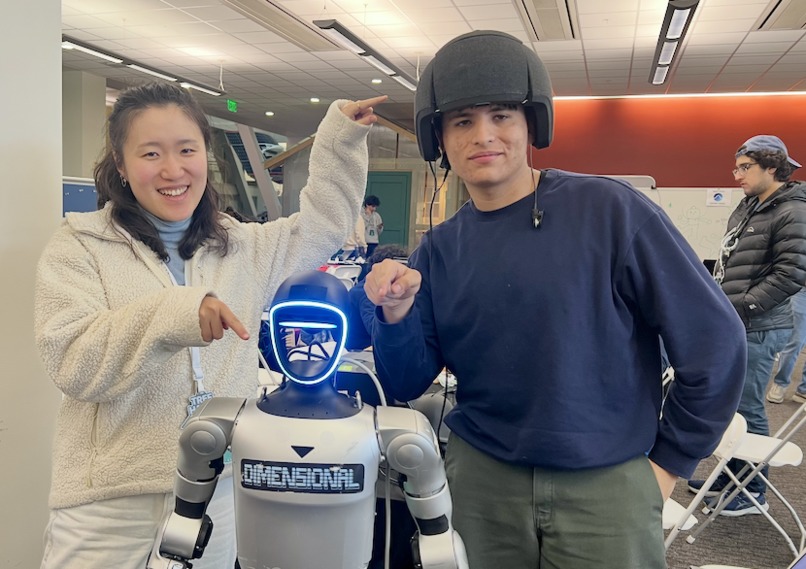
Brain to Humanoid
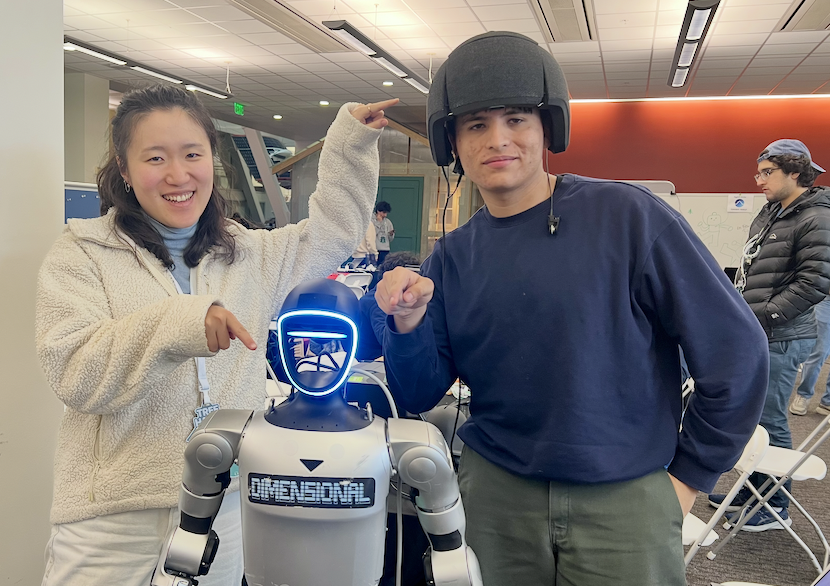
Brain to Humanoid
Last night, we trained an AI model that connects your brain directly to a humanoid — translating neural activity into real-time instructions like walk, turn, stop, or raise a hand for a wave or a kiss. Now imagine scaling that same interface to operate 1,000 humanoids in disaster zones clearing debris or across manufacturing floors adapting instantly to human judgment.
This is no longer science fiction. We proved that non-invasive, multimodal brain signals (EEG + NIRS) can be rigorously preprocessed, decoded with a real-time 50Hz transformer, and executed in closed-loop robotic control. Building and connecting these futuristic technologies is hard — brain recordings require disciplined preprocessing, multimodal signals demand careful synchronization and handling, compute is constrained, and while our model accuracy is an awesome starting point, there’s serious hill-climbing ahead.
Along the way, we learned that the breakthrough is not just in the model architecture, but in mastering the full system: cleaning noisy neural data, aligning intent labels precisely in time, designing stable real-time inference, and balancing latency with robustness. Brain-to-humanoid control is a systems problem — and solving it requires thinking beyond accuracy toward reliability, scalability, and human-centered design. But that’s exactly the point. Brain-to-humanoid control is no longer science fiction — it’s the foundation for pairing artificial intelligence with real intelligence at scale.
Next, we deploy this interface to more tasks, expand across diverse robot fleets, and take this platform-agnostic control layer from one humanoid to many — across disaster response, manufacturing, logistics, and beyond. If one human can supervise 1,000 robots with intent alone, then one day, I should be able to simply go on a walk with my robot dog. From brain to humanoid — at the speed of thought.


Log in or sign up for Devpost to join the conversation.