Inspiration
We started with a simple question: what if touch could carry language as easily as sight and sound? In classrooms, on factory floors, at checkpoints, and in disaster zones, eyes and ears are often busy or overwhelmed. People who are blind or low-vision still fight paper barriers every day. Teams that need silence still rely on clumsy signals. We set out to turn information into touch in a fast, private, and affordable way.
What it does
BrailleSense is a glove that converts text or short messages into precise fingertip vibrations as Braille or two finger Morse, letting the wearer feel menus, forms, captions, alerts, or pre shared cues without looking down, taking out a phone, or making a sound. It works offline, runs on commodity parts, and switches modes instantly. It supports accessibility by letting people read and practice Braille anywhere, enables silent communication with discreet cues for field operations, search and rescue, backstage, and control rooms, provides hands busy alerts as glance free prompts for technicians, cyclists, and factory workers, and helps with travel and language by scanning foreign text on demand and outputting it in Braille.
How we built it
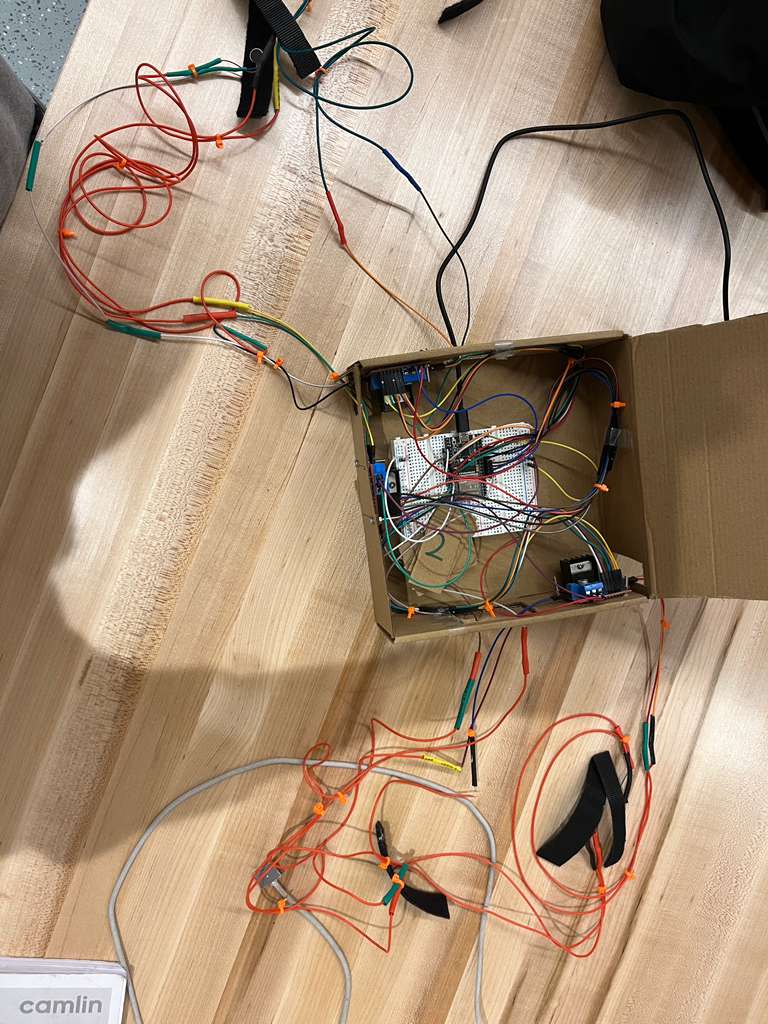
BrailleSense uses a haptic glove where an ESP32 drives six fingertip vibration motors through L298N drivers, and each pulse follows a kick and hold PWM profile so dots feel crisp yet comfortable. The message pipeline is simple: the ESP32 accepts plain serial commands MODE B or MODE M, then SEND followed by your text. An optional vision and OCR module uses a Raspberry Pi with a NoIR camera to capture a page, boost contrast with OpenCV, recognize text with Tesseract, and stream it to the glove, and it also works without the camera for typed or preloaded messages. For safety and power, the motors run on a separate five volt rail with large capacitors while the Pi, ESP32, and driver share ground, and we cap duty cycle and add rest gaps to prevent fatigue.
Challenges we ran into
We fixed power issues first. Early tests reset the controller when motors surged, so we separated the power rails and added large capacitors to stabilize everything. Next we focused on feel rather than just buzz. Many patterns were muddy at first, so we tuned duty, duration, and gaps until dots and dashes were unmistakable. Finally we improved OCR reliability. Lighting and angle mattered a lot, so we used adaptive thresholding and a simple camera mount to keep pages flat and bright, which made recognition dependable for demo texts.
Accomplishments that we're proud of
We built a working end to end system where text goes in and tactile language comes out in seconds. The same glove supports dual mode haptics, Braille and Morse, with instant switching. Every component comes from the hackathon list, which makes the build repairable, reproducible, and low cost. Most importantly, the demo is self explanatory, place a page or type a word and the glove speaks in touch.
What we learned
Tactile user experience is a craft, milliseconds matter, as do finger placement and rest timing. Privacy by default matters too, offline pipelines earn trust in classrooms and field operations. Simplicity wins, clear serial commands and modular hardware let us move fast and invite schools and makers to build on the platform.
What's next for BrailleSense
We will add on-device language detection and translation packs with Braille output. We will enable continuous reading with line tracking and a tactile cursor. We will ship educator tools to push lessons to many gloves and track progress. We will design a slim enclosure with a battery for all day wear. We will publish an open kit so schools and community labs can build their own at cost.

Log in or sign up for Devpost to join the conversation.