BrailleEase – Turning Touch into Understanding
Inspiration
Braille remains one of the most important tools for literacy, independence, and communication among visually impaired individuals. However, many caregivers, teachers, volunteers, and family members are unable to read Braille, creating barriers to communication and access to information.
We were inspired by the idea of making Braille more accessible to everyone. Rather than treating Braille as a specialized language understood by only a few, we wanted to create a solution that could bridge the gap between tactile communication and digital understanding. Our goal was to enable anyone with a camera-enabled device to interpret physical Braille quickly and intuitively.
What It Does
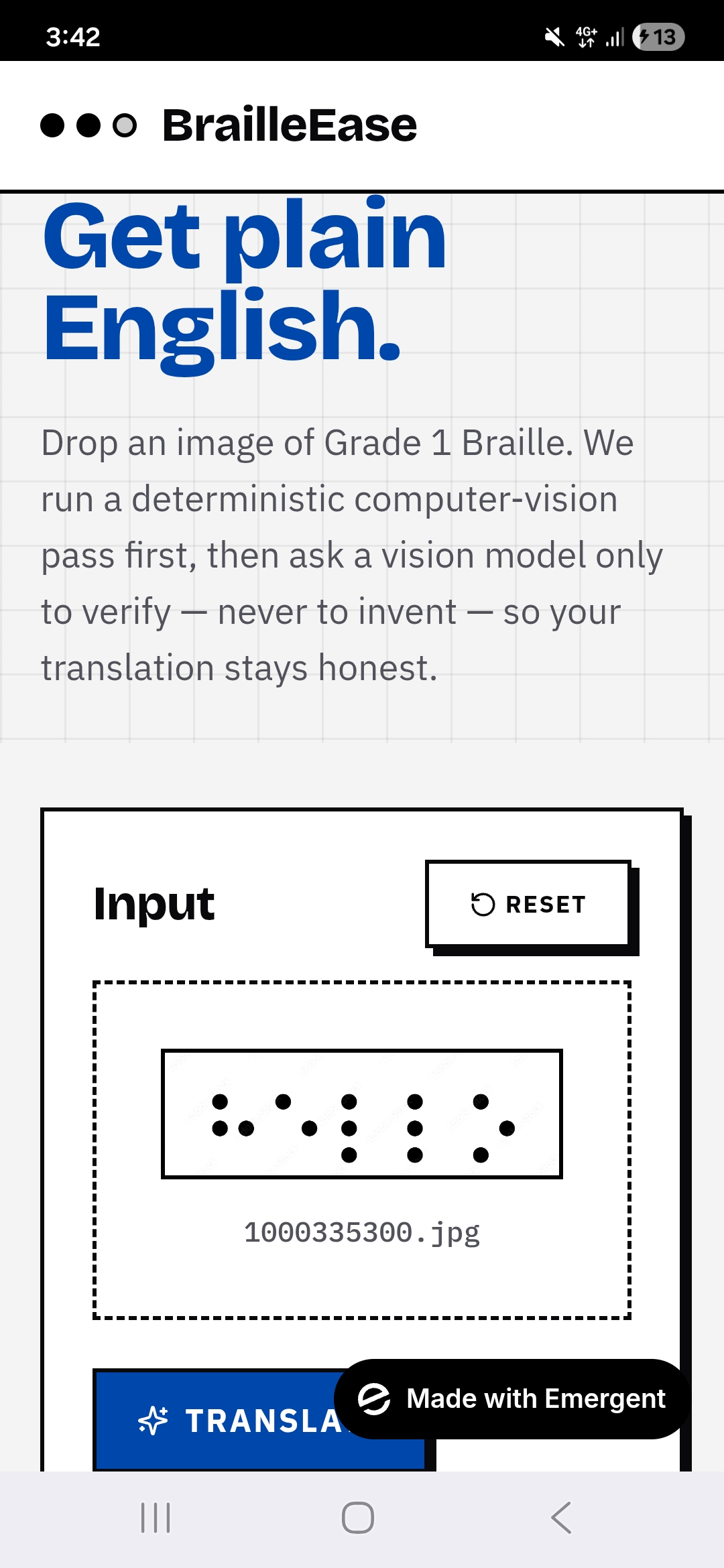
BrailleEase is an accessibility-focused platform that converts physical Braille into readable text and speech. Users can upload an image or scan Braille using a camera, and the system processes the image, identifies Braille patterns, translates them into English text, and provides spoken output.
The platform is designed for:
- Visually impaired individuals
- Caregivers and family members
- Teachers and educators
- Accessibility volunteers
- Schools and support organizations
By transforming Braille into text and audio, BrailleEase helps improve communication, learning, and accessibility.
How We Built It
BrailleEase combines computer vision, image processing, Braille decoding, and speech technologies into a unified accessibility platform.
The system follows a multi-stage recognition pipeline:
Image Input
     ↓
Image Preprocessing
     ↓
Braille Dot Detection
     ↓
Braille Cell Segmentation
     ↓
Pattern Recognition
     ↓
Braille Translation
     ↓
Text & Speech Output
We designed the application using a modern web architecture with responsive user interfaces, accessibility-focused design principles, and integrated AI-assisted image analysis. The platform supports image uploads, real-time processing, text extraction, confidence scoring, and speech synthesis to provide a complete end-to-end experience.
Special attention was given to usability, ensuring that users could interact with the system through simple workflows while still receiving detailed recognition results and accessibility support.
Challenges We Ran Into
One of the biggest challenges was handling the variability of real-world Braille images. Differences in lighting, image quality, shadows, camera angles, and Braille embossing styles can significantly affect recognition accuracy.
Another challenge was ensuring that the system remained accessible while still providing meaningful technical functionality. Balancing usability, performance, and recognition quality required continuous refinement of both the processing pipeline and the user experience.
Designing a solution that could communicate confidence levels and recognition results clearly to users was also an important consideration.
What We Learned
This project taught us that accessibility challenges require both technical innovation and human-centered design. We gained valuable experience in computer vision workflows, Braille recognition concepts, image preprocessing techniques, speech technologies, and accessibility-focused application design.
Most importantly, we learned that impactful technology is not simply about sophisticated algorithms—it is about creating tools that help people communicate, learn, and interact more effectively.
Future Improvements
Future versions of BrailleEase could include:
- Grade 2 Braille support
- Multi-language Braille recognition
- Offline mobile deployment
- Real-time video stream recognition
- Wearable device integration
- Enhanced camera guidance and alignment assistance
- Improved recognition accuracy through larger training datasets
BrailleEase represents a step toward a more inclusive future where information can be accessed and understood regardless of how it is presented.


Log in or sign up for Devpost to join the conversation.