Inspiration
Accessible signage often stops at a visual mockup. BrailleCraft started as an attempt to make the fabrication details inspectable by students and volunteers, from the braille translation itself to the physical dot spacing a finger will feel.
What it does
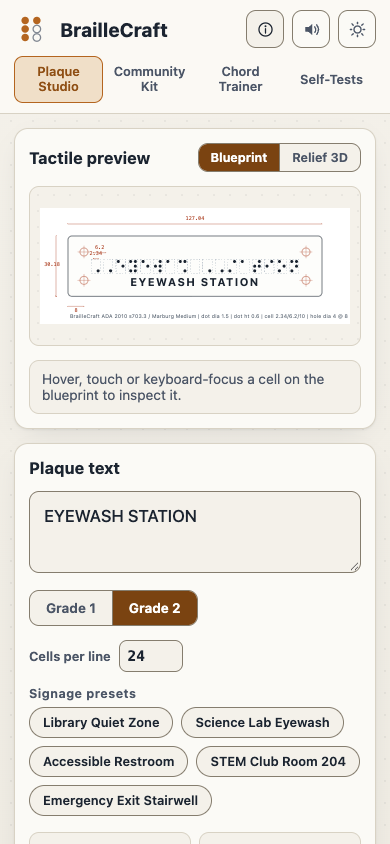
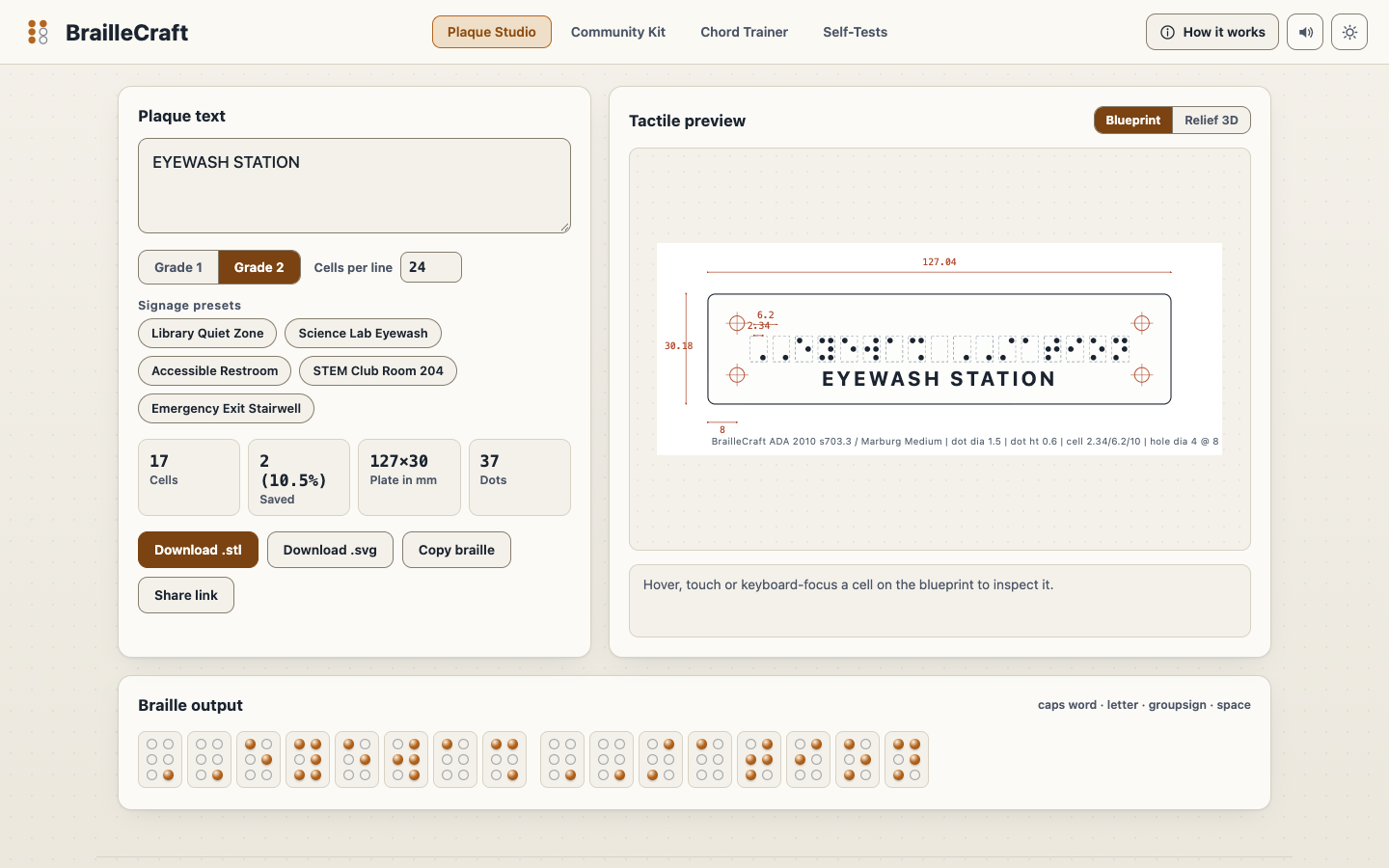
BrailleCraft is an offline tactile engineering studio. It translates text into Unified English Braille Grade 1 or contracted Grade 2, lays the cells out on an ADA-dimensioned tactile plaque, exports a watertight 3D-printable STL and a millimetre-true SVG blueprint, and teaches six-key Perkins chord entry. A community kit batches a hallway of signs into one volunteer print job with copy counts, a print-shop handoff sheet, and study cards. Everything runs client-side with no build step, CDN, font dependency, account, or network call.
How it was built
The project is a static HTML, CSS, and JavaScript application. Its UEB encoder carries source spans and rule metadata for every cell. Its geometry engine uses ADA and Marburg Medium measurements, including a 1.5 mm dot base, 0.6 mm dot height, 2.34 mm intra-cell pitch, 6.2 mm inter-cell pitch, and 10 mm line pitch. The STL exporter uses a shared vertex pool and is tested for watertight manifold output. The Perkins trainer uses the real F D S J K L key map and progressive lessons.
Verification and honest scope
AI coding assistants Devin and Claude helped write the code, tests, and documentation under Aariv Patel's direction. The product does not call an AI service at runtime. Fresh verification on November 27, 2026 passed 632 Node tests with zero failures. The in-page self-test button rechecks 35 UEB, ADA, STL, and kit invariants. BrailleCraft is a fabrication planning aid. Final signage should still be touch-checked by a braille reader and mounted according to local accessibility requirements.
