-
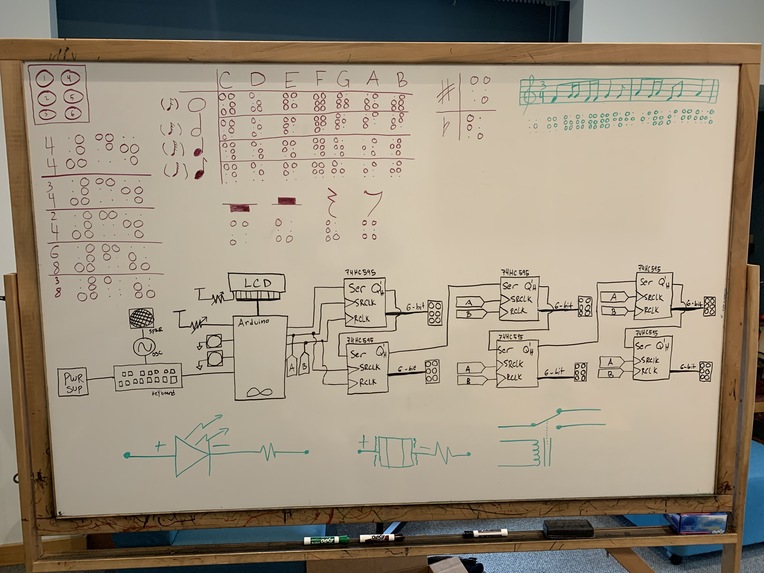
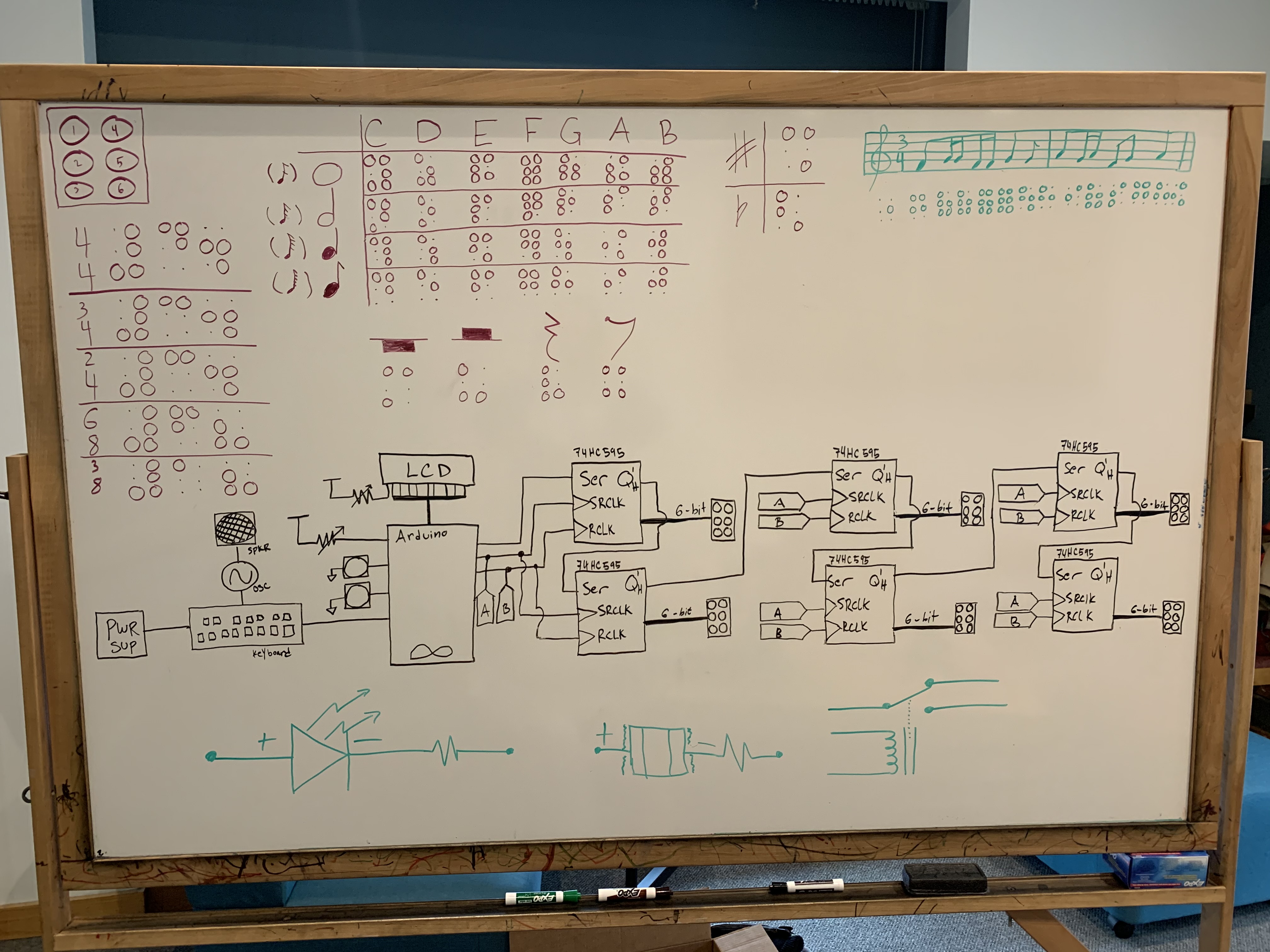
Presentation board with schematic
-
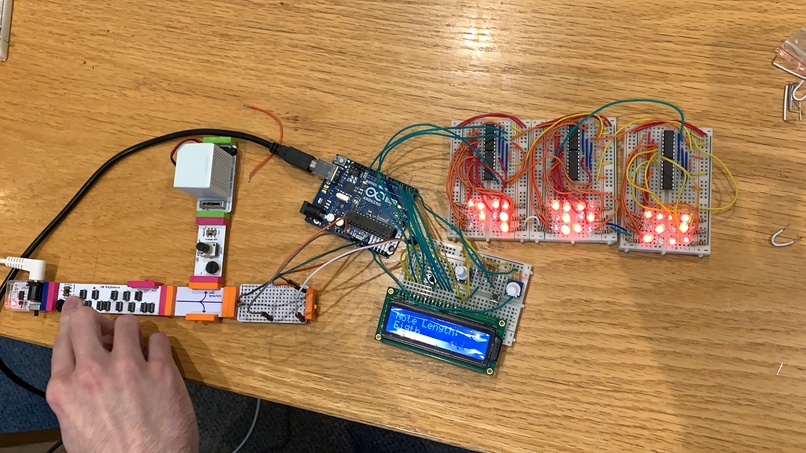
Physical circuit

Inspiration
Our inspiration originally came from this year's theme of accessibility. There are many hurdles to overcome to become a successful musician - issues such as lack of access to music lessons, lack of funds to pay for instruments, and the like prevent many individuals from pursuing their dreams of learning music. For differently-abled individuals, these difficulties can be magnified by physical or mental limitations that would otherwise prevent them from getting a typical music education or participating in the music world. The aim of our project was to prove a concept that for a tool that would enable blind people to easily digitally write music. Our project would in theory allow blind individuals to compose music digitally and call it back, allowing them ease of access to similar tools that seeing individuals have easy access to.
What it does
The device uses a combination of hardware and embedded software to convert electronic music to its Braille representation. The user can specify key signature, time signature, and play and display music. While the current prototype uses LEDs, a real version would readily be able to use haptic feedback via actuators.
How we built it
We used an arduino as an embedded microcontroller to read from a Little Bits keyboard. This input is then displayed on using shift registers and LED Braille cells built into a solderless breadboard.
Challenges we ran into
Most of the technology available to us in this hackathon was not readily able to interface together, so we had to reverse engineer several different systems to activate them through unintended means. Combined with the sheer complexity of some of the systems we built, this made for a challenging, high-stakes project with a lot that could go wrong.
Accomplishments that we're proud of
We probably made this look much, much easier than it was. Though we were fighting our materials most of the way, we managed to put together a fully-functional bug-free prototype.
What we learned
Through this process, Jacob and I learned how to work together with a protracted timeline to accomplish a relatively difficult task. Coming together with a stranger and learning how to work with someone on the fly while also staying focused - with a lack of sleep - was a challenge that was really enlightening.
What's next for Braille Music Notation Converter
The LED Braille cells and LCD display were merely intended for proof of concept, demonstrating our ability to accept input from complex sources and convert it to Braille using any digital output, including real haptic sensors to enable reading by touch. Future work would involve implementing these changes and rendering the device fully functional.

Log in or sign up for Devpost to join the conversation.