Inspiration
Medellín has an extraordinary independent creative scene, but discovering its artists often depends on already knowing their names, following the right communities, or finding the right venues.
We first explored this problem with Bragi in 2024, as a platform designed to connect artists with potential clients. For the Qloo Agentic Hackathon, we took that original mission in a new direction:
What if the music, films, and cultural experiences you already love could lead you to an independent creator in your own city whom you have never heard of?
That question became Bragi Taste Agent.
What it does
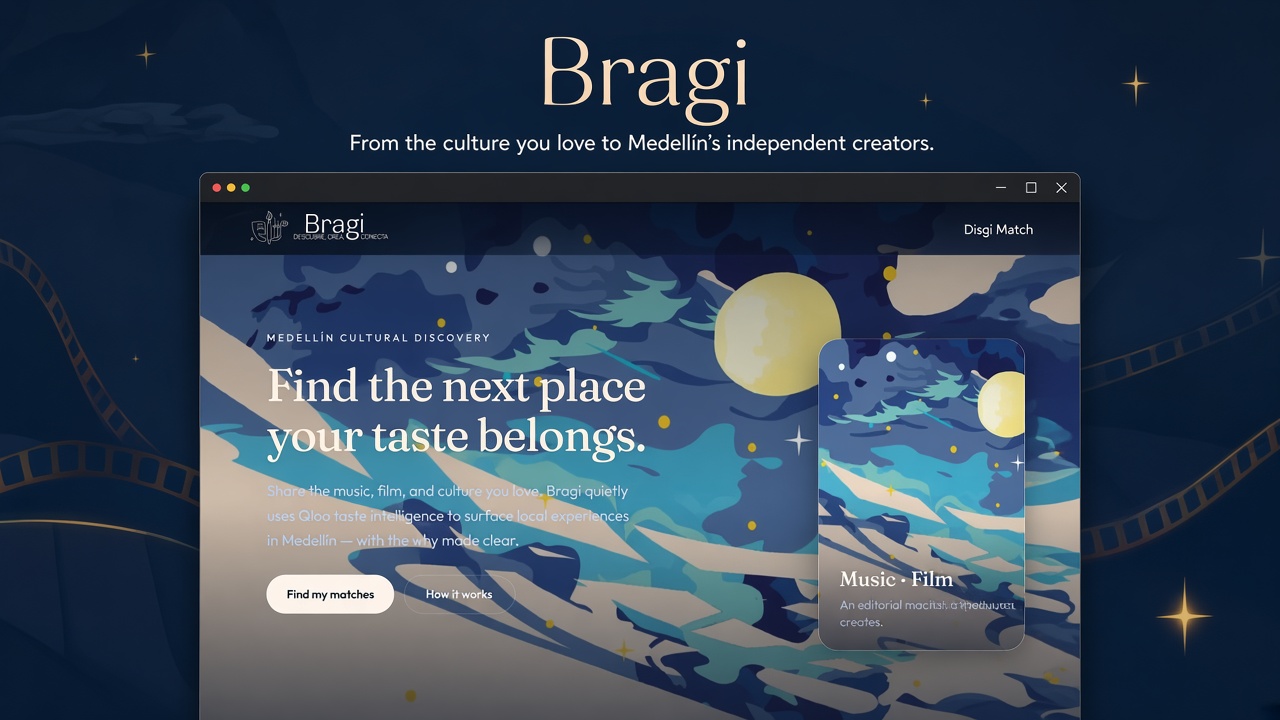
Bragi is a Qloo-powered cultural discovery agent that connects global tastes to local creativity.
Users select their favorite artists, films, genres, or cultural interests and choose what they want to discover: Creators, Places, or Surprise me.
Bragi then runs a multi-stage discovery workflow:
- Understand your taste: Resolve cultural interests using Qloo Search and Tags.
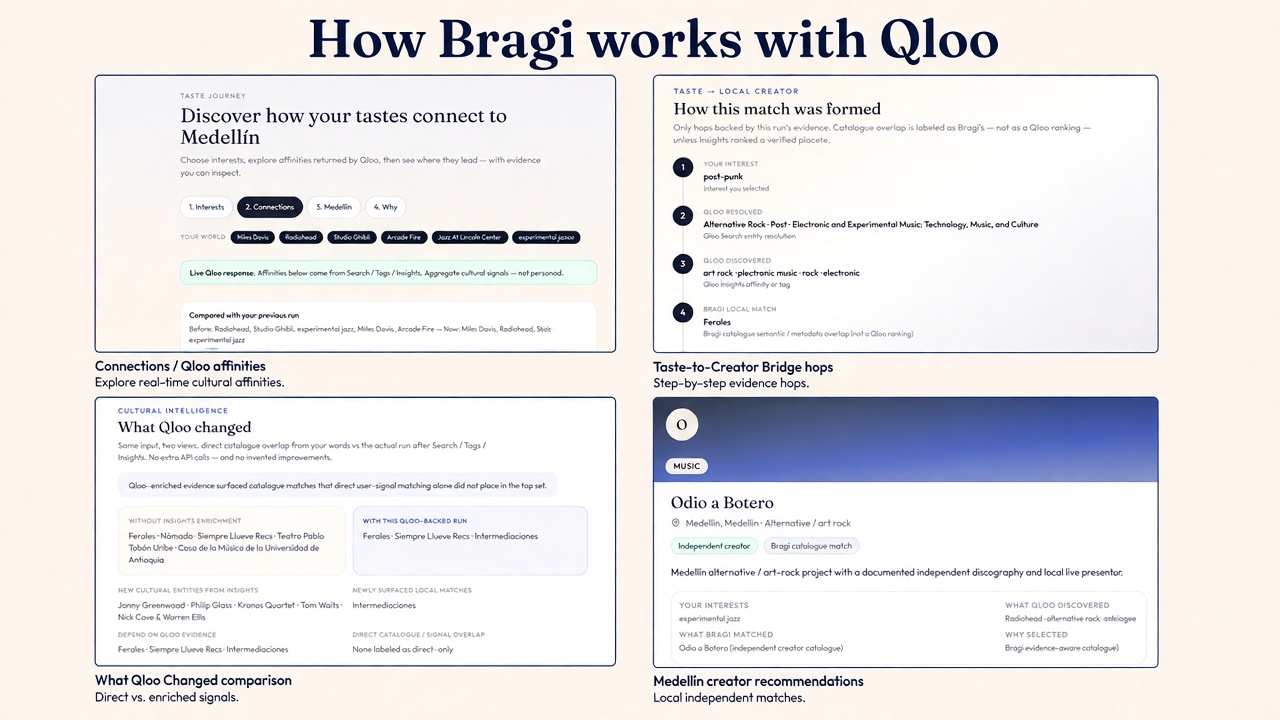
- Discover connections: Use Qloo Insights to uncover related cultural entities and affinities beyond the original input.
- Find local matches: Evaluate a curated catalogue of verified Medellín creators, cultural projects, and venues.
- Explain the recommendation: Show the evidence behind each match and distinguish Qloo's findings from Bragi's own catalogue ranking.
- Refine your discovery: Use More like this, Not my style, or Surprise me again to influence subsequent searches.
Our signature feature, Taste-to-Creator Bridge, makes the discovery process visible: from an interest the user selected, through Qloo evidence, to a real independent creator and their portfolio.
What Qloo Changed compares direct catalogue matching against Qloo-enriched matching under consistent constraints, showing what cultural intelligence actually contributed.
How we built it
We rebuilt Bragi for this hackathon using Next.js 15, React 19, TypeScript, Tailwind CSS, and Vercel.
The server-side discovery agent orchestrates Qloo Search, Tags, and Insights to construct an evidence-based taste profile. A dual-path recommendation engine combines Qloo-native contextual affinity ranking for verified place entities with Bragi's own matching system for local creators and projects.
Every recommendation preserves its provenance. A Bragi catalogue match is never misrepresented as an artist directly ranked by Qloo.
We also implemented bounded API requests, timeout handling, honest empty states, interactive feedback, and automated testing with Vitest and GitHub Actions.
Challenges we ran into
Cultural relevance: Some Qloo responses contained different tag identifiers representing the same concept. Initially, those duplicate signals inflated scores and occasionally promoted unrelated artists. We corrected this through general-purpose tag deduplication rather than hardcoded artist exclusions.
Local accuracy: We discovered that an existing catalogue entry incorrectly identified a Bogotá band as being from Medellín. We removed the entry and audited the geographical and cultural provenance of the catalogue.
Explainability: An important challenge was separating actual Qloo evidence from relationships created by our recommendation algorithm. We designed the Taste-to-Creator Bridge and What Qloo Changed to make that distinction explicit.
Reliability: Live cultural discovery requires multiple external API calls. We introduced bounded execution, request prioritization, and graceful handling of incomplete evidence to keep the public demo responsive.
Accomplishments that we're proud of
- Built a functional, publicly accessible, end-to-end cultural discovery agent using the live Qloo API.
- Connected cultural affinities to verified Medellín creators and projects, including Alcolirykoz, Ferales, tapelooplab, and Intermediaciones.
- Created an inspectable explanation of how a personal interest becomes a local recommendation.
- Implemented feedback that influences subsequent discovery rather than merely changing the appearance of results.
- Developed an honest comparison that makes Qloo's contribution visible without inventing accuracy improvements.
- Validated the system using automated tests and live cultural discovery scenarios.
What we learned
We learned that a recommendation becomes more useful when people can understand why it exists.
Qloo can reveal cultural relationships that are not obvious from a simple keyword search. But turning those relationships into trustworthy local recommendations also requires accurate metadata, careful ranking, and transparent explanations.
We also learned that responsible cultural discovery means acknowledging uncertainty instead of presenting every association as a verified fact.
What's next
Our next goal is to expand Bragi beyond its initial Medellín catalogue, with more verified independent creators, multilingual discovery, and tools that allow cultural organizations to maintain their own profiles.
Our long-term vision is a discovery layer where global cultural intelligence helps local creative communities become visible.
Try Bragi: https://bragi-qloo.vercel.app
Source code: https://github.com/DOVRC/bragi-qloo
Built With
- github
- github-actions
- next.js
- node.js
- qloo-api
- qloo-insights
- qloo-search
- qloo-tags
- react
- tailwind-css
- typescript
- vercel
- vitest
