-
-
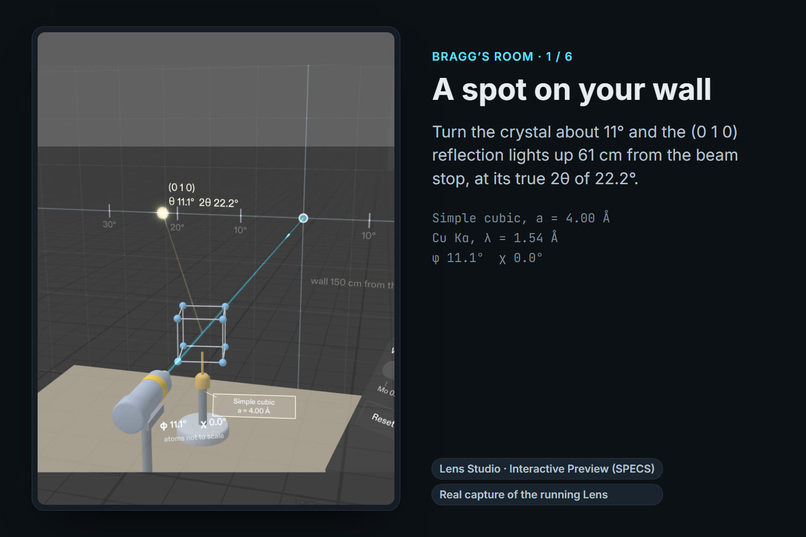
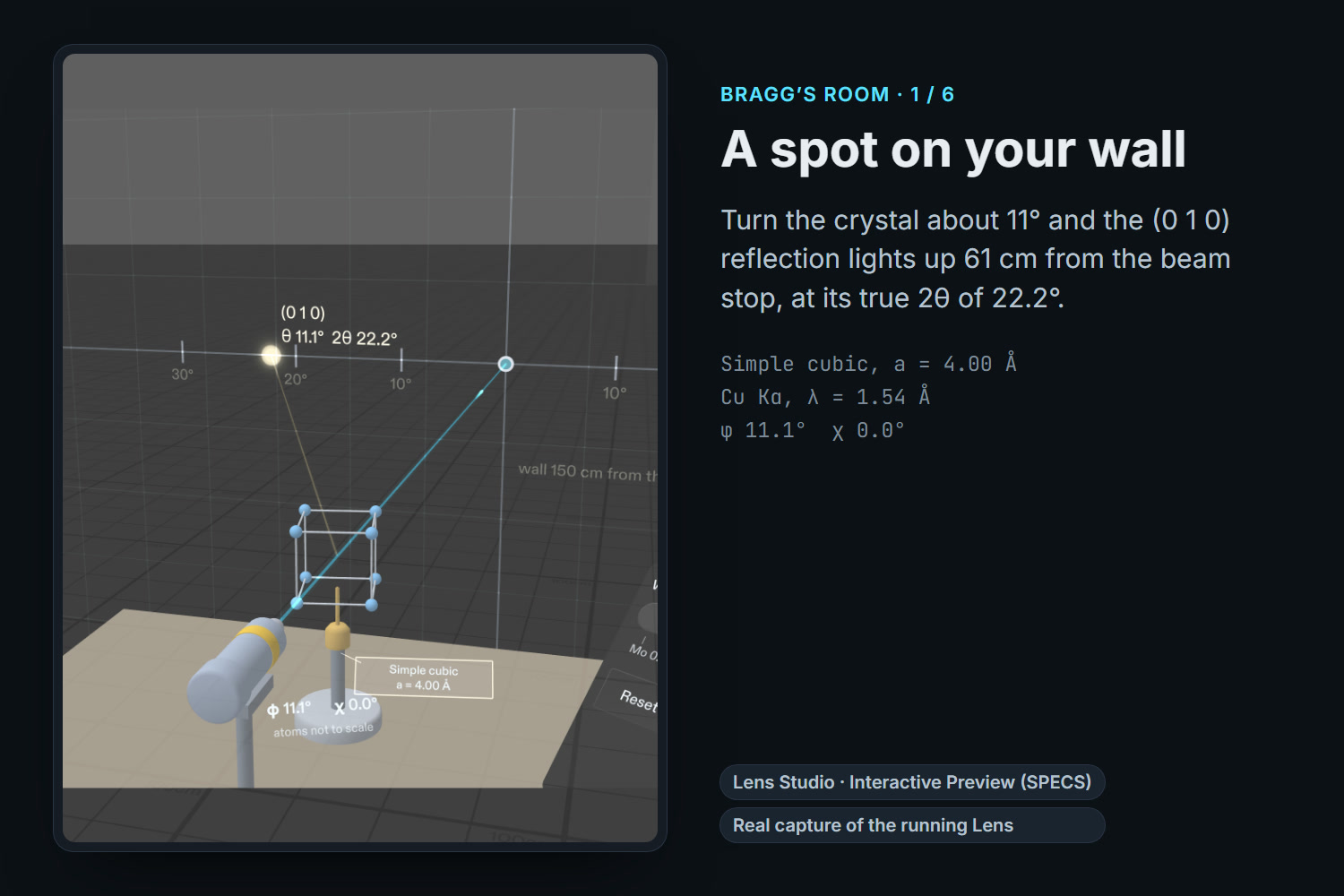
Turn the crystal about 11° and (0 1 0) lights up on the wall at its true 2θ of 22.2°, 61 cm from the beam stop.
-
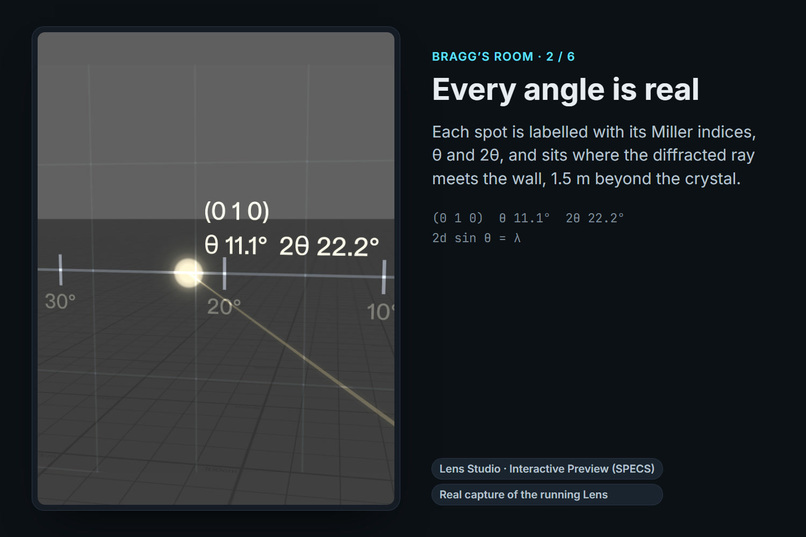
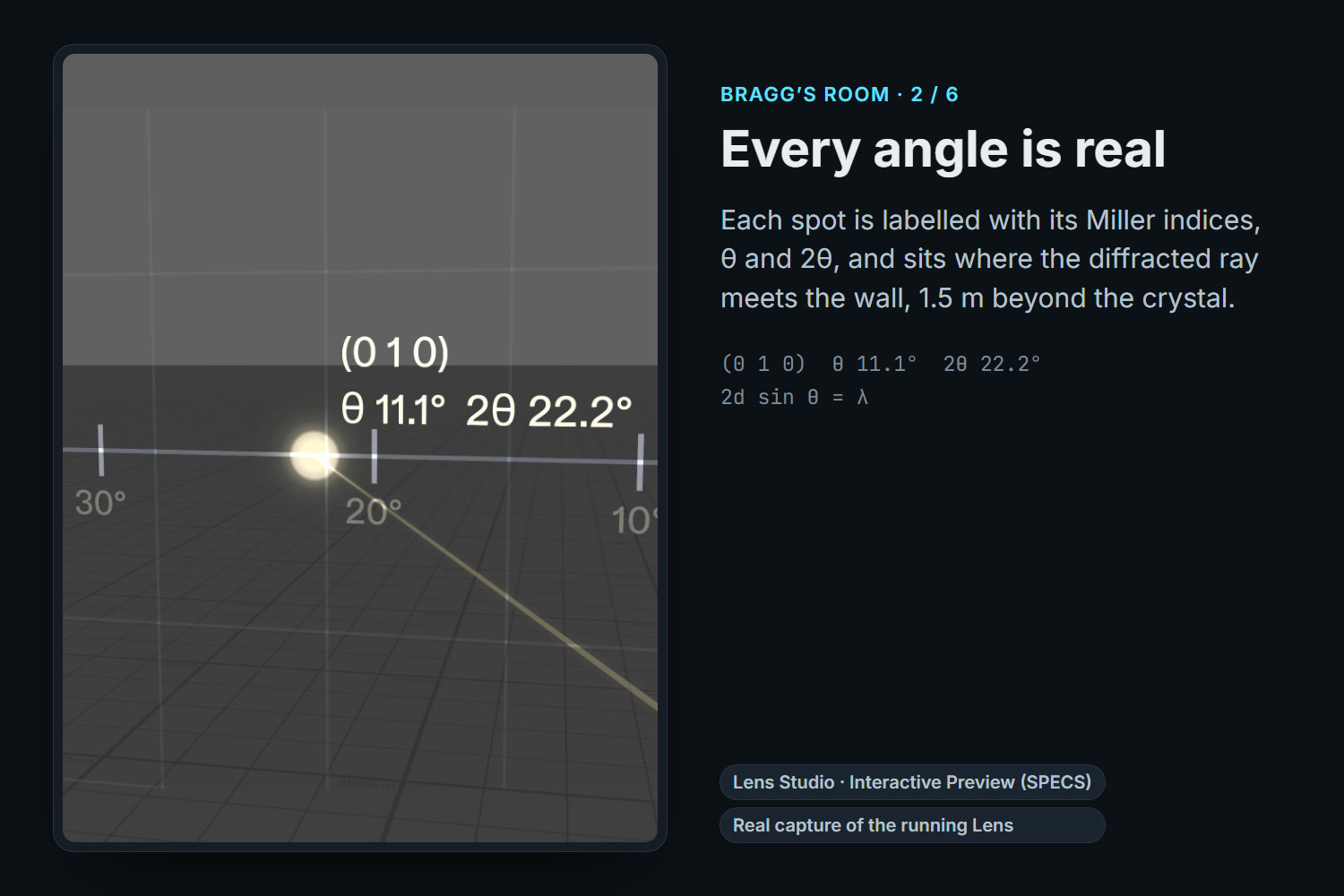
Every spot is labelled with its Miller indices, θ and 2θ, and sits where the diffracted ray meets the wall 1.5 m away.
-
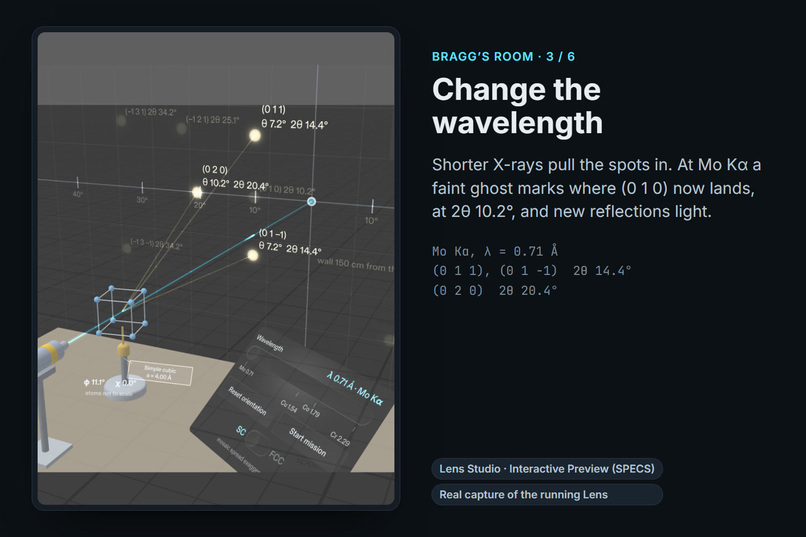
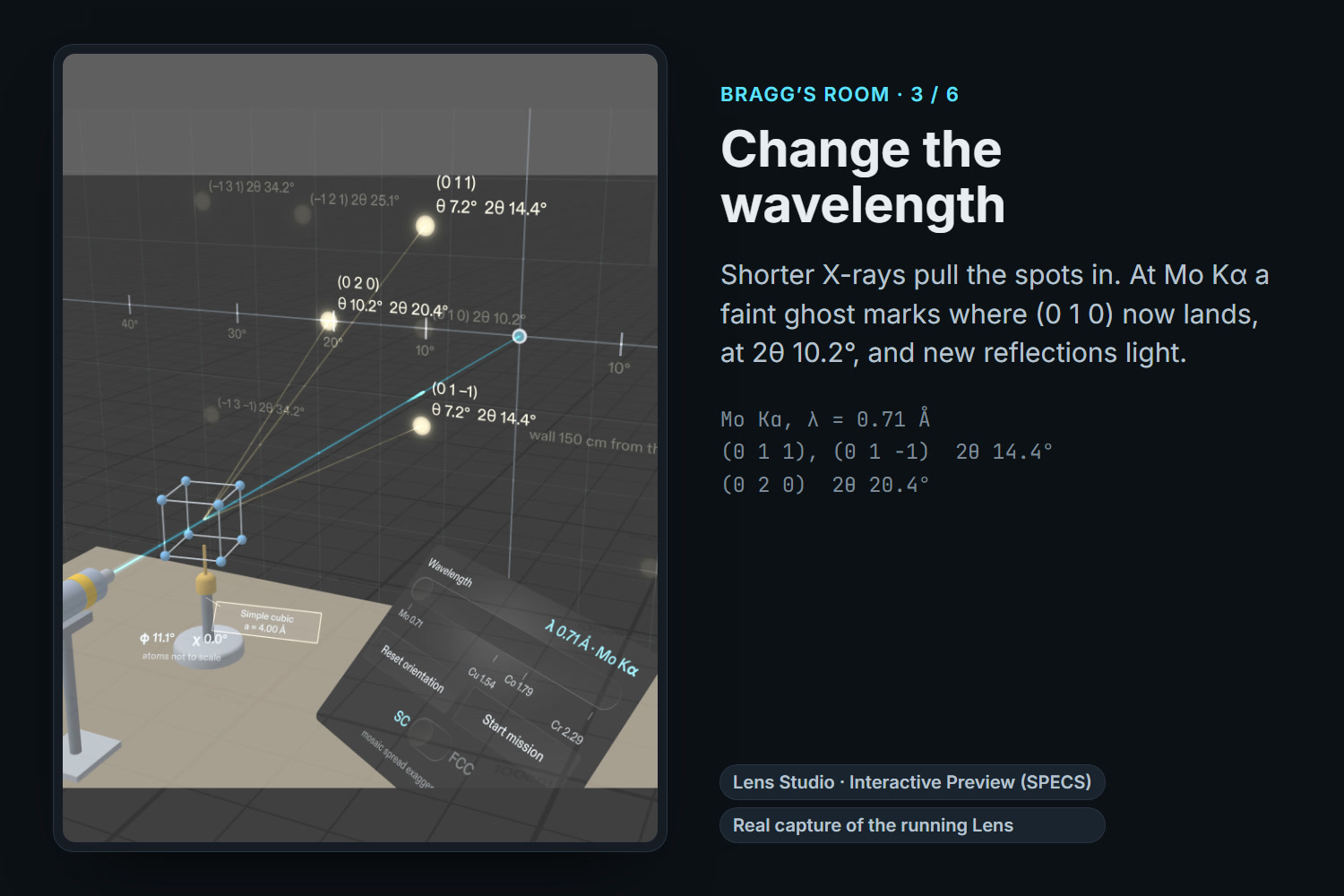
Shorter X-rays pull the spots in. At Mo Kα a faint ghost marks where (0 1 0) now lands, at 2θ 10.2°.
-
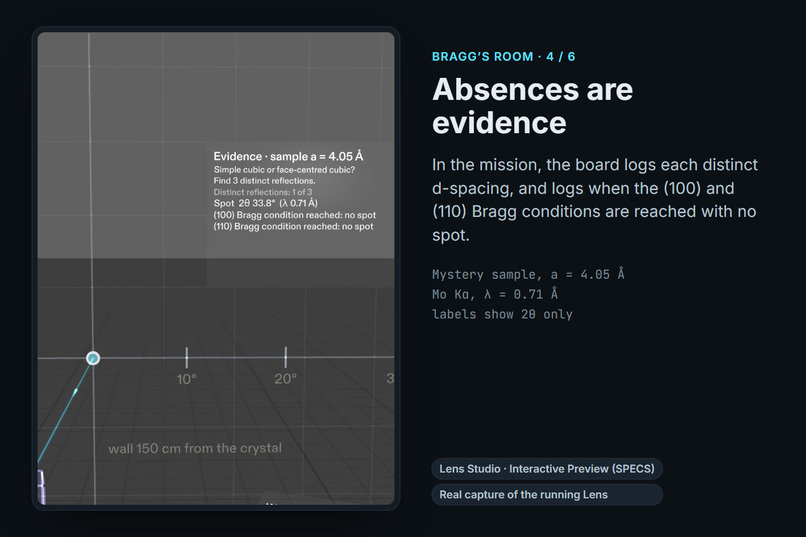
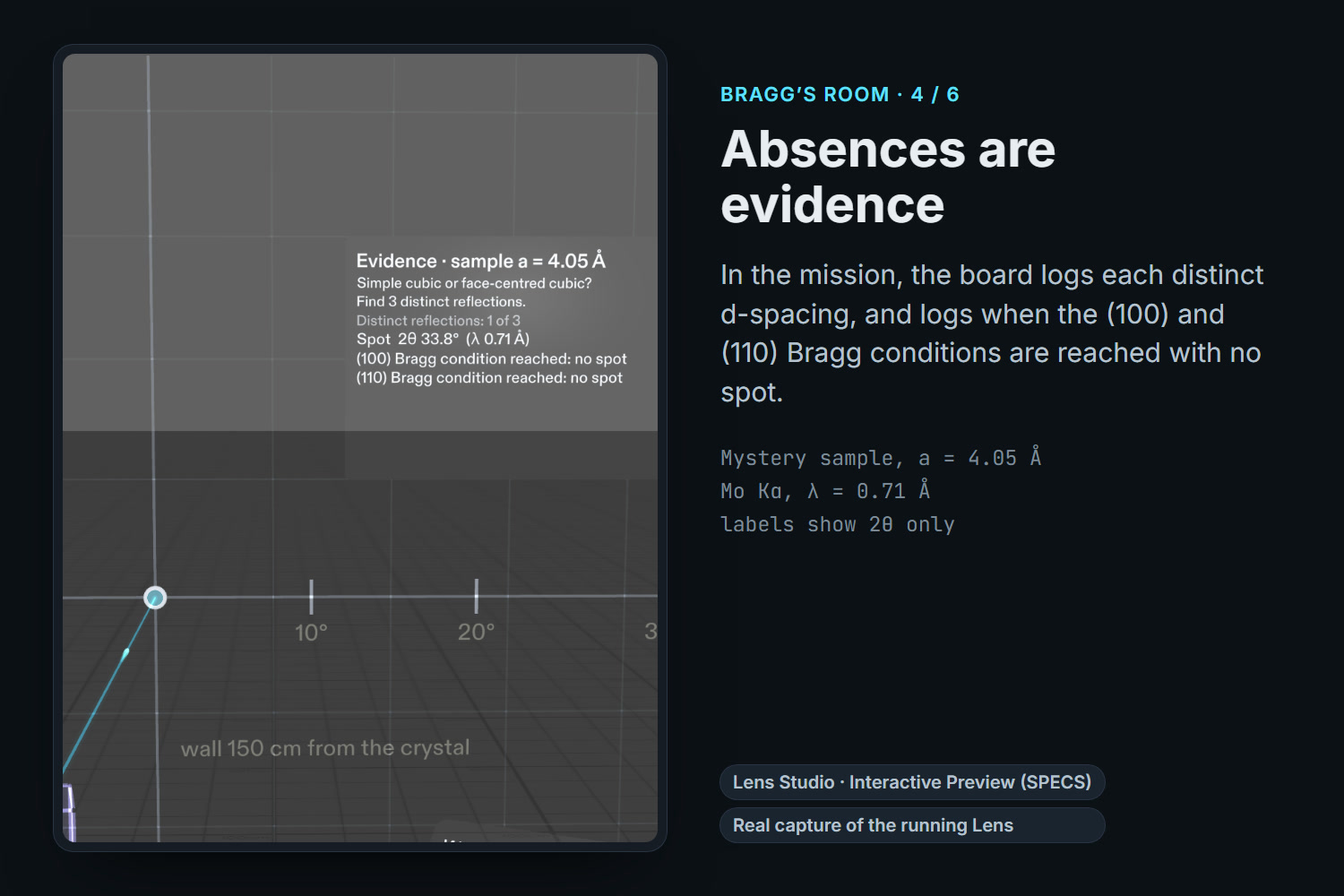
In the mission, the board logs each d-spacing, and when the (100) and (110) conditions pass with no spot.
-
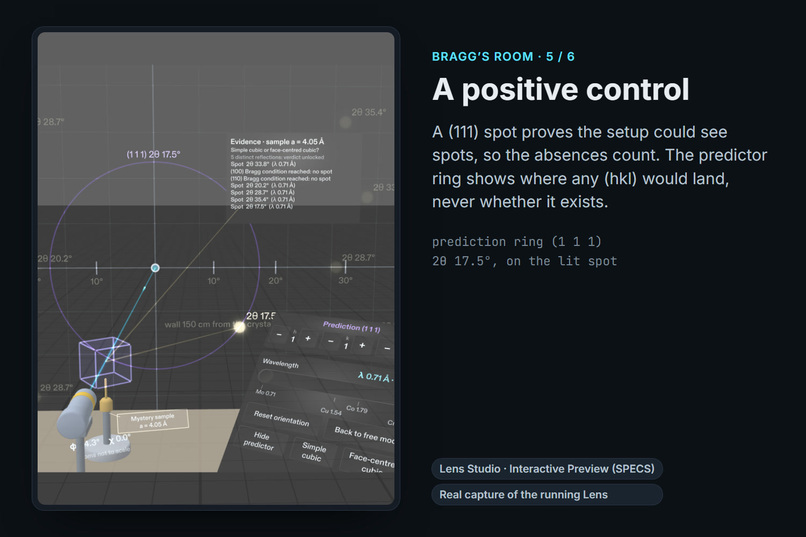
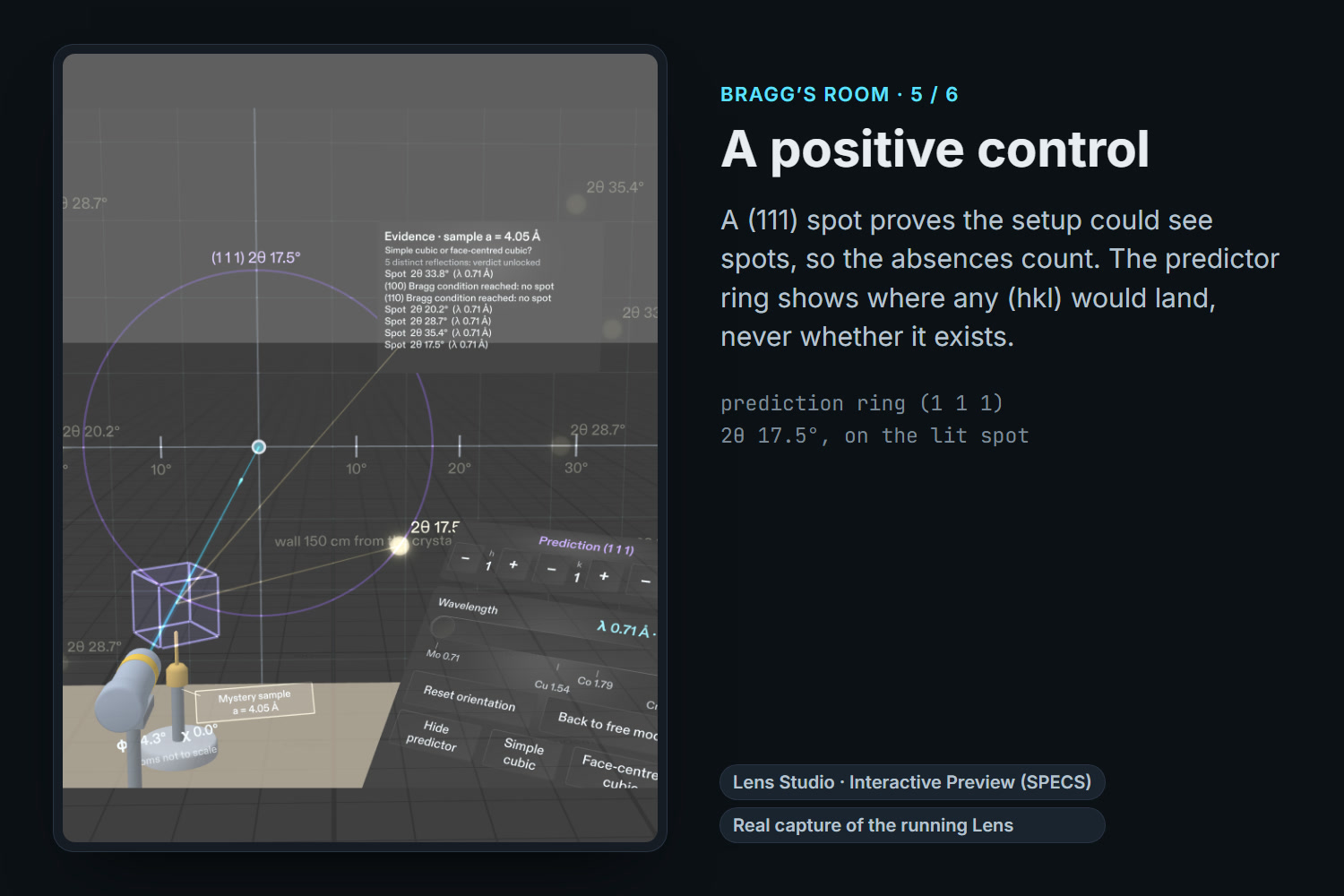
A (111) spot is the positive control. The predictor ring shows where any (hkl) would land, never whether it exists.
-
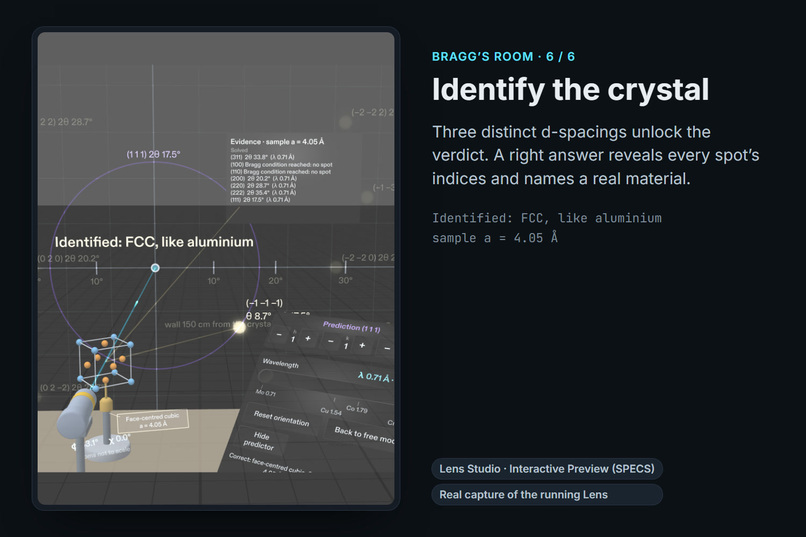
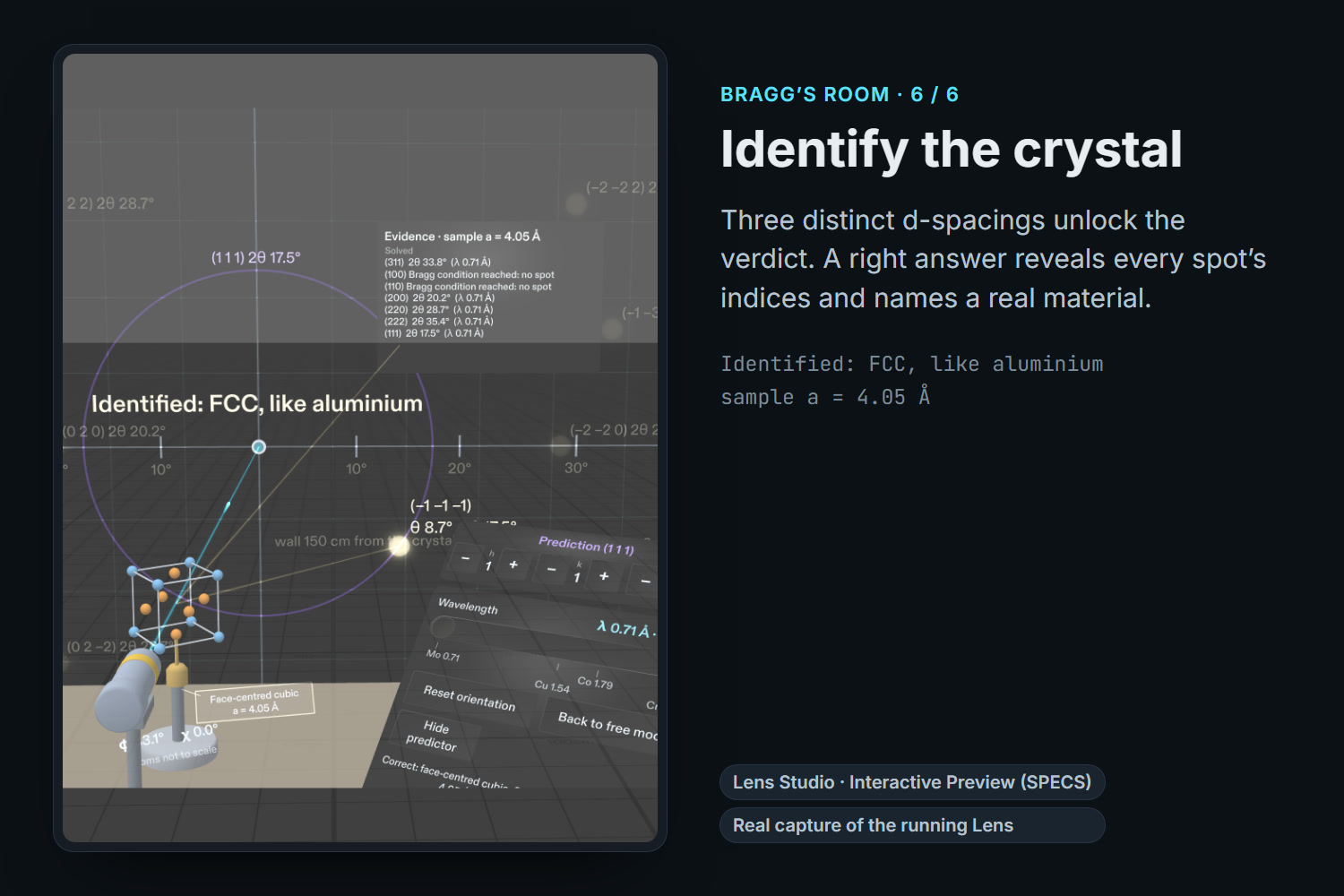
Three distinct d-spacings unlock the verdict. The right answer names a real material: FCC, like aluminium.
What it does
Bragg's Room puts an X-ray diffraction experiment in your room. A crystal sits on your desk in an X-ray beam; the beam runs to a detector on the wall 1.5 m beyond it. You pinch-drag the crystal to turn it, the way a two-circle goniometer does: left/right spins it, up/down tilts it, and it never rolls about the beam. When a set of lattice planes meets the Bragg condition, a spot lights up on the wall at its real scattering angle, labelled with its Miller indices, θ and 2θ, and a chime sounds from the spot itself. Turn the crystal about 11° and the (0 1 0) spot appears 61 cm from the beam stop at 2θ = 22.2°; turn 1° further and it goes dark again.
A wavelength slider runs from Mo Kα to Cr Kα. A longer wavelength pushes a lit spot outward and a shorter one pulls it in, and a faint ghost keeps showing where each found reflection would land. A toggle switches the crystal from simple cubic to face-centred cubic, so you can watch the mixed-parity reflections disappear.
The mission is Identify the crystal. You get a mystery sample with a known lattice parameter, randomly simple cubic or face-centred cubic, and labels that show only 2θ. You hunt for reflections, and an evidence board on the wall logs each distinct d-spacing you observe. It also logs when the crystal passes through the (100) and (110) conditions and nothing lights. An absence only counts with a positive control: a (111) or (200) spot proves the setup could see spots at all. A predictor shows where any (hkl) would land without revealing whether it exists. When you name the lattice, the Lens checks your evidence, tells you what contradicts a wrong answer, and on a right one reveals every spot's indices and names a real material with that structure ("Identified: FCC, like copper").
The physics is the vector (Laue/Ewald) form: |k| = 1/λ, reciprocal lattice vectors rotate with the crystal, a reflection lights when |k + G| ≈ |k| (within a 1.0° mosaic window, exaggerated so spots can be found by hand), and the diffracted ray k + G is intersected with the wall. The atoms are drawn enlarged and labelled "atoms not to scale"; every angle and direction is real.
In Lens Studio's preview the wall and desk are virtual stand-ins drawn at real size. On SPECS, the detector would anchor to your real wall.
Who it's for
Undergraduate physics, chemistry and materials students, and the people who teach them. Diffraction is usually taught with a flat diagram: two lines for the planes, two arrows, and nλ = 2d sin θ. The equation is right, but the diagram hides the part students find hardest: how the crystal's orientation in 3D, the beam and the spot's position on the detector are linked. In Bragg's Room that link happens at room scale with real angles. Your hands turn the crystal while your eyes stay on the wall pattern.
For teachers, there's a 30-minute class activity with learning goals, a before-and-after prediction question, discussion questions and an answer key: lesson plan.
Designed for glasses
I designed it around what glasses do well, and around what they can't do:
- Your room is the interface. Nothing floats in front of your face like a web page. Labels sit beside the spots on the wall, the φ and χ readouts sit on the goniometer base, and the evidence board hangs on the wall beside the beam stop.
- Hand and wall in one view. The crystal sits about 25° below your eye line and the beam stop about 7° below it, so you can watch your hand turn the crystal and the first spots light up on the wall together.
- One gesture, few buttons. A pinch-drag turns the crystal. Everything else is a big button on a console on the desk. The predictor stays folded until you open it, and the verdict buttons appear only once you've found three distinct reflections.
- Only what's needed. In a mission, spot labels show 2θ only. The off-wall hint appears only when a lit reflection misses the wall and nothing on the wall is lit.
- Sound and edges for a narrow view. Each spot chimes from where it is on the wall, and a chevron at the edge of your view points to a lit spot you can't see.
- Readable from where you stand. Measured from the start position, spot labels are about 5 cm per line (about 1.4° tall), and the smallest text, the board's status line, is still 0.69°.
- Black is see-through. On SPECS, black renders as transparent, so the wall is a faint light grid, not a solid panel.
Why it matters
Bragg's law is easy to learn as a formula without the geometry behind it. Teaching papers report this:
- Students who can recite 2d sin θ = nλ "find it more difficult to sketch the corresponding geometry" of a real experiment [1].
- Students who solve Bragg's-law problems correctly still picture diffraction orders wrongly in real space [2].
Physics-education research on diffraction of particles found similar difficulties at every level: after standard teaching, first- to third-year students couldn't predict how a pattern changes when the setup changes [3].
Crystallography as a whole depends on picturing structures in 3D. A review of virtual- and augmented-reality environments for learning crystallography found that they help with exactly these spatial problems, and that AR was the least used of the technologies reviewed [4]. A small classroom study of VR and AR for crystal structures reported better test results and 3D drawing skills [5].
Bragg's Room aims at the step that the flat figure leaves out: where the spot goes. You turn the crystal with your hand, and the spot appears on your wall at its real angle.
What's new
There are good teaching tools for single-crystal diffraction: XRayView [6], which covers the reciprocal lattice, the Ewald sphere and systematic absences; EwaldSphere [7], a virtual diffractometer with an area detector; EPFL's DiffractOgram; York's interactive Ewald-sphere tutorial; and CrystalMaker's SingleCrystal. All of them draw the pattern on a screen.
In Bragg's Room the pattern is in your room: you find the spot on your wall at its true 2θ, 61 cm from the beam stop, by turning the crystal with your hand while you watch the wall. A search for this submission found no other tool that puts a single-crystal X-ray pattern at its true angles in the learner's own space. Classroom laser demonstrations do throw diffraction patterns onto real walls, but those patterns come from gratings, not from crystal planes at X-ray angles.
The mission is about reasoning, not only seeing:
- the evidence board logs what lit and what didn't;
- an absence counts only once a positive control proves the setup could see spots;
- a wrong verdict is answered with the evidence against it.
That's how a crystallographer argues for a structure.
How accurate it is
Every angle and direction is computed with the vector (Laue/Ewald) form and then checked in three ways:
- Unit tests. The physics is checked against hand-computed Bragg angles; there are 124 unit tests in all.
- Measured data. The physics is also checked against a measured powder pattern of real aluminium [8]. The FCC rule allows exactly the nine lines that were measured up to (422), every d-spacing agrees within 0.001 Å, and every 2θ agrees within 0.05°. The table is in the README (
npm run reference). - Labels for what isn't real. What's deliberately exaggerated, the atom size and the 1.0° mosaic window, is labelled in the Lens.
How I built it
I planned the Lens with the plan-lens skill from the Learn AR with SPECS skill pack. Its interview checked my idea against AR design practice and against what Lens Studio's preview can show, and produced the design brief. The design decisions in it are mine; values marked "(default)" were filled in by plan-lens for me to review. Its questions changed the design:
- It pointed out that if every round kept a = 4.0 Å, the first spot would give the answer away: at Cu Kα, simple cubic lights (100) at 2θ ≈ 22°, and FCC has nothing below 39°. And if a were hidden, the line ratios couldn't tell the two apart. So in the brief, each round's sample tag shows a random lattice parameter (3.3–5.7 Å), and the FCC verdict rests on absences with a positive control.
- It asked which reflections should get ghost markers in a mission. Answering it, I saw that drawing ghosts for allowed reflections would leak the answer, so the predictor shows any (hkl) you pick, whether or not it exists.
- It flagged that the preview can't detect walls. So the brief uses a virtual wall at real size as a stand-in, and keeps snapping to a real wall out of the done criteria.
As a diffraction researcher, I specified the physics myself: the vector Laue/Ewald form, the FCC selection rule, and unit tests against hand-computed Bragg angles.
Coding agents then built it with CLAD through Lens Studio and the Lens Studio MCP. CLAD's specs-experience-builder agent built the room, the console (Spectacles UI Kit) and the sounds. CLAD's live-lens-tester agent wrote LEAF scenarios for each done criterion, and all eight pass in the preview, driving the Lens with simulated pinch-drags and button presses. The physics and game logic were written to my specification and are checked by 44 command-line unit tests, including hand-computed Bragg angles; 80 more check the room's code-built geometry. A fresh clone of the public repo opens in Lens Studio 5.24.1 with no missing assets, and all eight LEAF scenarios pass there too (340 of 340 checks). The full record, including what the agents chose during the build and what I directed, is in the build report.
Pre-existing code: none, apart from the Lens Studio Specs Base Template, Snap's packages (Spectacles Interaction Kit, Spectacles UI Kit, LEAF, Bitmoji 3D) and the vertex-colour material that ships with the CLAD plugin.
About the video: all the footage is the Lens running in Lens Studio's Interactive Preview, driven by a LEAF scenario with real pinch-drags and button presses. One mission round (0:48 to 1:42), from Start mission to the verdict, is an uncut real-time screen recording with a running clock on screen. The preview runs at only about 5 frames per second on my PC, so the motion there is choppy. The other shots were captured frame by frame. The narration is synthesized speech (Bark). The preview records no sound, so the Lens's own sounds are placed where its log says they played. The mission round is fixed to FCC, a = 4.05 Å, with a test hook so it matches the narration.
Testing so far
Before testing with real students, I ran simulated first-time-user walkthroughs. Three AI agents each played one persona and drove the Lens in Lens Studio's preview, using only what's on screen and the README's controls: a first-year chemistry student, a PhD student who runs a diffractometer, and a lecturer following the lesson plan.
They aren't real users, and they can't show that anyone learns from it. But the most useful finding was positive: the PhD persona checked every number on screen by hand, and all of them were right to 0.1°. They also found real problems:
- all three were confused by the off-wall hint;
- the mission never stated its question, and the verdict never said "correct";
- my lesson plan asked for a distance the screen didn't show.
I fixed all of them in the Lens and in the lesson plan, and re-shot the video. Details: simulated walkthrough.
What I learned
- Correct physics isn't automatically clear physics. The off-wall hint was physically right: at some orientations, high-angle reflections really are in condition and miss the wall. But it showed next to a lit spot and read as a contradiction. It took three decisions to fix: hide it while a spot is lit on the wall, hide it until a first spot has been found, and finally make it state a fact ("A reflection at 2θ 51.0° is lit, but misses the wall.") instead of giving advice.
- Real behaviour can make a busy interface. With a 1.0° mosaic window at Mo Kα, several reflections light at once at most orientations. That's what a rotating crystal really does, but it means the slowdown and the guide arrow help less than planned. The Lens keeps the honest physics, and the helper windows are tunable.
- An absence needs a positive control. Writing that rule into the Lens made me spell out what I'd tell a student: a missing (100) spot only counts once a (111) or (200) spot proves the setup can see spots at all.
- Tests make a design changeable. Because every done criterion from the plan-lens brief had a LEAF scenario, each fix after the walkthrough could be re-checked in the preview straight away.
What's next
- Real SPECS. Try it on a real SPECS against a real wall: the wall anchor, the hand-drag feel and the narrow field of view are untested.
- More classroom testing. Run the lesson plan with a class and compare the before and after answers.
- More of the physics: body-centred cubic as a third answer; structure-factor intensities, so spots differ in brightness; and a powder mode with Debye–Scherrer rings on the wall.
References
- T. E. Weirich (2025). A new paper-based approach for teaching Bragg's law. Acta Cryst. E 81, 1195–1199. https://doi.org/10.1107/S2056989025010576
- N. Stojilovic (2026). Taking Bragg's Law to a Higher Cognitive Level: Using Sketches to Assess Misconceptions of X-ray Diffraction Orders. J. Chem. Educ. 103(8), 4237–4242. https://doi.org/10.1021/acs.jchemed.5c01304
- S. Vokos, P. S. Shaffer, B. S. Ambrose & L. C. McDermott (2000). Student understanding of the wave nature of matter: Diffraction and interference of particles. Am. J. Phys. 68(S1), S42–S51. https://doi.org/10.1119/1.19519
- J. Extremera, D. Vergara, L. P. Dávila & M. P. Rubio (2020). Virtual and Augmented Reality Environments to Learn the Fundamentals of Crystallography. Crystals 10(6), 456. https://doi.org/10.3390/cryst10060456
- M. S. Abdüsselam, S. Çıldır & S. Atasoy (2023). The effect of virtual and augmented reality on teaching crystal structure of materials and student reflections in applications. Int. J. Technology Enhanced Learning 15(3), 215–233. https://doi.org/10.1504/IJTEL.2023.131848
- G. N. Phillips Jr. (1995). XRayView: a teaching aid for X-ray crystallography. Biophys. J. 69, 1281–1283. https://doi.org/10.1016/S0006-3495(95)80035-4
- L. J. Barbour (2018). EwaldSphere: an interactive approach to teaching the Ewald sphere construction. J. Appl. Cryst. 51, 1734–1738. https://doi.org/10.1107/S1600576718012876
- H. E. Swanson & E. Tatge (1953). Standard X-ray Diffraction Powder Patterns. NBS Circular 539, Vol. I, "Aluminum (Cubic)". https://doi.org/10.6028/NBS.CIRC.539v1
Built With
- clad
- claude-code
- leaf
- lens-studio
- lens-studio-mcp
- plan-lens
- spectacles-interaction-kit
- spectacles-ui-kit
- typescript
