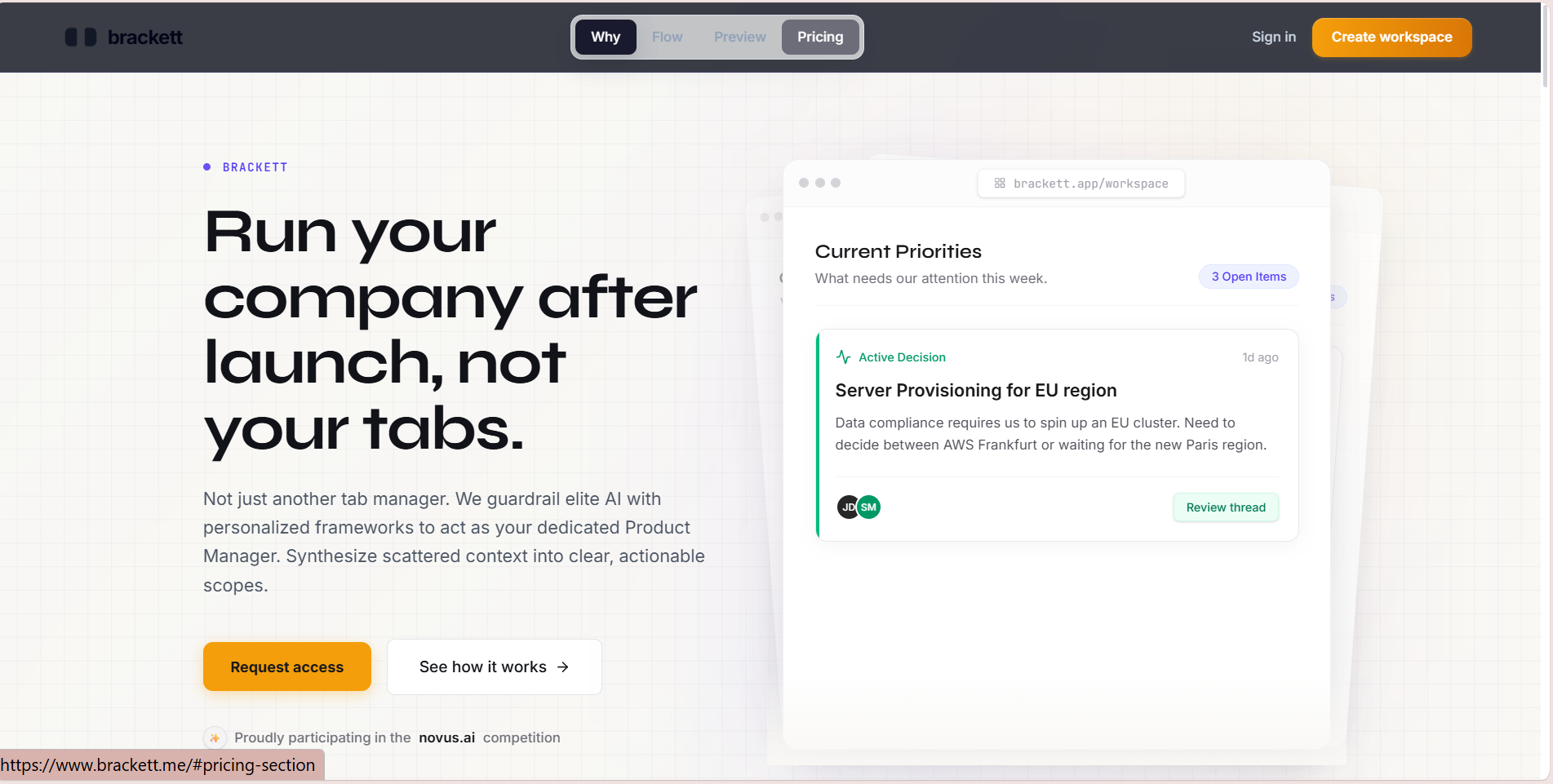
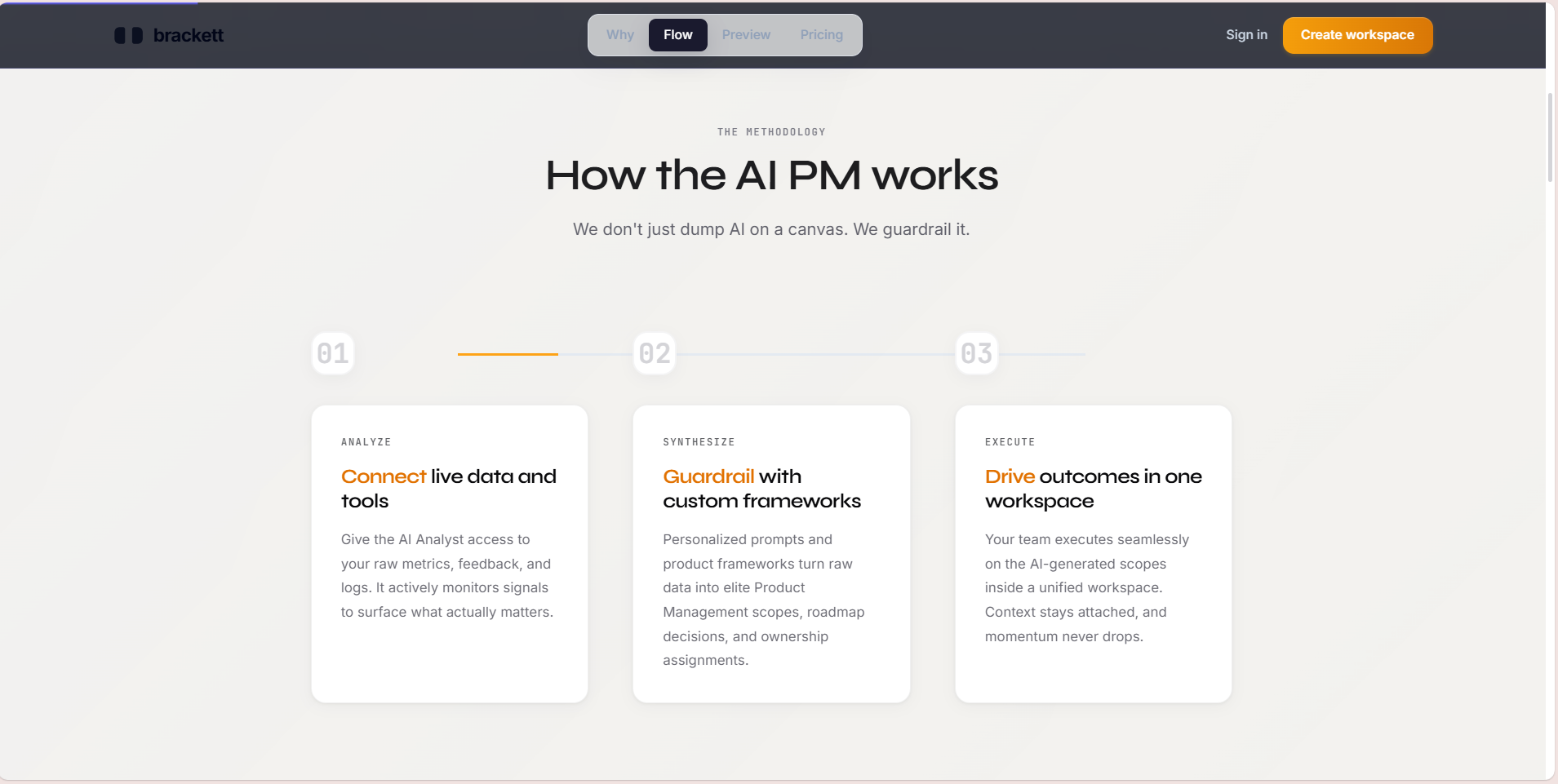
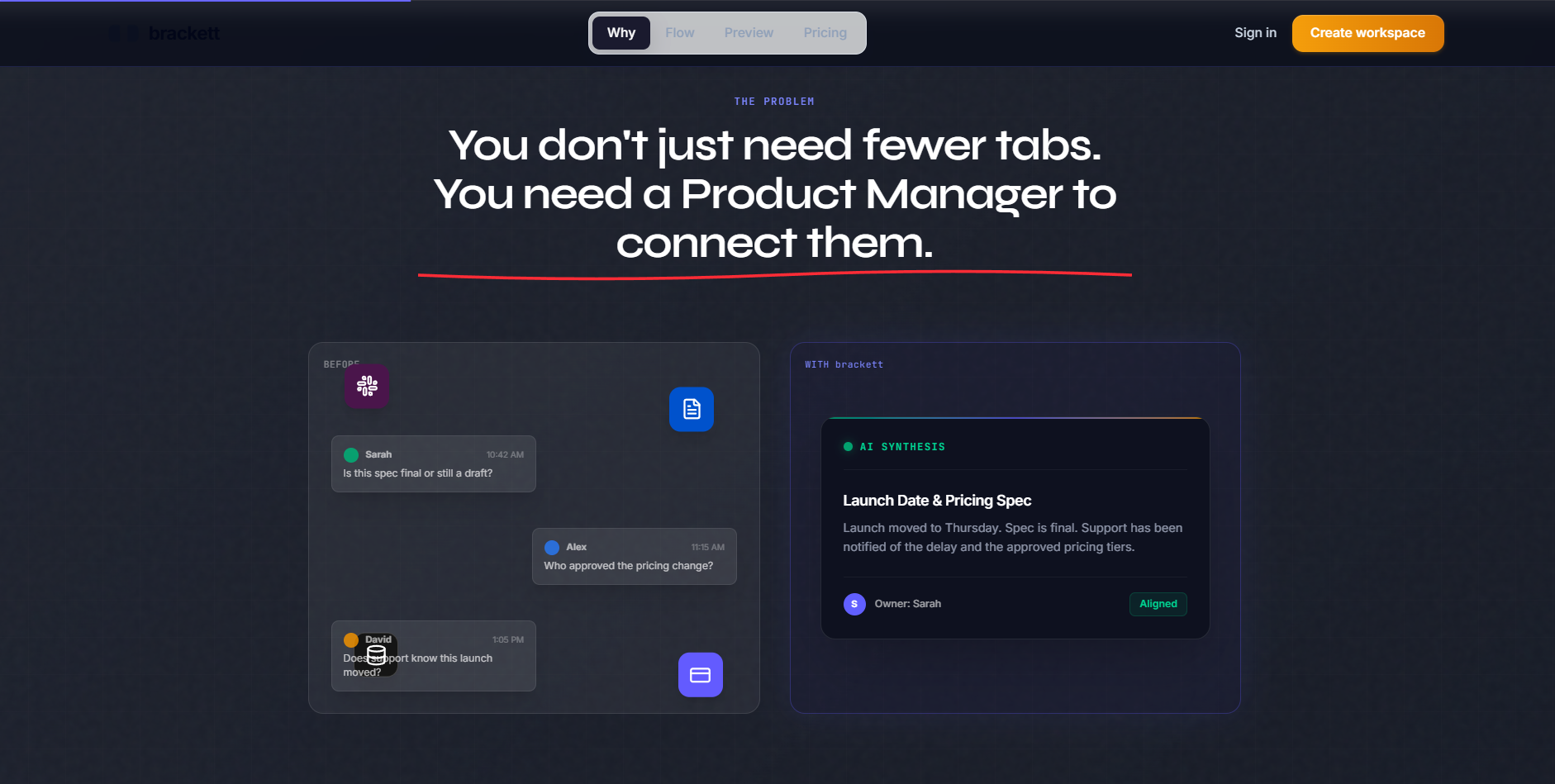
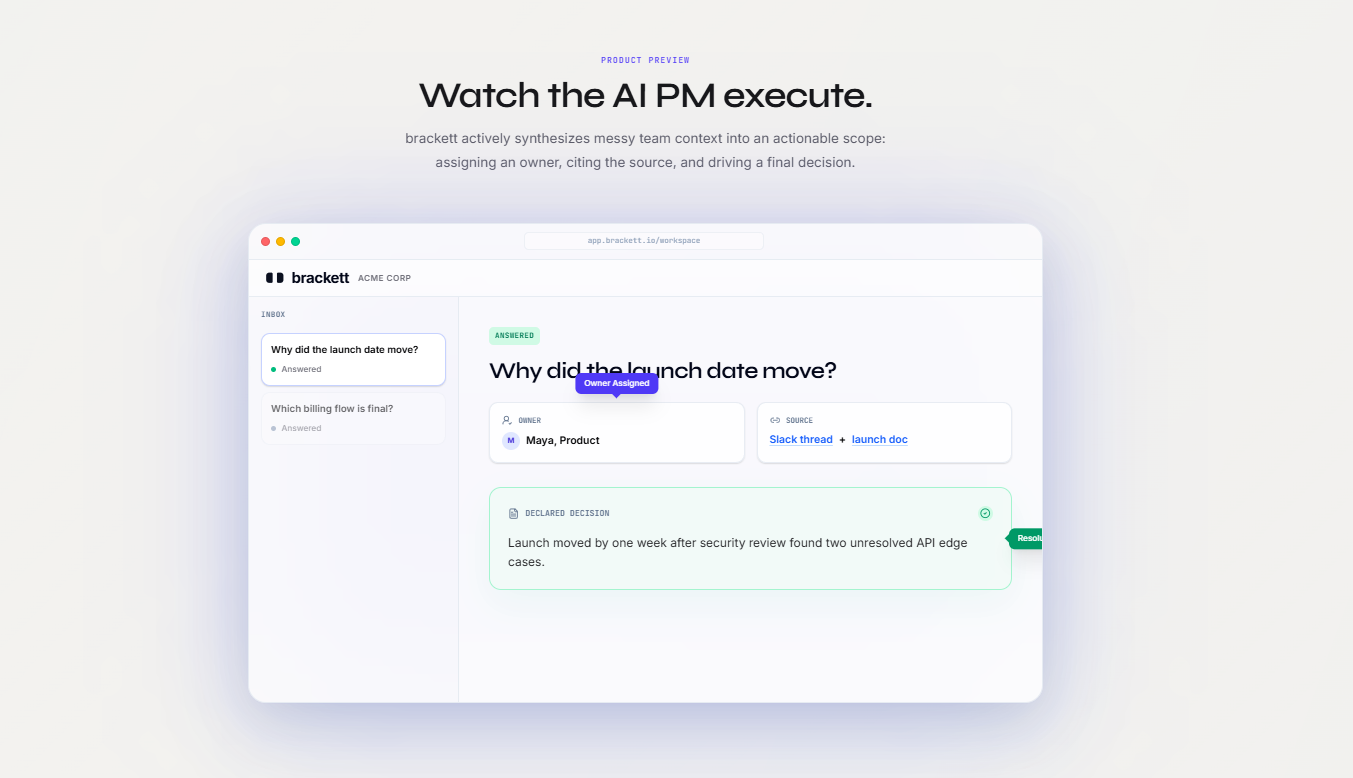
Brackett – Post‑Launch Workspace with an Internal PM and BA
What inspired us
After launch, most startups discover they don’t really have “one product,” they have ten scattered tools.
Roadmaps in Notion, metrics in dashboards, specs in random docs, decisions in Slack, and AI chats in a separate tab – all drifting apart.
At the same time, early teams rarely have a dedicated Product Manager and Business Analyst.
They need someone to choose the right problems (PM) and someone to translate them into precise flows and requirements (BA), but those roles usually arrive much later.
Brackett was inspired by that gap: give post‑launch startups a single workspace that feels like having both an internal PM and an internal BA riding along with the team from v1 onward.
What we learned
1. Teams don’t lack data – they lack structured decisions
Most teams already track signups, activation, retention, and revenue.
The problem is that signals live in different tools and never get synthesized into “here’s what we’re doing this week and why.”
We started thinking of decision quality as:
[ \text{Decision Quality} \approx f(\text{Signal Coverage}, \text{Context Alignment}, \text{Framework Quality}) ]
and realized we had to improve all three at once, not just add more charts.
2. PM and BA are different muscles – teams need both
We saw a clear split in what teams were missing:
- PM muscle: vision, strategy, prioritization, “what to build next and why”.
- BA muscle: requirements, flows, edge cases, “how exactly should this work so dev can’t misinterpret it”.
Most tools either help with vision (roadmaps) or with specs (ticketing), but not with both as a single thought process.
That pushed us to design Brackett’s AI so it can act as an internal Product Manager and an internal Business Analyst:
- Internal PM: picks problems, frames opportunities, and proposes bets.
- Internal BA: breaks those bets into detailed flows, data needs, and acceptance criteria.
3. AI is only useful when constrained by roles and frameworks
Unstructured AI chat is good at words, bad at responsibility.
If you ask “What should we do next?” and get a generic answer, nobody feels accountable.
We learned that AI becomes useful when it behaves like a role with a mandate:
- As PM, it must respect product vision, constraints, and KPIs.
- As BA, it must respect systems, dependencies, and edge cases.
So instead of:
[ \text{Output} = \text{LLM}(\text{Prompt}) ]
we pushed toward:
[ \text{Output} = G_{\text{PM+BA}}\big(F(\text{Signals}, \text{Context}), \text{Frameworks}\big) ]
where (G_{\text{PM+BA}}) is a guardrailed reasoning flow that explicitly mimics how a PM and BA would work together.
How we built it
We built Brackett as four layers, with PM+BA behavior baked in.
1. Workspace layer (shared brain)
This is where the team talks, records hypotheses, and logs decisions.
We designed it so each decision is tied to the signals and AI reasoning that led to it, just like a PM+BA pair would document context and requirements.
2. Integrations layer (connect your apps)
We connect to the tools teams already use (analytics, docs, task systems) and normalize the important signals – funnels, cohorts, feedback highlights – into a common model the internal PM+BA can reason about.
3. Metrics and insight layer
Instead of becoming a full BI tool, we focused on post‑launch questions: activation, retention, drop‑offs, and the impact of recent changes.
This layer gives the internal PM enough signal to prioritize, and the internal BA enough structure to define what “good” looks like in each change.
4. Internal PM and BA layer
This is the core.
We designed two complementary behaviors:
Internal PM mode
- Clarifies the problem, user segment, and success metrics
- Proposes experiments, roadmap moves, and “what to do next” options
- Justifies choices using connected data and product frameworks
Internal BA mode
- Translates chosen options into flows, fields, states, and edge cases
- Produces structured requirements, acceptance criteria, and test ideas
- Checks feasibility and consistency across the workspace
Under the hood, this is implemented as guardrailed AI pipelines backed by a curated library of product and analysis frameworks.
We continuously refine those frameworks so that recommendations stay grounded and repeatable, rather than one‑off generations.
Challenges we faced
1. Explaining “internal PM + BA” without overwhelming users
Most people already confuse PM and BA in real life.
Explaining that Brackett offers both internally, in a single AI‑first workspace, risked sounding like jargon.
We iterated toward a simpler story:
“Brackett gives you a post‑launch workspace with an internal Product Manager to choose the right bets and an internal Business Analyst to specify them clearly for execution.”
That framing tested much better in conversations than abstract AI descriptions.
2. Making recommendations trustworthy, not just fluent
If the internal PM+BA is going to tell a team what to do, they need to trust it.
We had to design for:
- Transparency: show which data and frameworks influenced a recommendation.
- Structure: force responses into decision templates, not open‑ended essays.
- Safety: guardrails to avoid hallucinated metrics or impossible flows.
Trust here is less about “AI accuracy” and more about making the reasoning legible, like working with a real PM+BA pair.
3. Managing scope between PM and BA depth
Every feature could be explored at two levels:
- PM level: does this move the needle?
- BA level: can this actually be built correctly?
We constantly had to cut “nice to have” BA detail when it did not meaningfully change PM‑level outcomes, and vice versa.
That tension is what kept Brackett focused on its core job: help post‑launch teams connect their tools, talk in one place, and get PM‑grade strategy plus BA‑grade clarity from a single workspace.
Built With
- apis
- css
- github
- javascript
- langchain
- next.js
- node.js
- openai
- postgresql
- react
- render
- rest
- sql
- supabase
- tailwind
- typescript
- vercel

Log in or sign up for Devpost to join the conversation.