-
-
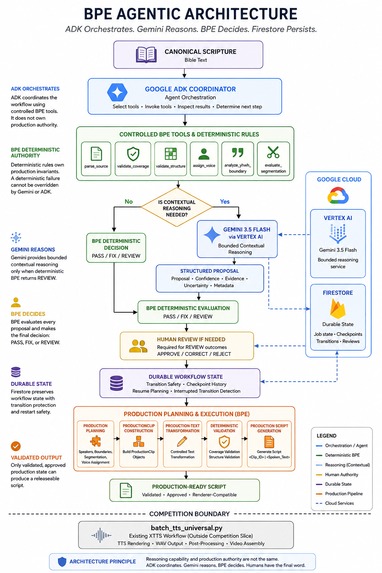
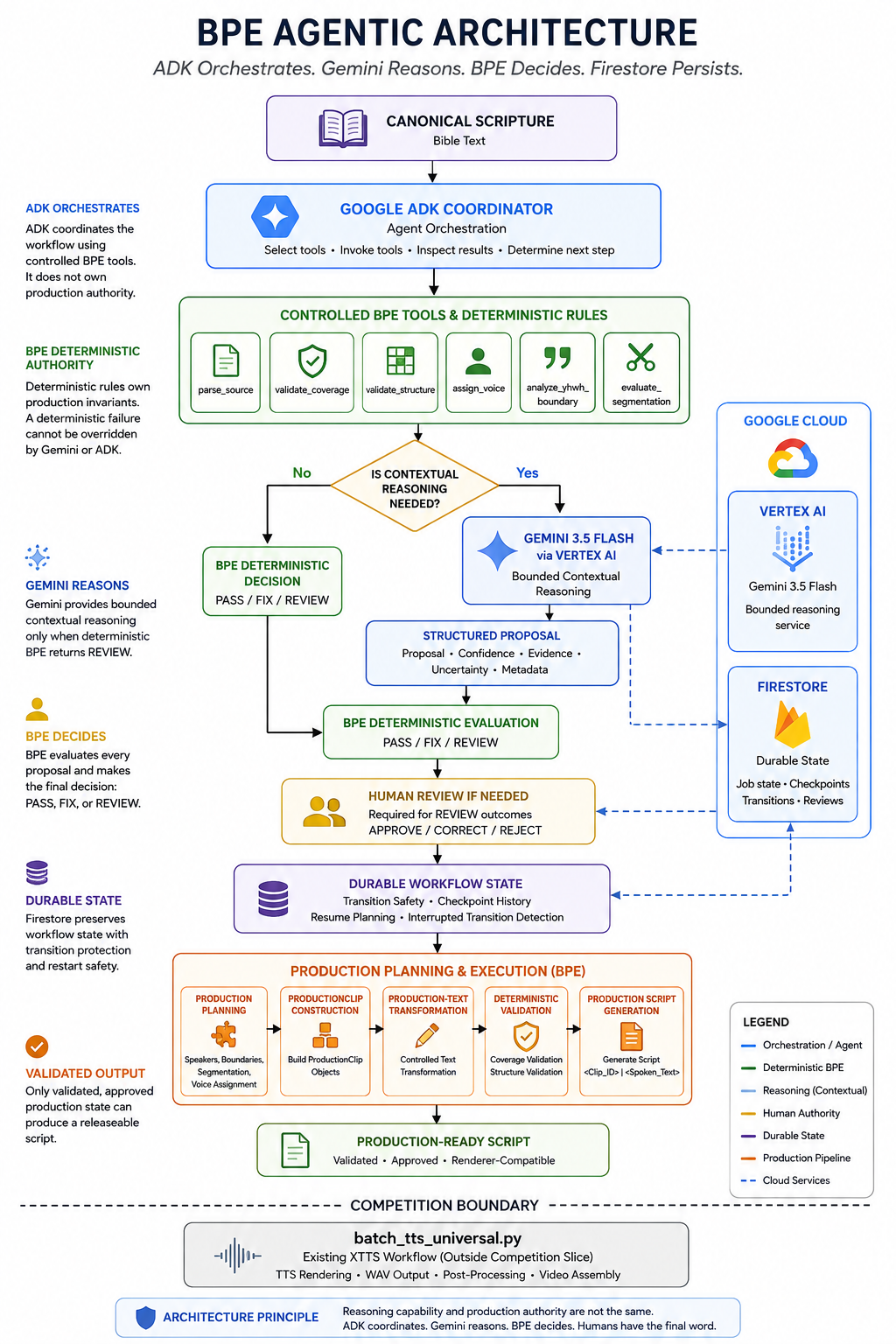
BPE architecture: ADK orchestration, bounded Gemini reasoning, deterministic authority, Firestore state, and human review.
Inspiration
BPE Agentic Production grew out of a real Scripture audio production problem.
While producing Scripture narration, I learned that turning a chapter into production-ready audio requires much more than sending text to a text-to-speech model. The workflow has to determine speakers, preserve verse structure, assign voices, split long passages naturally, validate production rules, generate deterministic clip IDs, and stop when something is uncertain enough to require human judgment.
I had already been developing the broader Bible Production Engine and using a local XTTS workflow for Scripture production. For this hackathon, beginning August 13, 2026, I built BPE Agentic Production as a new agentic competition implementation around that real production experience.
The goal was not to let AI take control of the production system. It was to find a safe way for AI agents to help coordinate it.
What it does
BPE Agentic Production coordinates Scripture production through Google ADK while keeping production authority inside deterministic BPE rules.
The system follows a simple principle:
AI may orchestrate and propose. BPE owns production rules and authorization. Humans resolve uncertainty.
Google ADK coordinates the workflow and tool calls. Deterministic BPE components validate production decisions and control whether work can continue. Gemini 3.5 Flash, accessed through Vertex AI, is used only when bounded reasoning is useful. Gemini can return a structured proposal containing reasoning, confidence, evidence, and uncertainty, but it cannot authorize production.
When deterministic evaluation returns REVIEW, the workflow pauses for human review instead of allowing the agent to continue.
The competition implementation also demonstrates a real Genesis production path that reaches restart-safe, renderer-compatible production output with deterministic clip IDs and female/male voice assignments.
How I built it
The competition implementation uses:
- Python
- Google Agent Development Kit (ADK) 2.6.3
- Gemini 3.5 Flash through Vertex AI
- Google Cloud
- Cloud Firestore
- pytest
- deterministic BPE validators and production rules
The architecture separates orchestration, reasoning, deterministic authority, persistence, human review, production planning, and rendering responsibilities.
Firestore provides the durable persistence architecture for restart-safe workflows. The competition demo also shows actual Agent Platform and Firestore API activity in the Google Cloud project.
A local XTTS renderer can consume the production-ready script output. Because voice-cloning assets are private biometric material and the renderer has substantial local model requirements, those assets are intentionally excluded from the repository. Reproduction of the judged agentic workflow does not require private voice samples.
Challenges
The hardest architectural problem was deciding where AI should stop.
It would have been easier to let an LLM make production decisions directly, but that would weaken the deterministic production system I was trying to preserve. Instead, I built a hybrid boundary where Gemini can help reason about uncertain cases while BPE independently evaluates the result.
Another challenge was making the workflow restart-safe. Agentic orchestration becomes much more useful when interrupted work can resume from durable state rather than simply starting over.
Finally, I wanted the competition project to remain connected to a real production workflow instead of becoming a synthetic demo. The Genesis end-to-end path proves that the architecture can produce output shaped for an actual downstream renderer.
What I learned
This project changed how I think about agentic systems.
I learned that useful agency does not necessarily mean giving an AI more authority. In this system, the agents become more useful because their authority is clearly bounded.
ADK provides orchestration. Gemini provides bounded reasoning. Deterministic software provides authority. Firestore provides durable state. Human review resolves uncertainty.
Those components can work together without requiring any one of them to control the entire system.
What's next
After the competition freeze, BPE Agentic Production can be reintegrated into the broader Bible Production Engine and expanded beyond the competition slice.
Future work can extend production planning, additional canonical books, Apocryphal and other public-domain texts, renderer integration, observability, and more sophisticated human-review workflows while preserving the same authority boundary.

Log in or sign up for Devpost to join the conversation.