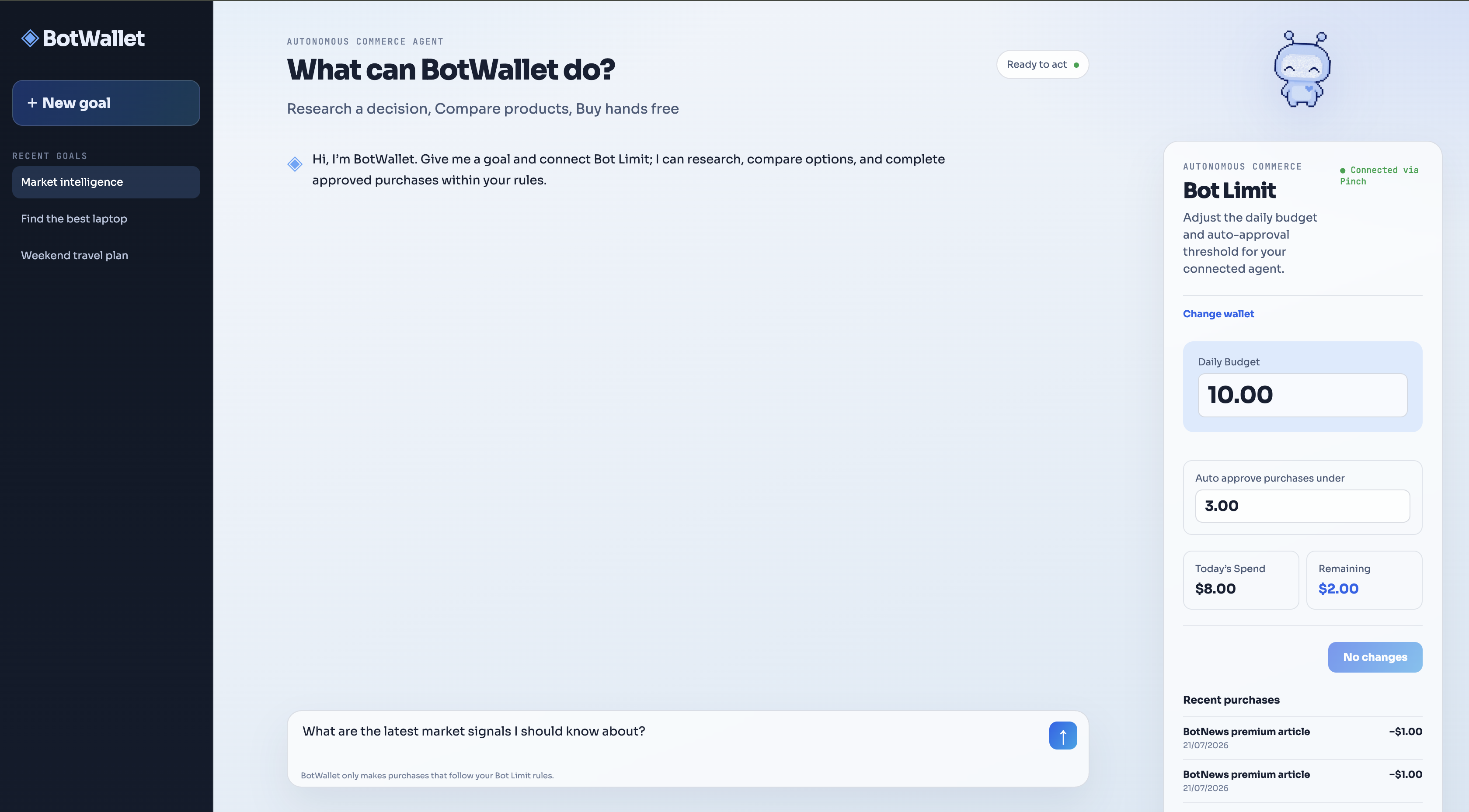

Botwallet is a AI agent payment infrastructure and development tool that let's AI agents become paying customers.
About the Project
We started with a pretty different idea
Our first thought was to build something that could block AI bots. Bots are everywhere on the internet, and according to Cloudflare, automated traffic made up around 56% of internet activity in 2024. That number will only grow. A lot of this traffic is scraping websites, consuming resources, and taking data without paying for it. Our initial thinking was simple: how do we stop them?
But while brainstorming and building with GPT-5.6 and Codex, we started questioning the idea itself. AI agents are clearly becoming more common, especially with the boom of tools like OpenClaw and the growing shift toward autonomous agents, esp agentic workflow. If agents are going to become a bigger part of how people interact with the internet, maybe blocking them isn't the future. Basically the point of agentic workflow is to reduce the amount of decisions human needs to make as much as possible.
We flipped the question around:
What if bots could become customers?
Instead of blocking AI agents, what if websites could actually charge them and let them buy things automatically?
That became the idea behind botwallet :) We built the project around three sides of the problem: the customer, the agent, and the vendor.
The Customer
From the customer's perspective, BotWallet is an AI assistant that can actually buy things for you. You can give it spending limits and rules, and it can search for something you need and make an approved purchase without you having to manually go through every checkout page. Safe + efficient developer tool.
The long-term idea is that you could ask an AI agent to handle things like subscriptions, utilities, travel, clothes, news, or other online purchases. You tell it what you want and what it is allowed to spend, and it handles the transaction. Like giving your secretary a credit card and telling them to book you the cheapest flight to the Alps, and get the best ski gear too.
The AI Agent
The agent is the bridge between the customer and the internet. Today, most websites are designed around humans. You find a product, click buttons, add something to a cart, enter payment details, and complete checkout. An AI agent can't easily do this at scale because the entire experience is built around a human using a browser.
We wanted to explore a different model: machine-to-machine commerce.
In our demo, the agent requests premium content from BotNews. The website responds with a 402 Payment Required message containing the available payment offer. The agent understands the offer, checks its spending rules through BotWallet, pays through Pinch, and then requests the content again.
No shopping cart. No human clicking through checkout. The agent communicates directly with the service and completes the transaction. Directly changed payment infrastructure.
The Vendor
The other side of BotWallet is the website owner.
Right now, many websites see bots as a problem. Instead of asking, "How do I stop bots?", a website owner should ask: "How do I make money from them?"
BotNews is our example of what this could look like. A website, API, or online service could implement the same type of payment flow and allow AI agents to become paying customers.
This creates a potential new audience for businesses: AI agents acting on behalf of people.
It also creates a new source of valuable business data, shown through the vendor dashboard. Vendors can see how much revenue comes from AI agents, what they are requesting and buying, and where this new traffic is coming from. This helps businesses understand and optimise for an entirely new type of customer and cater to bots, which could lead to entirely NEW ways to advertise eg AI assistants, AI search results, and RAG systems, rather than videos and banners.
can work for anything, APIs, data, subscriptions, travel, utilities, clothes, and other online purchases.
Problems We Faced
Several different parts together: the AI agent, BotWallet, BotNews, the HTTP 402 Payment Required flow, and Pinch Payments. We had to make sure they could communicate correctly and that a payment could happen without a human going through a traditional checkout. Def a big mix of api's and documentation to read through :)
We also ran into real integration issues during development. We had payment failures, spending-limit restrictions, server and port conflicts, and problems getting the different services to communicate correctly. We had to repeatedly test the full flow, find where it broke, fix it, and run it again
Weirdly another challenge was making the concept easy to understand. The technology behind machine-to-machine payments can sound boring, so we had to simplify the experience and build a demo that clearly shows what is happening: an agent requests something, receives a 402, understands the payment requirement, checks its spending rules pays and gets access.
The final challenge was deciding how much to build for the hackathon. We could have spent all our time adding more security features, but we realised that proving the core idea was more important. Leads me to what we learnt, don't overengineer!
What We Learned
The biggest thing we learned was that the obvious idea isn't always the best idea (aside from learning to not waste too much time on designing a cute mascot).
Autonomous agents are becoming a bigger part of the internet, so instead of building another system to keep them out, we could build infrastructure that lets them participate in the economy.
We also learned that building a technically impressive system isn't enough. The important question is whether you're solving something people and businesses will actually want. & sometimes make something the future wants, which might not be obvious today
customers want AI assistants that can actually get things done, agents need a way to pay, and vendors need a way to monetise this new traffic. BotWallet sits in the middle of all three.
Bots are blocked today. Bots can be customers tomorrow.
Built With
- 402
- agentic
- bot
- codex
- developertool
- github
- workflows

Log in or sign up for Devpost to join the conversation.