Inspiration
Every quarter a team asks the same question with money on the line: do we hire, automate, or reorganise? The answer usually comes from the loudest opinion or the latest AI tool demo. Yet Jira already holds the evidence: every status change of every work item, with a timestamp.
Eliyahu Goldratt showed that a system moves only as fast as its constraint, and that an hour saved anywhere else is a mirage. Ichak Adizes showed that teams stall when a management role is missing, most often the one that decides what to start and what to drop. We wanted a manager to get both answers from their own Jira in a minute, with a price tag that separates real money from money that exists only on paper.
What it does
Open Bottleneck Economist in any Jira project (Apps in the project sidebar):
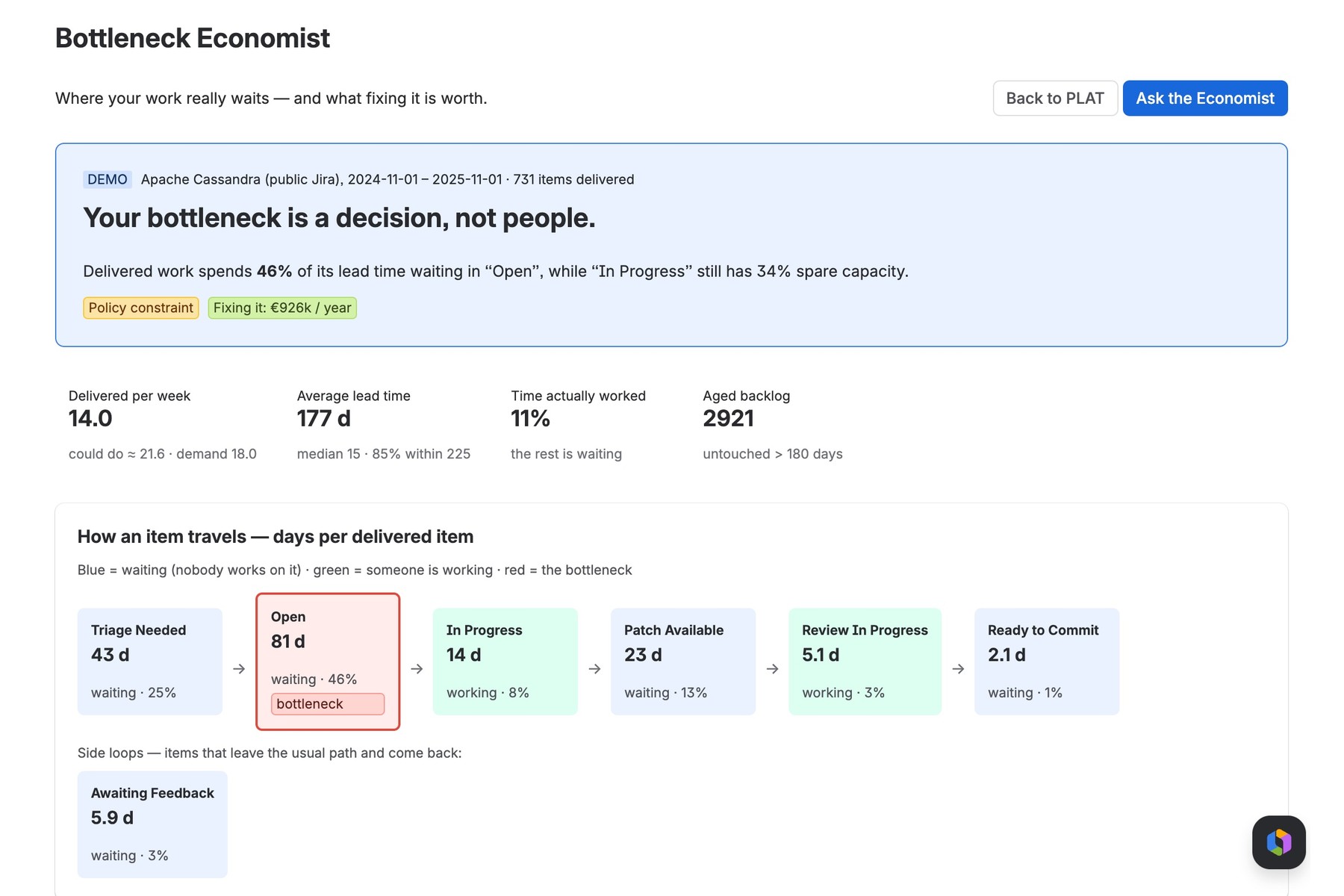
- How an item travels. One year of delivered work becomes a flow: days per item in every status, waiting (blue) or worked on (green), the bottleneck in red.
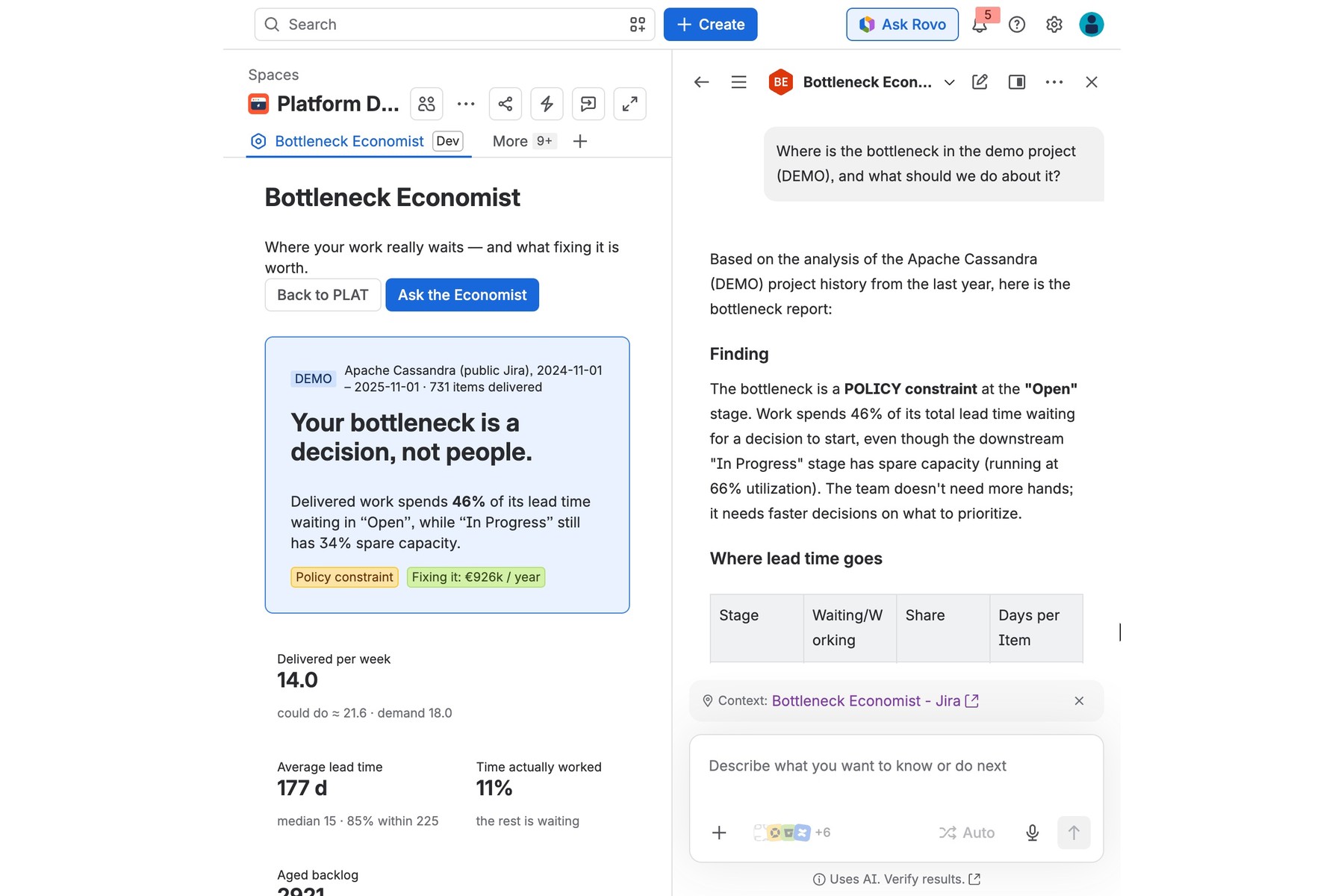
- The constraint, in one sentence. On one year of public Apache Cassandra history: "Your bottleneck is a decision, not people. Delivered work spends 46% of its lead time waiting in 'Open', while 'In Progress' still has 34% spare capacity." That is a policy constraint. More people or automation won't help; changing the rule will.
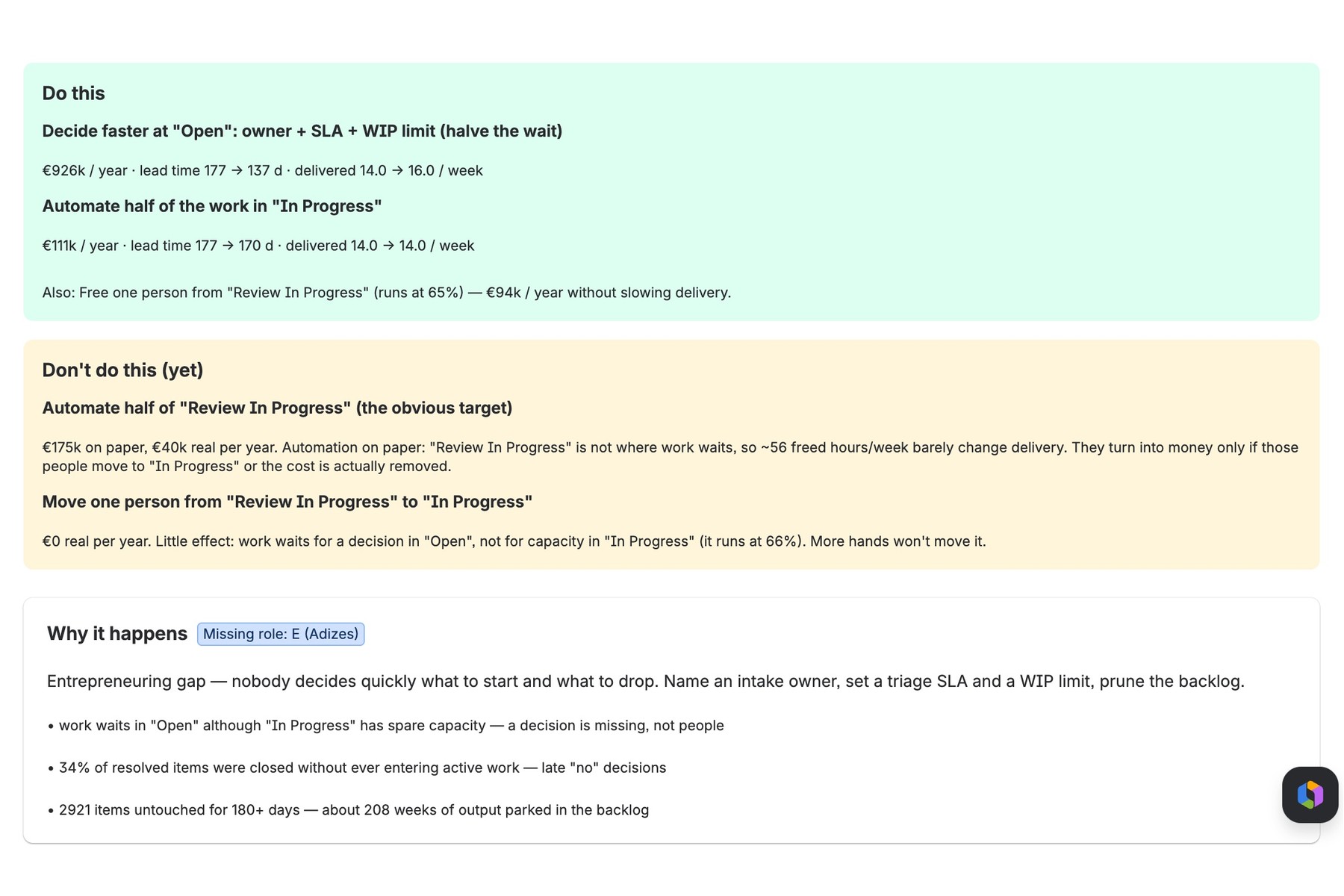
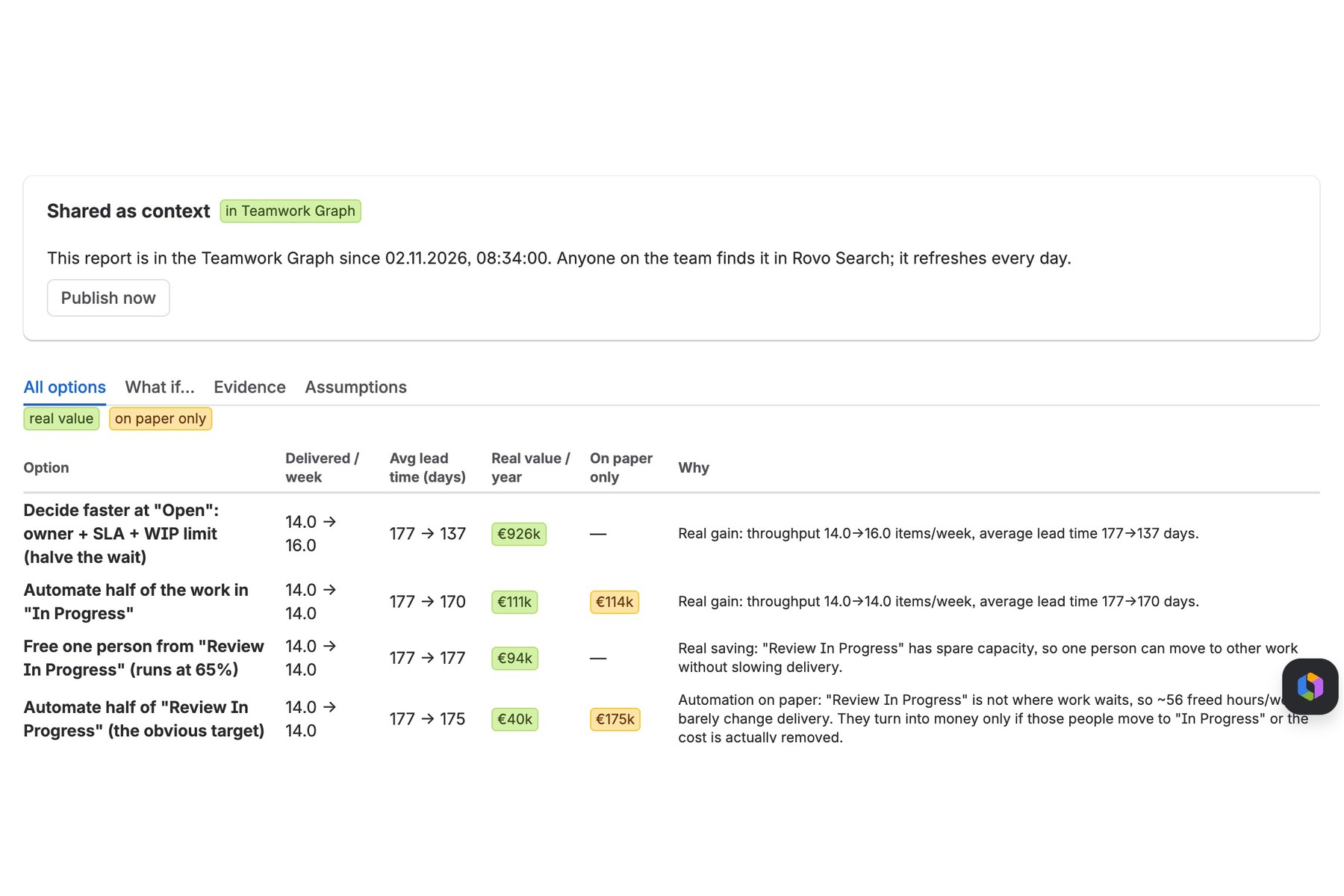
- Do this / Don't do this (yet). Every option is priced per year in throughput-accounting terms:
- Decide faster at "Open" (owner + SLA + WIP limit): €926k/year real.
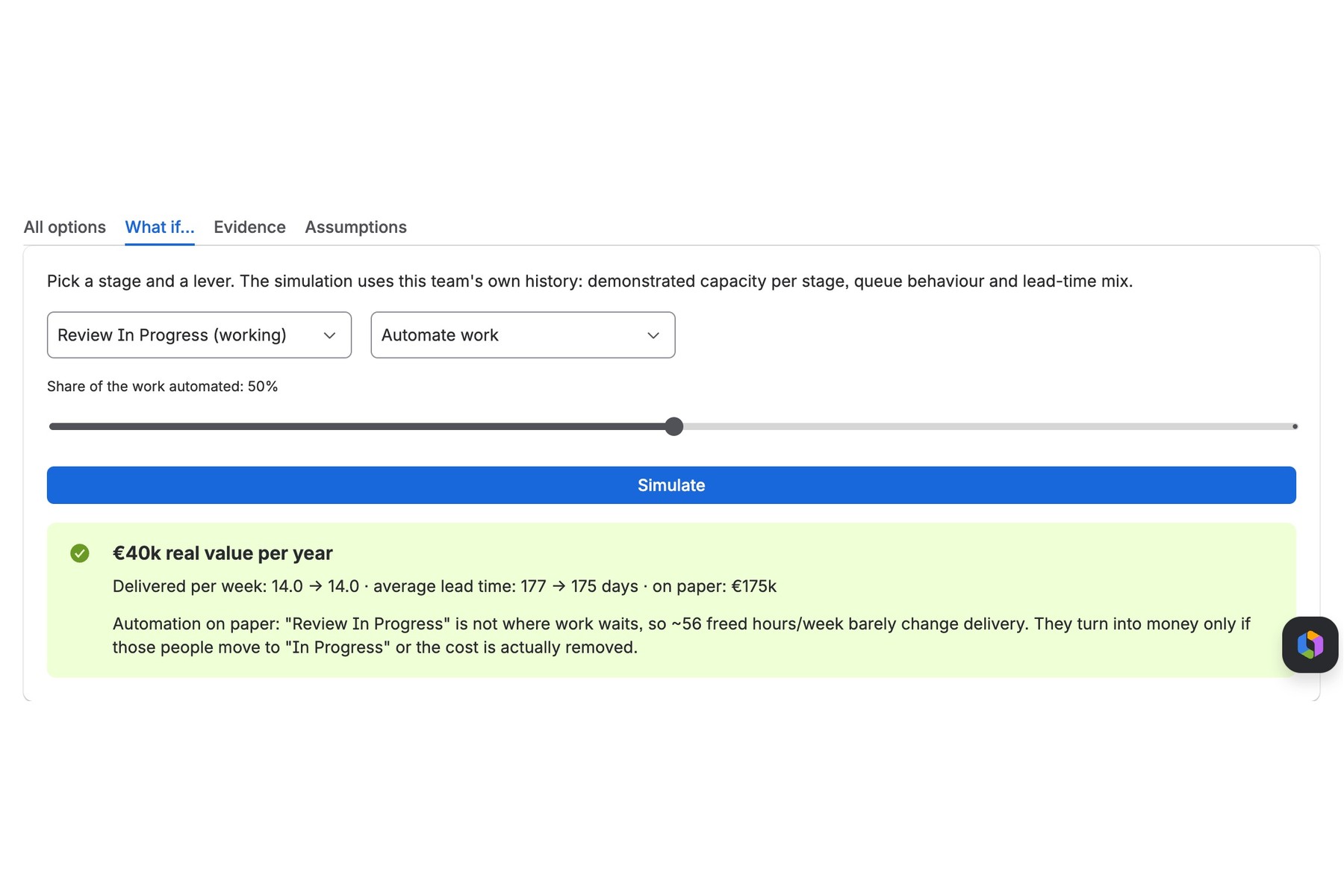
- Automate half of code review, the obvious target: €175k on paper, €40k real. Review is not where work waits, so the freed hours don't deliver anything faster.
- Hire another developer: −€94k/year.
- Why it happens. The Adizes PAEI lens names the missing role from flow evidence. Here it is Entrepreneur: 34% of resolved items were closed without ever being worked on (late "no" decisions), and 2,921 items have been untouched for 180+ days.
- What if… A simulator prices any change at any stage (automate, change a decision rule, hire, move, free a person) and shows delivered items per week and lead time before and after. Money assumptions (cost per hour, value per delivered item, cost of delay, currency) are editable per project.
- Ask the Economist. A Rovo agent answers "Where is our bottleneck?", "What if we automate code review?" or "Is hiring another developer worth it?" from the same tools and always quotes the tool's numbers, never its own.
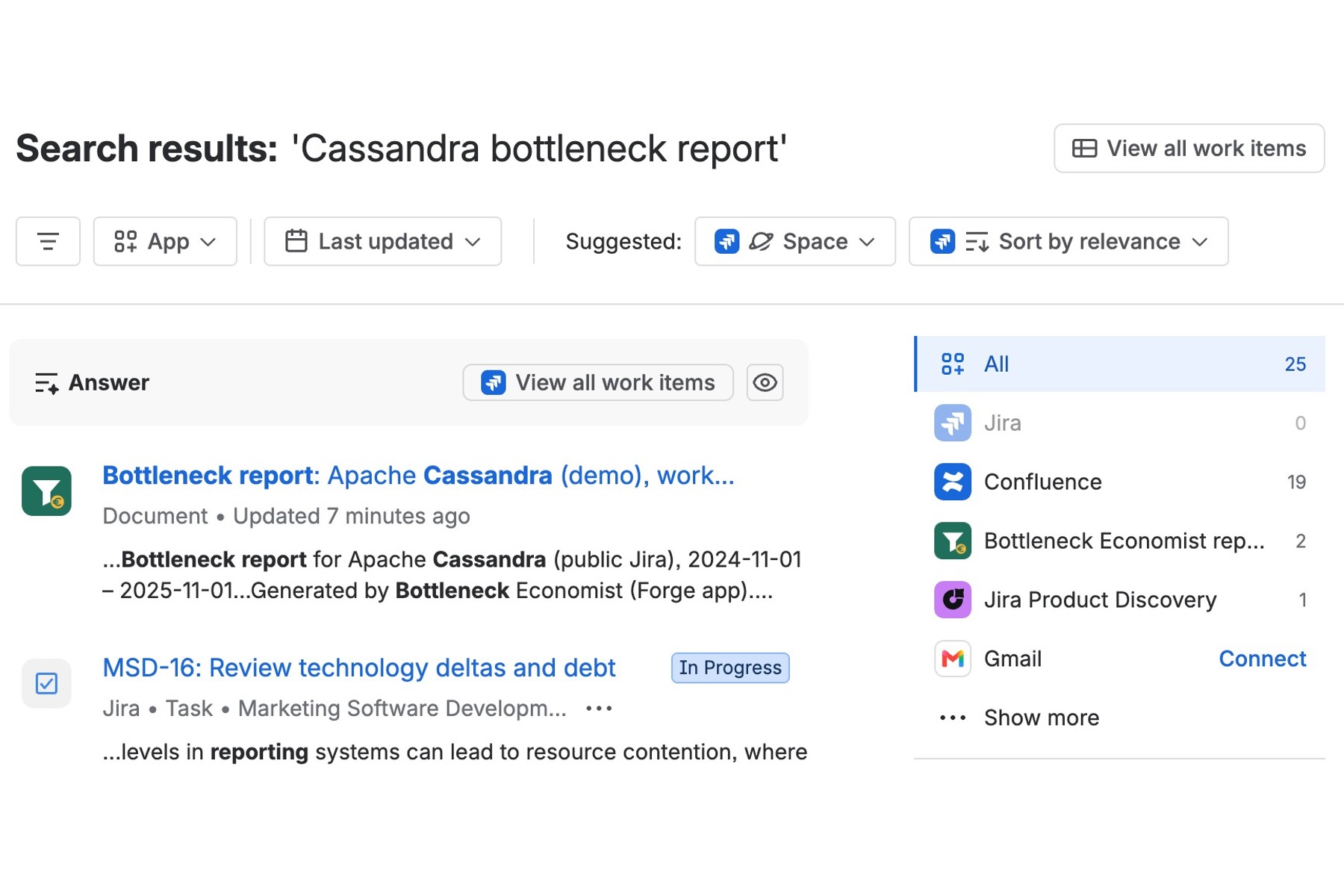
- Shared as context. A Teamwork Graph connector publishes each project's report into the graph, associated with the work items stuck at the bottleneck right now. Anyone on the team then finds "where our work waits and what it costs" in Rovo Search, linked to the very issues that are waiting.
- Any agent, not only Rovo. The same tools are exposed through the Atlassian MCP server (
rovo:mcp), with an open-sourceSKILL.mdso Claude, ChatGPT or Cursor know how to use them well.
How we built it
- Forge, Jira project page in UI Kit (
jira:projectPage): flow chart, option tables, simulator, workflow setup, assumptions. - Rovo agent (
rovo:agent) with 5 actions:analyze-flow,get-analysis-status,simulate-what-if,recommend-actions,set-assumptions. - Atlassian MCP (
rovo:mcp) exposing four of them as tools, plusskills/bottleneck-economist/SKILL.md. - Teamwork Graph connector (
graph:connector,@forge/teamwork-graph):atlassian:documentobjects withissueIdOrKeysassociations; publishes on connection, then on a daily orchestration task (scheduleOrUpdateTask+taskRunner). - Async events (
consumer): large projects (thousands of issues with full changelogs) are read in the background within Forge limits; the page shows progress. - Forge KVS for reports, assumptions and workflow setup. Everything runs on Atlassian; no data leaves it.
- Engine in TypeScript: status segmentation, main path vs side loops, utilisation per stage, constraint classification (policy vs capacity), throughput accounting (real vs paper value), PAEI evidence rules.
- Demo data: one year (Nov 2024 to Nov 2025) of the public Apache Cassandra Jira, 731 delivered items, bundled as aggregates only.
Challenges we ran into
- "Waiting" isn't a Jira category. A status name doesn't say whether anyone works on the item: "Patch Available" means "waiting for a reviewer". We classify statuses by meaning and let teams correct the classification on a Workflow setup screen.
- Bulk edits lie. Teams that bulk-close old issues create fake flow. We detect status changes made in bulk (within two minutes of each other) and show a data-quality warning next to the result.
- Paper value is seductive. Freed hours look like savings in any spreadsheet. Throughput accounting made us show them separately: they become money only if people move to the constraint or the cost actually disappears.
- Teamwork Graph connections are created by an admin in Atlassian Administration, and a connection stops accepting writes after a manifest change. We publish on connection and on a daily orchestration task, forget connections the platform reports as gone, and show the publication status (with a Publish now button) on the page.
Accomplishments that we're proud of
On real public data, the app reaches a conclusion a team would argue about for weeks: the expensive fix everyone wants (automate review, hire) is worth almost nothing, and the cheap one (a decision rule at intake) is worth €926k a year. It shows its evidence, and it never blames a person.
What we learned
Most delivery problems that look like capacity problems are decision problems. The data to prove it is already in Jira; it only needs to be read as a flow and priced honestly.
Who built it
The idea and product decisions are Khrystyna Didukh's; she built it for Codegeist 2026 together with Claude (Anthropic) as her coding partner.
What's next
- Jira Service Management queues and Confluence approval flows with the same engine.
- Cost of delay from Jira fields (due dates, priority, linked revenue).
- A weekly digest from the Rovo agent when the constraint moves.
Built With
- forge
- forge-ui-kit
- jira
- model-context-protocol
- node.js
- react
- rovo
- teamwork-graph
- typescript
