-
-
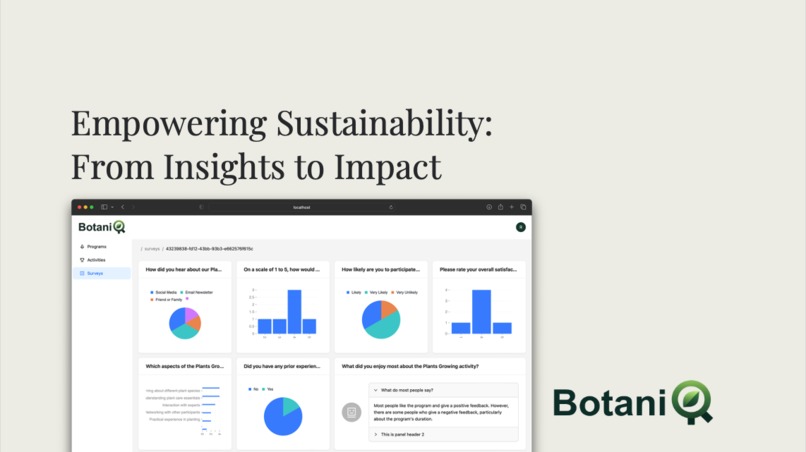
Project Cover
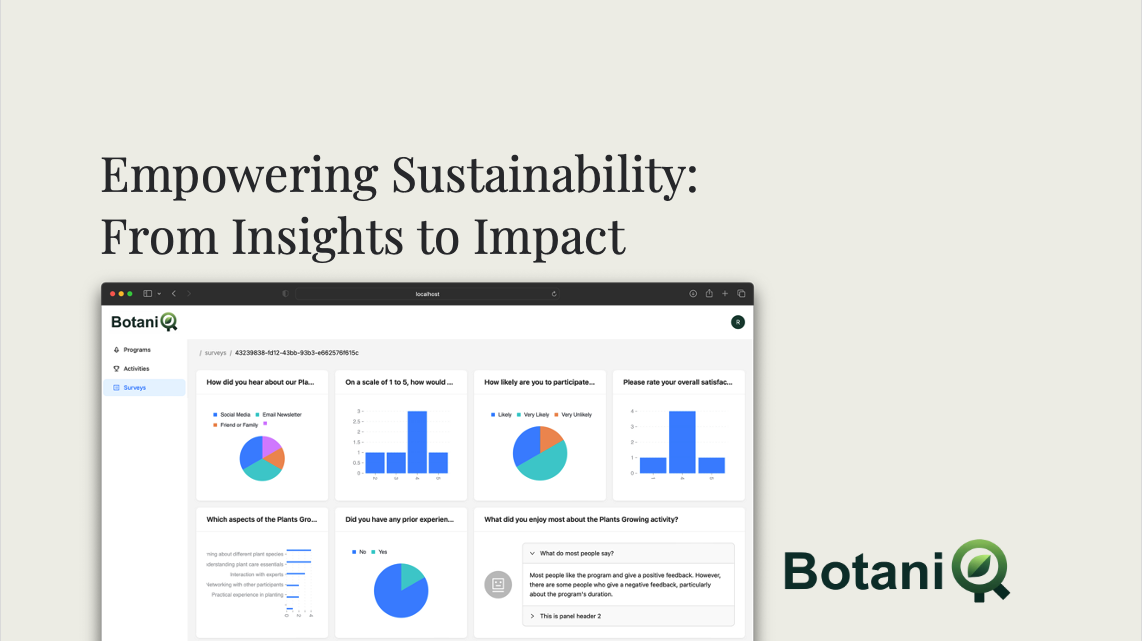
Inspiration
Recognising the challenges that GUI faces in collecting, managing and interpreting data from diverse feedback avenues and survey sources, especially with a large number of volunteers who provide essential feedback to GUI programs and activities, we set out to create a solution that not only simplifies the process of data analysis but also empowers decision-makings at GUI with actionable insights.
What it does
BotaniQ aims to provide a user-friendly interface for GUI to manage their programs and activities, while facilitating a streamlined process for collecting, analysing and interpreting data from diverse feedback channels with regards to their sustainability efforts. Beyond mere data management, BotaniQ integrates analytics tools that automatically process and visualise the data, highlighting key trends, patterns and insights. It utilises on sophisticated Artificial Intelligence (AI) to provide three forms of analysis - Sentimental, Summary and Keyword. Ultimately, BotaniQ aims to transform the way GUI manages its sustainability programs and activities by empowering data-drive decisions that amplify the impact of their work, fostering a more sustainable future through informed and strategic action.
How we built it
We used Next.js as our frontend framework coupled with typescript for strict typing and data cohesiveness. We chose Supabase as a backend provider as Supabase provided scalable and extensive SQL capabilities, which were required in our design and product requirements due to the interconnectedness of the large amount of data we were processing. Lastly, we integrated Open Source AI models to process and interpret the data through Natural Language Processing (NLP) functionalities. To optimise the use of AI while managing costs and efficiency, we implemented a caching strategy in our database to reduce the number of redundant AI calls for similar queries, thereby enhancing performance and minimising operation expenses.
Challenges we ran into
One of the primary hurdles was integrating Open Source AI models into our system effectively. To ensure that our model delivered accurate analyses of a large amount of data, we had to fine tune and train our models through complex prompt engineering. This required a deep understanding of how to craft prompts that could guide the AI to interpret and analyse the data in ways that aligned with our specific needs. Furthermore, the large amount of data to be processed posed a problem for data size limitations.
Ensuring privacy and security of data in our system was also paramount. We encountered challenges in implementing end-to-end encryption and secure data transfer protocols. Fortunately, we were able to overcome this by implementing Row-Level Security (RLS) with Supabase through a set of security policies on our database tables. This meant that we could control access to individual rows based on user roles or specific criteria.
Accomplishments that we're proud of
We are immensely proud of crafting a robust, intuitive and minimalist interface which makes the use of the platform accessible to users of varying technical backgrounds. We prioritised intuitive navigation ensuring that users could find the information that they need easily. This involved a thoughtful layout and user flow between different parts of the platform, which was achieved through the use of Table Top Exercises and User Journey Mapping where we identified any potential pros and cons of our initial design.
What we learned
Adapting to the challenges during the software development process, we learnt to manage large datasets and ensure system scalability reinforced the importance of flexibility and continuous learning. The interdisciplinary nature of the project also taught us the need for effective communication and collaboration across different domains, ensuring that everyone's expertise was adequately harnessed.
What's next for BotaniQ
- Integration with more form platforms We aim to expand compatibility to include a broader range of form platforms, enhancing the system ability to gather from diverse sources. We also hope to simplify the data import processes, ensuring seamless data flow from different tools and to facilitate unified data collection
- More in-depth charts We hope to develop and improve on advanced visualisation tools to offer more nuanced insights. This includes tailoring visualisation options to match the specific needs of GUI sustainability programs, enabling stakeholders to easily understand impacts, trends and outcomes
- AI-Powered Solutioning We want to leverage on AI to provide solution development through suggesting actionable strategies based on user feedback. This includes predictive analytics that forecast the outcomes of sustainability initiatives, allowing for proactive adjustments
Built With
- antd
- nextjs
- supabase
- typescript

Log in or sign up for Devpost to join the conversation.