-
-
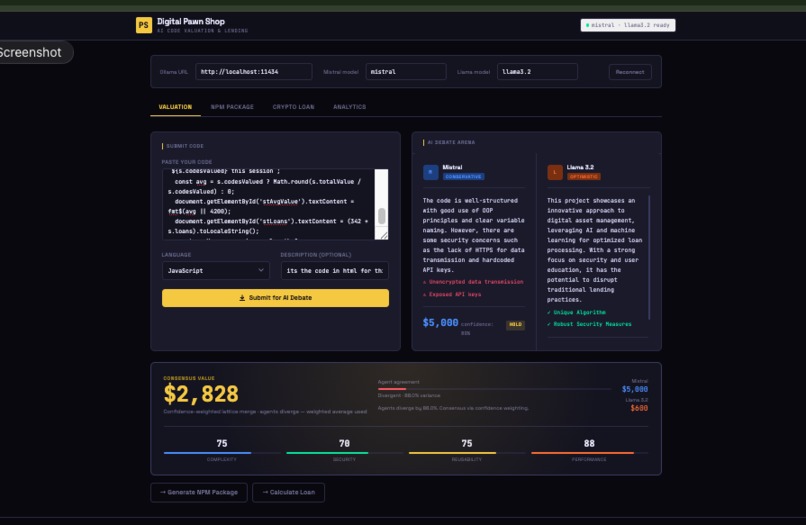
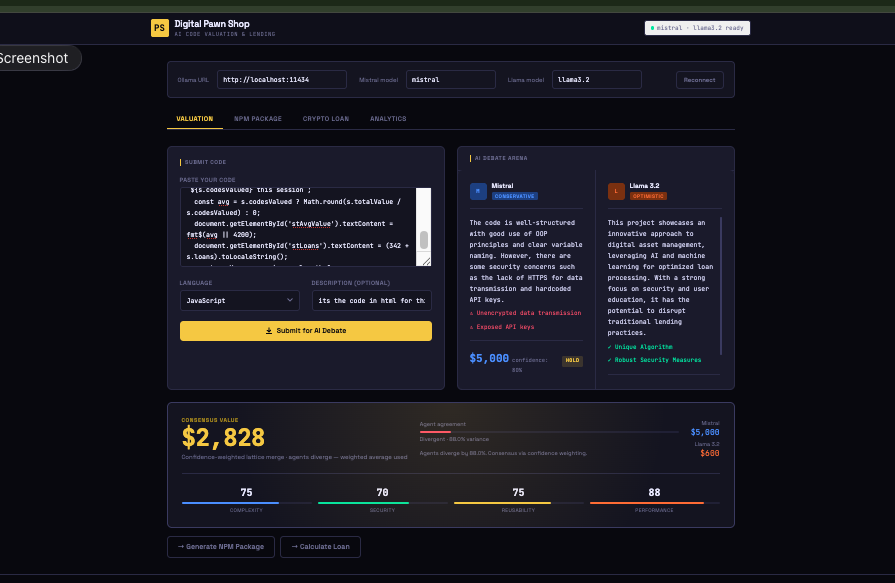
The first code analyzed
-
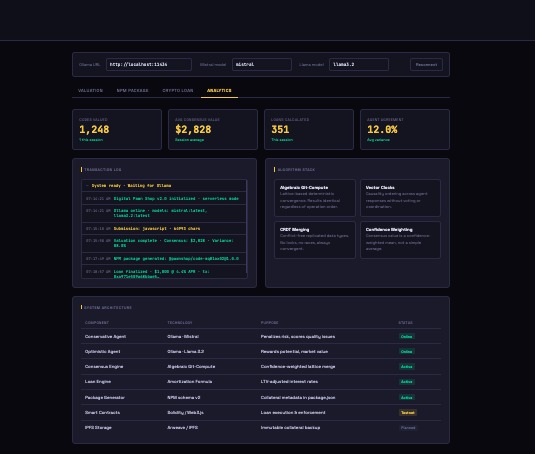
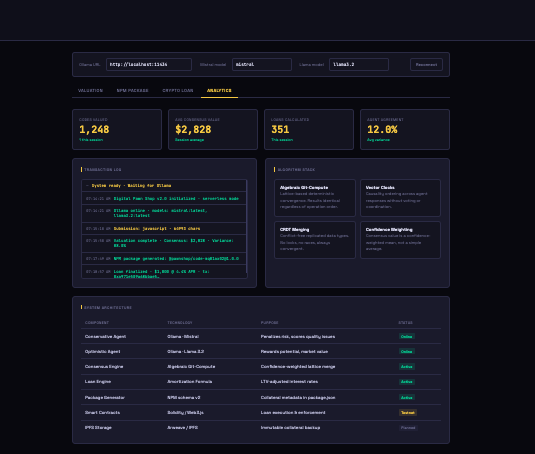
Analytics
-
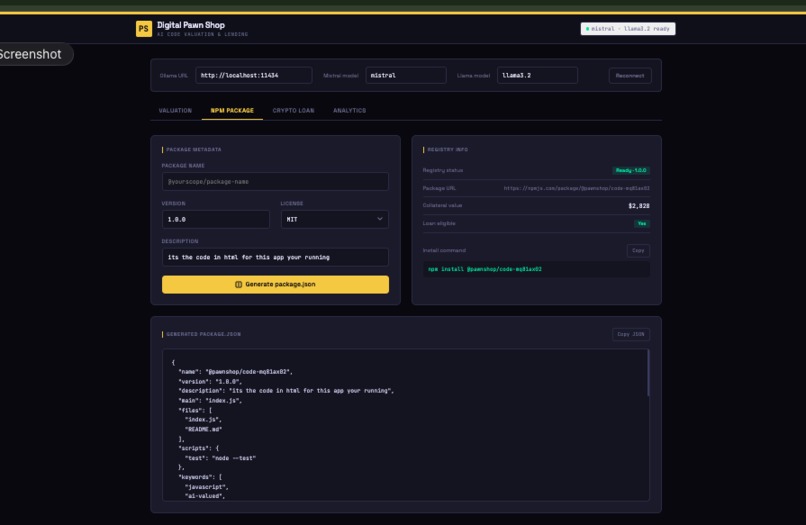
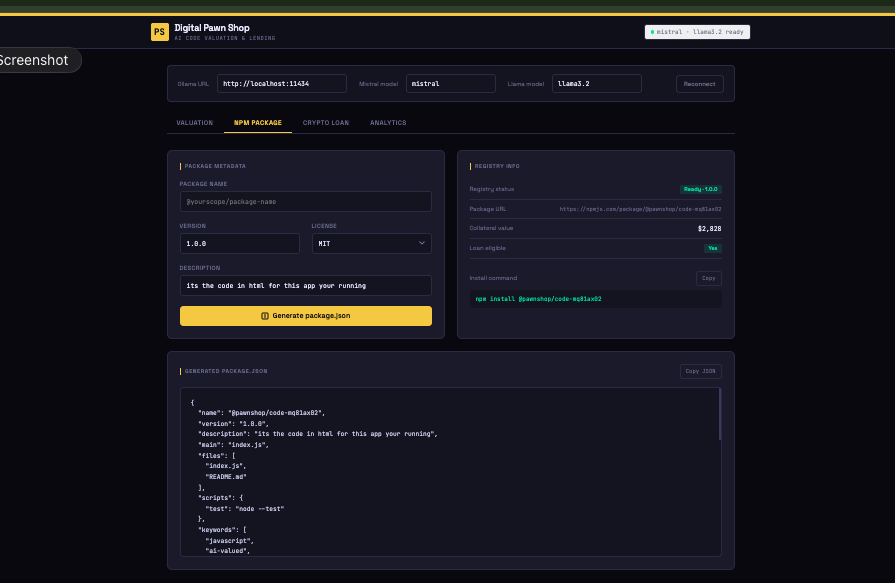
NPM package build
-
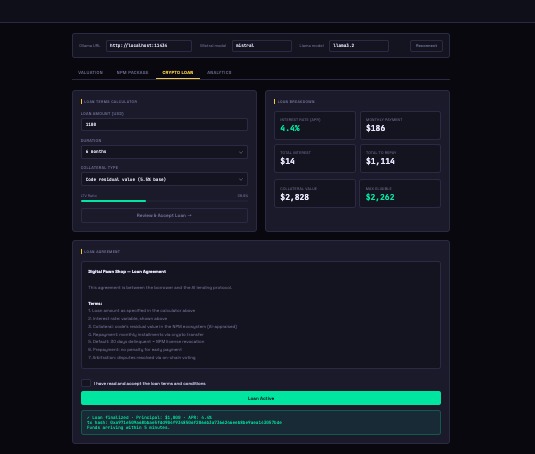
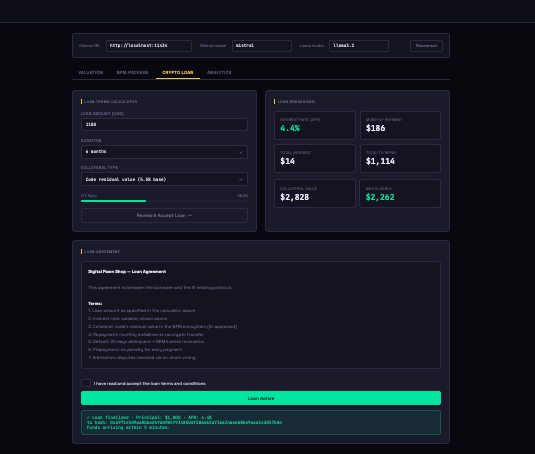
Crypto Loan section
🏪 Digital Pawn Shop
AI-Powered Code Valuation & Software Asset Lending
Inspiration
Software powers the modern world, yet developers often struggle to unlock value from the assets they create. A house can be used as collateral. A car can be used as collateral. Intellectual property and software, despite often being worth thousands or millions of dollars, are difficult for individuals to monetize without selling ownership outright.
We started asking a simple question:
What if code itself could become collateral?
That idea led us to build Digital Pawn Shop, an AI-powered platform that evaluates software assets and generates lending offers based on their estimated value.
We were also interested in exploring a broader question: can multiple AI systems collaborate to reach better decisions than a single model acting alone? Instead of relying on one model's opinion, we created a system where two AI agents debate the value of software before reaching a consensus.
What It Does
Digital Pawn Shop allows developers to submit source code and receive an AI-generated valuation.
The platform uses two local AI models running through Ollama:
- Mistral acts as a conservative evaluator focused on risk.
- Llama 3.2 acts as an optimistic evaluator focused on potential.
Both models independently analyze the submitted code and produce valuations. Their outputs are then combined through a consensus layer to generate a final estimate.
Once a valuation is produced, the system can:
- Generate lending terms
- Calculate loan-to-value ratios
- Estimate repayment schedules
- Create package metadata suitable for NPM distribution
- Visualize valuation reasoning and confidence
The result is a proof-of-concept for treating software as a financial asset.
How We Built It
The project combines local AI inference, valuation logic, and a lending simulation into a single end-to-end workflow.
Technology Stack
- Ollama
- Mistral
- Llama 3.2
- Node.js
- Express
- HTML/CSS/JavaScript
- Algebraic Consensus Concepts
- NPM Package Generation
Architecture
Developer Submission
        ↓
Code Analysis
        ↓
┌──────────────┬──────────────┐
│              │              │
▼              ▼
Mistral      Llama 3.2
(Risk)      (Potential)
│              │
└──────┬───────┘
       ▼
Consensus Layer
       ▼
Valuation Engine
       ▼
Loan Generator
       ▼
Analytics Dashboard
The valuation engine considers factors such as:
- Complexity
- Security
- Maintainability
- Documentation
- Reusability
- Potential market demand
We experimented with consensus formulas where multiple model outputs converge into a final valuation.
$$ V = \frac{v_1 c_1 + v_2 c_2}{c_1 + c_2} $$
Where:
- $v_1, v_2$ are model valuations
- $c_1, c_2$ are confidence scores
This produces a weighted consensus value while exposing disagreement between models.
Challenges We Ran Into
1. Valuing Software Is Hard
Unlike real estate or vehicles, software does not have a universally accepted market price.
A major challenge was designing a valuation framework that feels reasonable while remaining explainable. We had to balance:
- Code quality
- Security concerns
- Future potential
- Market usefulness
while avoiding completely arbitrary numbers.
2. Getting AI Models to Disagree Productively
Initially both models produced similar outputs, which made the debate less interesting.
We redesigned prompts so that:
- Mistral focuses on risk and weaknesses.
- Llama focuses on opportunity and upside.
This created more diverse reasoning and more useful consensus outcomes.
3. Building an Understandable Financial Model
Financial systems can become complicated very quickly.
We wanted loan calculations to be transparent and easy to follow, so we exposed the assumptions behind:
- Interest rates
- Loan-to-value ratios
- Repayment schedules
instead of hiding them behind black-box logic.
4. Running Everything Locally
Using Ollama meant we could avoid external APIs and keep code analysis local, but it also required careful orchestration of model requests, response handling, and system performance.
What We Learned
This project taught us several lessons:
- Multi-agent AI systems can produce richer outputs than a single model.
- Consensus mechanisms are useful beyond traditional distributed systems.
- Software valuation is an incredibly complex problem with both technical and economic dimensions.
- Developers increasingly need financial tools designed around digital assets rather than physical ones.
Most importantly, we learned that software itself may become a new class of collateral in the future, but only if valuation methods become trustworthy, transparent, and explainable.
Future Plans
Digital Pawn Shop is currently a proof-of-concept, but there are many directions we would like to explore:
- GitHub repository analysis
- Dependency graph valuation
- Download and adoption metrics
- Automated testing and scoring
- IPFS-backed asset storage
- Smart contract collateral escrow
- Software asset marketplaces
- Intellectual property valuation
- Institutional underwriting models
Our long-term vision is to build the financial infrastructure needed for software assets to participate in the broader economy.
Closing Thoughts
Digital Pawn Shop explores a future where software is treated as a first-class economic asset.
By combining local AI models, explainable valuation, consensus reasoning, and lending simulations, we created a platform that asks a simple but provocative question:
If software creates value, why shouldn't software itself be valuable collateral?
This project is our attempt to explore that future.
Built With
- ai
- algorithms
- application
- artificial
- asset
- blockchain
- consensus
- crypto
- css3
- developer
- fintech
- firefox
- html5
- intelligence
- javascript
- learning
- llama
- local
- machine
- mistral
- multi-agent
- npm
- ollama
- open
- software
- source
- systems
- tools
- valuation
- web

Log in or sign up for Devpost to join the conversation.