-
-
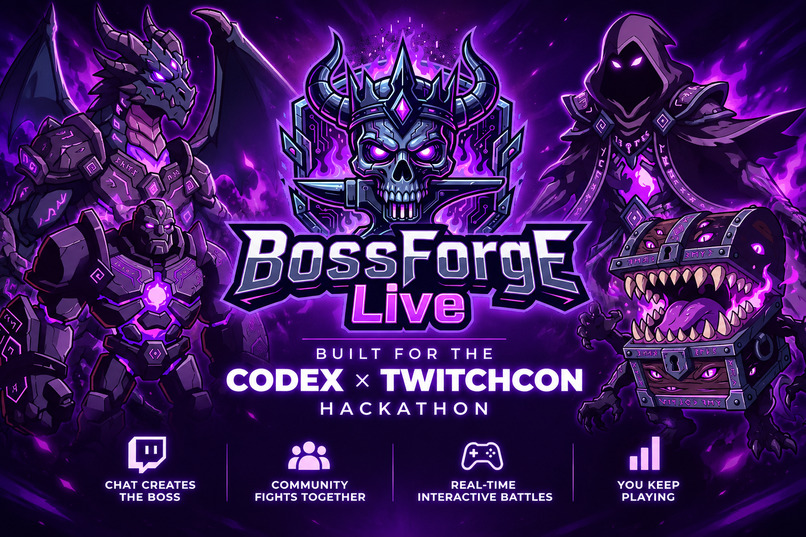
BossForge Live - TwitchCon 2026 x Codex
-
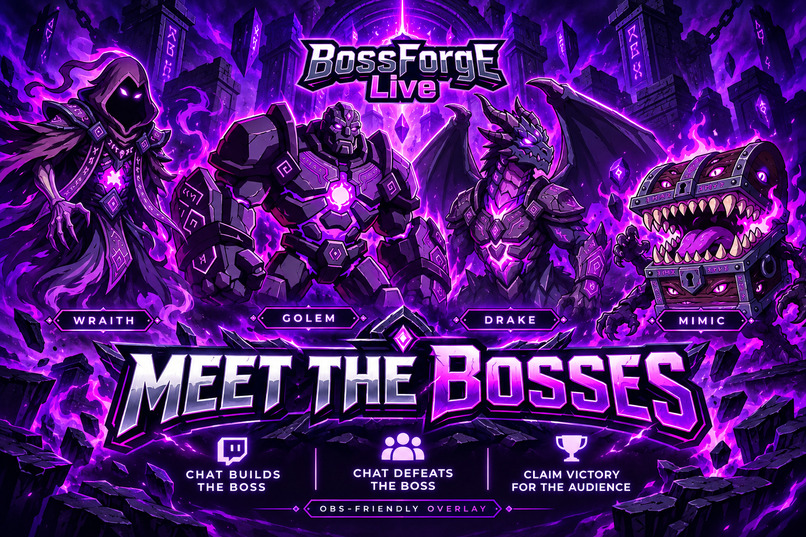
BossForge Live - Meet the Bosses
-
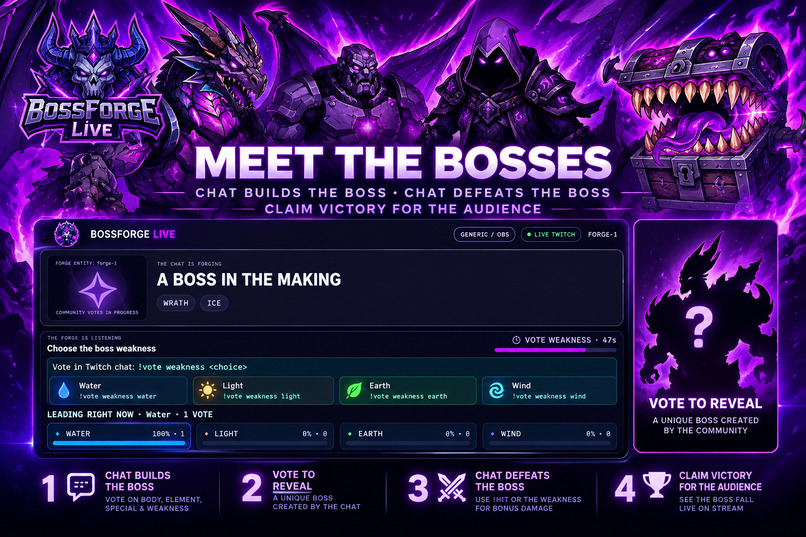
BossForge Live - Chat to Reveal the Boss
-
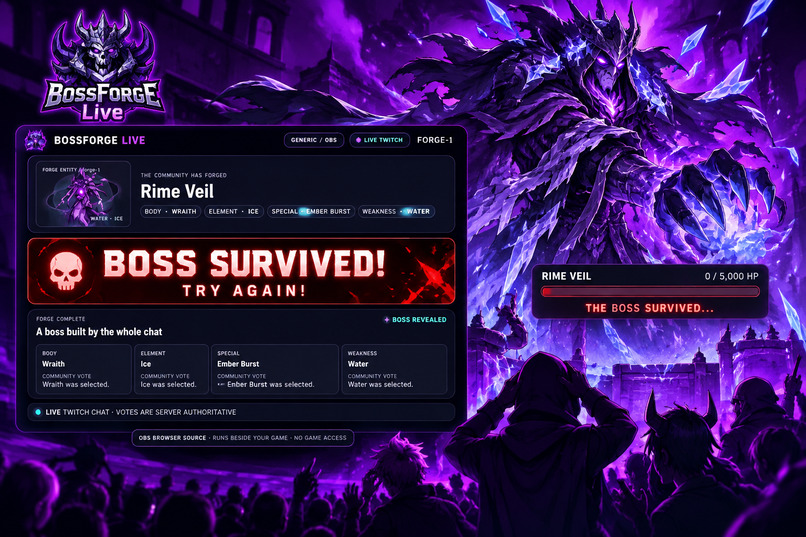
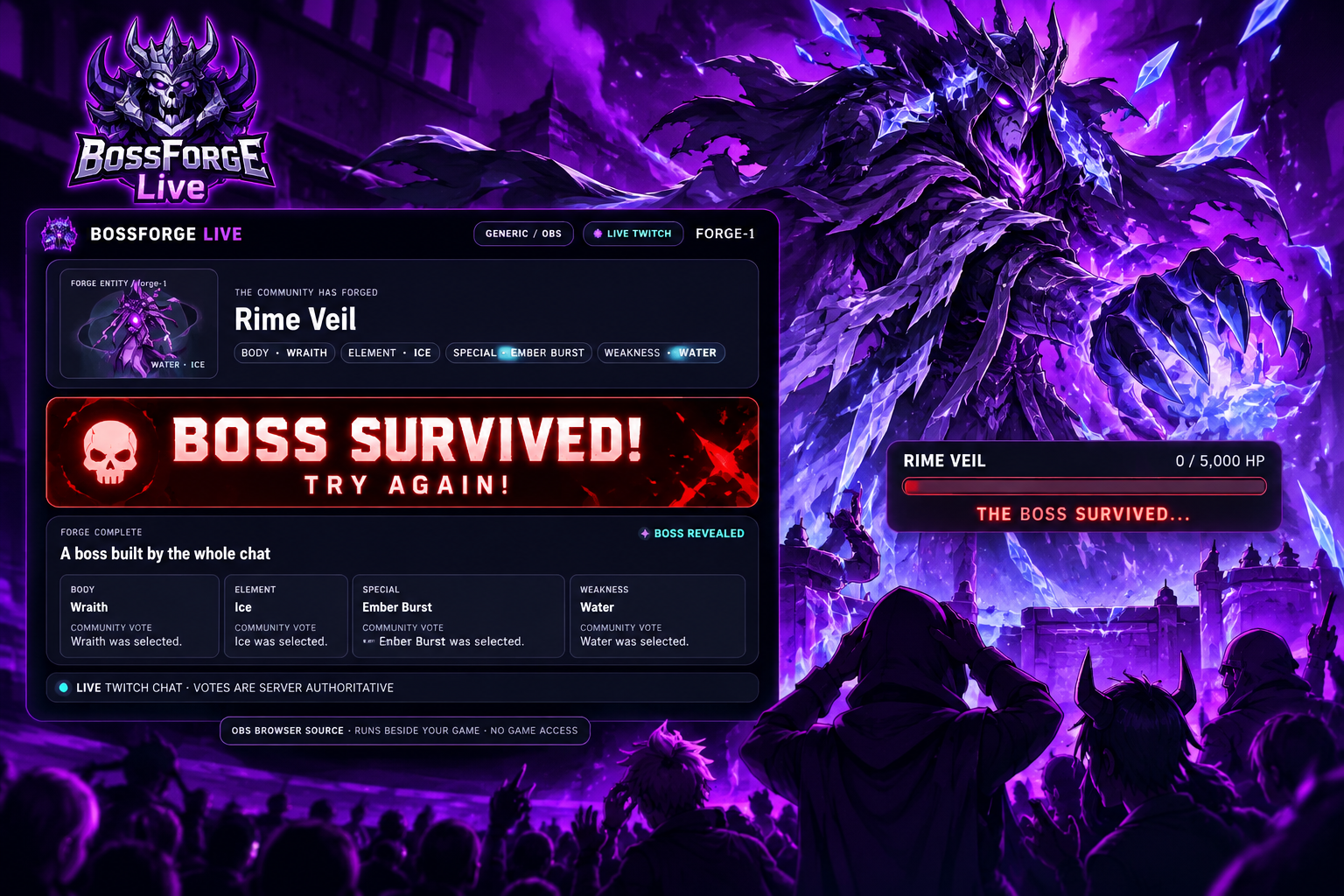
BossForge Live - Suffer Defeat!
-
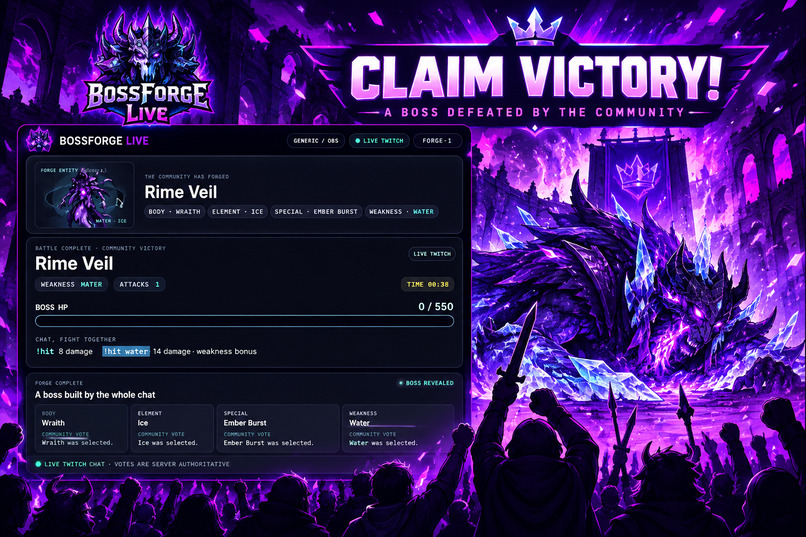
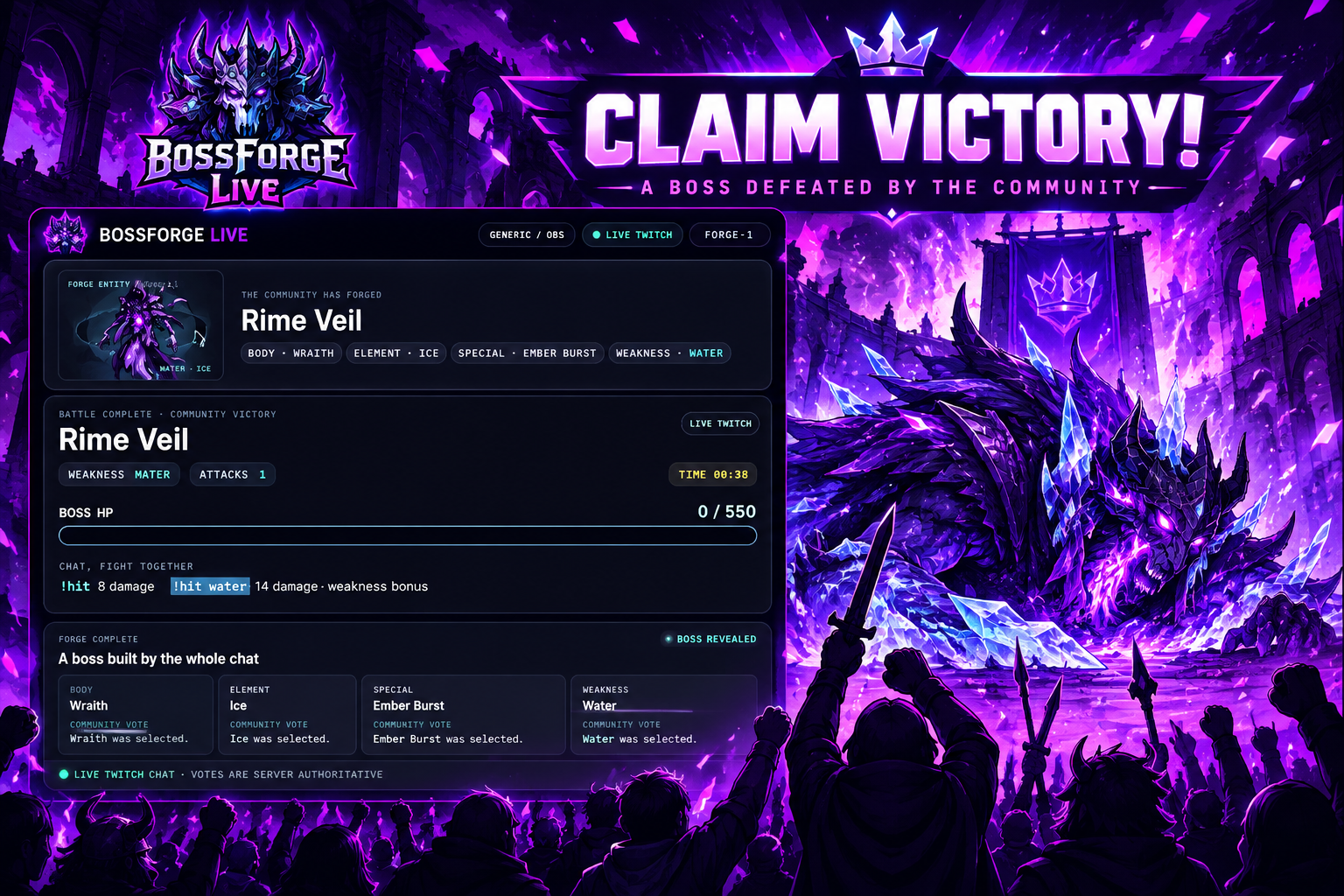
BossForge Live - Claim Victory!
Inspiration
What if the hardest boss on your stream wasn't created by a game developer, but by your own Twitch community?
Twitch has always been about community. Viewers cheer, react, vote, and share memorable moments with their favorite streamers. But we wanted to take that interaction further.
Instead of simply watching gameplay or choosing between predefined events, we imagined an experience where Twitch chat could create an entirely new boss—and then work together to defeat it.
That's how BossForge Live was born.
Our original vision was to let audiences design monsters for their favorite streamers to fight. As we developed the idea, we realized something even more interesting: what if the streamer didn't have to stop playing their existing game?
What if the community could build and battle its own boss directly on the livestream?
That became our guiding principle:
Chat creates the boss. Chat fights the boss. The streamer keeps playing.
Every community has a personality. Every monster they create should reflect it.
And every stream should have the potential for an unexpected boss battle.
What it does
BossForge Live turns Twitch chat into a cooperative boss battle that works alongside almost any game.
The experience has four stages:
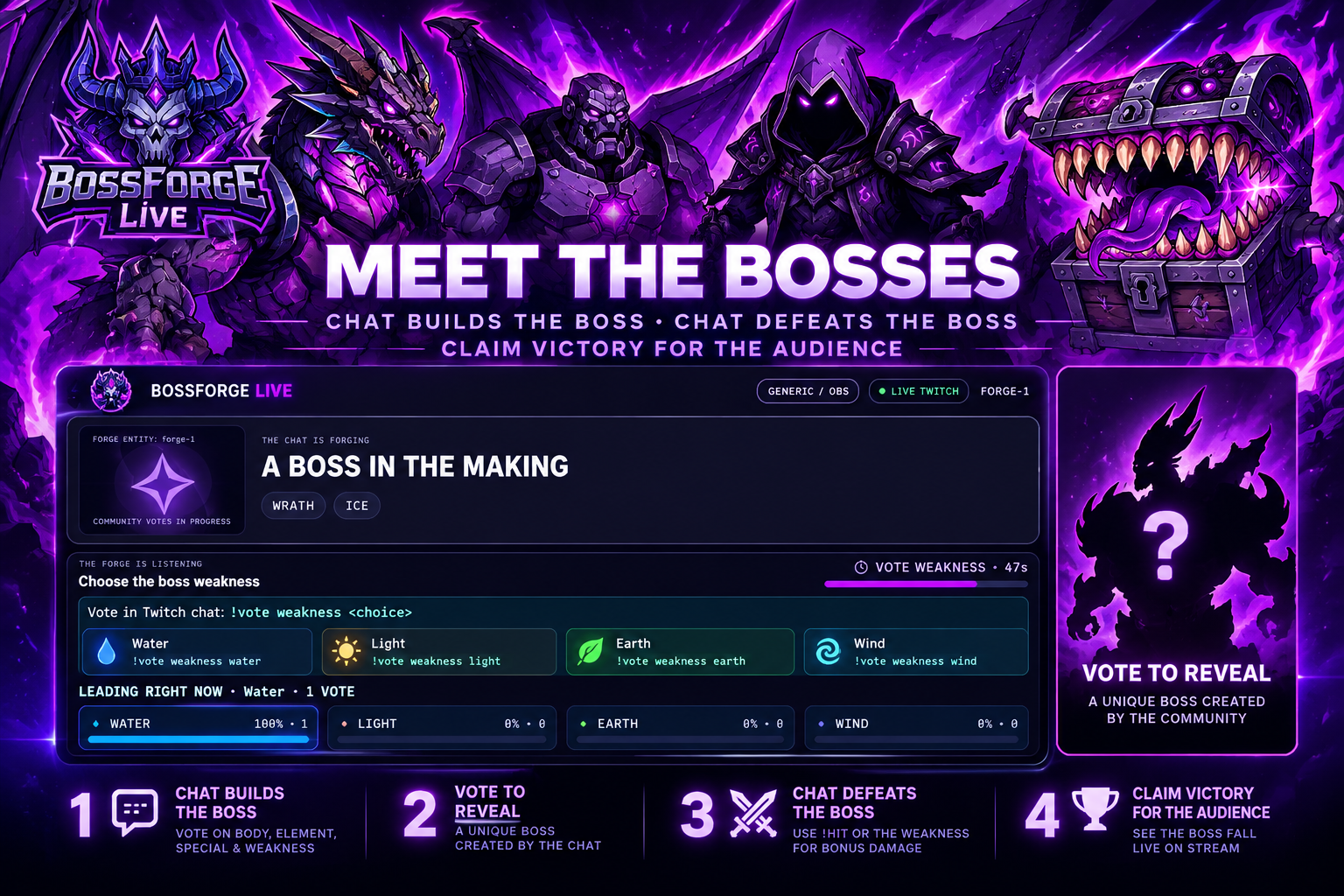
- Forge the Boss: Twitch viewers vote through chat to choose the monster's body, element, special ability, and weakness. Each voting stage determines another part of the creature.
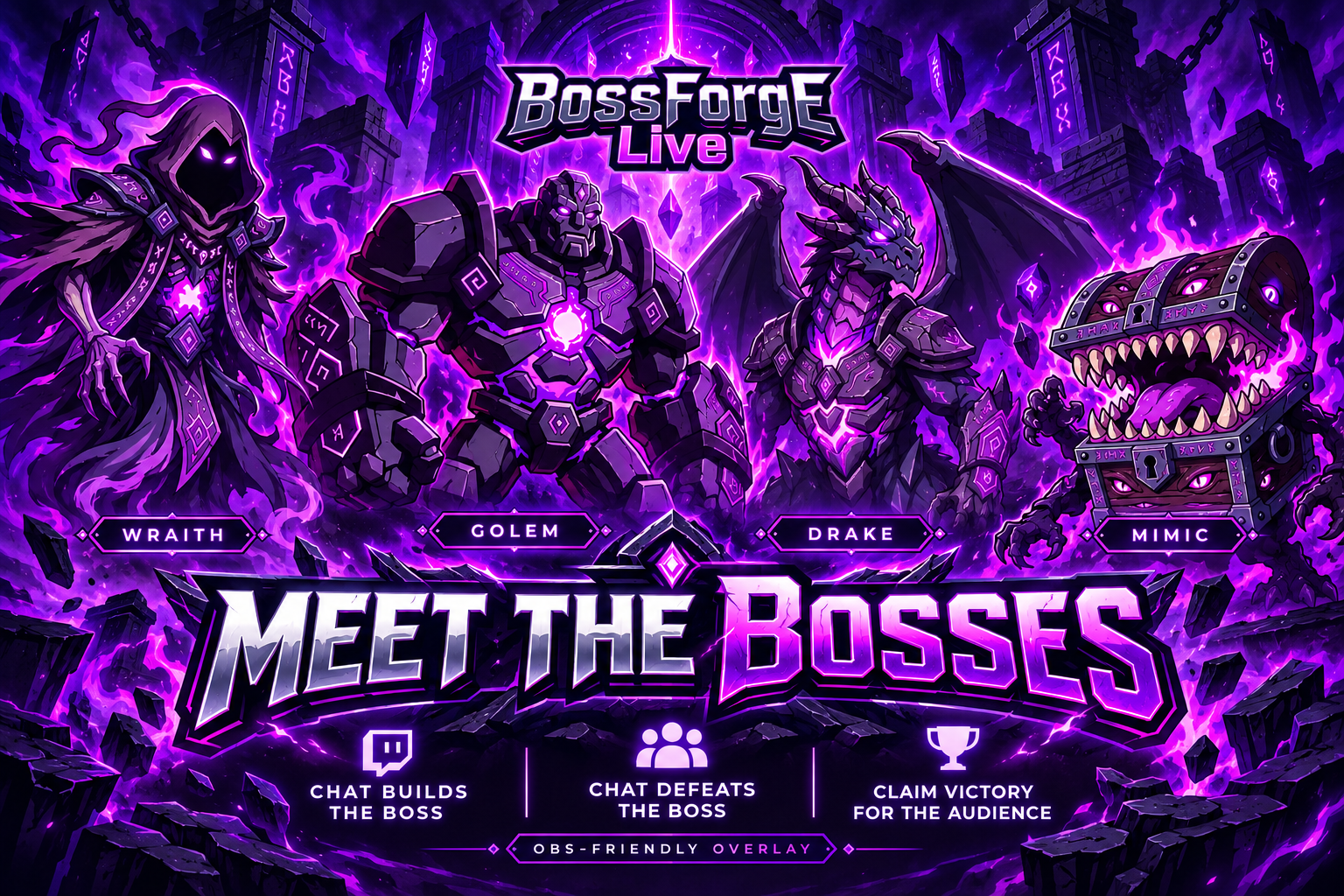
- Bring It to Life: The winning choices combine into a unique boss with original character artwork, generated attributes, and animations. The community can create Wraiths, Golems, Drakes, and Mimics with different elemental combinations.
- Battle Together: Once the streamer starts the encounter, viewers attack through Twitch chat using
!hitor an element-specific command. Matching the audience-selected weakness deals bonus damage. BossForge manages HP, attack validation, cooldowns, and battle outcomes on the server. - Claim Victory or Try Again: If the community reduces the boss's HP to zero before time expires, everyone celebrates a Community Victory. Otherwise, the boss survives. The streamer can start another forge and let chat create a new challenger.
The entire experience appears through an OBS-compatible browser overlay, displaying the boss, animations, voting instructions, health bar, timer, and battle status.
Unlike traditional game integrations, BossForge doesn't need access to the streamer's game, control their character, or modify gameplay.
The streamer keeps playing. The community creates its own challenge alongside the action.
The result is a second layer of entertainment powered entirely by the audience.
How we built it
We created BossForge Live from a new GitHub repository for the Codex × TwitchCon Hackathon, using OpenAI Codex as our primary AI coding partner.
Rather than asking AI to generate an entire application in one attempt, we organized development into bounded milestones with explicit requirements, automated tests, security controls, GitHub pull requests, and independent code reviews.
Our technology stack includes:
- React, TypeScript, and Vite for the streamer dashboard and OBS overlay.
- Node.js and Fastify for server-authoritative voting and battle orchestration.
- WebSockets for real-time dashboard and overlay updates.
- Twitch OAuth and EventSub for authenticated Twitch chat integration.
- Zod for strict validation of messages, state, and shared contracts.
- Vitest for deterministic unit, integration, and security regression tests.
- CSS animations and original SVG artwork for four distinct animated boss characters.
- Phaser 3 for a separate optional browser-based arena prototype.
- pnpm and GitHub for monorepo management, version control, and review-driven development.
A key architectural decision was separating Twitch message ingestion from voting, boss generation, and combat.
The backend validates incoming Twitch events, processes accepted chat commands, maintains authoritative battle state, and distributes privacy-safe updates to the dashboard and OBS overlay.
We also developed a deterministic simulation system that exercises the same voting and battle architecture without requiring a live Twitch connection.
Codex helped us implement features, generate tests, investigate failures, improve animations, resolve security findings, and document our decisions.
Human-led architecture, explicit merge approvals, and independent reviews remained part of the process throughout the hackathon.
Challenges we ran into
1. Twitch developer registration
One of our earliest blockers was Twitch developer-account phone verification. We encountered an invalid mobile-number error while registering the application.
Rather than allowing that to stop development, we built a deterministic Twitch chat simulation adapter so we could continue testing voting and event handling locally.
We subsequently resolved the registration issue and integrated official Twitch OAuth and EventSub, enabling genuine audience voting and chat interactions.
2. Reliable real-time Twitch connectivity
During live testing, we encountered unexpected EventSub disconnects that interrupted active voting.
We traced a reproducible issue to an overly narrow keepalive timing allowance, implemented a bounded correction, and preserved fail-closed behavior so disconnected sessions could not silently continue or resume old battles.
Our owner-operated reliability retest subsequently passed six checks, including a sustained connection under OBS and gameplay load. We retained the limitations of that evidence rather than claiming that all possible connection issues had been eliminated.
3. Securing an application controlled by chat
Twitch chat is untrusted input.
We had to design protections against invalid commands, replayed messages, stale events, unauthorized mutations, disconnected sessions, and incorrect battle attribution.
We separated private viewer information from browser-facing state and made the OBS overlay read-only. The server—not the browser or Twitch viewer—decides whether an attack is accepted and how much damage it causes.
4. Making bosses feel alive
We wanted BossForge to look like a real game experience rather than a statistics dashboard.
We incorporated original vector artwork for Wraith, Golem, Drake, and Mimic, then added distinct idle animations and hit reactions, including reduced-motion support.
We also developed synthetic browser visual tests to inspect layout and presentation across different viewport sizes.
5. Working under hackathon deadlines
Building quickly with AI is powerful, but unreviewed changes can introduce subtle defects.
We used smaller implementation phases, precise test requirements, independent audits, and documented evidence to keep development moving without losing control of the system.
Our biggest lesson was that speed matters—but trustworthy, verifiable progress matters more.
Accomplishments that we're proud of
We're proud that BossForge Live evolved from an ambitious concept into a working local Twitch-integrated application during the hackathon.
Our accomplishments include:
- Implementing a complete four-stage boss-forging system driven by audience votes.
- Integrating authenticated Twitch OAuth and EventSub chat ingestion.
- Building four original animated boss characters.
- Creating a server-authoritative community combat system.
- Supporting
!hitfor 8 damage and matching-weakness attacks for 14 damage. - Making the boss's weakness genuinely audience-selected rather than silently defaulting to Water.
- Implementing replay protection, per-viewer cooldowns, rate limits, and disconnected-session cancellation.
- Creating a read-only OBS overlay that can accompany the streamer's existing game.
- Building a deterministic simulation environment for repeatable development and testing.
- Maintaining detailed engineering specifications, security documentation, and independent GitHub review records.
At our weakness-voting correction milestone, 293 automated tests passed across separate package test runs. The combined parallel test command still had a known SVG checksum timeout, which we documented rather than representing as a complete green run.
We also observed genuine Twitch voting and a matching-weakness attack reducing the boss from 550 HP to 536 HP during an owner-operated live test.
Some end-to-end acceptance checks—including a verified live Community Victory and current native OBS HP synchronization—remain open.
Beyond the technical work, we're proud that we used Codex not just to write code, but to support a disciplined process of implementation, testing, review, and improvement.
What we learned
BossForge taught us that building a community-driven gaming experience requires more than connecting Twitch chat to an application.
The difficult part is turning unpredictable audience activity into fair, secure, and entertaining gameplay.
We learned how important it is to keep chat ingestion, voting, boss generation, and battle authority separate.
We also discovered that the best product direction sometimes emerges during implementation.
Our initial idea asked the streamer to fight the audience-created boss inside a dedicated arena.
But we realized that requiring streamers to switch games would limit the experience.
By making the audience fight its own creation through an OBS overlay, we could create something more flexible: a companion experience that works alongside the games streamers already love.
We learned that AI-assisted development works best when paired with clear specifications, measurable acceptance criteria, and human judgment.
Codex can accelerate the engineering. But deciding what to build, how to secure it, and what evidence is sufficient remains our responsibility.
And perhaps our favorite lesson is that a memorable gaming moment doesn't always require a complicated new game.
Sometimes all it takes is a community, one ridiculous monster, and a shared goal.
What's next for BossForge Live
Our immediate priority is completing the remaining live Twitch and native OBS acceptance checks, polishing the streaming experience, and documenting the complete battle cycle.
Beyond the hackathon, we envision BossForge Live becoming a reusable community-engagement platform for streamers.
Future possibilities include custom boss themes, seasonal monsters, viewer achievements, community leaderboards, configurable difficulty, streamer-controlled events, and additional interactive encounter types.
We also want to improve onboarding so streamers can integrate BossForge into their existing OBS setup with minimal configuration.
Our long-term goal is to make audience-driven boss battles accessible to creators regardless of the game they're playing.
Because the most memorable boss battle shouldn't always be the one the developer planned.
It should be the one your community created—and defeated together.
BossForge Live — Chat Creates the Boss. Chat Fights the Boss. The Streamer Keeps Playing.
Built With
- fastify
- github
- node.js
- openai-codex
- pnpm
- react
- typescript
- vite
- vitest
- websockets
- zod


Log in or sign up for Devpost to join the conversation.