Inspiration
We saw local coffee shop owners and bakers, people passionate about their craft, drowning in administrative work. They were juggling spreadsheets for inventory, a separate app for staff schedules, and a notebook for supplier orders. They were so busy managing the business that they were losing time building it.
Our inspiration was to build the one tool they've always needed: a smart, reliable assistant manager who never sleeps. We wanted to create a single interface they could talk to in plain English—like texting a human—and have the AI actually do the work for them, from reordering milk to finding someone to cover a shift.
What it does
- Manage Inventory & Analytics: Prompt the AI what you bought ("Just got 20 lbs of coffee beans"), and it updates your database, dashboard, and quantitative and monetary stats. The AI monitors sales trends and expiration dates to provide concrete marketing ideas ("Your syrup expires in 2 days, try a 'buy 2, get 1 free' breakfast special") and long-term advice ("Pumpkin Spice sales are up 200%, post a deal on social media").
- Handle Staff Scheduling: An owner can say, "Add Mia to Saturday's shift," "Terminate John," or "Find someone to work Friday morning." The AI updates the schedule, recalculates the payroll, and changes all monetary dashboards to reflect the new reality.
- Automate Re-ordering: When the AI gives a "low on sugar" alert, the user can simply say "Order more." Boss AI will either email the desired supplier about the order details and seal the deal.
How we built it
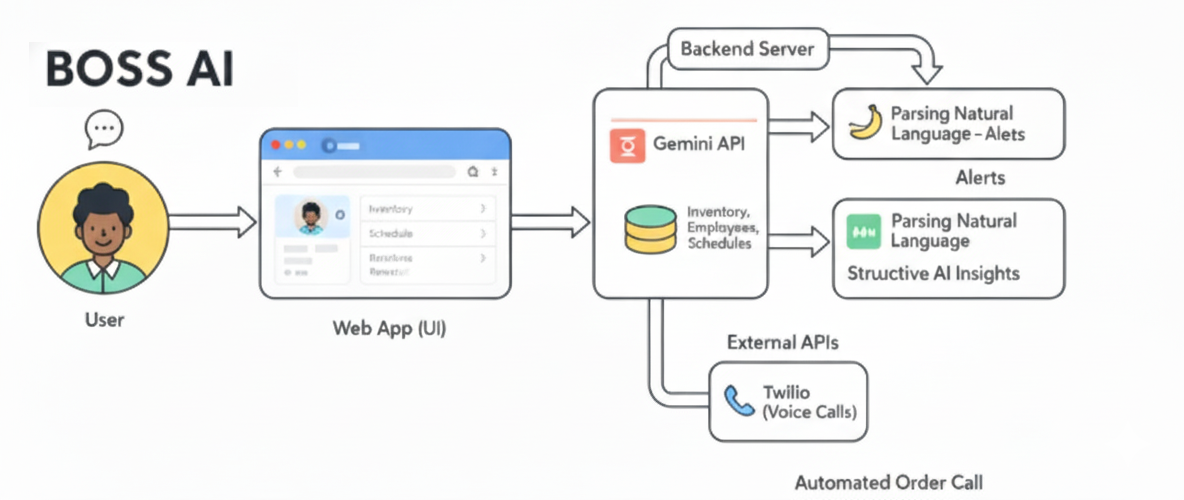
- Core Logic: The "brains" of the operation are powered by the Google Gemini API. We used its advanced natural language processing and reasoning to handle the user's "fuzzy" commands (like "running low on sugar") and turn them into structured data for our database.
- Web Framework: The front end is a React web application, providing a fast, real-time chat interface and a dynamic dashboard.
- Database: We used MongoDB for our database to store all inventory, employee data, and schedules, allowing the AI Agent to conduct seamless, real-time updates across the app.
- Backend: A Node.js (Express) server manages the API endpoints, database logic, and the orchestration of the different services.
Challenges we ran into
Our biggest challenge was integration. Our team initially developed the React frontend, the Node.js backend logic, and the external API integrations in parallel to move quickly. While each component worked perfectly in isolation, our first attempt to merge them all resulted in a total system failure. We faced a cascade of issues: the frontend and backend had API contract mismatches, the data flow from Gemini to our MongoDB database was breaking, and our codebases had diverged so much that git merge conflicts were crippling. We had to halt all new development and learn the hard way that defining a strict, unified API contract before writing code is just as critical as the code itself.
Accomplishments that we're proud of
- The "Zero-Training" Interface: We're most proud of the simplicity. We built a powerful backend, but the user only sees a simple chat box. The fact that a non-technical business owner can just start talking to it and have it work is our biggest accomplishment.
- Proactive Marketing: The AI doesn't just store data; it uses it. We're very proud of the system that connects expiration dates to sales trends to create genuinely useful marketing ideas that can save a business money and reduce waste.
What we learned
This project was a massive leap out of our comfort zone, as most of our team came in as beginners. Our steepest learning curve, by far, was MongoDB. We had never used a NoSQL database at this scale and, for the past whole day, we struggled, trying to treat it like a simple spreadsheet, which just kept breaking our app. The breakthrough came when we stopped just storing data and learned as a team how to model real-world relationships—how one "employee" document connects to multiple "schedules." The moment we finally ran a command like "Add Mia to Saturday's shift" and watched it correctly update the employee, create a new shift, and recalculate the payroll stats all at once was a huge victory. We learned that we could tackle a complex, professional-grade technology that intimidated us and build something that truly works.
What's next for BOSS AI
- POS & E-commerce Integration: Our number one priority is to connect Boss.ai to major Point-of-Sale systems (like Square, Toast, and Shopify). This would make inventory tracking completely automatic, as sales would be deducted in real-time.
- Interactive Voice: Right now, our phone call is a one-way message. We want to use AI to make it a two-way conversation, so it can handle simple responses from the supplier like, "We only have that in the 10-gallon size, is that okay?"
- Automated Marketing: When the AI suggests a "Pumpkin Spice" promotion, we want the next step to be a button that says, "Post this." Boss.ai would then automatically draft the social media post and marketing email for the owner to approve.
References
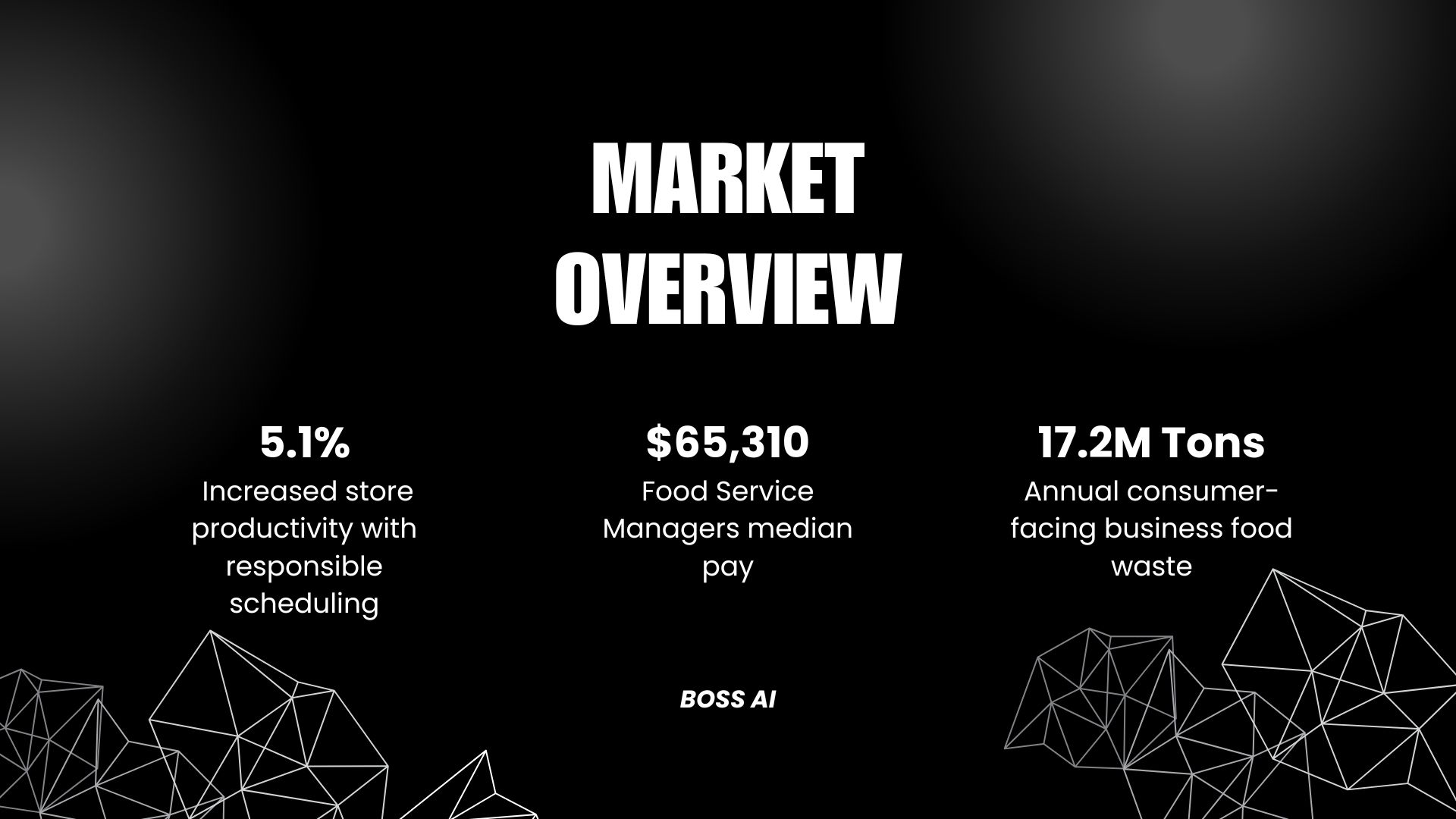
- Bureau of Labor Statistics, U.S. Department of Labor, Occupational Outlook Handbook, Food Service Managers, at https://www.bls.gov/ooh/management/food-service-managers.htm (visited October 13, 2025).
- Kesavan, S., Lambert, S. J., Williams, J. C., & Pendem, P. K. (2022). Doing Well by Doing Good: Improving Retail Store Performance with Responsible Scheduling Practices at the Gap, Inc. Management Science, 68(11), 7818–7836. https://doi.org/10.1287/mnsc.2021.4291
- ReFED. (2025). From surplus to solution: 2025 ReFED U.S. food waste report. https://refed.org/uploads/refed-us-food-waste-report-2025.pdf?_cchid=3f68e988d1f538626f8069df6771e1df


Log in or sign up for Devpost to join the conversation.