-
-
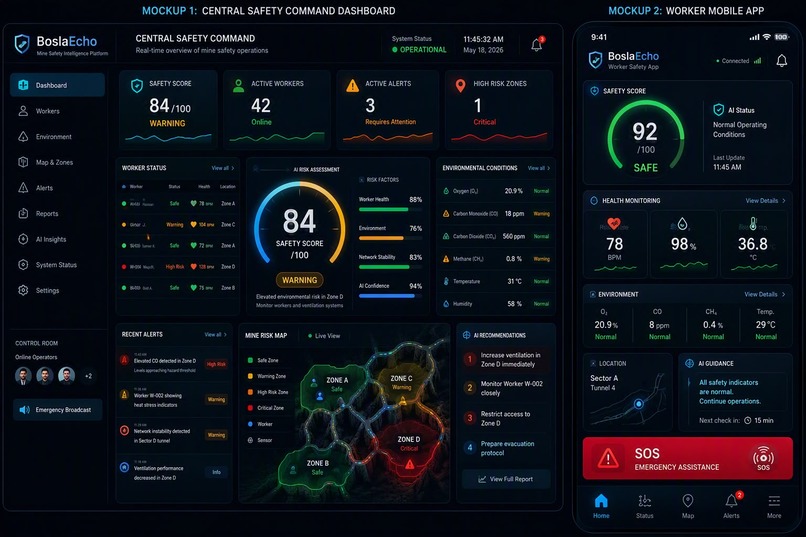
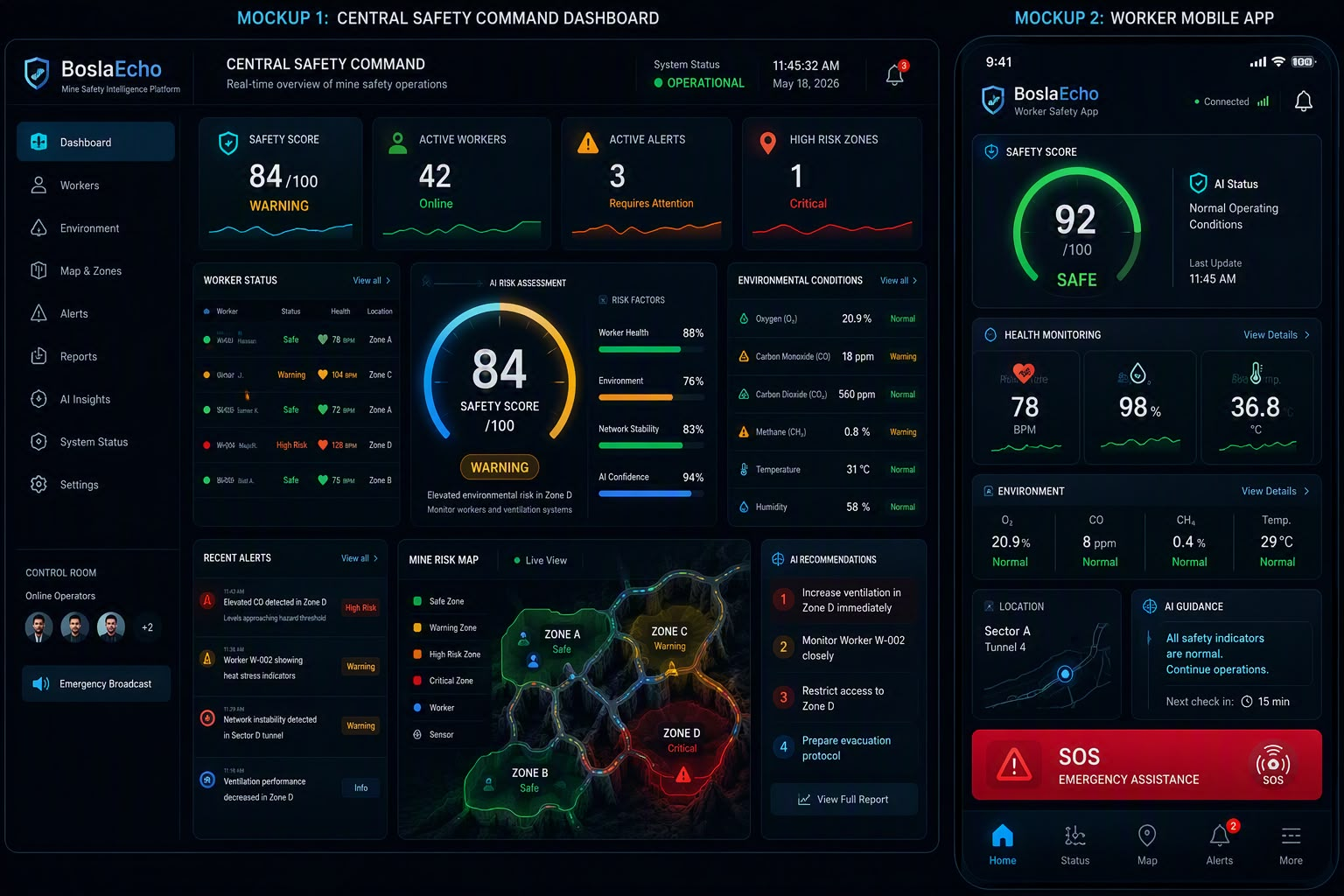
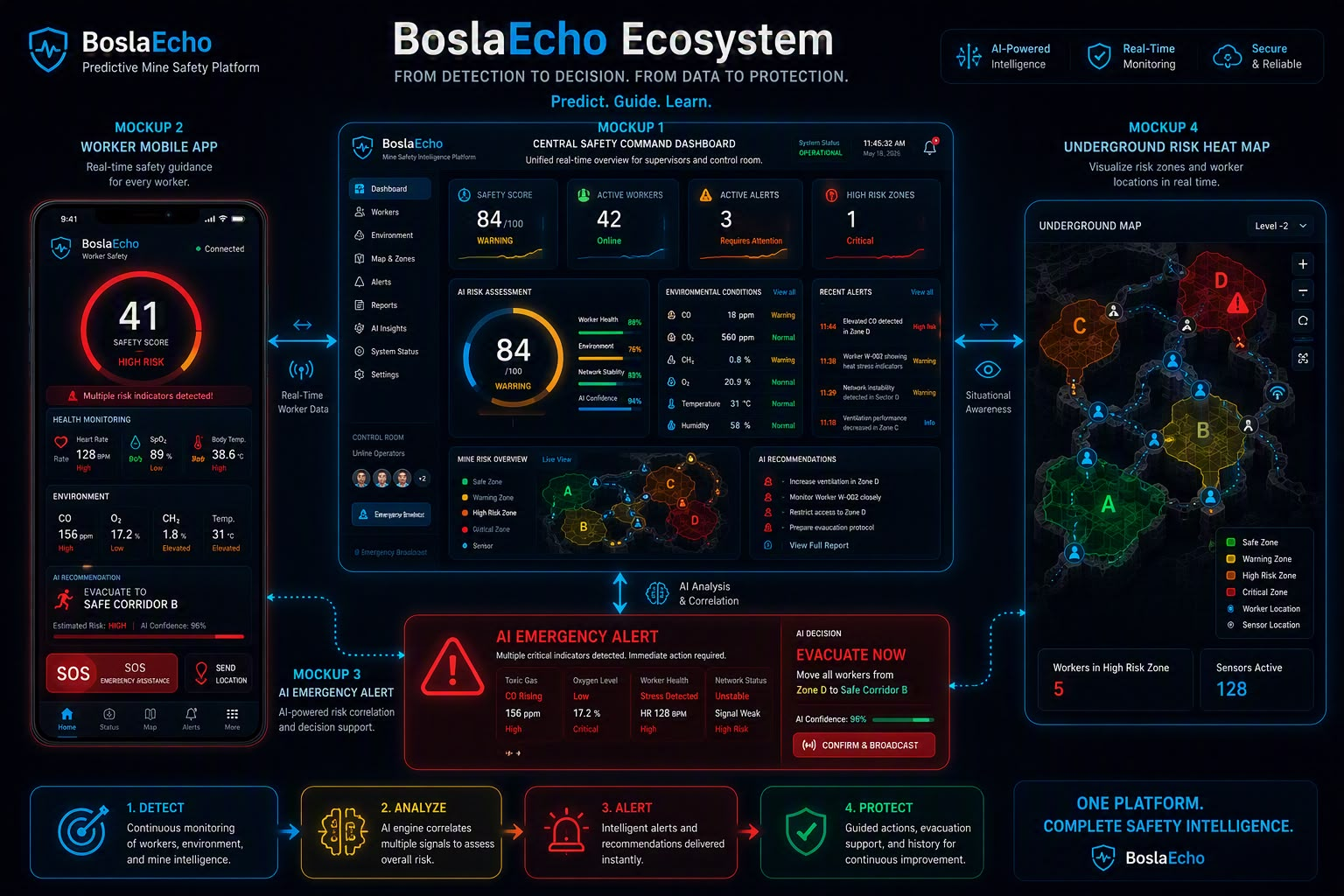
Central Safety Command Dashboard: unified real-time view of worker status, environmental conditions, active alerts, and mine risk zones.
-
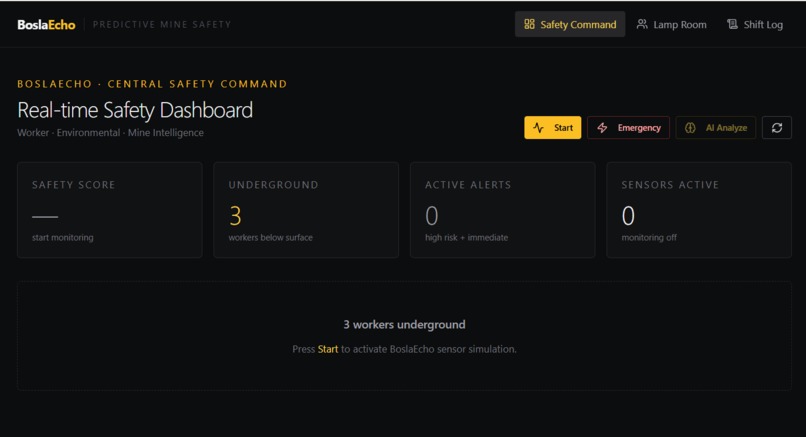
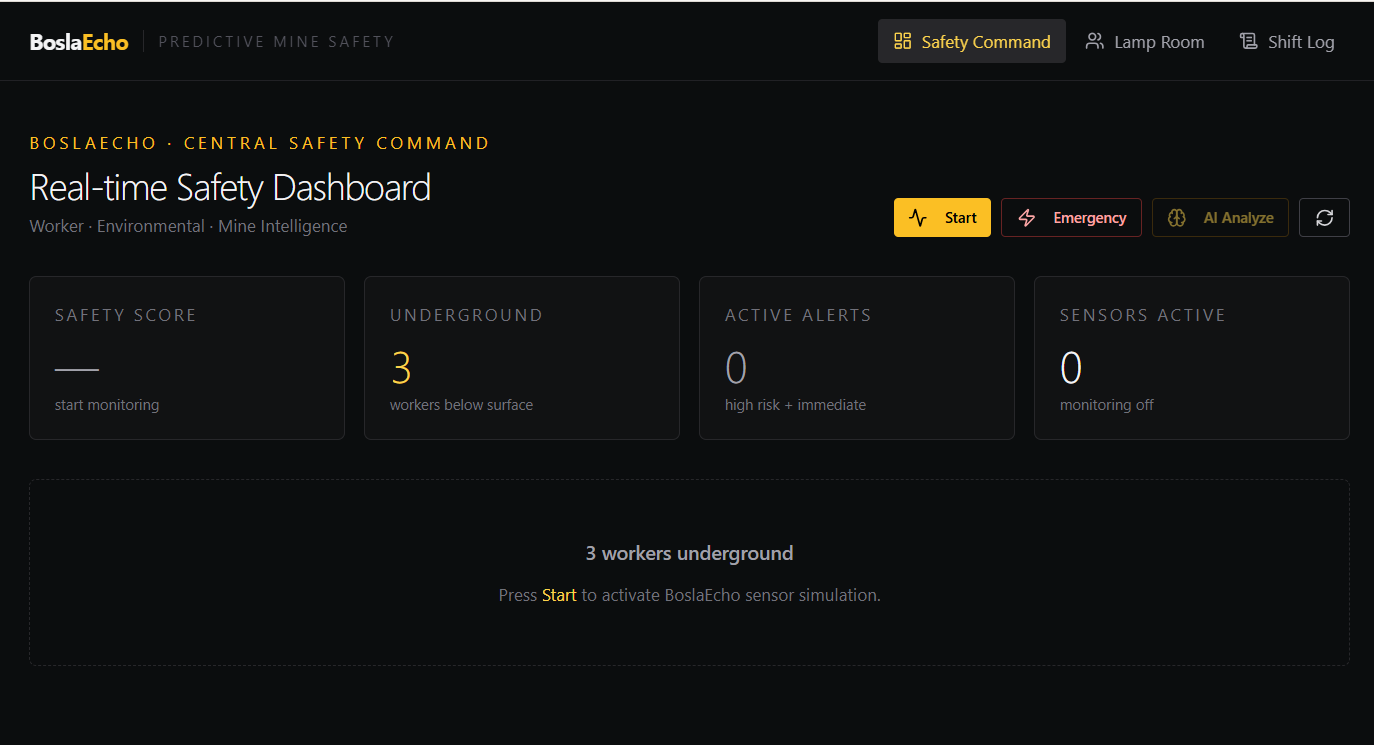
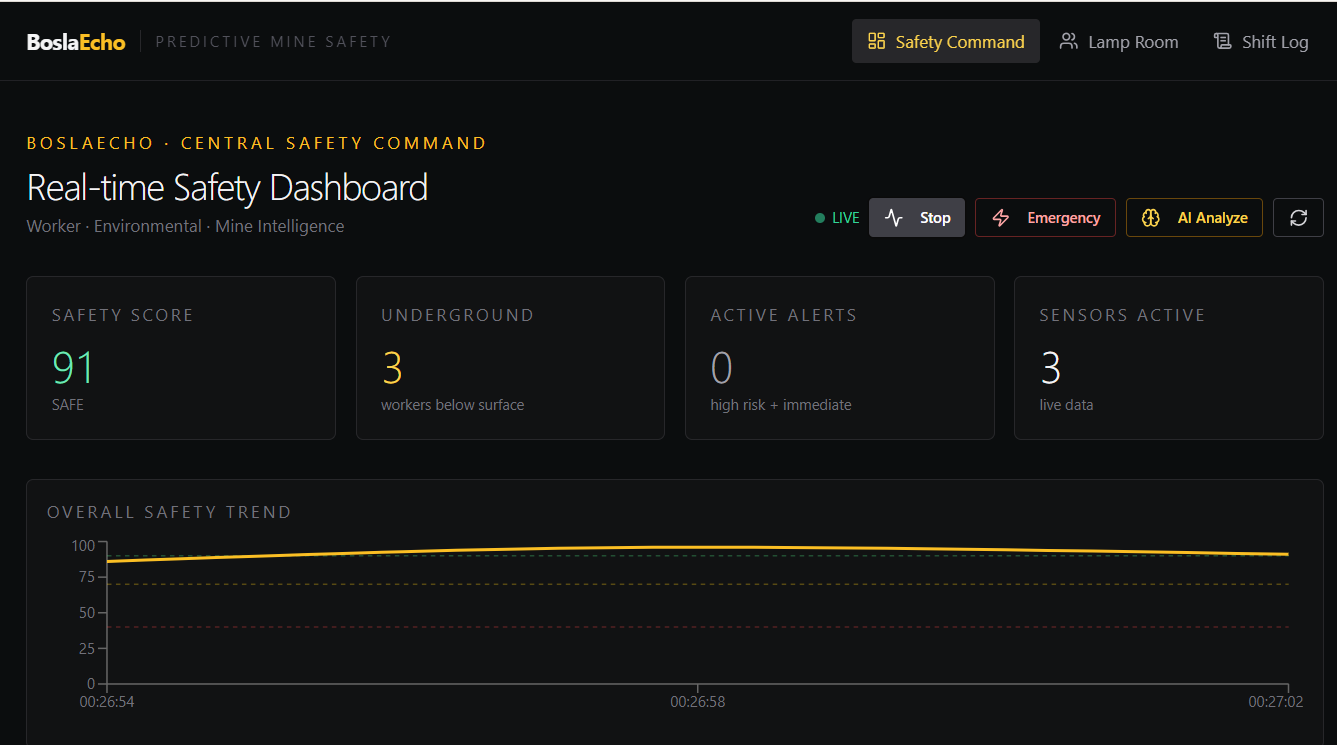
The actual working BoslaEcho prototype dashboard, prior to starting live sensor monitoring.
-
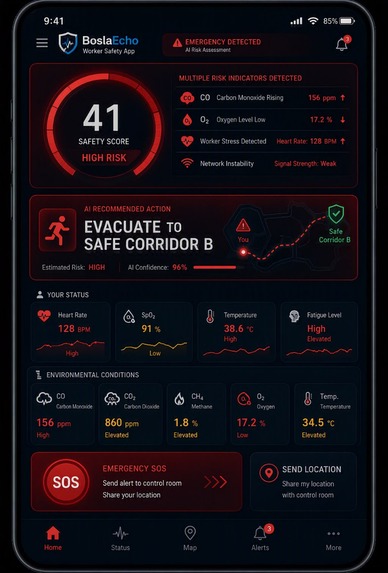
Worker Safety Mobile Interface — real-time Safety Score, health status, and emergency SOS for workers.
-
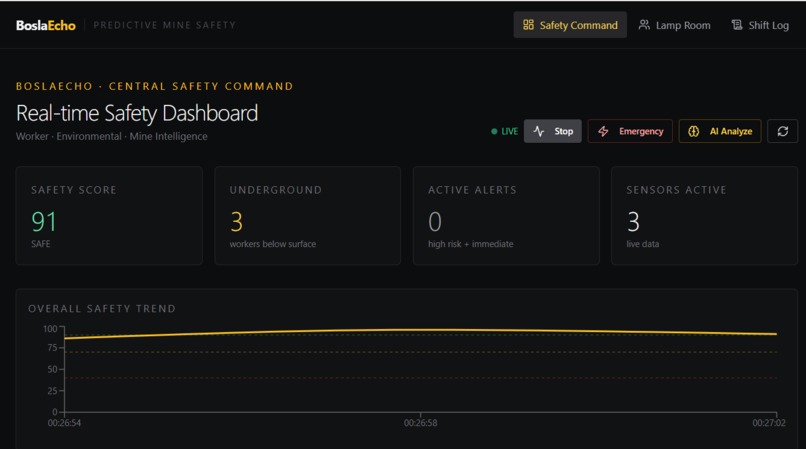
BoslaEcho live prototype running in Safe status, actively monitoring underground conditions in real time.
-
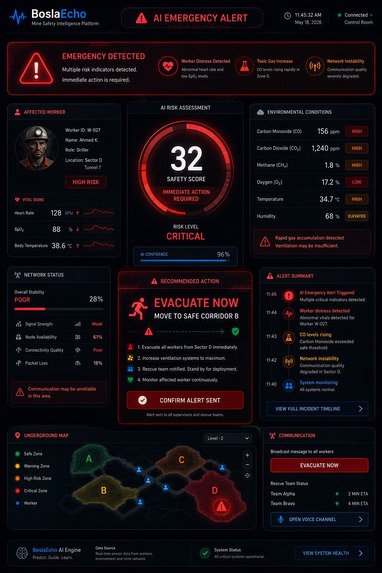
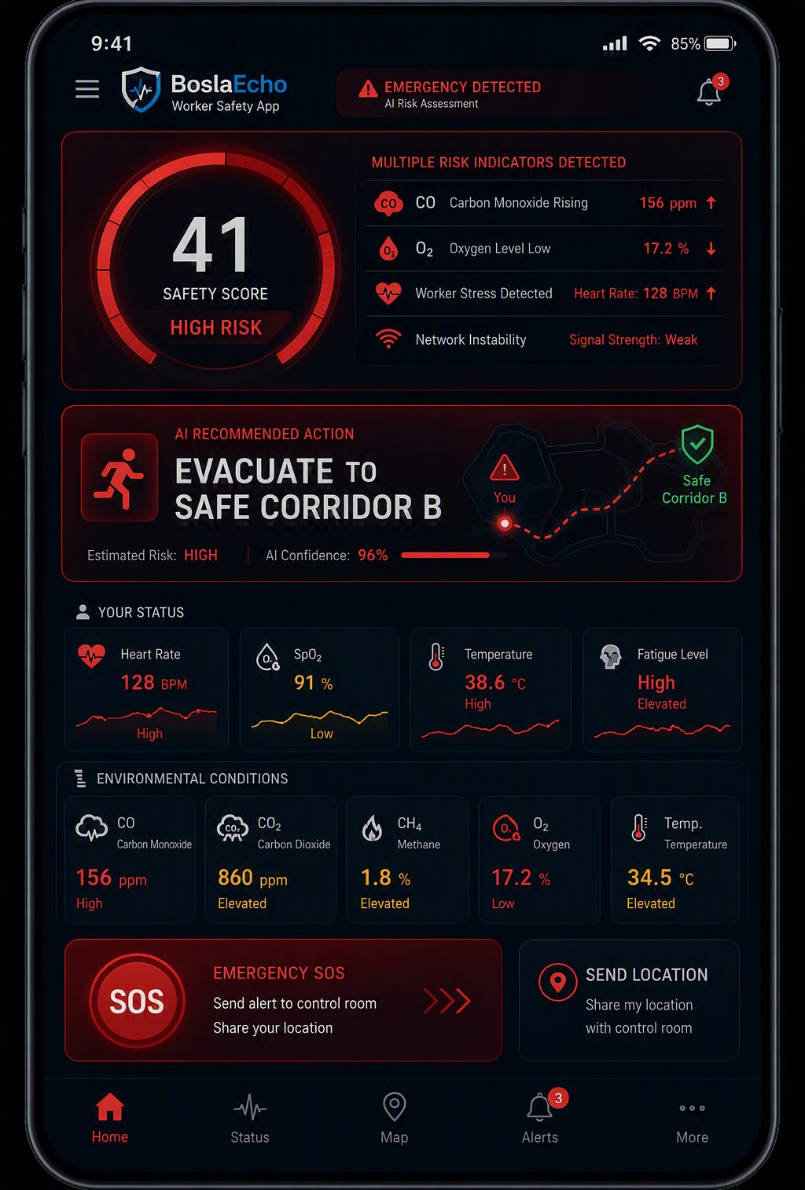
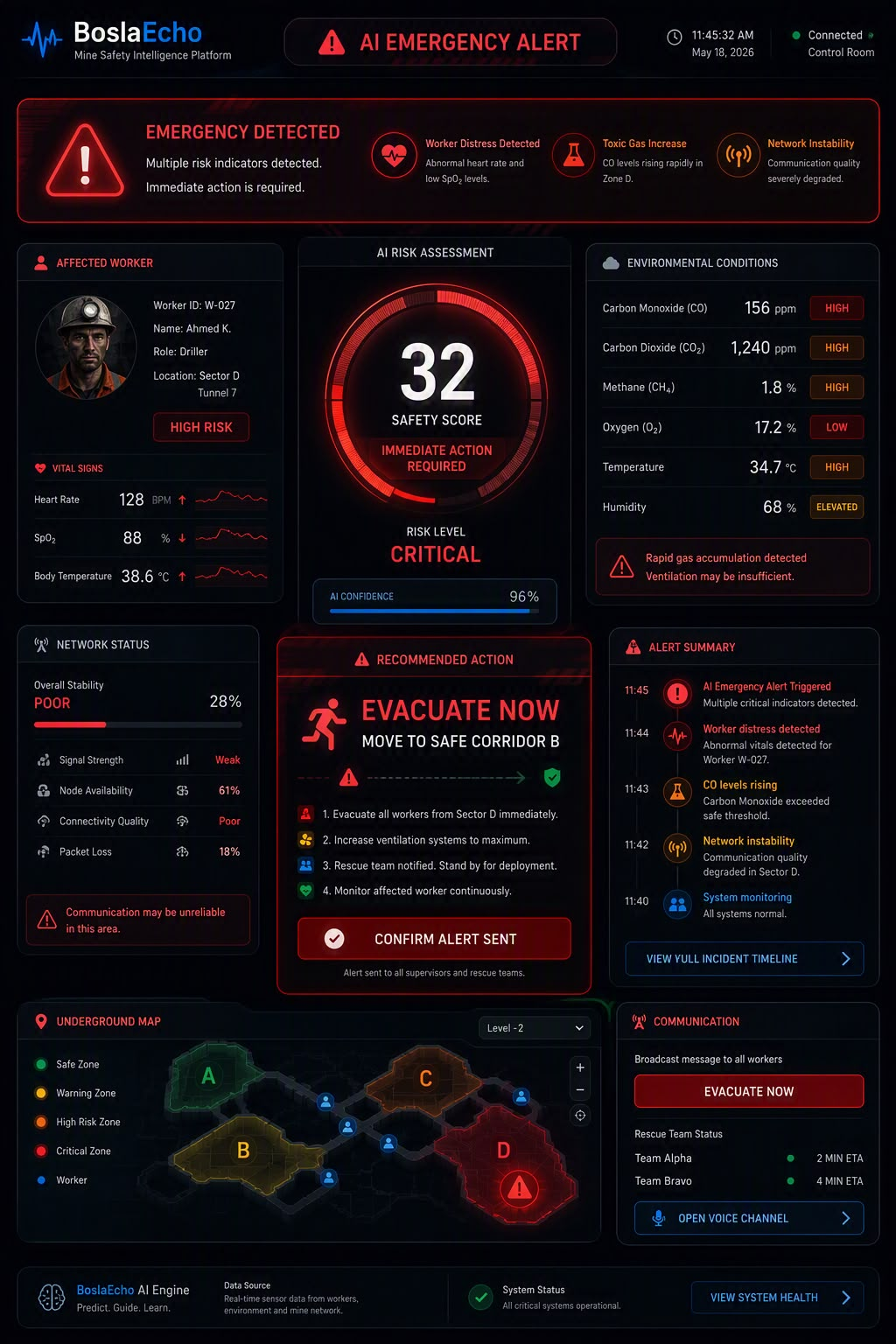
AI Emergency Alert — combines worker, environmental, and network signals into one actionable emergency recommendation.
-
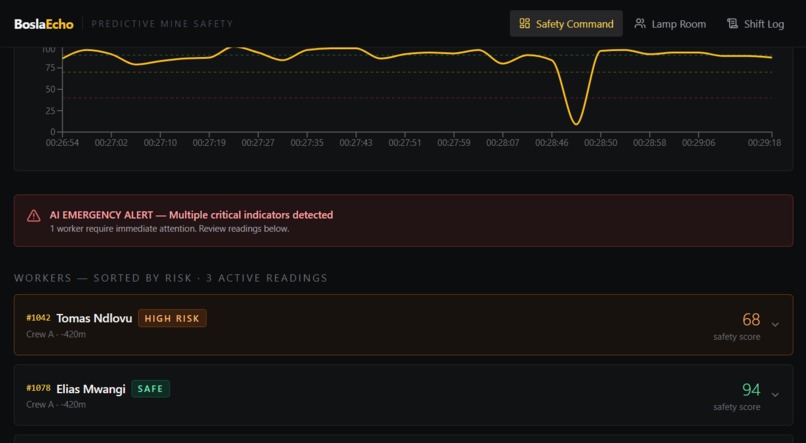
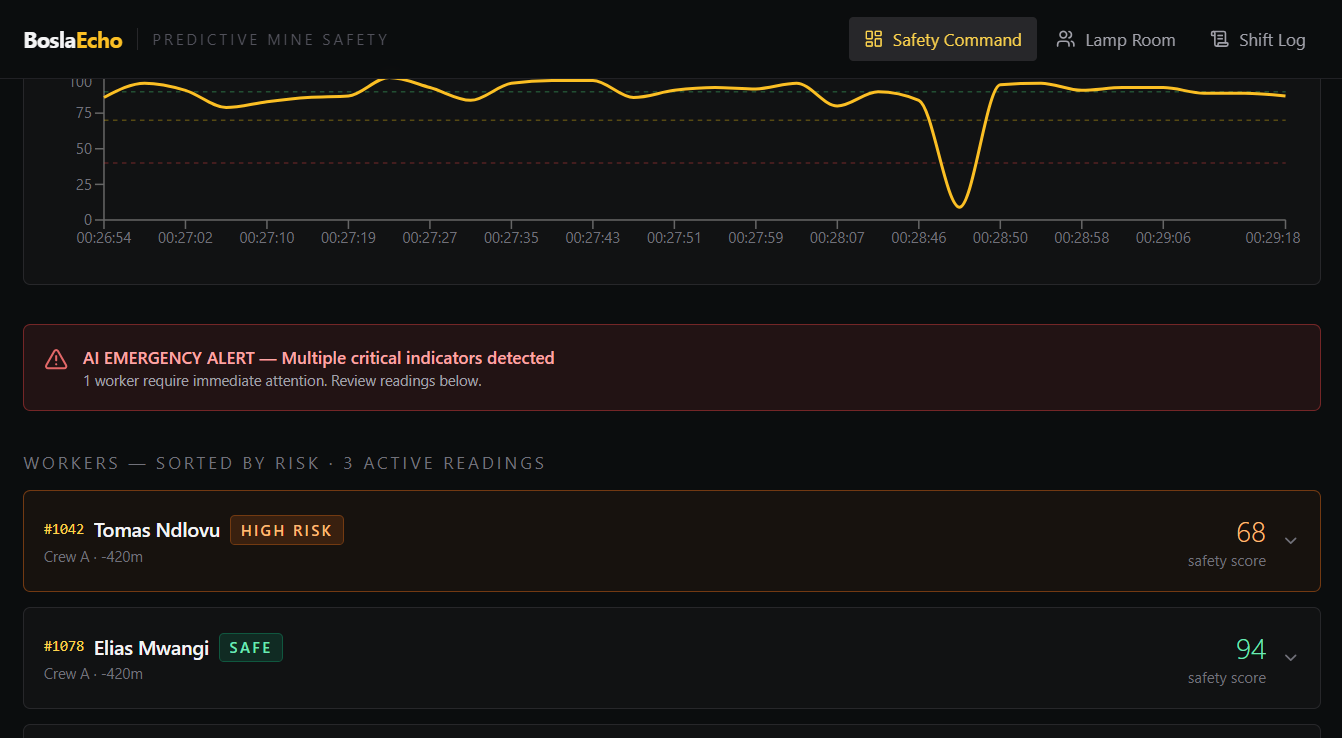
Real-time AI Emergency Alert — a sudden risk spike automatically flags the affected worker and sorts all workers by risk level.
-
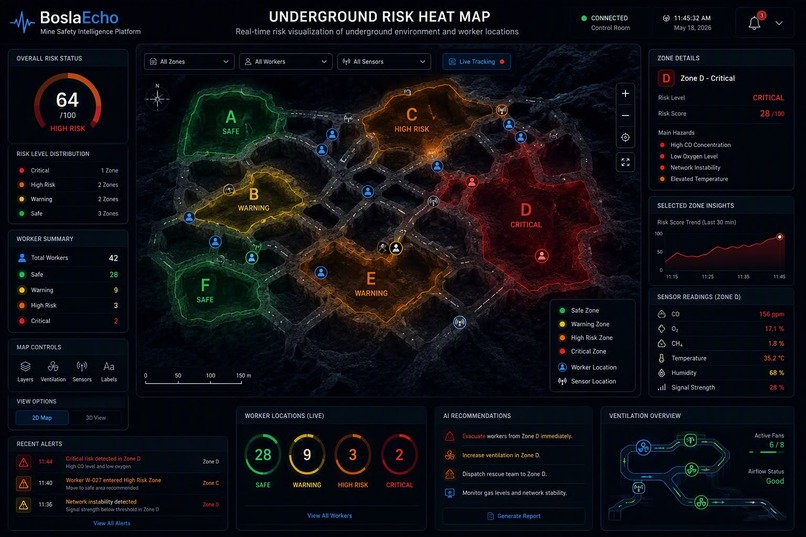
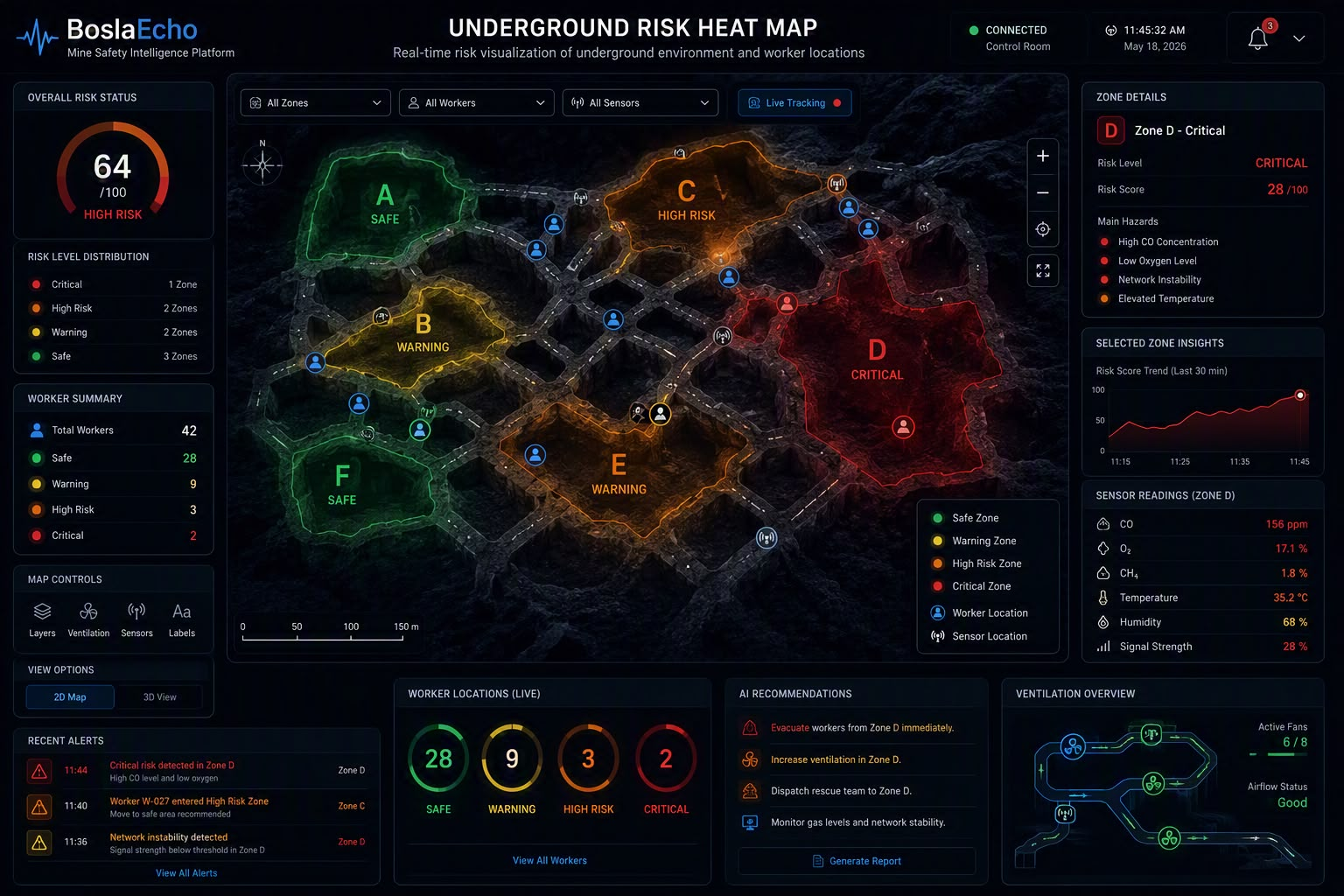
Underground Risk Heat Map — real-time visualization of risk zones and worker locations.
-
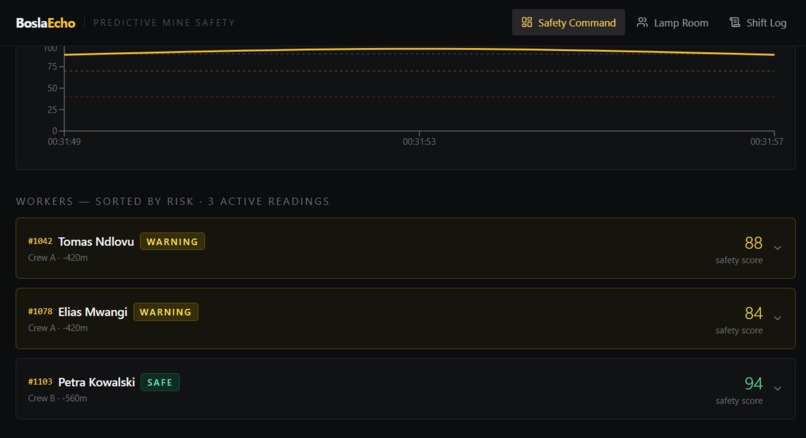
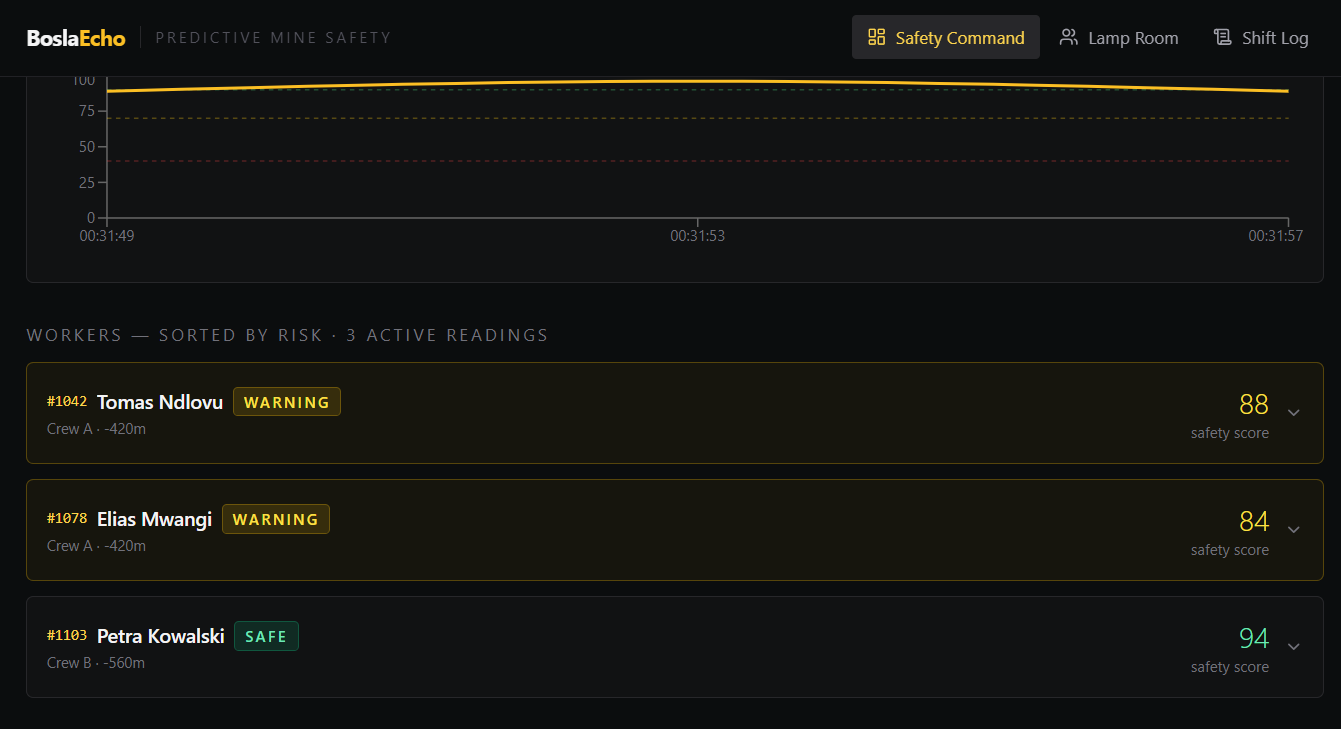
Workers sorted by risk in real time — the dashboard continuously updates status as conditions change across all three crews.
-
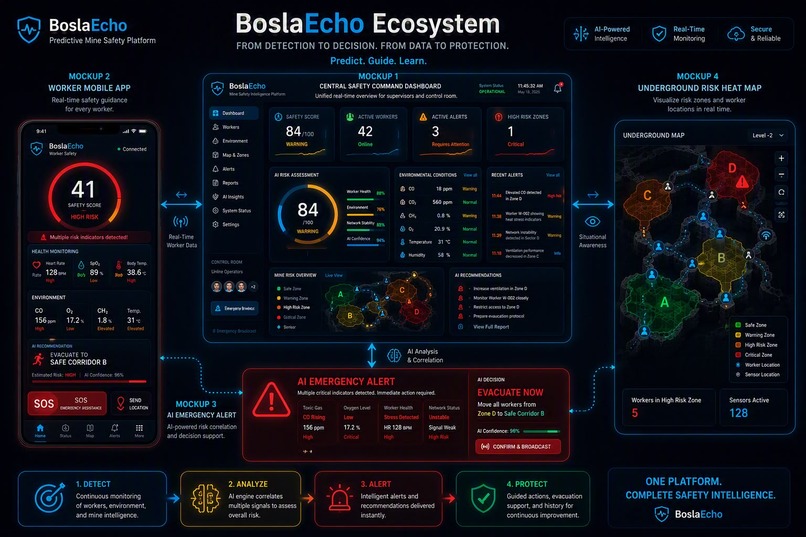
BoslaEcho Ecosystem — from detection to decision, from data to protection.
Inspiration
Underground mining is one of the most hazardous work environments in the world. Conditions can change within seconds — toxic gases can accumulate, oxygen levels can drop, workers can experience heat stress or fatigue, and communication networks can become unstable. The problem isn't a lack of monitoring technology. Mines already use gas sensors, wearable health monitors, and communication systems. The real problem is fragmentation. Each system reports its own data separately, and safety teams are left to manually piece together multiple disconnected readings before understanding the true risk — often under time pressure, when every second matters. We asked ourselves: what if a mine safety system could connect the dots automatically, the way an experienced supervisor would, but faster and continuously?
What it does
BoslaEcho is a predictive mine safety platform that transforms fragmented safety signals into one actionable safety decision. It combines three intelligence layers: Worker Intelligence — heart rate, blood oxygen (SpO₂), and body temperature to detect early signs of heat stress, fatigue, or distress. Environmental Intelligence — carbon monoxide, carbon dioxide, methane, oxygen levels, temperature, and humidity to catch hazardous conditions before they escalate. Mine Intelligence — signal strength, connectivity stability, and node availability across the underground communication network. At the core is an AI Predictive Risk Engine that doesn't evaluate these signals in isolation — it correlates them to produce a single, unified Safety Score (0–100), classified as Safe, Warning, High Risk, or Immediate Action Required. Based on that score, the platform generates alerts, highlights high-risk zones, and recommends specific actions to supervisors and workers in real time through a live dashboard.
How we built it
We designed BoslaEcho as a layered system: Sensor Layer — worker and environmental sensors collect real-time physiological and environmental data. Edge Processing Layer — a compact node/gateway filters, validates, and packages the data before transmission. Wireless Mesh Network Layer — a resilient underground mesh network with multi-hop routing and automatic path recovery, so communication stays reliable even in disrupted zones. Cloud AI Engine — processes all three intelligence layers together with historical safety memory to output the Safety Score, risk classification, and recommended actions. Dashboard & Alert Layer — the real-time interface supervisors and workers actually use, showing live safety status, worker conditions, risk zones, and recommendations. For the MVP, we used simplified hardware — an Arduino, an MQ gas sensor, a pulse sensor, a temperature sensor, and a vibration motor — to demonstrate the multi-signal decision logic end to end: detect, analyze, assess risk, alert, and recommend action. On the software side, we built a working dashboard prototype with real-time safety score calculation, active alerts, worker risk sorting, and an AI-generated emergency analysis feature.
Challenges we ran into
Designing a fair Safety Score formula. Combining worker health, environmental data, and network stability into one number required deciding how to weight each factor (we used Worker Health × 0.3 + Environmental Safety × 0.4 + Network Stability × 0.3 for the prototype) without oversimplifying real safety risk. Avoiding overclaiming. We were careful to position BoslaEcho responsibly — for example, the system doesn't directly detect tunnel collapse; abnormal network behavior is treated as one additional signal, not a definitive diagnosis. Keeping the interface simple despite complex data. Supervisors need to understand risk at a glance, not read through raw sensor feeds — so a lot of iteration went into the dashboard design across our four mockups (Central Command, Worker Mobile App, AI Emergency Alert, and Underground Risk Heat Map). Simulating realistic emergency scenarios with limited MVP hardware to convincingly demonstrate multi-signal correlation (e.g., rising CO + dropping O₂ + elevated heart rate + network instability happening together).
Accomplishments that we're proud of
Building a working end-to-end prototype that actually demonstrates the full decision loop — detection, analysis, risk assessment, alert generation, and recommended action — not just a static mockup. Designing a unified Safety Score that successfully correlates three completely different data domains (physiological, environmental, and network) into one interpretable number. Creating a real-time AI Emergency Analysis feature that generates human-readable, context-aware recommendations (e.g., "Initiate emergency extraction and deploy oxygen supply immediately") instead of just raising a generic alarm. Designing four distinct, cohesive dashboard interfaces (Central Command, Worker Mobile App, AI Emergency Alert, and Underground Risk Heat Map) that all speak the same visual and safety language. Translating a genuinely complex, multi-layer technical architecture into something a non-technical safety supervisor could understand and trust at a glance.
What we learned
We learned that the hardest part of safety technology isn't usually detecting a single hazard — most existing systems already do that well. The hard part is correlation and communication: turning multiple valid but disconnected data streams into one clear decision a human can act on immediately. We also learned a lot about underground wireless mesh networking constraints, and about how to design AI outputs (like our Safety Score and recommended actions) that build trust rather than causing alert fatigue.
What's next for BoslaEcho
Pilot testing in controlled mining environments with real operational data. Safety expert review and model calibration to refine Safety Score weights and thresholds. Moving from simulated sensors to certified industrial-grade hardware. Expanding the AI engine with a digital twin of the mine environment for predictive emergency simulation (Year 3 roadmap goal).
Built With
- ai
- arduino
- cloud-computing
- dashboard
- edge-computing
- environmental
- health-monitoring
- iot
- javascript
- machine-learning
- mine-safety
- mq-gas-sensor
- node.js
- predictive-analytics
- pulse-sensor
- react
- real-time-data
- risk-assessment
- sensors
- temperature-sensor
- vibration-motor
- wireless-mesh-network

Log in or sign up for Devpost to join the conversation.