-
-
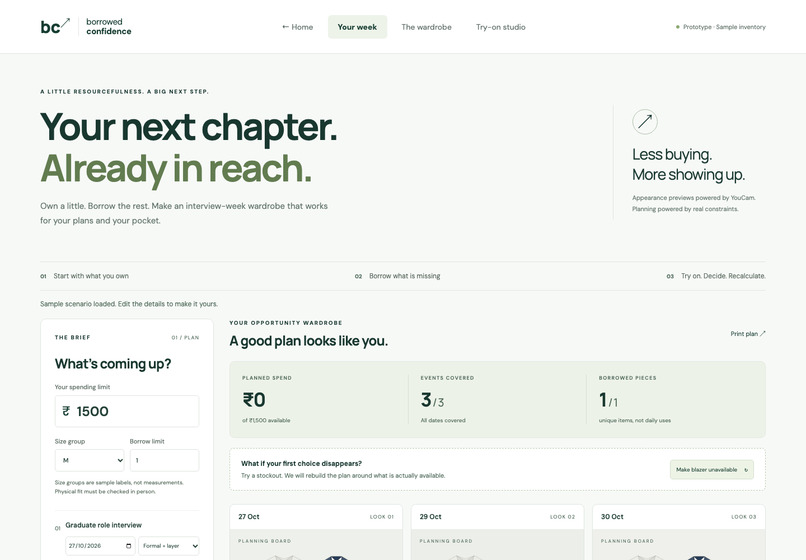
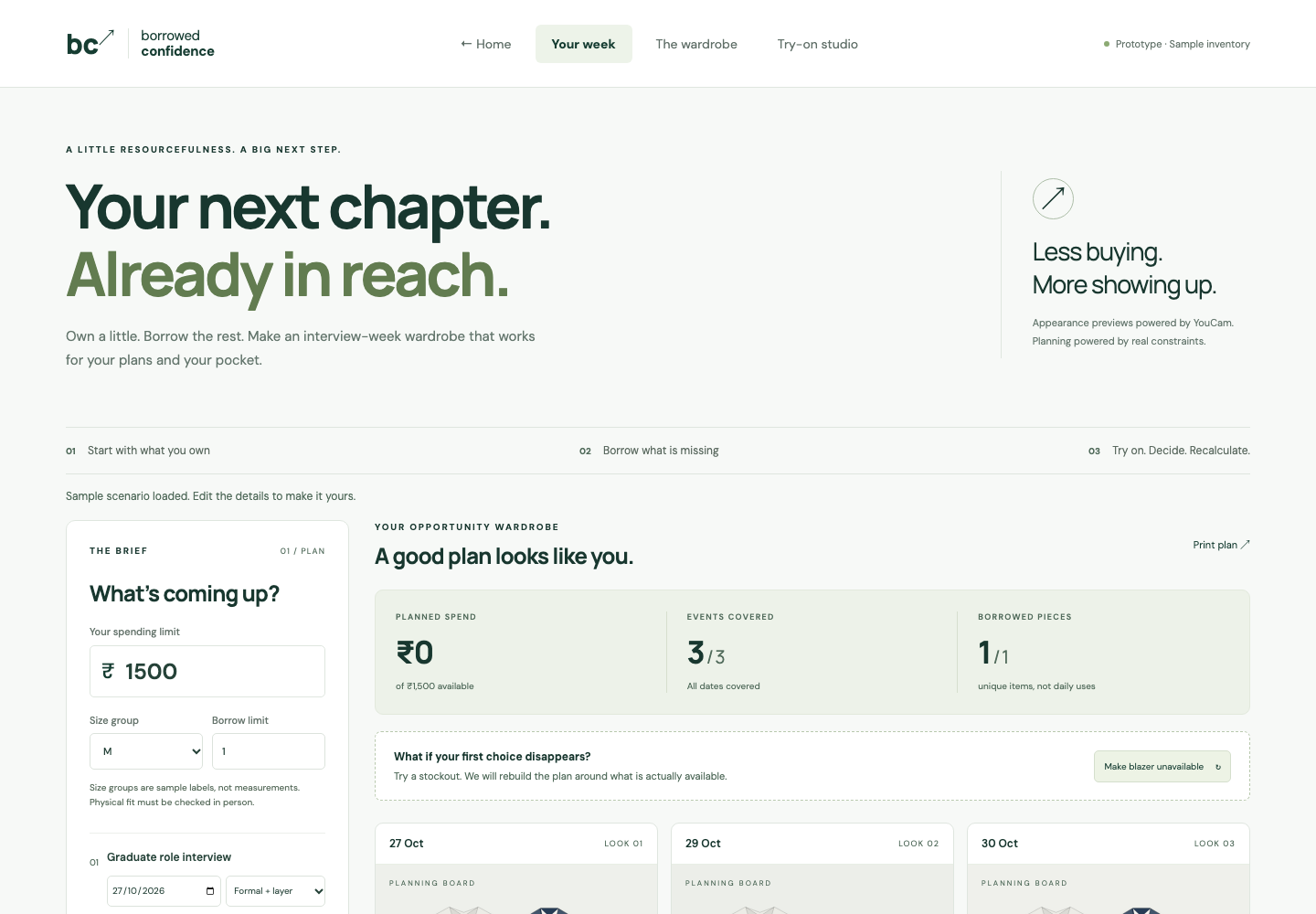
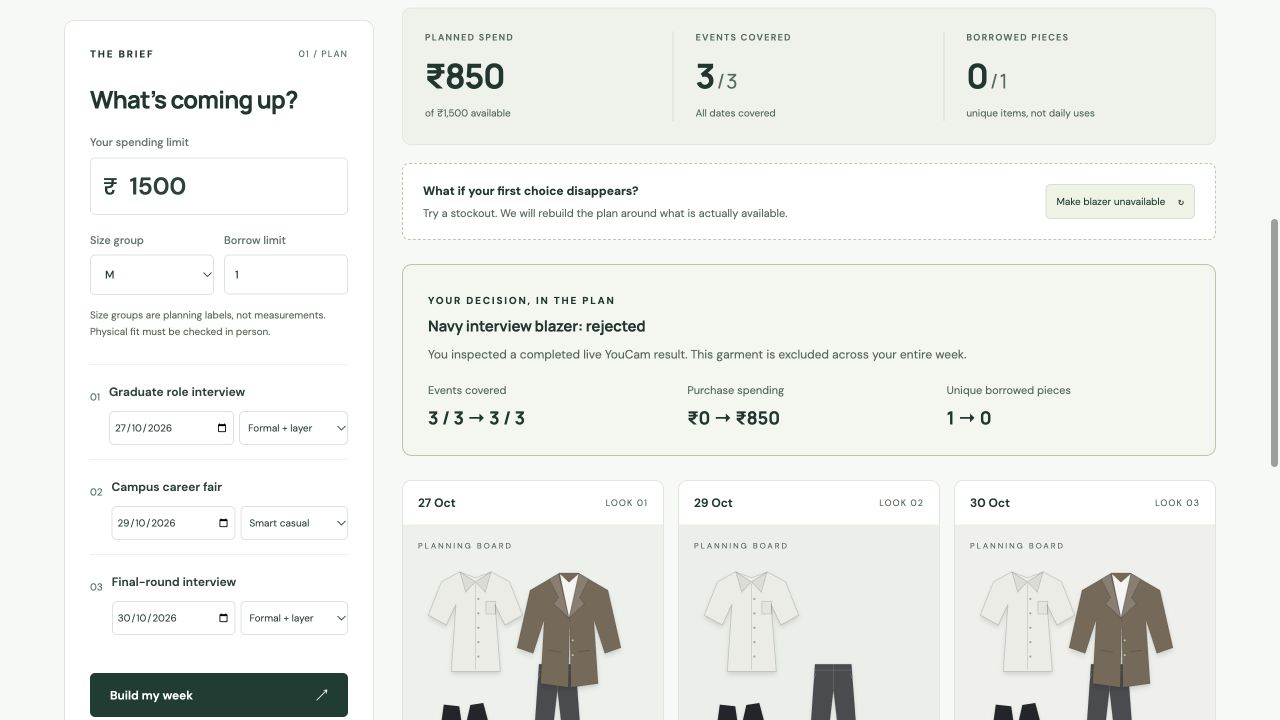
Functional planner: 3/3 events, ₹0 purchase spending, one borrowed piece. Fictional sample inventory.
-
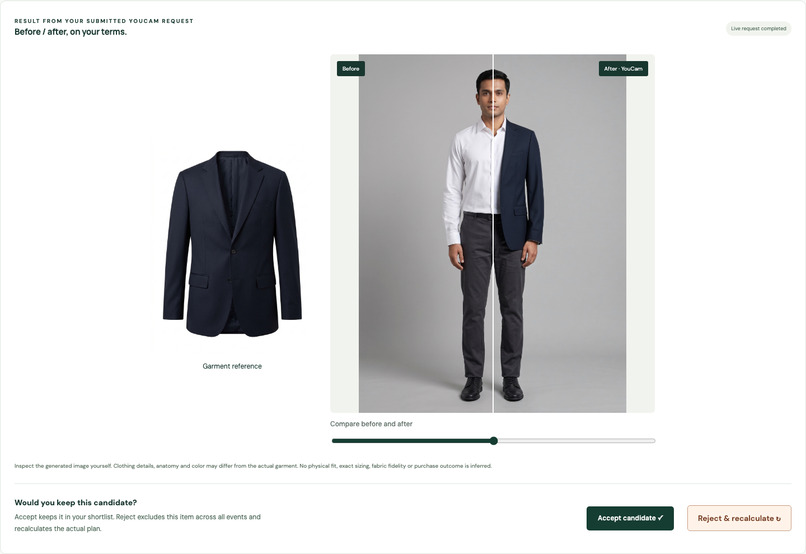
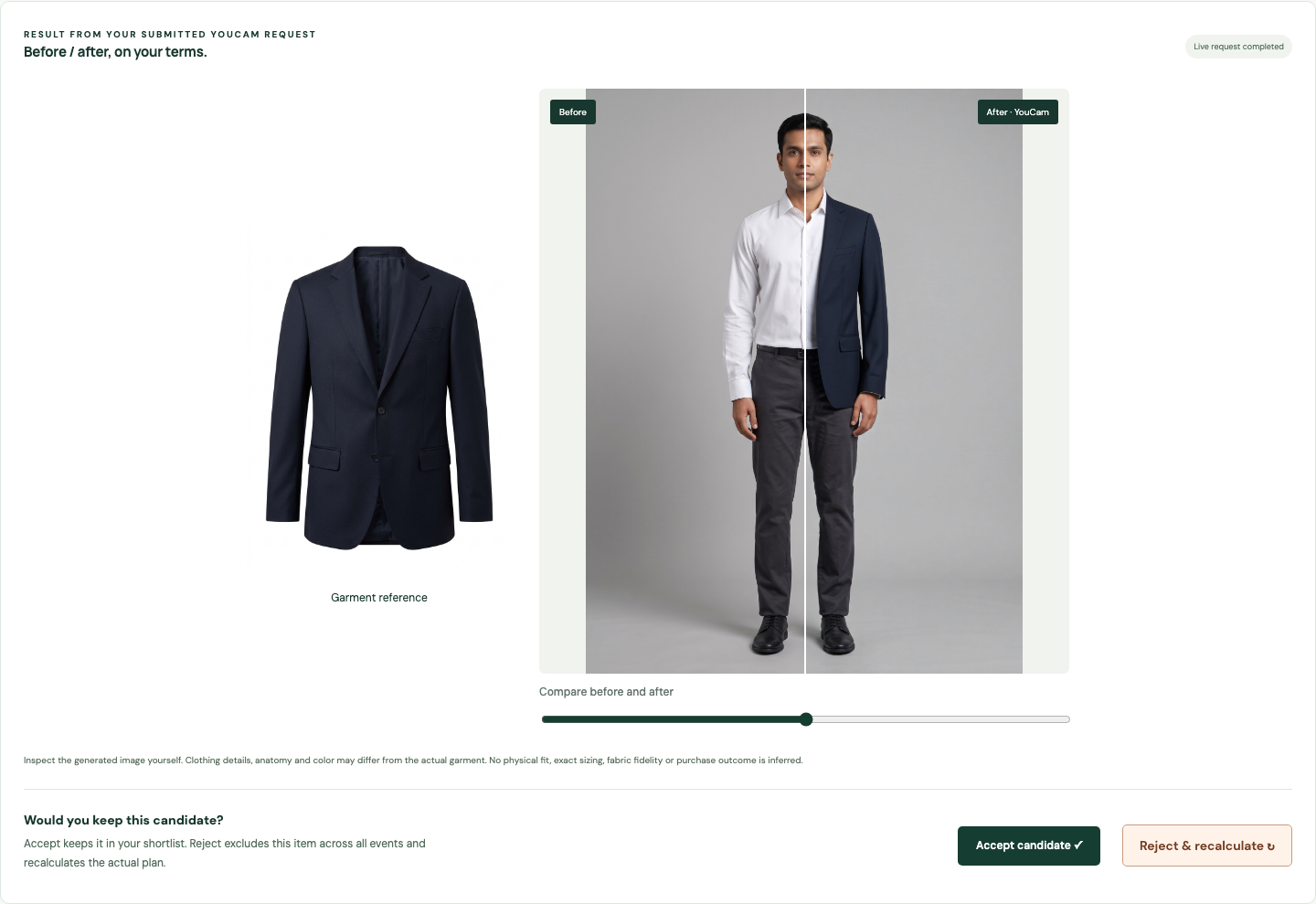
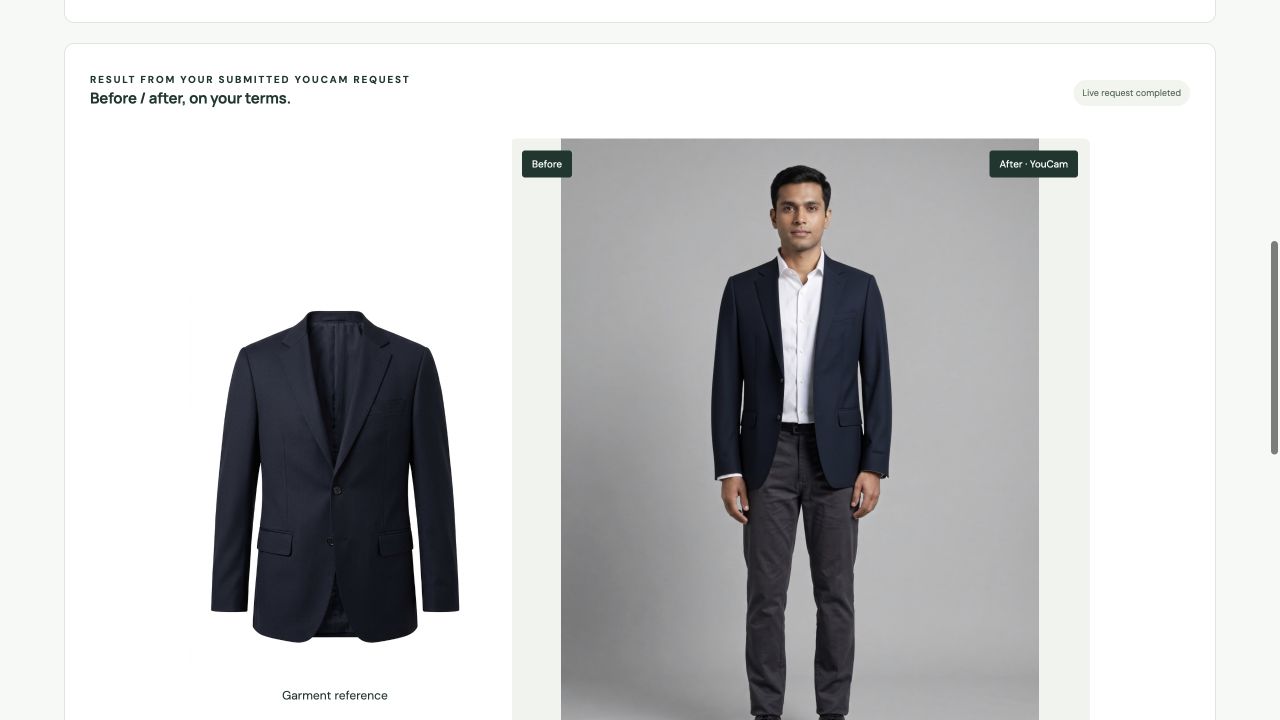
Fresh real YouCam outer result, Oct 30: synthetic inputs, 17.6 seconds, 2 units. Appearance only; not verified fit.
-
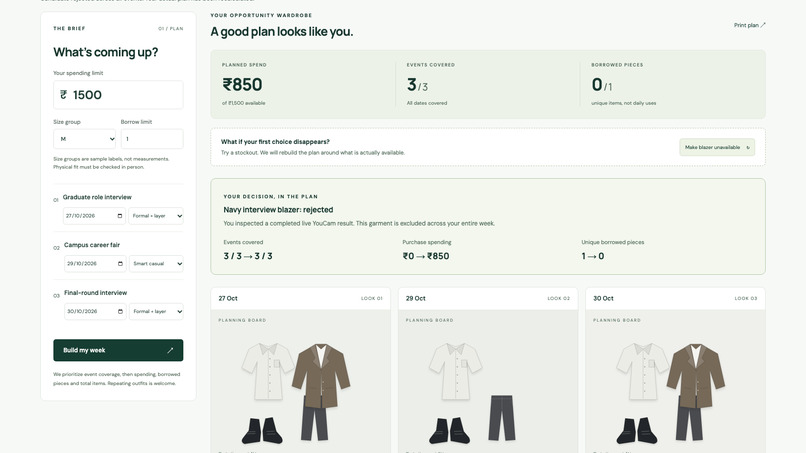
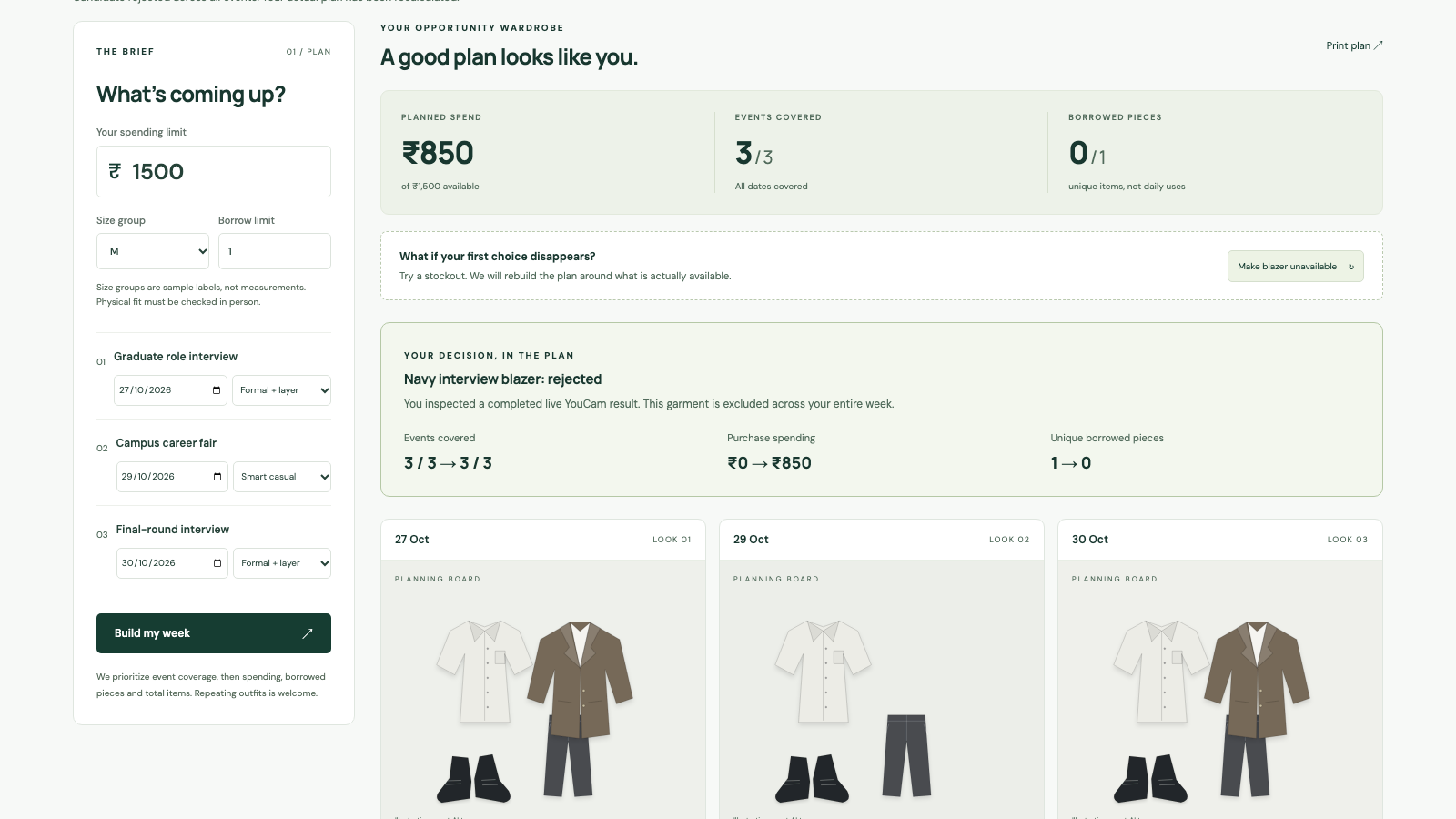
After real-result inspection and rejection: 3/3 coverage retained, spending ₹0→₹850, borrowed pieces 1→0. Fictional scenario.
-

Hosted app at 390 px: garment decision changes the actual wardrobe plan. Sample stock and prices; no reservations.
-
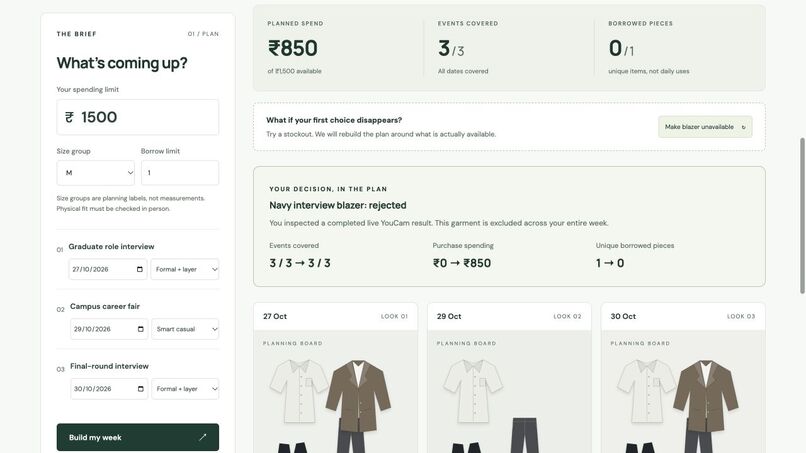
Rejecting the new hosted YouCam result recalculates the real plan: 3/3 events, ₹0→₹850, one loan→zero. Fictional scenario.
-
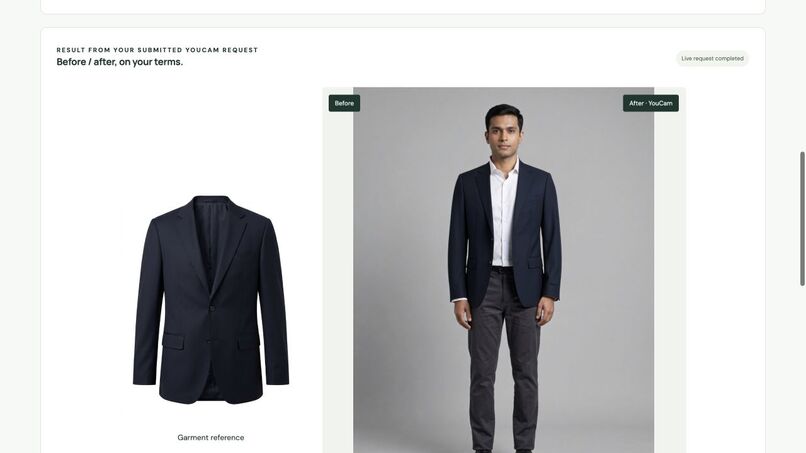
New public-host YouCam outer result, Nov1. Synthetic adult and blazer inputs; visual appearance only, not sizing evidence.

Inspiration
An interview on Tuesday, a career fair on Thursday, a final round on Friday. A student may own the essentials and still need one suitable layer. Choosing it means answering several questions together: can I get it for every date, return it on time, stay within budget, and feel comfortable wearing it?
Campus clothing closets already help with access. Borrowed Confidence explores the planning around that access. We have no university partnership or validated student outcomes; the starter inventory, prices and lending policies are fictional.
What it does
Borrowed Confidence builds a multi-event wardrobe from clothes you own, can borrow or could buy. Add or edit garments with prices, availability dates, size groups and loan lengths. Turn off fictional starter items to plan with your own entries. Nothing is reserved or purchased.
The demo connects three decisions:
- Borrow instead of buy: one borrowed blazer covers both formal interviews within its loan window.
- Preview before accepting: select that exact garment from an outfit and inspect a YouCam appearance preview with a before/after comparison.
- Recover when plans change: reject the garment or mark it unavailable, and the planner recalculates event coverage, spending and borrowed pieces under the actual constraints.
The fictional baseline covers 3/3 events with zero purchase spending and one borrowed piece. Rejecting the blazer finds an ₹850 purchase that covers the same events. Lowering the budget to ₹500 honestly leaves a partial 2/3 plan.
Why YouCam is essential
The deterministic solver checks access, dates and spending. YouCam Clothes Virtual Try-On shows what a shortlisted garment might look like on a person. Human judgment connects the two: rejection excludes that exact garment across the week, rather than leaving a generated image disconnected from the plan.
The public app now lets judges generate a fresh preview free of charge, without registration or their own API key. A new request completed through the hosted app on November 1, returned a genuine image, and consumed exactly 2 units. The existing credits cover the remaining allocation. Shared limits are 30 accepted submissions per UTC day and 100 total, with 5 per browser session per UTC day. Remaining capacity is visible; a request is never automatically retried.
Consent and Generate are separate deliberate steps. Loading synthetic example images makes no provider call. The original October 25 result remains available as a clearly labeled historical replay; replay never uses an uploaded visitor photo.
How we built it
React and strict TypeScript provide the interface. A bounded deterministic search maximizes covered events, then minimizes unique purchase spending, borrowed pieces and total pieces. Purchases are counted once even when reused, prices use integer paise, and partial plans remain visible when complete coverage is impossible.
Express, SQLite, Sharp and Zod handle consented images and asynchronous YouCam work. The server registers two files, uploads normalized bytes using the returned signed PUT URLs, creates one cloth-v4 task and polls its status. A blazer uses the documented outer category. Images are validated and metadata stripped before upload. Credentials stay in a private mounted file; source image bytes are not persisted by the application. The stable Node24 host has HTTPS and persistent private storage.
What we learned
Our first real upper_body render replaced the underlying shirt. A later outer render with a different base outfit retained a visible white shirt beneath the blazer. We preserved both outputs and their limitations; the runs are not a controlled experiment or evidence of general layering reliability.
Joining visual inspection to the optimizer was the harder product problem. Garment and event context now survive navigation, an in-progress render keeps its context, and decisions use stable garment IDs so identical names cannot transfer rejection.
Seven reproducible simulated scenarios retain the original fixture and record explicit deltas. Their selected objectives match independent exhaustive enumeration, with zero detected constraint violations. They demonstrate borrowing, stockout recovery, an affordable replacement, an insufficient budget, conflicting loan dates, rejection and no complete wardrobe. They do not establish customer savings or human outcomes. Evaluation and evidence.
Design
Pine green, paper surfaces, garment schematics and a chartreuse opportunity ticket give the app a campus-editorial identity. The planner, studio and decision summary form one journey. Keyboard controls, responsive layouts and explicit progress/error states help users inspect the result and understand what changed.
The 2:29 narrated demo shows genuine October 30 application footage, including one real request and its complete 17.62-second wait at actual speed. Idle holds are trimmed. The current public release is separately tested; the recorded result is not presented as a new request on every viewing.
Limitations and next steps
Generated appearance cannot establish physical fit, exact sizing, fabric fidelity or purchase success. Planning size groups are labels, not measurements. The loan model uses calendar days, one continuous loan and same-day pickup; it omits opening hours, deposits, cleaning, travel, shipping and taxes. User-entered availability remains unverified. Clearing a session does not delete provider-held images. Anonymous sessions provide isolation, not verified identity.
A permissioned campus-closet pilot should test actual availability policies and whether students understand the planning and preview decisions. We have not performed student usability research or measured employment, environmental or retail outcomes. Broader garment-quality evaluation and lender scheduling come before reservations.
Built With
- express.js
- react
- sharp
- sqlite
- typescript
- youcam-api
- zod
