Inspiration
A student might need a scientific calculator for one exam, a geometry set for one lesson, or art supplies for one project. Meanwhile, another student may have exactly that item sitting unused.
BorrowBlock grew from a simple question: could a school make it easier for students to share what they already have?
What is the specific problem, and how do we know it is real?
The problem we are exploring is temporary access to school essentials. Finding someone with a spare item, arranging collection, and remembering the return date can involve several separate conversations.
Our prototype demonstrates this through an illustrative scenario: Jordan needs a calculator for a maths test, and Maya has one available to lend.
We have not yet conducted formal student interviews or a school pilot. The profiles, listings, and borrowing activity shown in the demo are sample data. Our next validation step is to speak with students about their recent borrowing experiences and ask a school coordinator what a practical collection arrangement would require.
What BorrowBlock does
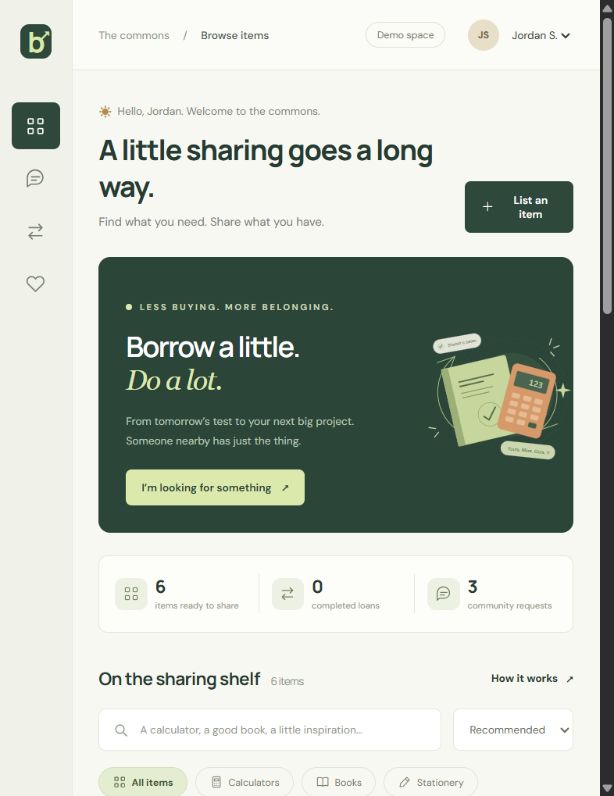
BorrowBlock brings item discovery, community requests, and loan tracking into one school sharing board.
Students can:
- Browse and search listings by category.
- View an item’s condition, owner, and lending period.
- Request an item with a return date and an optional note.
- Post what they need and when they need it.
- Offer an available item in response to a community request.
- Track a loan through approval, collection, and return.
The owner approves a borrowing request and confirms collection. When the borrower records a return, the owner confirms receipt before the item becomes available again.
The demo uses a school library desk as an example collection point. A real collection arrangement would need agreement from the school.
How we built it
BorrowBlock uses HTML, CSS, and JavaScript, with original inline SVG illustrations and Google Fonts. It is deployed on Vercel.
Browser localStorage preserves demo listings, requests, and loans after a page reload. A student selector lets viewers explore both sides of the borrowing process.
Challenges we faced
One challenge was making the handover process clear. A request, an approved loan, a collected item, and a completed return are different stages. We built explicit status changes so each person can see what needs to happen next.
Another challenge was availability. An item should not remain available while it is reserved or on loan. We connected listing availability to the loan workflow, including cancellation and return.
We also had to keep the scope manageable. We focused on a complete borrowing journey and clearly identified the prototype’s limits instead of presenting simulated accounts as real authentication.
What we learned
We learned that a community tool needs clear responsibilities as much as a useful interface. Who approves the loan? Where is the item collected? Who confirms its return? Answering those questions shaped the application.
We also learned the value of testing a full journey from both perspectives. We tested requesting, approval, collection, return confirmation, community offers, cancellation, listing creation, and persistence after reloading.
What we accomplished
We built and deployed a working prototype with searchable listings, community requests, lending offers, and a complete loan lifecycle.
The demo shows how an item can move from an available listing to a completed loan and become available for another student.
What’s next
The current prototype stores data in one browser. The account selector is a demonstration feature, not authentication, and there is no shared database or messaging service.
Our next steps are to:
- Interview students and validate the most useful item categories.
- Agree on a collection process with a school coordinator.
- Add verified school accounts and server-side permissions.
- Introduce shared storage so students can interact across devices.
- Add moderation and appropriate safeguards for student information.
- Run a small pilot and measure completed loans and user feedback.
BorrowBlock’s goal is simple: help students access useful things through the community around them.
Borrow a little. Do a lot.

Log in or sign up for Devpost to join the conversation.