-
-
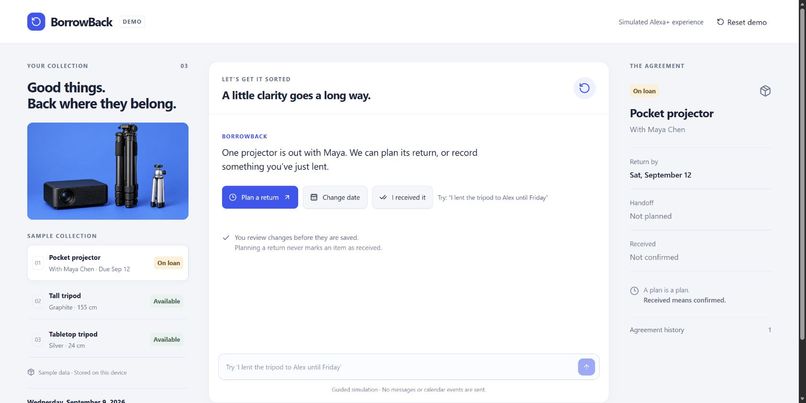
Working web prototype: synthetic loans and explicit confirmation. Simulated Alexa+; no live Alexa integration.
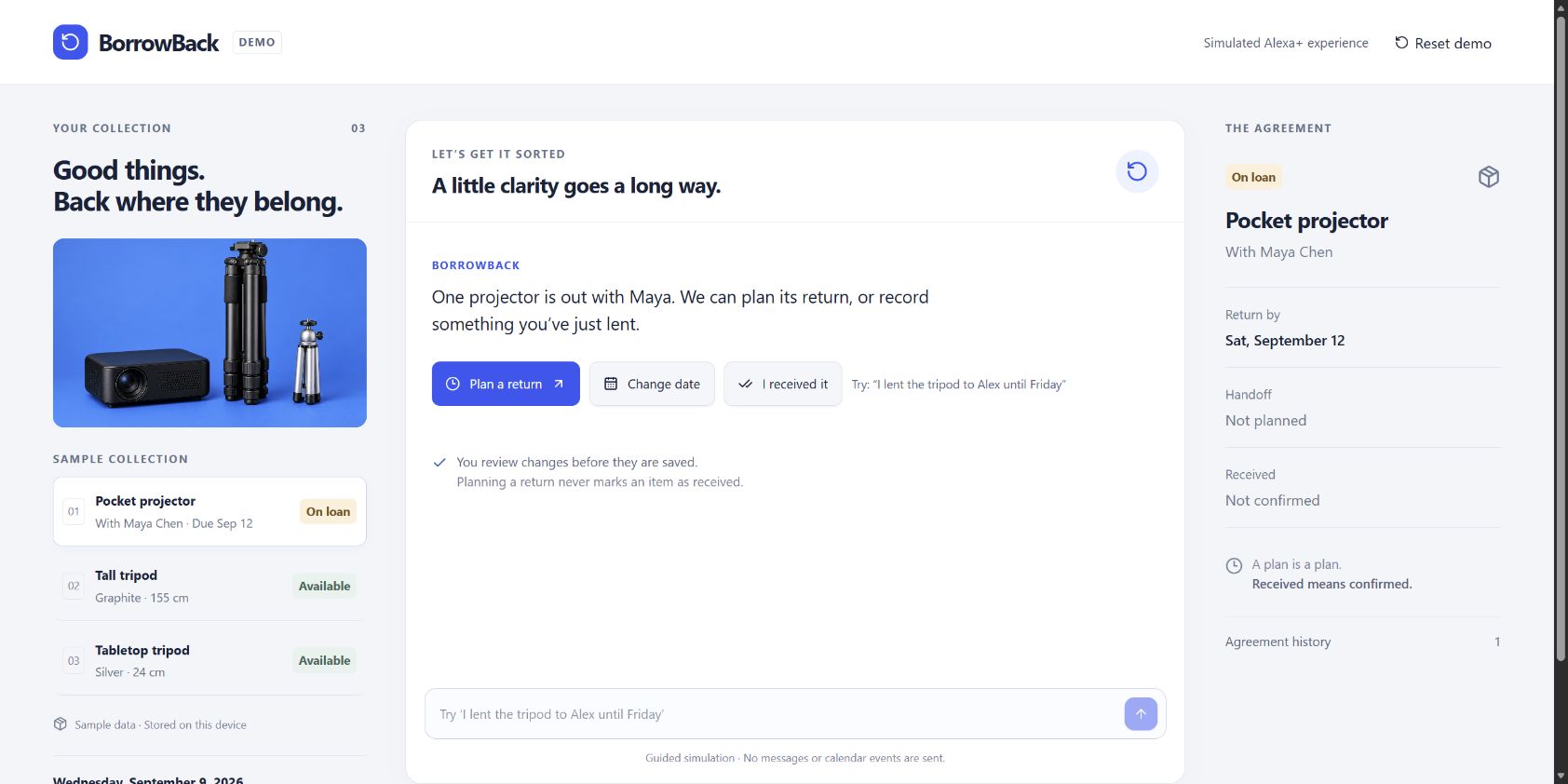
BorrowBack is a simulated Alexa+ web experience built for the Amazon Developer Hackathon. It is not connected to a live Alexa backend. All people, loans and schedules in the demo are synthetic.
Inspiration
An equipment loan can be described casually: “I lent the tripod to Alex until Friday.” The useful work is in what that sentence leaves open: which tripod, which date, when both people can meet, and whether the object has actually come back. BorrowBack explores a focused conversational flow for those decisions. This is a design hypothesis, not a claim based on a user study.
What it does
BorrowBack clarifies ambiguous objects, previews agreements, supports date corrections, intersects sample schedules, exports a tentative calendar file, and records receipt only after explicit confirmation. Confirmed data stays on the device after reload. Users can inspect history and undo the latest change.
How it was built
React and Vinext run the interface on Cloudflare Workers. Two actual MCP tools use Streamable HTTP and protocol 2025-11-25: resolve_item and find_return_windows. The client initializes the session, discovers tools with tools/list, then calls the selected tool. Zod validates inputs and state transitions. A guided deterministic parser orchestrates the simulated conversation; no live Alexa, voice, language model or calendar service is connected. Codex assisted implementation, research and validation. The original product illustration was generated for this project.
Challenges and accomplishments
The main challenge was preserving uncertainty and separating intentions from completed actions. A missing detail does not create a loan; a conflicting schedule does not invent a time; a calendar export does not mark receipt. Tests cover those boundaries, invalid inputs and concurrent MCP requests. The browser walkthrough shows actual interactions with the working prototype, including persistence after reload, a handoff plan, an ICS download and explicit receipt. It is edited between real interaction segments, with English captions and no generated footage.
What we learned
A compact state machine and explicit proposals can make a simulated assistant's behavior inspectable. Correct MCP negotiation, empty notification responses and a Worker-compatible validator mattered more than adding another conversational surface. A simulation is useful evidence of the workflow, but it cannot substitute for testing the eventual Alexa/calendar integration with real users.
Next steps
Validate the workflow with actual equipment-sharing groups. Only after that, add authenticated shared records and a properly permissioned Alexa/calendar integration. No external messaging or data collection is included in this prototype.
Open Source mini contribution
New MIT-licensed BorrowBack repository created during the hackathon window. Contribution: a proposal/confirmation state machine, read-only MCP tools, device-local interface, tentative ICS export and 20 regression/integration tests. GitHub contributor: EazyHood. Repository and contribution URL: https://github.com/EazyHood/borrowback . No external maintainer acceptance or merged PR is claimed.

Log in or sign up for Devpost to join the conversation.