-
-
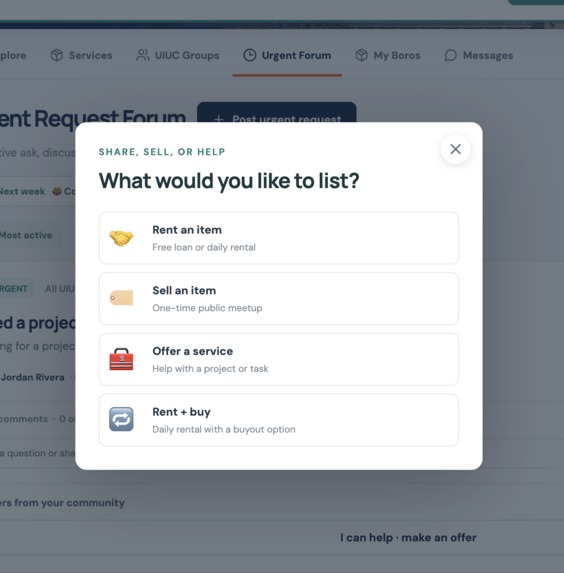
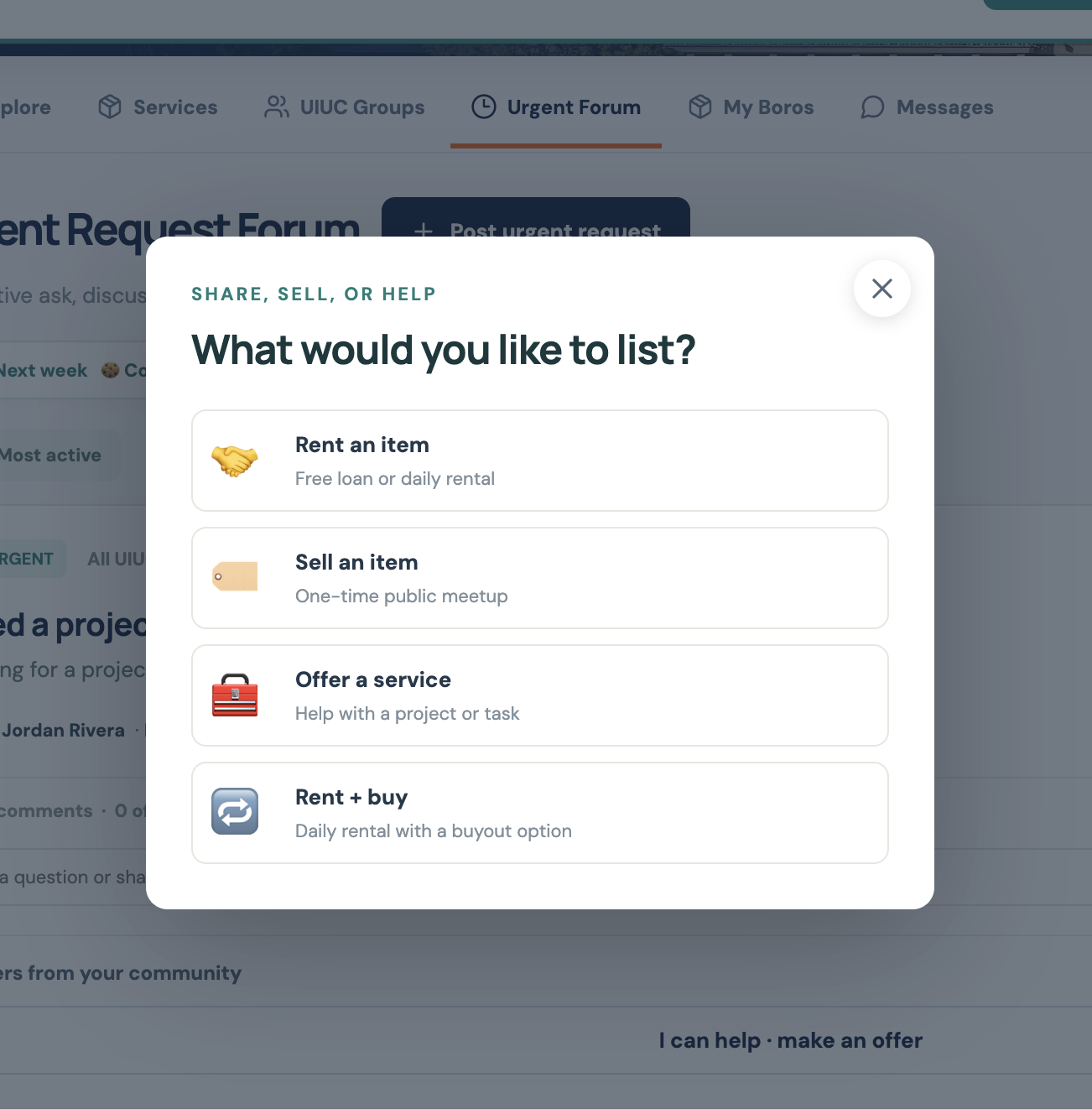
Listing options
-
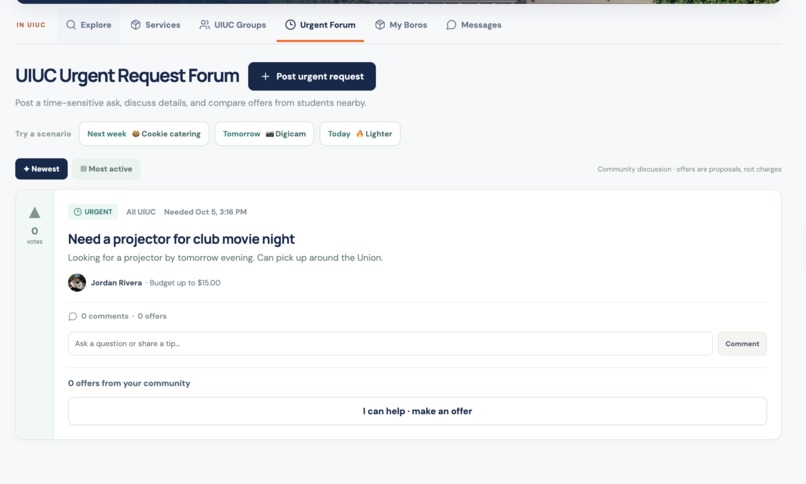
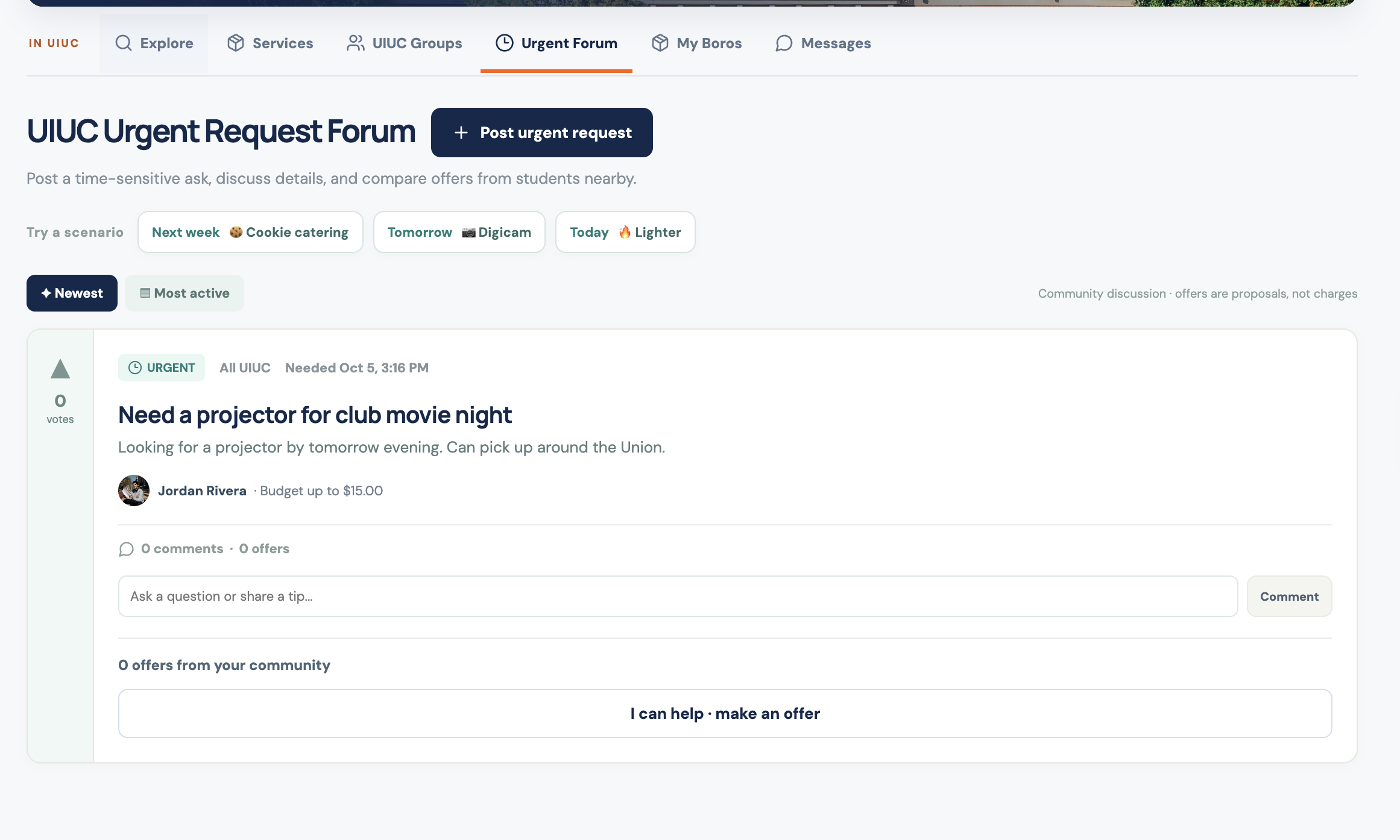
Urgent requests!
-
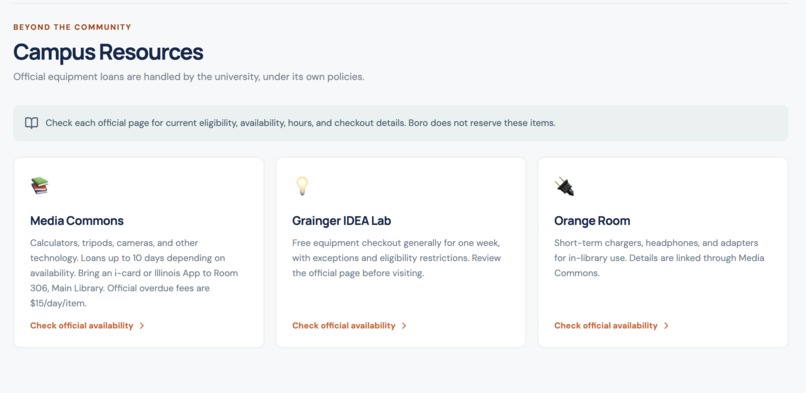
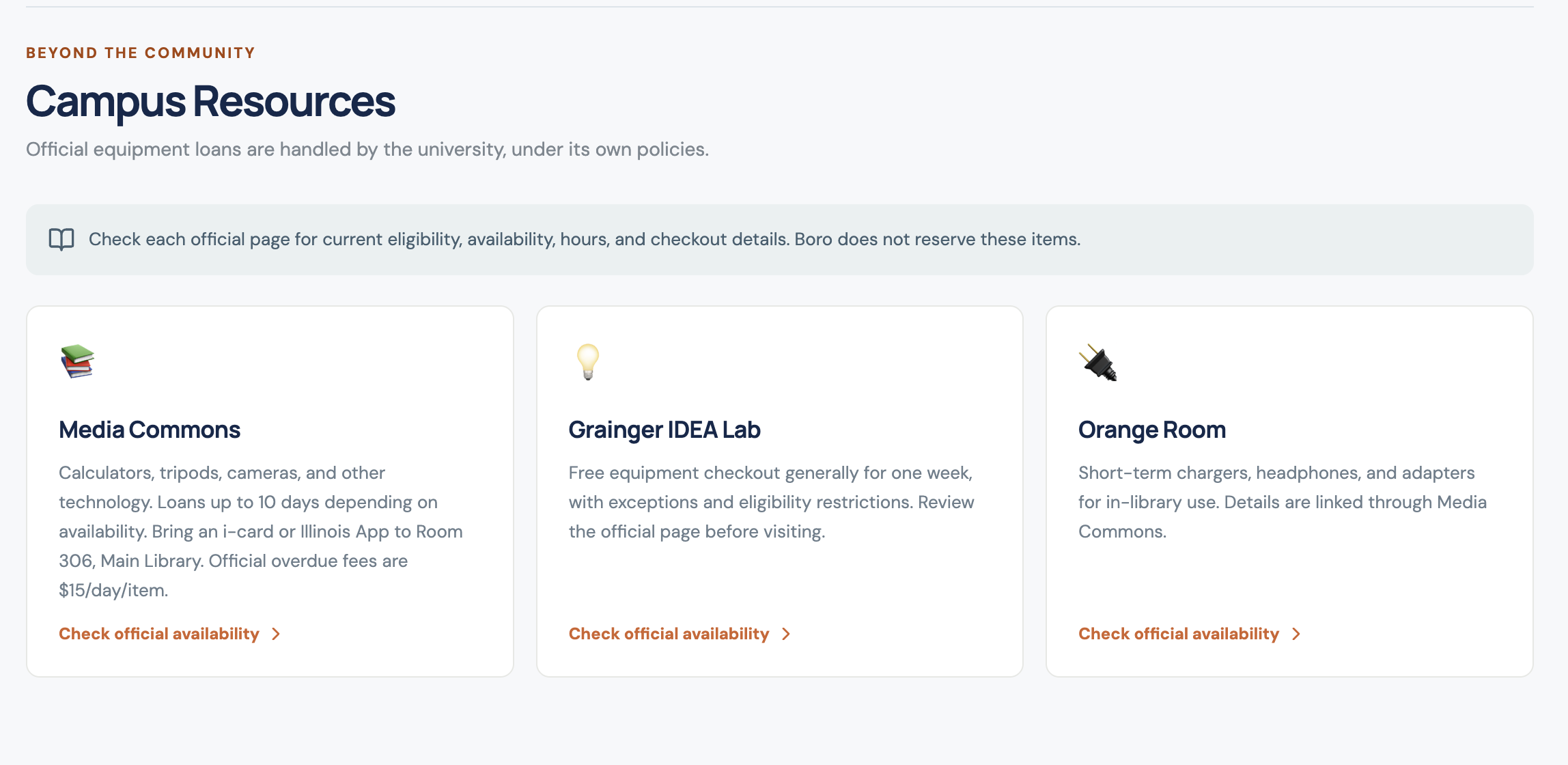
Campus resources!
-
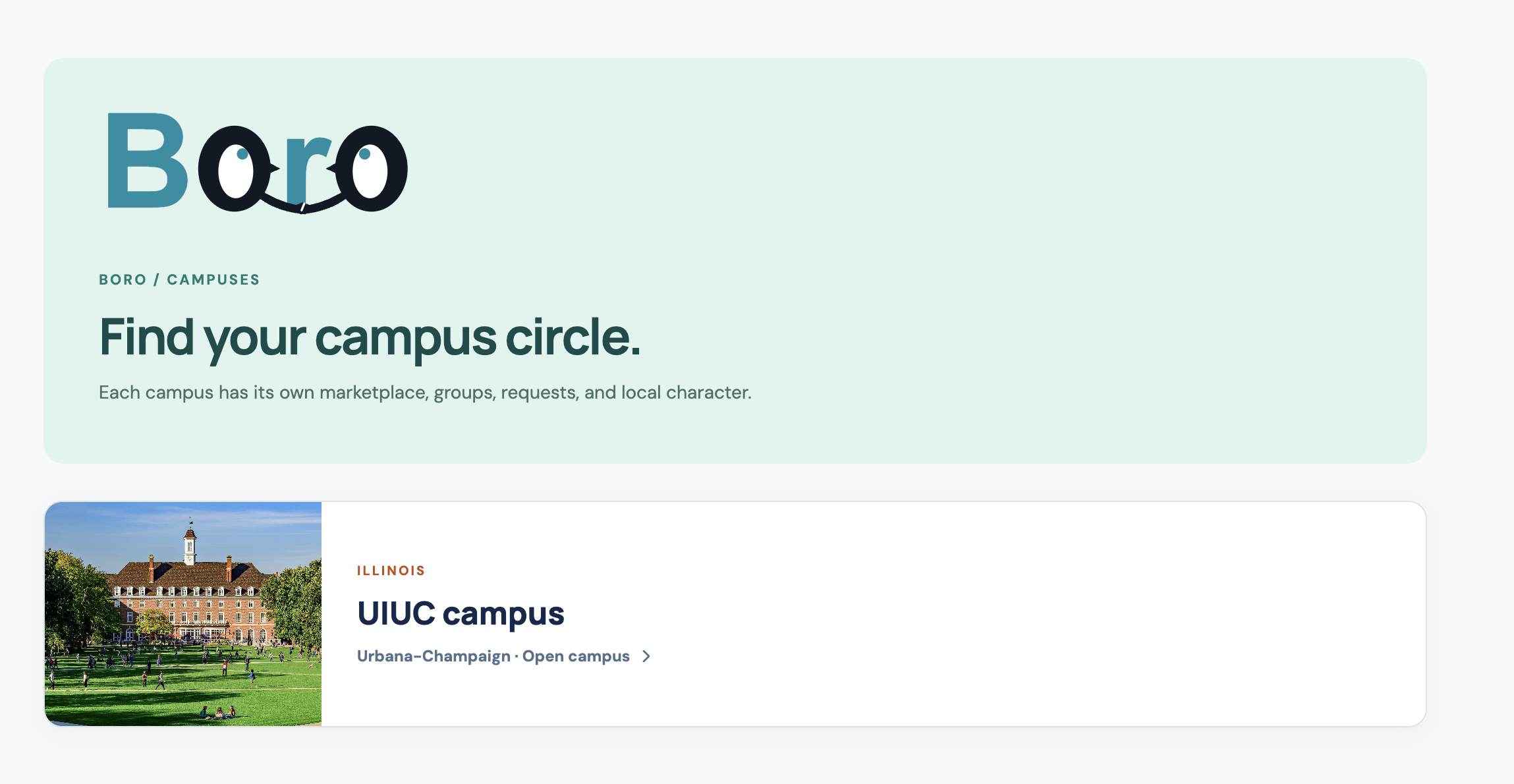
Find your campus!
-
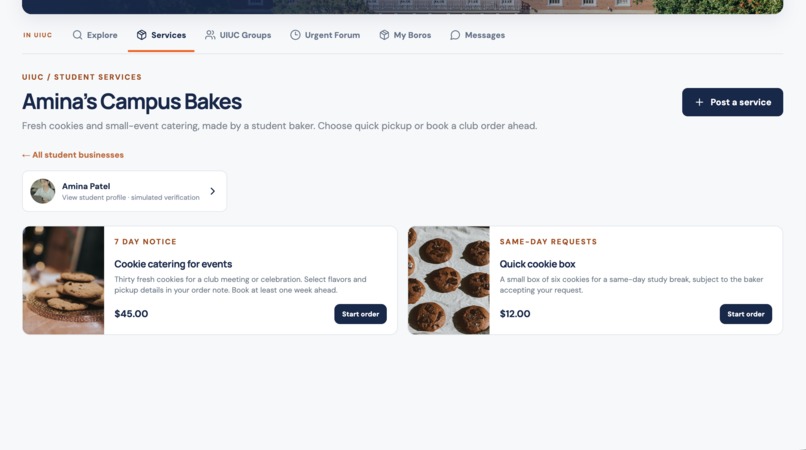
Support campus businesses
Boro — Borrow More. Own Less.
Boro is a UIUC-only marketplace where students borrow, buy, and book services from each other instead of buying new or meeting strangers from Facebook Marketplace. It addresses three barriers: cost, trust, and discovery.
Prototype: Try Boro
What did you build and how does it address the prompt?
We redesigned peer-to-peer exchange for a single campus. General marketplaces like Facebook Marketplace and Craigslist are built for strangers buying and selling. Students often need to borrow something for a day, from someone they can trust, within walking distance. Boro is built for that.
Target users and barriers
Primary users: UIUC students on tight budgets who need something briefly—a vacuum, a camera for a class project, a mini-fridge at move-in, or a suit for a career fair—but cannot justify buying it.
Secondary users: Student entrepreneurs and clubs, including bakers, barbers, photographers, artists, and RSOs, who sell to campus but have no storefront beyond Instagram stories and flyers.
Who gets left out today:
- Students without a car or local network, including freshmen, transfer students, and international students, who have no one to borrow from.
- Students who do not use Facebook or do not feel safe meeting a stranger from the internet.
- Student sellers who cannot afford ads or a storefront.
Financial barrier
Students buy new for a one-time need or go without. Boro lets them borrow or rent by the day, with lease-to-buy as an option for bigger items.
Trust barrier
Students deal with anonymous strangers, scams, and little recourse if an item comes back broken. Boro's proposed protection includes verified @illinois.edu accounts, borrowing agreements, deposits, and before-and-after condition photos.
Discovery barrier
Needs and offers are scattered across GroupMe, Instagram, Fizz, and flyers. Boro brings listings, services, urgent requests, and campus groups into one feed.
What the research says
Students are spending less and already borrowing.
A Fizz survey of 6,844 verified students in July 2026 found that 45% expect to spend less this year, 50% are buying fewer products, 33% shop secondhand, and 19% borrow or share instead of buying.
- Source: Fizz back-to-college survey.
- Implication: Borrowing is already a habit that Boro can support.
Campus-only trading has demonstrated demand.
Fizz's marketplace drew 50,000 listings and 150,000 item messages in its first rollout from March to May 2024. Payments were not integrated.
- Source: TechCrunch.
- Implication: Borrowing, payments, and accountability offer opportunities beyond campus buying and selling.
Campus proximity helps establish trust.
Fizz's co-founder said: "If you know they're in the dorm next door to you, you don't have any reason to figure out if they're legitimate or not."
- Source: TechCrunch.
- Implication: Campus membership and proximity can reduce uncertainty about who students are dealing with.
Social-media scams create real financial risk.
Americans reported $2.1 billion lost to scams that started on social media in 2025. Facebook led all platforms, and social media was the top contact method in loss reports from ages 18–29.
- Source: FTC Data Spotlight, April 2026.
- Implication: Trust and accountability matter for student exchanges.
Cost blocks access to academic necessities.
A 2020 survey of more than 5,000 students found that 65% skipped buying a textbook because of cost; 90% of those students worried it would hurt their grades.
- Source: U.S. PIRG Education Fund.
- Implication: Lower-cost access to needed items can support students academically.
In-person exchanges fit student habits.
OfferUp's 2025 Recommerce Report found that 75% of Gen Z enjoy meeting buyers or sellers face to face, and 49% sold a used item for the first time in the past year.
- Source: OfferUp 2025 Recommerce Report.
- Implication: Local campus handoffs fit an existing preference.
From our interviews: [Add 3–5 findings from students you talked to: who they were, what surprised you, and one design change their feedback caused.]
How Boro solves it
- Campus-only network: Accounts are designed to connect to an
@illinois.eduemail. - Four ways to exchange: Rent or borrow, buy, book a service, or lease-to-buy.
- Borrowing agreements: Each loan records dates, price or free lending, deposit terms, and late fees.
- Condition photos: Lenders and borrowers photograph the item before and after the loan so disputes have evidence.
- Lender profiles: Students list what they are willing to lend, from art supplies to appliances.
- Urgent Forum: Students post same-day needs; classmates reply with offers and negotiate a price.
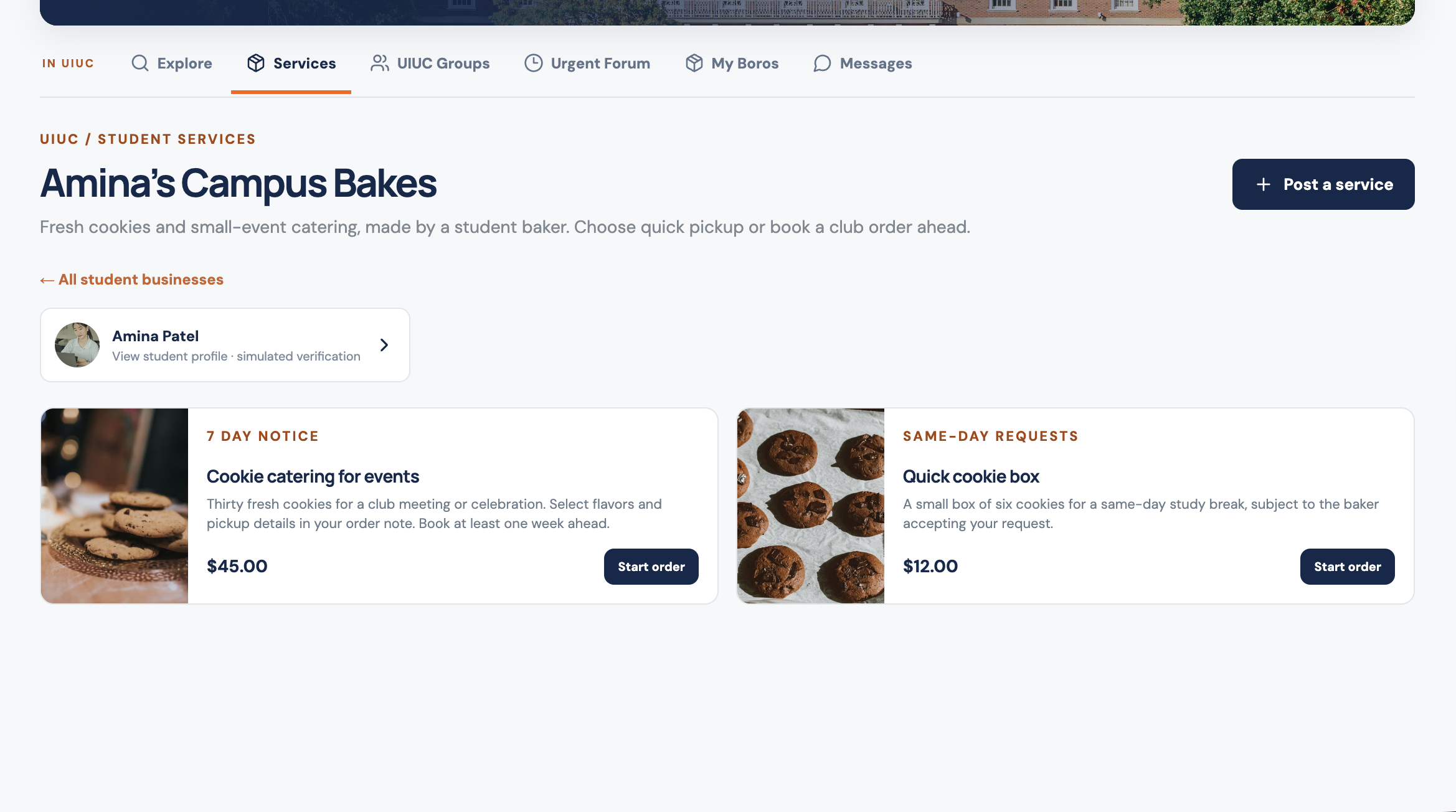
- Student services: Catering, photography, moving help, haircuts, and art commissions appear alongside items.
- Groups and messaging: Public or private groups support clubs and dorm floors, with a chat thread for each item.
Why not the alternatives?
Facebook Marketplace / Craigslist
- Open to anyone.
- Primarily built for buying and selling.
- No built-in campus borrowing agreements, deposits, or condition-photo workflow.
- Student businesses are mixed in with the broader marketplace.
Fizz Marketplace
- Verified student access within an app centered on anonymity.
- Primarily built for buying and selling.
- Borrowing protection is not its focus.
- Student services are not its focus.
Boro
- Designed for verified UIUC students with named profiles; ratings are planned.
- Supports borrowing, buying, services, and urgent requests.
- Includes agreement, deposit, and condition-photo workflows.
- Gives student businesses a dedicated place beside item listings.
How did you build it?
We built a fully clickable front-end prototype in React, TypeScript, and Vite, hosted on GitHub Pages. We structured the code so backend integrations can be added through a dedicated service layer.
Tools
Frontend
- Prototype: React 19, TypeScript 5.9 in strict mode, Vite 7, custom CSS, and Lucide icons.
- Production plan: The same stack, hosted on Vercel.
Data
- Prototype: Browser
localStoragewith seeded demo data. - Production plan: Supabase Postgres, with each table keyed by
campus_id.
Sign-in
- Prototype: Four demo student accounts.
- Production plan: Supabase Auth with verified
@illinois.eduemail addresses.
Payments and deposits
- Prototype: Simulated checkout, deposits, and late fees.
- Production plan: Stripe Connect.
Messaging
- Prototype: Item-specific threads stored locally.
- Production plan: Supabase Realtime plus message moderation.
Integration layer
- Prototype: Services wrapped in
demoServices.ts. - Production plan: Replace the demo wrappers with real API calls.
Hosting
- Prototype: GitHub Pages, deployed through GitHub Actions.
- Production plan: Vercel.
AI tools: [Add the AI tools you used and what each contributed: scaffolding, UI, copy, debugging, or other work.]
Challenges and how we solved them
- No time for a real backend. We wrapped sign-in, payments, and storage in one service layer,
demoServices.ts. This keeps the demo interactive and creates defined integration points for Supabase and Stripe. - Photos in browser storage.
localStoragehas limited capacity, so we compress condition photos in the browser before saving them. - Demonstrating a two-sided marketplace. We seeded four student accounts and ready-made scenarios, including cookie catering, a camera rental, and an urgent request. Judges can explore both the lender and borrower experience, including simulated deposits and late fees.
- Invalid booking dates. Borrowing agreements validate dates before saving.
Key tradeoffs
Front-end-only prototype
- Benefit: A complete, clickable demonstration of the core flows within hackathon time.
- Tradeoff: Data lives in one browser. The service layer and planned production schema provide a starting point for backend integration.
Verified UIUC students only
- Benefit: A shared campus community and more accountable identities.
- Tradeoff: A smaller initial pool. We plan to seed supply through clubs, student businesses, and move-in and move-out activity.
Named profiles with planned ratings
- Benefit: Accountability across exchanges.
- Tradeoff: Less privacy than anonymous apps. Profile visibility and reporting tools will need careful design.
Deposits on loans
- Benefit: More confidence when lending valuable items.
- Tradeoff: Upfront cash can become another financial barrier. We propose deposits that scale with item value and decrease as borrowers establish a reliable history.
Multiple exchange types
- Benefit: Borrowing, buying, services, lease-to-buy, and urgent requests give students several reasons to return.
- Tradeoff: Supply could spread thin. We would launch with borrowing and the Urgent Forum as the initial focus.
In-person handoffs without shipping
- Benefit: No shipping costs and the possibility of same-day exchanges.
- Tradeoff: Meeting safety requires attention. Boro would suggest public exchange spots, such as the Champaign Police Department's monitored exchange area.
How can you implement this further?
Our next step is a one-semester UIUC pilot: test whether students complete exchanges, return to the platform, and trust the process before expanding campus by campus.
Roadmap
- Pilot-ready platform: Add Supabase Auth with
@illinois.eduverification, Postgres with row-level security, Stripe Connect deposit handling, post-exchange ratings, and report and block tools. - Campus launch: Launch around move-in and move-out, when students acquire and sell the most. Seed supply through clubs, RSOs, and student businesses; recruit student ambassadors; and seek promotion through official UIUC accounts.
- Trust and protection: Explore ID checks for high-value items, lending limits based on exchange history, a damage-protection model, and a map of public exchange locations.
- Access features: Add screen-reader support, high-contrast mode, and multiple languages for international students.
- More campuses: Use
campus_idto establish separate school communities within the same application.
Business model: Free lending stays free. Boro would take a small fee on paid rentals and services and offer paid featured placement to clubs and student businesses.
Go-to-market flywheel
Each club or student business that promotes its Boro listing introduces potential buyers to other sellers. As supply and participation grow, more students can find a useful reason to join.
Success metrics
North star: Completed exchanges per week, including borrows, sales, and service orders. This measures whether both sides successfully follow through.
Verified users
- Measures: Reach across campus.
- Proposed semester-one target: 1,000 users.
Activation
- Measures: The percentage of new users who complete an exchange within 14 days.
- Proposed semester-one target: 40%.
Urgent Forum fill rate and response time
- Measures: Whether students get their same-day needs met.
- Proposed semester-one target: 70% filled, with a median time to first offer under two hours.
On-time return rate
- Measures: Whether agreements and deposit incentives support reliable returns.
- Proposed semester-one target: 95%.
Damage disputes
- Measures: Whether lending remains dependable.
- Proposed semester-one target: Fewer than two disputes per 100 loans.
Money saved per borrower
- Measures: Retail price minus the amount paid to access the item.
- Proposed semester-one target: Track and report.
Participation among underserved students
- Measures: Participation by first-years, international students, and students without a car.
- Proposed semester-one target: Compare participation against their share of campus.
Sign-ups from club and business promotion
- Measures: Whether student organizations and sellers help bring in users.
- Proposed semester-one target: 30% of sign-ups.
Sources
- The $103.5 Billion Back-to-College Season — Fizz, August 2026; survey of 6,844 verified students conducted in July 2026.
- Fizz, the anonymous Gen Z social app, adds a marketplace for college students — TechCrunch, July 2024.
- Reported losses to scams on social media eight times higher than 2020 — FTC Data Spotlight, April 2026.
- Fixing the Broken Textbook Market, Third Edition — U.S. PIRG Education Fund, February 2021; survey conducted in 2020.
- Secondhand shopping becomes the norm in 2025 — Retail Insider, covering OfferUp's 2025 Recommerce Report.
- U of I announces third straight record freshman class — Fall 2026 enrollment information.
- Internet Purchase Exchange Locations — City of Champaign.
- Boro repository
READMEandTECH_STACK.md.
Built With
- codex
- html
- typescript


Log in or sign up for Devpost to join the conversation.