Inspiration
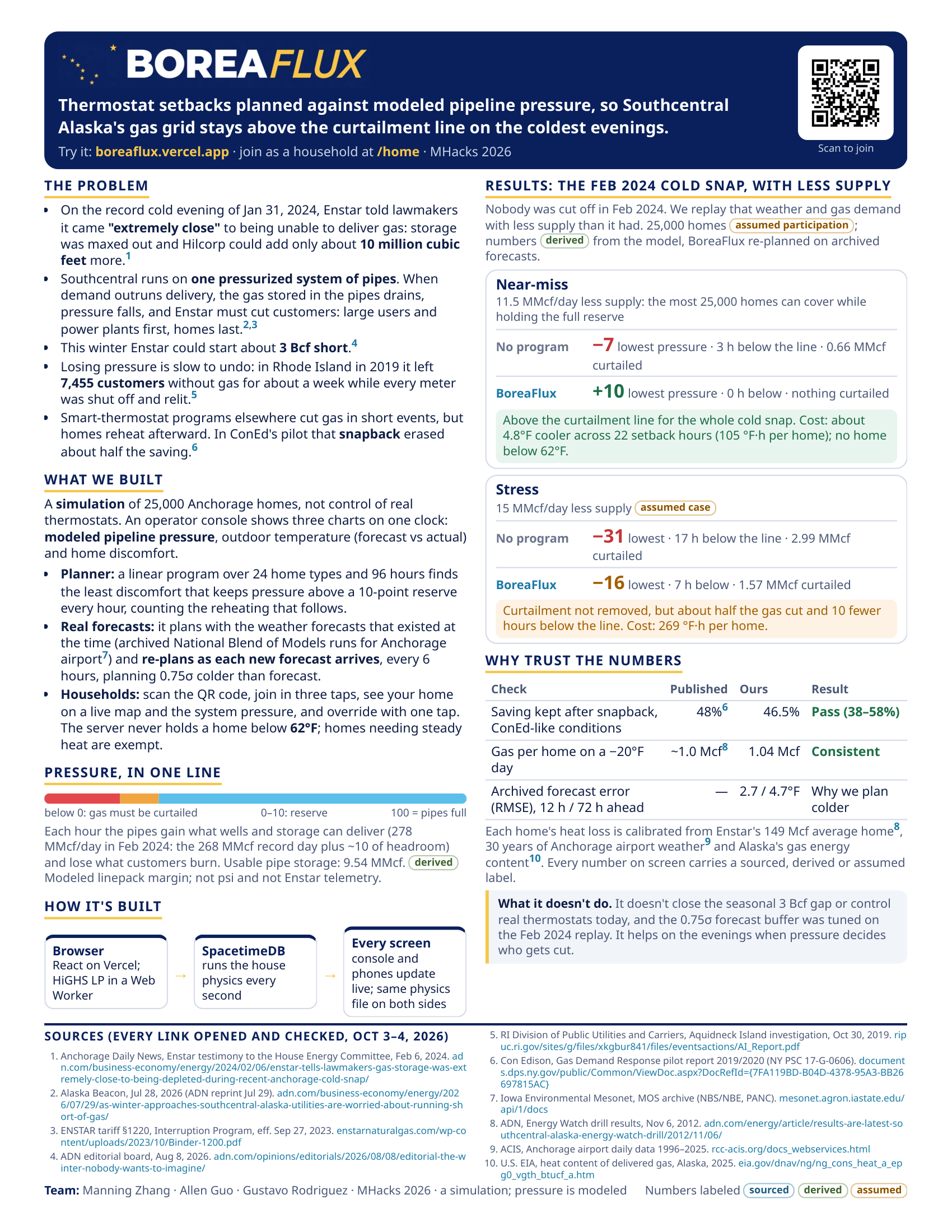
There’s a serious chance that Southcentral Alaska runs out of natural gas this winter. This almost happened in Manning’s hometown, Anchorage, in February of 2024 during a cold snap that reached -20° F. Natural gas powers and heats our businesses, schools, hospitals, and homes. As gas supply dwindles, so does pipeline pressure. If pipeline pressures dip below a certain amount, utility companies are forced to cut off customers to prevent serious infrastructural problems, a situation called curtailment. Public officials have called this winter a crisis. While the general public can’t meaningfully affect total gas volume consumed over the course of winter, by working together, can we affect peak gas consumption rate enough to avoid curtailing customers around our city? Legislators have asked this question. Utility company presidents have been … unclear. BoreaFlux answers and delivers the solution.
What it does
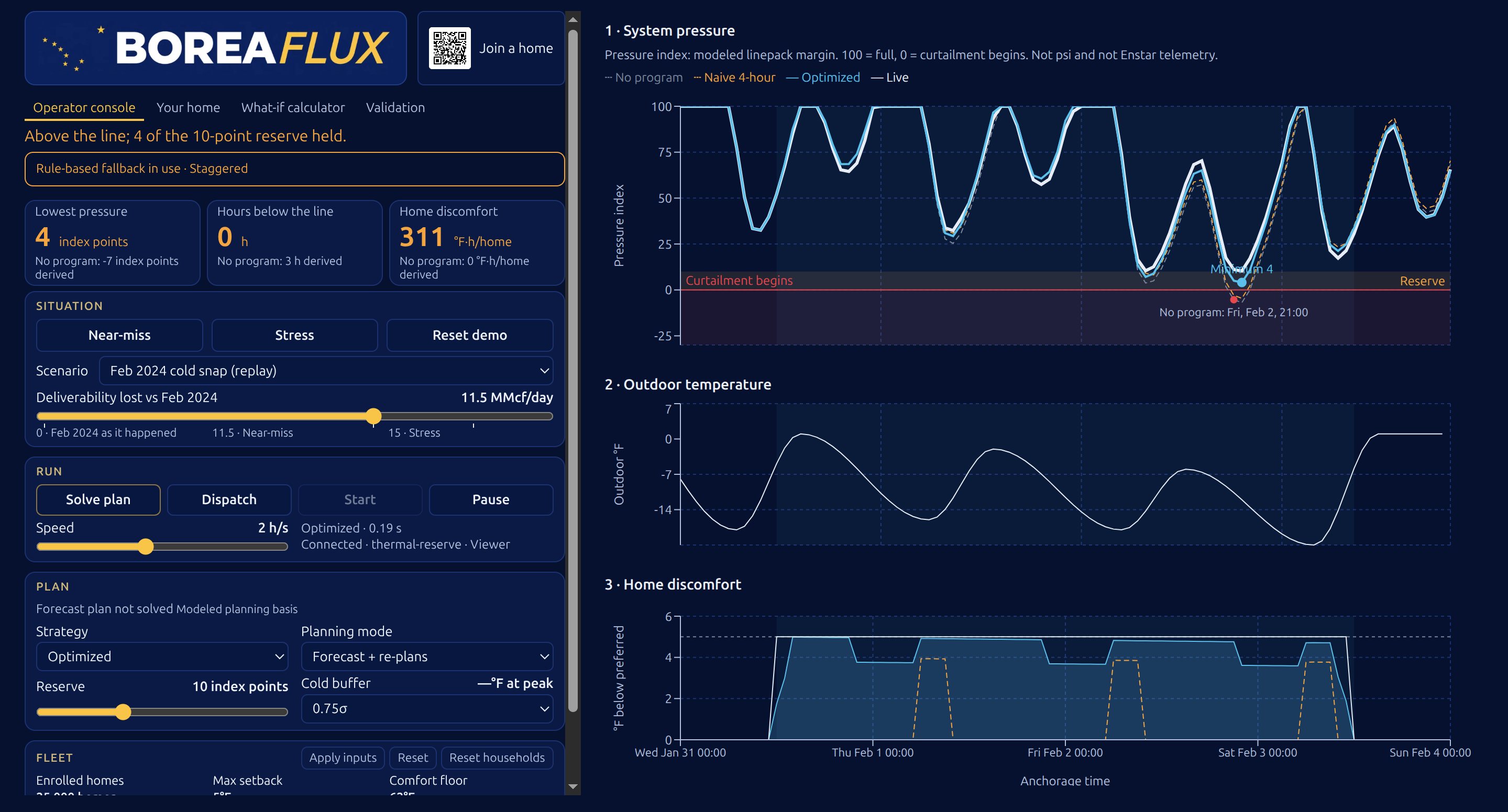
BoreaFlux coordinates volunteer residential thermostats to mitigate or completely avoid curtailment. When large numbers of homes turn the heat back up after having it down to conserve gas usage, the peak gas rate snaps back, putting extra load on the pipelines. BoreaFlux reads temperature forecasts to continuously replan usage, intentionally landing snapback on warmer days with more remaining pipeline capacity. On top of that, it solves a linear program to maximize gas rate reduction, while minimizing user discomfort in Fahreinheit-hours away from user temperature preferences, constrained using thermodynamic models of houses. It will never allow homes to go below specified temperatures, and users can override at any time.
On our demo website, we simulate BoreaFlux on Anchorage homes and visualize its impact, with variable enrollment numbers, gas deliverability, and planning preferences. Additionally, anyone can enroll as an additional home, observing the (sped up) simulated adjustments to their thermostat when an operator runs the simulation.
How we built it
Our website uses SpacetimeDB to sync our simulation scenarios across multiple thermostats (phones), and operator laptops. As thermostats are adjusted by BoreaFlux, two Gemini agents pull information from the database to provide live updates via text through Photon Spectrum, allowing users to stay informed and learn more about our model and the current energy situation.
To create our codebase, we used React and Typescript for the front end, with calls going to SpacetimeDB to update our data across devices. The Photon Spectrum texting system runs on a Node server on a Linux Laptop, with calls made to the Photon API to send text messages. To build out our codebase we used a combination of Claude Agents and an OpenAI agent to implement different aspects of the app. We used Tailscale to allow the agents to communicate, and created documentation to define their roles and ownership of files, allowing them to integrate seamlessly.
Challenges we ran into
We initially worked and visualized in units of billions and millions of cubic feet per second. This turned out to be completely the wrong way to approach and understand it, due to reasons involving dynamics and gas usage history over time. After some issues with getting proper PSI numbers due to proprietary information, we settled on a representative pressure index estimated from previous incidents.
We also had to verify much of the work coming from agents, requiring extensive system testing. We resolved bugs in actions such as resetting a simulation, texting right after a scenario occurred, and manipulating various UI elements.
Accomplishments that we're proud of
We’re proud of the process of iteration and development that we undertook for this project. Throughout the development of both the application and the modeling, we had to analyze, discuss, adjust our model parameters, and reframe output objectives in order to get to our final product. We are proud that we were able to apply our model with real world data and see how our model could have a positive impact.
What we learned
We learned significantly about how to collaborate on a team for software development. We divided our tasks with each partner owning different portions of the codebase and communicating as our implementations interfaced with each other. We also learned the importance of testing software and how to manage multiple agents to maximize efficiency.
What's next for BoreaFlux
Internally, users are organized into Tier 1 (smart thermostats) and Tier 2 (manual/dumb thermostats). We would love to see BoreaFlux be able to physically manipulate a real thermostat, which could lead to integration of our system in a study with potential for real world use, allowing us to develop actual integrations for smart thermostats and automatic messaging systems for manual thermostats. We would also love to expand our computing power and bandwidth to communicate with a large number of devices at the same time efficiently, and collect data from this use.


Log in or sign up for Devpost to join the conversation.