Inspiration
WHO projects a shortage of 11 million health workers by 2030, with the greatest gaps in low- and lower-middle-income countries. In remote facilities, outreach programmes and telemedicine services, that shortage is already visible: a small clinical workforce must assess growing queues while patient information arrives through spoken accounts, field notes, results and referrals.
Outbreaks and disasters do not create a new workforce; they compress even more urgent decisions into the same limited capacity. Qualified support may exist elsewhere, but it cannot help until each case is clear enough to review and reaches an authorised clinician.
That is the gap Regina addresses. We built a Good Neighbour Agentic pipeline for coordinated health operations: not an autonomous clinician, but a dependable way for patients, field workers, local care teams and approved clinical neighbours to work from the same evidence-linked case.
What it does
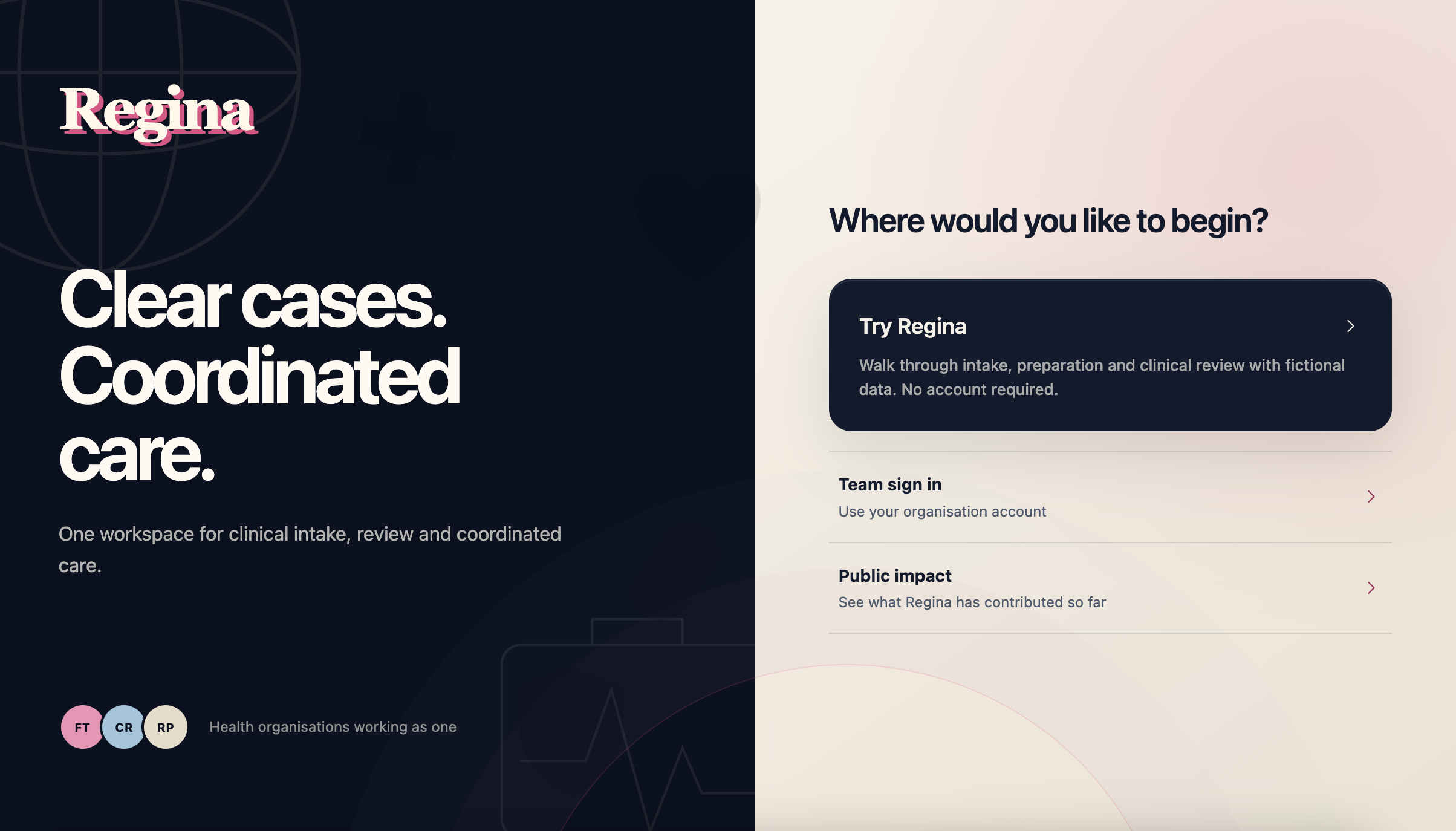
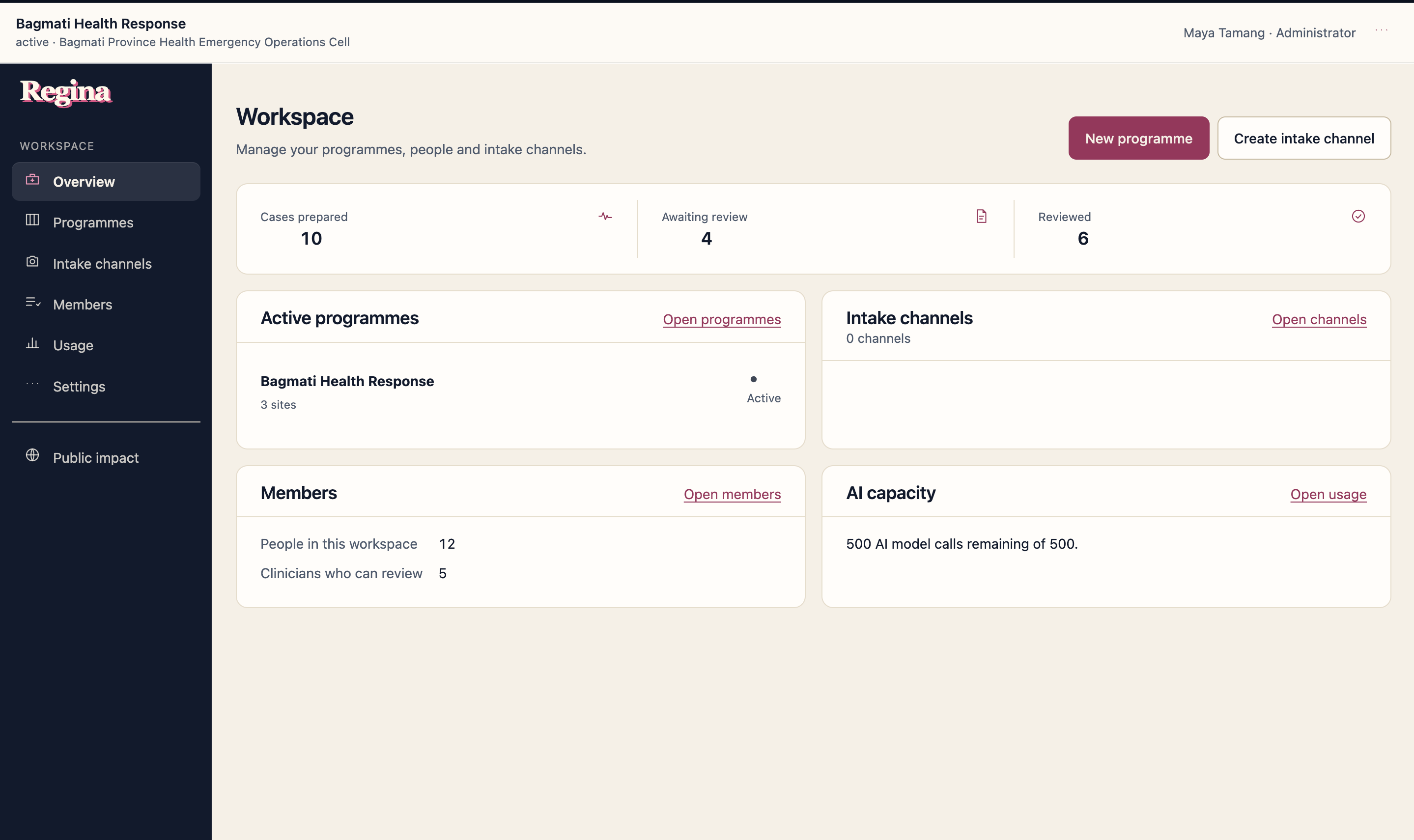
Regina is an AI-assisted intake and case-preparation system for health programmes that work through community clinics, field posts and remote clinicians. It takes a patient's account and prepares an evidence-linked case that a qualified clinician can review.
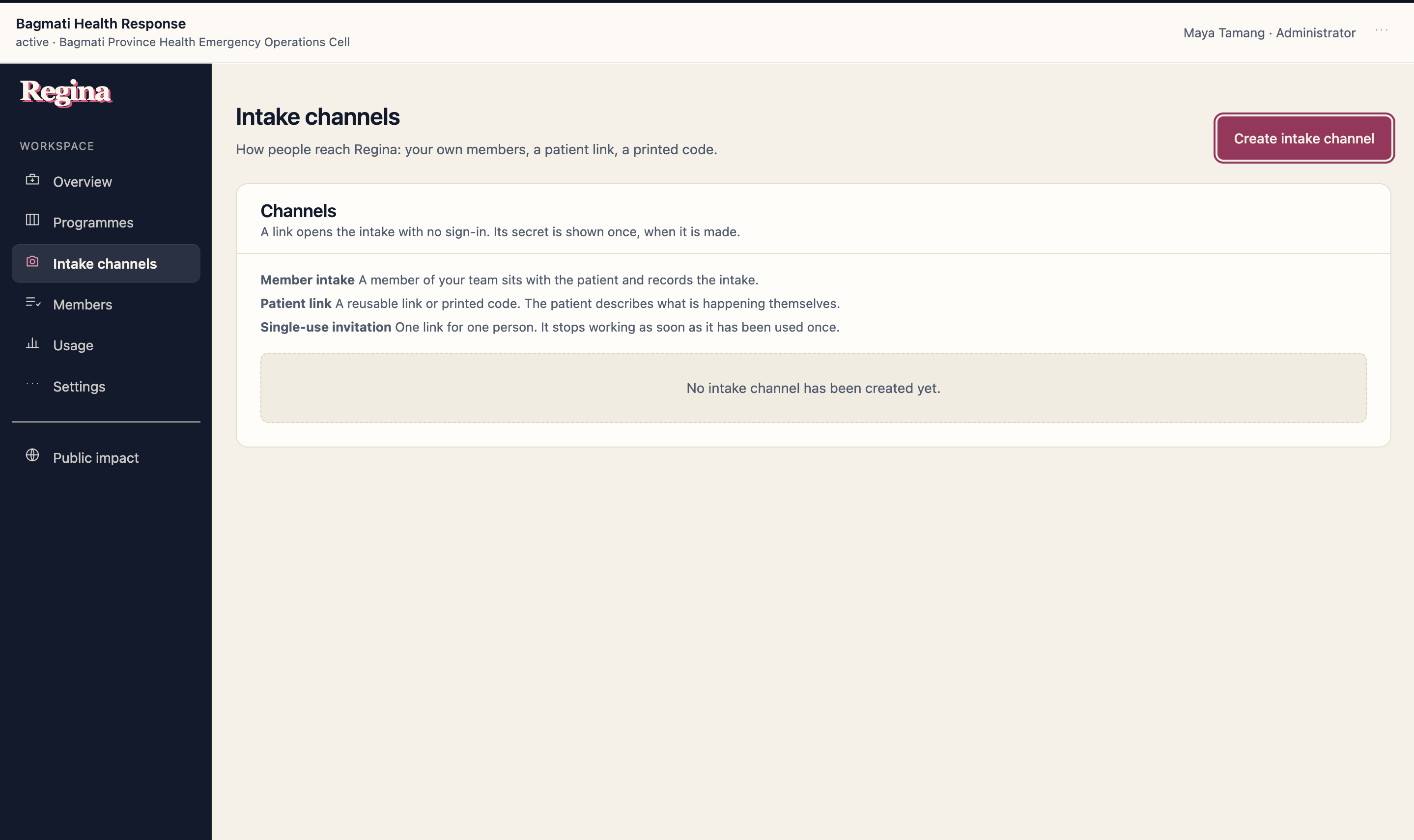
- Intake anywhere. A patient or intake worker starts through a shared channel with typed text, a voice recording or a photographed document.
- Bounded follow-up. Regina asks smart questions drawn from the account, approved local guidance and governed symptom associations.
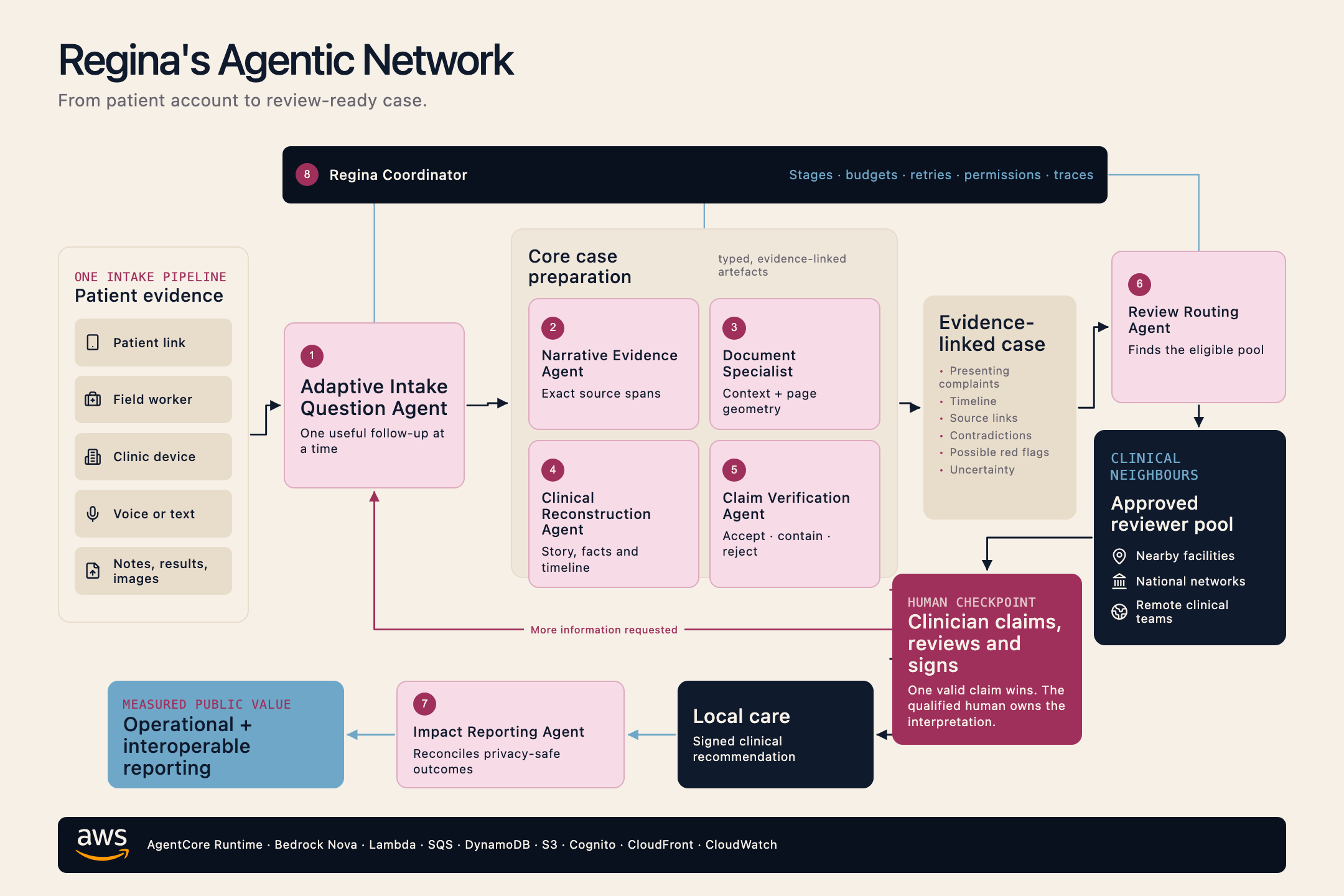
- Evidence, not opinion. Seven specialised agents segment the account, read and check documents, reconstruct the clinical story and verify every claim against its source. Each fact in the packet points to the words or the line it came from, with contradictions, uncertainty and possible red flags marked.
- A human claims the case. A routing agent shows only case metadata to the reviewers eligible for it. One clinician claims the case under a time-limited lease, reads the packet and signs the review.
- The answer goes back. The intake side authorised to act receives the signed recommendation for local follow-through.
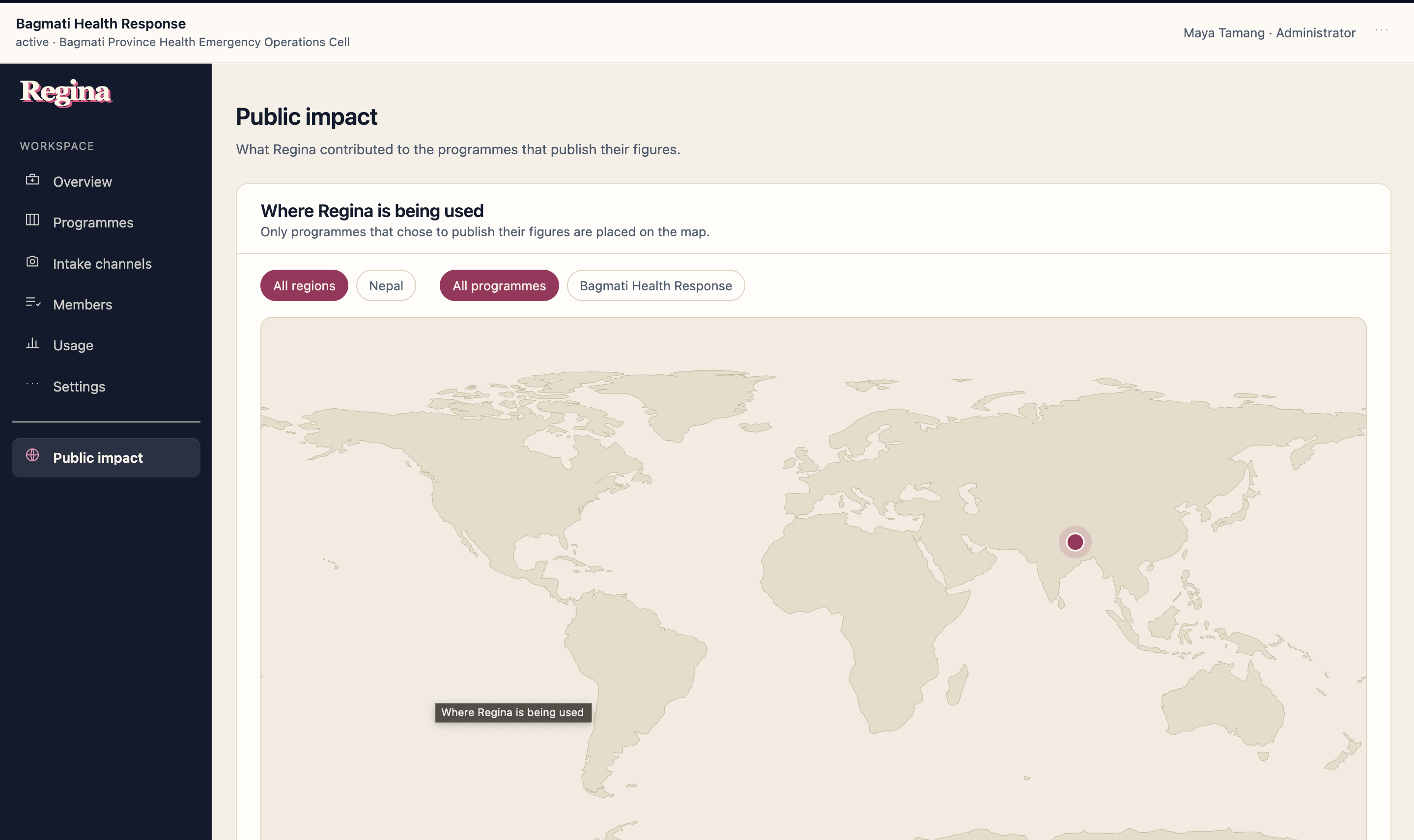
- Reporting without exposure. A privacy-gated reporting agent reconciles aggregate activity for programmes that opt in and produces narrow FHIR R4, HXL and WHO EMT MDS-aligned exports.
How we built it
| Layer | Implementation | Responsibility |
|---|---|---|
| Agent network | Strands Agents SDK with Amazon Nova 2 Lite | Seven narrow specialist roles for adaptive intake, narrative evidence, documents, reconstruction, claim verification, review routing and impact reporting |
| Control | Deterministic TypeScript coordinator, Zod contracts, Strands hooks, Cedar tool policies and bounded retries | Stage order, consent, question budgets, evidence gates, red-flag validation, disclosure and failure handling |
| Agent runtime | Amazon Bedrock AgentCore Runtime | Isolated, bounded execution of the preparation graph with external durable state |
| Workflow | AWS Lambda, SQS FIFO and DynamoDB | Asynchronous preparation, idempotency, transactional reviewer claims, lease recovery and capacity accounting |
| Product and evidence | CloudFront, Cognito, S3, Amazon Transcribe, KMS, SSM and CloudWatch | Web delivery, identity, evidence storage, recorded speech, encryption, configuration and redacted operational telemetry |
| Interoperability | FHIR R4 Bundle, HXL CSV and WHO EMT MDS-aligned aggregate exports | Narrow, documented exchange formats without claiming full conformance |
The application is deployed end-to-end on AWS. The public demonstration uses fictional people, organisations, and clinical accounts, but follows the same authentication, authorisation, agent preparation, storage, and review paths as an organisational workspace.
Challenges we ran into
| Challenge | Engineering decision |
|---|---|
| Handwritten or unclear documents invite confident guessing | Use a whole-page Document Specialist with a separate bounded check and preserve uncertain readings outside accepted evidence |
| Several eligible clinicians may claim the same case | Route metadata first, then use a DynamoDB transaction to create exactly one active lease |
| Public accountability can expose sensitive information | Derive counts deterministically after signed reviews and prevent reporting remarks from containing patient prose or identifiers |
Accomplishments that we're proud of
Regina is a working, non-trivial Strands system rather than a sequence of chat completions. The complete path—intake, automatic preparation, routing, atomic claim, signed review, authorised return and aggregate reporting—runs on AWS with the agent graph hosted in AgentCore.
We also built a reproducible evaluation harness around the product's real invariants:
| Evidence from deterministic replay | Result |
|---|---|
| Synthetic cases | 31, including 17 gold-annotated cases |
| Adaptive intakes within the question ceiling | 20/20 |
| Accepted claims without a real source span | 0 for Regina; 19 for the unguarded baseline |
| Forbidden claims presented as fact | 0 for Regina; 11 for the baseline |
| Contradiction recall, median | 1.0 for Regina; 0 for the baseline |
| Unauthorised reviewer offers | 0 for Regina; 10 for the baseline |
| Claimable cases checked with exactly one active lease | 23/23 |
| Uncertain-document containment, median | 1.0 for Regina; 0 for a naive single pass |
These replay results test the architecture and policy controls under fixed inputs; they are not claims of clinical accuracy or improved patient outcomes. The repository includes the corpus, fixtures, trajectories, scoring definitions and commands required to reproduce them offline.
What we learned
Provenance is part of the product experience. A clinician should be able to move quickly without being asked to trust an unexplained summary. The source, uncertainty and contradiction must remain one click away.
What's next for Regina
Before any real-world clinical use, Regina needs prospective evaluation with clinical reviewers and governance partners. The next product steps are organisation-controlled onboarding and credential workflows, stronger multilingual and low-connectivity intake, larger handwritten-document benchmarks, configurable retention and carefully scoped integrations with health operations.
Regina wants to become a shared intake and review layer for outreach programmes, public-health agencies, NGOs, mobile clinics and telemedicine networks, helping each organisation account for the AI and human capacity it contributes while keeping local authorities and qualified clinicians in control.
| Reference | |
|---|---|
| WHO — Health workforce | The projected global workforce shortfall and its concentration in lower-income settings |
| WHO — Classification and minimum standards for Emergency Medical Teams | Team-based emergency response, national coordination and operational reporting |
Built With
- amazon-web-services
- node.js
- react
- strands-agents-sdk
- typescript


Log in or sign up for Devpost to join the conversation.