-
-
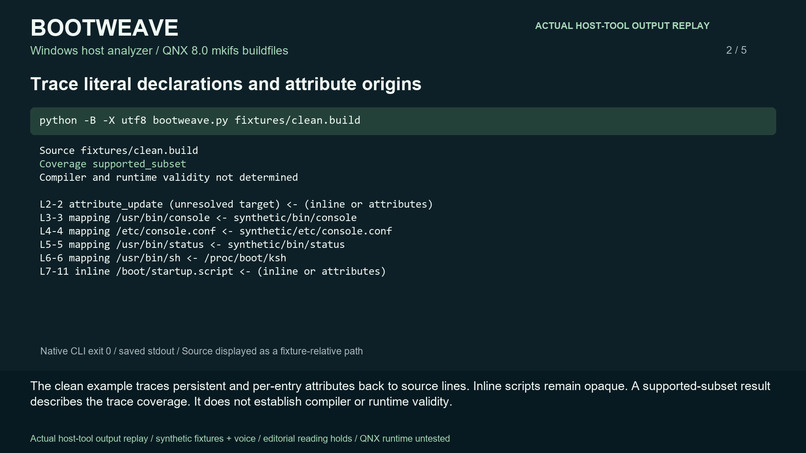
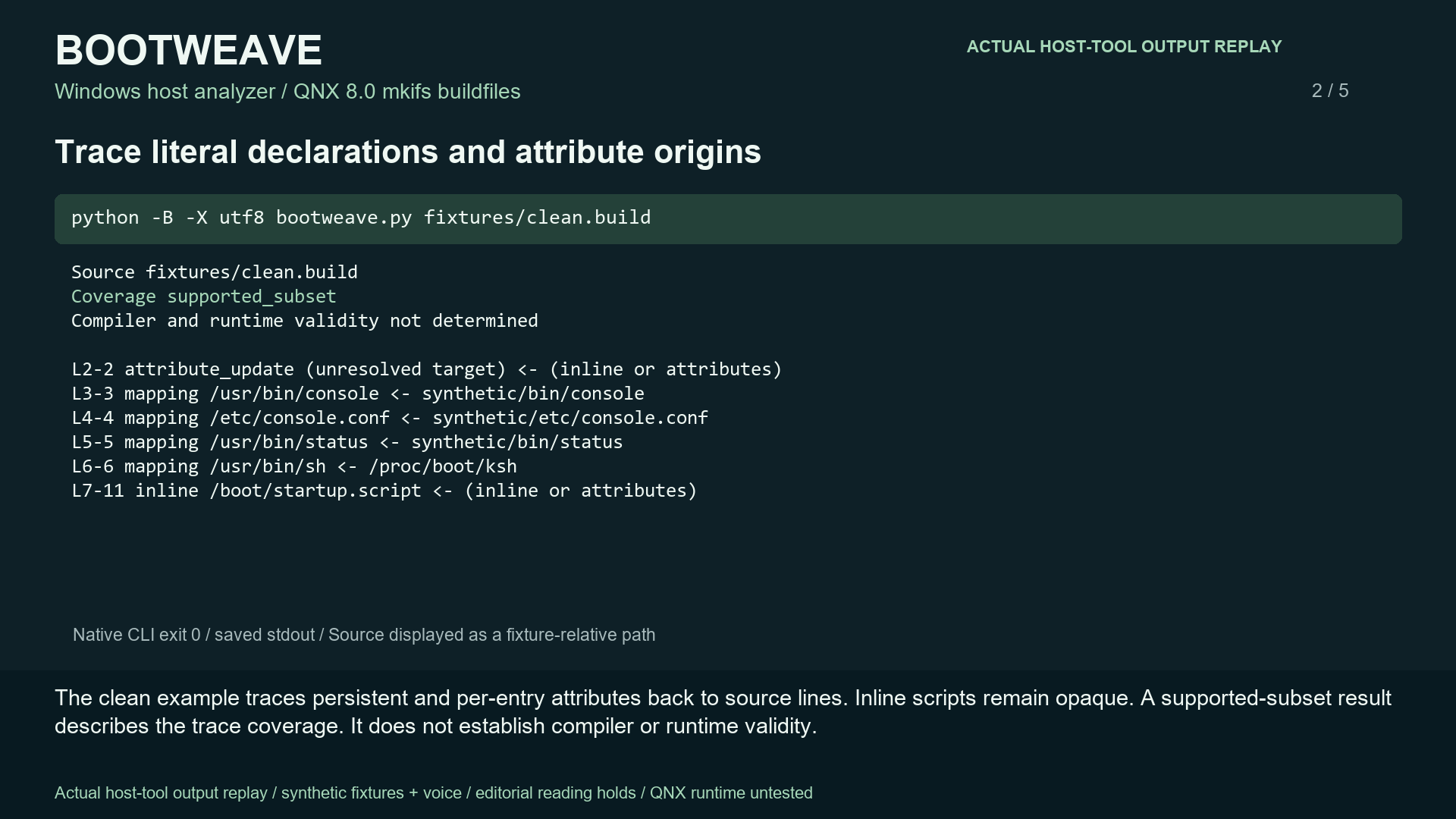
Clean synthetic fragment / actual Windows host output replay
-
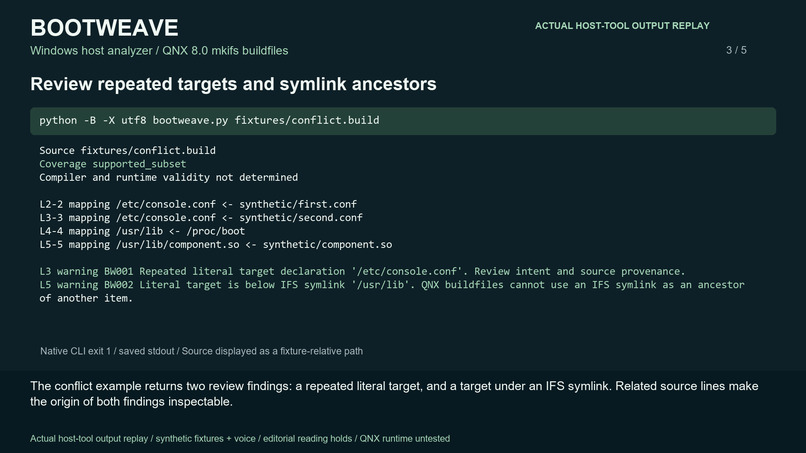
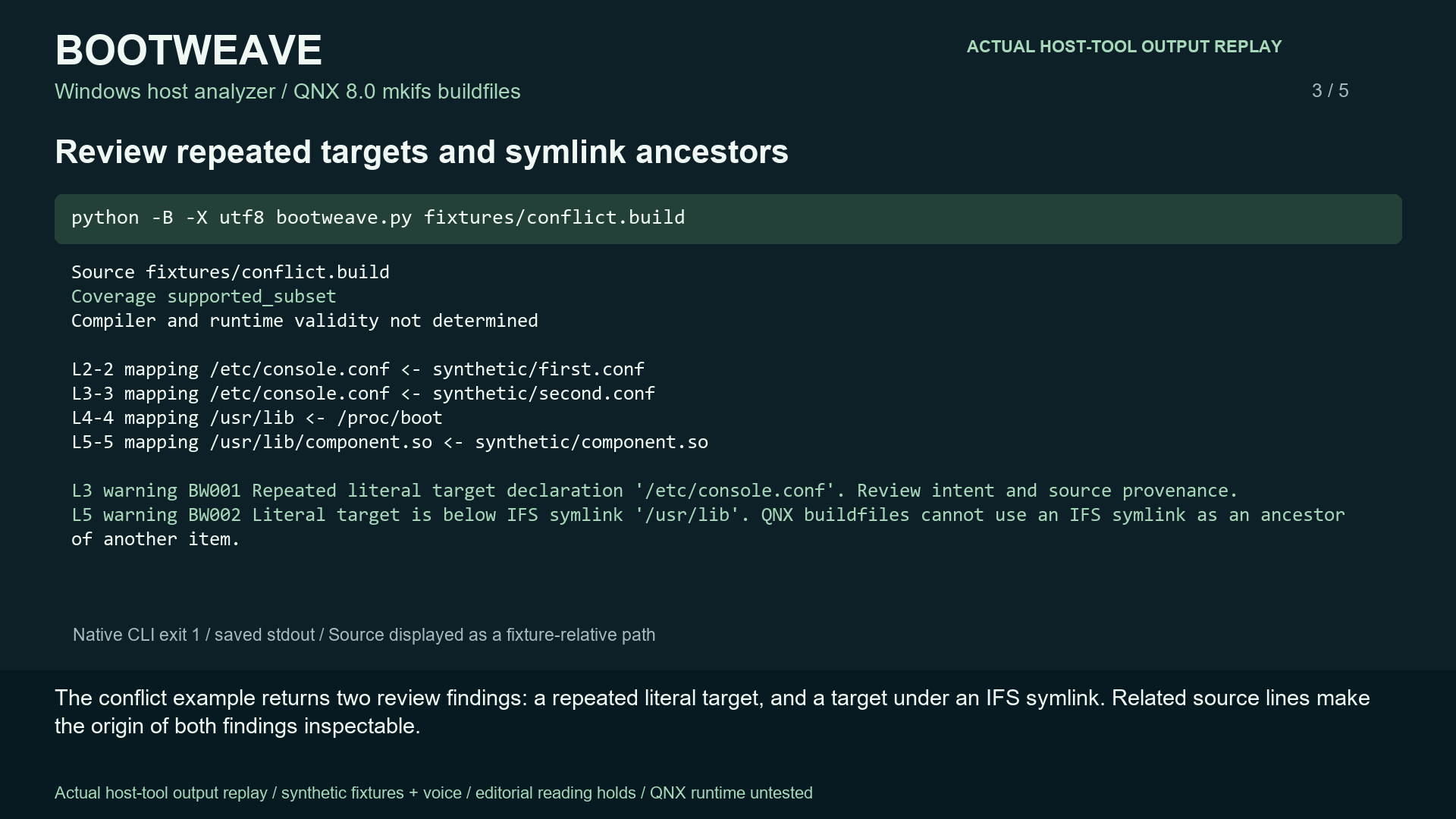
Conflict findings / actual Windows host output replay
Inspiration
A buildfile can look simple while inherited attributes and repeated declarations make a review difficult. The useful question is often which source line supplied a target or attribute, and which parts of the file still need investigation. BootWeave makes that provenance visible for a bounded subset of QNX 8.0 mkifs buildfiles.
What it does
BootWeave runs on the host and reads one UTF-8 buildfile. Each traced literal declaration includes its line span, effective attributes, and each attribute's source line and scope. Opaque inline-file bodies receive a source-text length and SHA-256. Static findings identify repeated literal targets (BW001) and explicit targets beneath a literal IFS symlink (BW002). A non-standalone unescaped closing brace outside the supported inline boundary produces BW910 and stops uncertain tracing. Variables and includes stay unresolved, with partial coverage reported explicitly. Text and JSON output make the result inspectable.
How we built it
The implementation uses Python 3.10+ language features and only the standard library. The retained execution environment was Windows with CPython 3.13.2. A bounded line-oriented analyzer tracks persistent and per-entry attributes, line provenance, opaque inline spans, and conservative unsupported-syntax diagnostics. The normal CLI provides text output, JSON output, an optional report file, distinct exit codes, and a 1 MiB input limit. Five original synthetic fixtures and 17 regression tests cover the supported contracts. QNX-specific syntax and IFS relationships were derived from the official QNX 8.0 mkifs reference. Implementation, synthetic fixtures, tests, documentation, and demonstration preparation used OpenAI Codex assistance. The runtime is deterministic and makes no model or external-service calls.
Challenges we ran into
A static tracer must preserve uncertainty when a statement cannot be interpreted safely. Unsupported inline headers initially risked letting opaque body text become false top-level declarations. The implementation now consumes the opaque body before excluding its unsupported header. The documented distinction between inline # data, escaped closing braces, and an embedded unescaped closing brace exposed another boundary case. BW910 conservatively stops the uncertain remainder. This keeps the reported declaration list within the analyzer's supported subset.
Accomplishments that we are proud of
The retained Windows run passed all 17 regression tests. The released implementation, tests, and five fixture files preserve those tested bytes. Three subsequent normal CLI executions produced exit 0 for the clean fragment, exit 1 for the repeated-target and symlink-ancestor findings, and exit 2 with BW910 for the unsupported inline boundary. The 78-second narrated demonstration replays those captured outputs and labels its synthetic fixtures, synthetic voice, editorial reading holds, and QNX runtime limits. The public repository contains reproducible commands, AI assistance disclosure, and a top-level MIT license.
What we learned
QNX buildfile analysis depends on attribute scope and lexical context. Inline content has different comment and closing-brace behavior from ordinary buildfile lines. Provenance helps explain static findings, while an explicit partial result preserves the distinction between traced declarations and unresolved syntax. The current evidence supports documented-syntax host analysis. It does not establish compiler compatibility, image validity, startup ordering, or QNX runtime behavior.
What's next for BootWeave
Extend the supported grammar incrementally with source-documented regression fixtures. Add compiler differential checks against a properly licensed QNX 8 toolchain, then validate resulting image and target behavior separately. Preserve explicit partial coverage whenever the analyzer cannot establish a reliable interpretation.
