Inspiration
- Reader opinions are fragmented across languages, platforms, and editions. Star ratings don’t explain why.
- Historical reviews miss fast-moving shifts driven by adaptations, price changes, and social buzz.
- Publishers, retailers, and authors need trustworthy, multilingual insights—grounded in evidence, not guesswork.
What it does
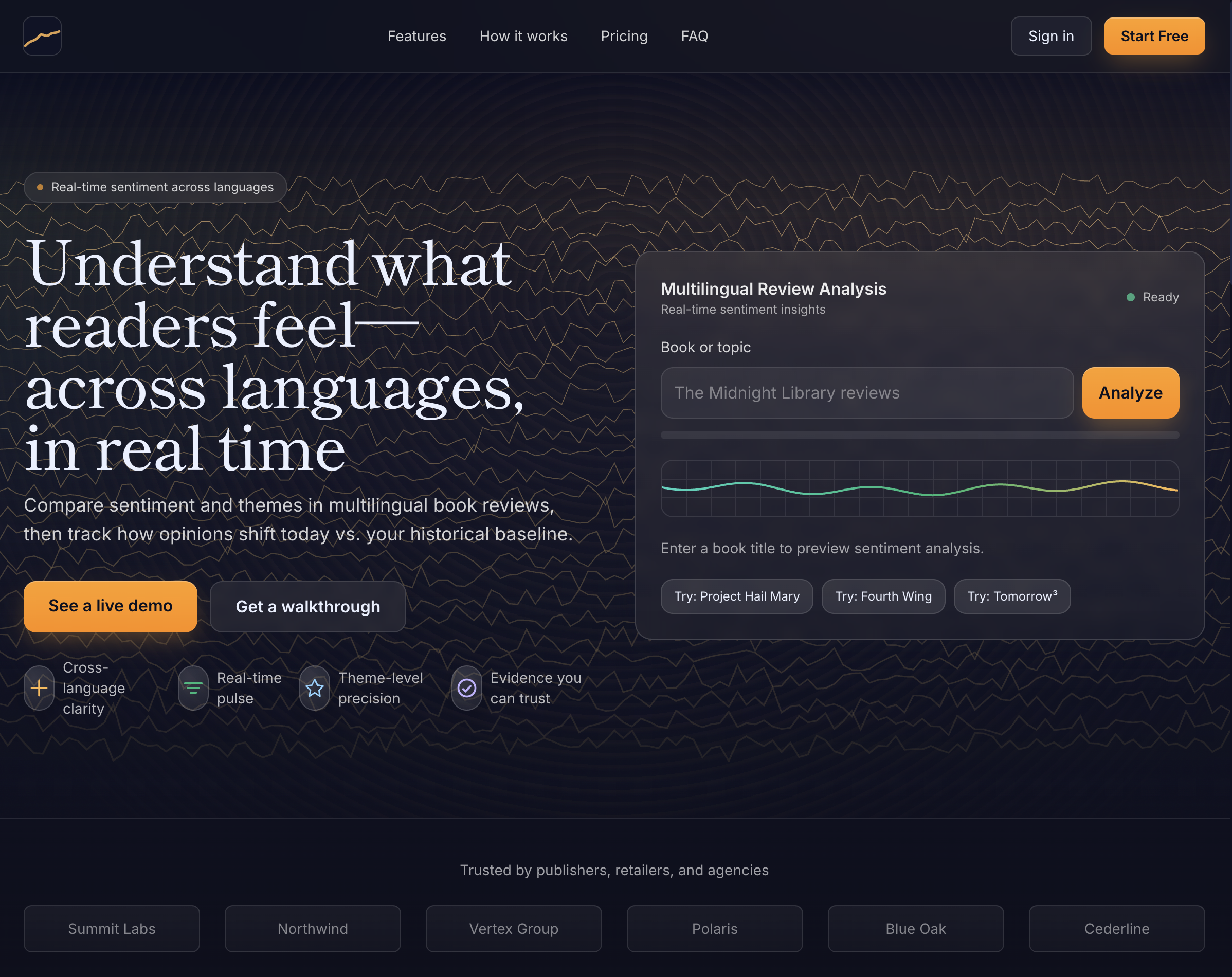
- Compares sentiment across languages for any book, series, or edition, with calibrated, apples-to-apples metrics.
- Breaks down sentiment by themes like pacing, characters, prose, tropes, translation quality, and audiobook narration.
- Tracks real-time shifts in posts/comments vs. historical baselines; flags emerging topics and anomalies.
- Surfaces representative multilingual review quotes with translation toggles and confidence scores.
- Powers discovery tools (read-alikes, motif explorer) based on what readers actually say, not just metadata.
How we built it
- Ingested historical reviews and real-time streams from social, forums, and retailer comments; auto-detected language and deduplicated near-duplicates.
- Used multilingual embeddings and classifiers (sentiment + multi-label themes) fine-tuned for book-review context.
- Calibrated models per language to ensure fair comparisons; maintained rolling aggregates (24h/7d/30d) against baselines.
- Implemented hybrid retrieval (semantic + keyword/entity boosts) and grounded generation with source citations.
- Delivered dashboards and alerts via an OLAP-backed API; stored raw text, embeddings, and audit logs for transparency.
Challenges we ran into
- Ensuring sentiment parity across languages with different slang, tone, and code-switching.
- Detecting spoilers and toxicity consistently while preserving useful signal for analysis.
- Controlling for platform, edition, and region mix so comparisons weren’t biased.
- Handling real-time data quality: deduplication, brigading spikes, and late-arriving events.
- Building trust: providing clear confidence intervals, significance tests, and easy access to source evidence.
Accomplishments that we're proud of
- A language-calibrated sentiment dashboard that reveals true cross-language differences, not model bias.
- Theme-level divergence matrix that surfaces nuanced insights (e.g., translation humor drift, narrator reception).
- Real-time delta monitor that caught shifts within hours, with evidence-backed alerts.
- Spoiler-aware, citation-first summaries that stakeholders can confidently share.
- Read-alike and motif explorer that meaningfully improves discovery across markets.
What we learned
- Calibration and stratification are critical for fair multilingual comparisons.
- Minimal translation for analysis, with translation for display, strikes the best balance of accuracy and performance.
- Domain-specific taxonomies (tropes, narration, translation quality) unlock far richer insights than generic sentiment alone.
- Transparency—citations, confidence, and per-language performance—drives adoption and trust.
What's next for BookLang
- Expand language coverage and improve slang/code-switching handling with targeted fine-tuning.
- Add edition-aware comparisons for new translations and audiobook re-releases, including narrator-specific analytics.
- Launch proactive alerts for adaptation news and market events with causal evidence trails.
- Integrate with publisher/retailer tooling (BI dashboards, CMS, CRM) and add role-specific reporting.
- Open a benchmarking hub: public multilingual retrieval/sentiment leaderboard for book reviews, plus sample datasets.
Built With
- airia
- clickhouse
- deepl
- linkup
- openai

Log in or sign up for Devpost to join the conversation.