-
-
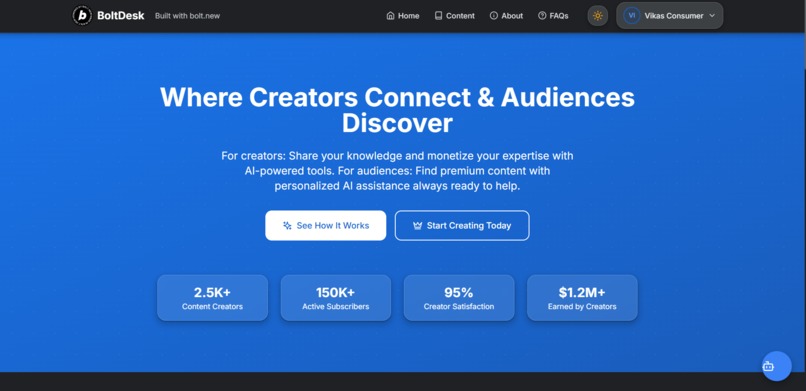
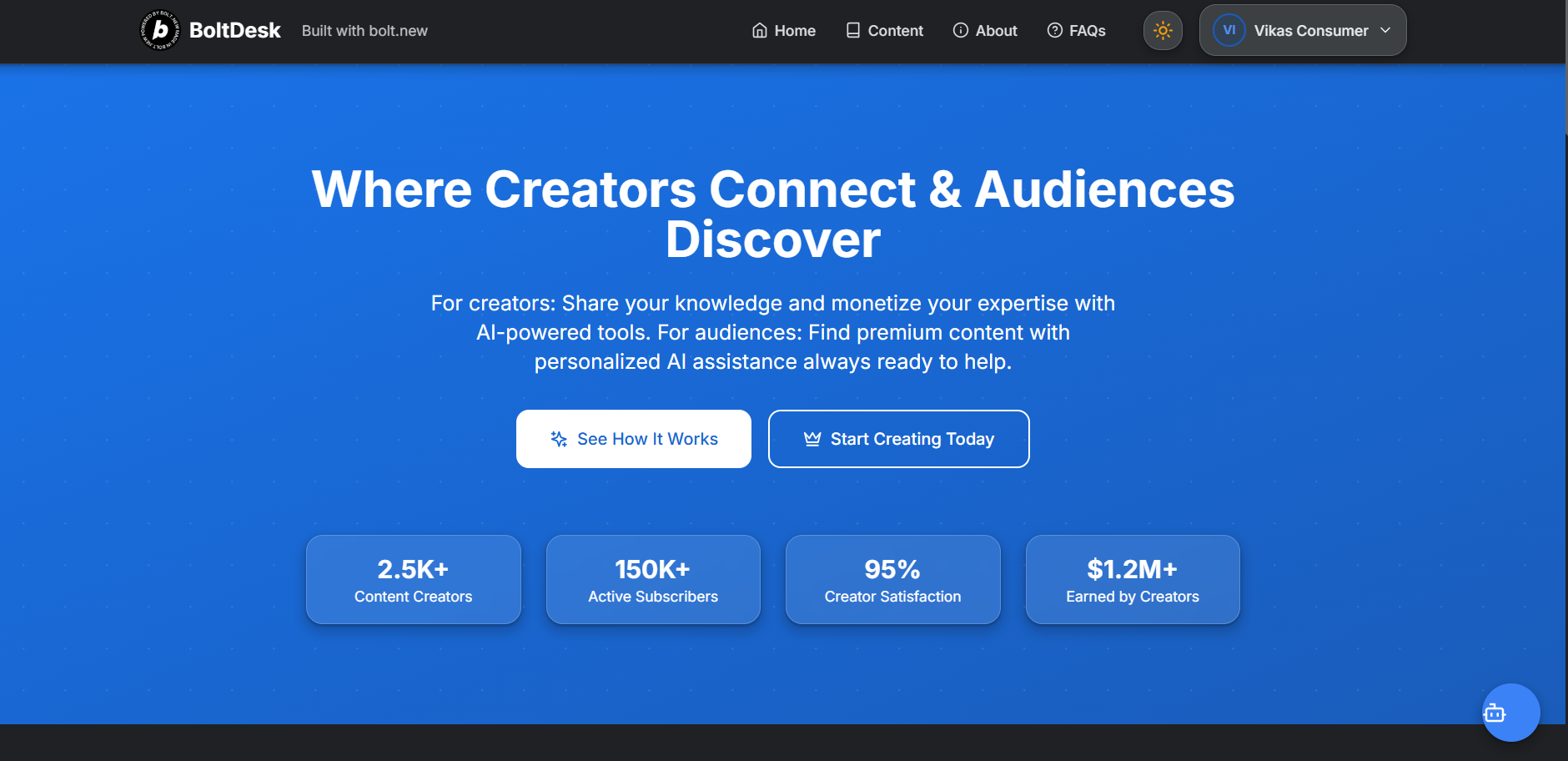
BoltDesk landing page
Inspiration
The inspiration for BoltDesk came from observing a critical gap in the creator economy. Today's content creators are forced to juggle 5+ disconnected tools (Patreon, Gumroad, Calendly, Notion, Linktree, etc.), leading to fragmented workflows, audience dispersion, and revenue leakage. As a finance professional transitioning into tech, I noticed that despite the explosion of creator tools, there wasn't a truly unified solution that integrated AI throughout the creator journey.
The lightbulb moment came when I realized that AI could do more than just assist creators—it could fundamentally transform how creators engage with their audiences by serving as their always-on digital twin. This would allow creators to scale their personal touch without scaling their time commitment.
What it does
BoltDesk is an AI-powered micro-portal that centralizes all aspects of a creator's business:
- AI Persona Creation: Creators train a personalized AI assistant that represents their voice, knowledge, and expertise, creating a 24/7 presence that engages with their audience
- Content Monetization Hub: Unified platform for selling courses, booking consultations, offering digital products, and managing subscriptions
- Dual Portal System: Separate interfaces for creators (management dashboard) and consumers (learning experience)
- Commission-based Revenue Model: Simple pricing with lower transaction fees than using multiple platforms (3% vs 8-12%)
- Custom Domain Support: Professional branding with seamless domain integration
- Audience Analytics: Comprehensive insights into engagement, conversion, and revenue metrics
The platform's core innovation is how it uses AI not just as a feature, but as the backbone that connects every interaction between creators and their audience.
How we built it
BoltDesk was built using a modern tech stack designed for performance and scalability:
Frontend Architecture: We created a responsive React application with TypeScript for type safety and better development experience. The dual-portal system required careful component design to maintain consistency while serving different user types.
UI Development: Tailwind CSS provided a utility-first approach that enabled rapid development of a beautiful, consistent interface. We enhanced this with Framer Motion animations to create a polished, engaging experience.
State Management: Zustand offered lightweight but powerful state management with persistence capabilities, making the app responsive and maintaining user state across sessions.
Mock Data System: We implemented a robust system to simulate backend functionality, allowing us to demonstrate the full capabilities of the platform even in prototype form.
AI Integration Points: We designed specific touchpoints throughout the application where AI services would integrate (chat interfaces, content analysis, personalization systems).
Deployment Pipeline: We set up Netlify for continuous deployment, allowing for rapid iteration and testing.
The development process followed a user-centered design approach, with the creator and consumer experiences being developed in parallel to ensure they complemented each other perfectly.
Challenges we ran into
Building BoltDesk presented several significant challenges:
Dual User Experience: Designing two distinct but interconnected interfaces (creator and consumer) required careful planning. Ensuring a cohesive feel while optimizing for different use cases was a complex balancing act.
State Management Complexity: With multiple user types, complex dashboards, and real-time interactions, managing application state became challenging. We had to restructure our Zustand store several times to find the optimal architecture.
Responsive Design Considerations: Creating complex dashboards that work seamlessly on both mobile and desktop required intricate CSS work and component design.
Interaction Design for AI Features: Designing intuitive interfaces for AI setup, training, and interaction presented unique UX challenges that required multiple iterations.
Performance Optimization: Ensuring smooth animations and transitions while maintaining performance, especially with data-heavy dashboard components, required careful optimization.
Authentication Flow Complexity: Implementing a secure yet user-friendly authentication system with role-based access control added significant complexity.
Accomplishments that we're proud of
Looking back on the development process, several achievements stand out:
Intuitive Setup Wizard: The AI agent creation flow simplifies what could be a complex process into a few intuitive steps, making advanced technology accessible to non-technical creators.
Comprehensive Analytics Dashboard: The analytics system provides creators with actionable insights through beautiful visualizations and meaningful metrics.
Seamless Mobile Experience: Despite the complexity of the application, we achieved a fully responsive design that works flawlessly on all device sizes.
Unified Monetization System: Successfully integrated multiple revenue streams (courses, consultations, digital products) into a single, easy-to-manage interface.
Accessibility Considerations: We implemented robust keyboard navigation, appropriate contrast ratios, and screen reader compatibility throughout the application.
Design Language Consistency: Maintained a coherent design language across both creator and consumer portals, creating a unified brand experience.
What we learned
The development journey provided valuable insights and learning experiences:
AI Integration Best Practices: We learned how to design systems that leverage AI capabilities while maintaining a natural, human-centered experience.
Dual-Audience UX Patterns: We developed effective patterns for creating applications that serve distinct user groups with different needs and technical abilities.
State Management Optimization: Working with complex state interactions across multiple views taught us advanced state management techniques.
Performance Bottlenecks: We identified key areas where performance optimizations were critical, particularly in animation-heavy interfaces and data visualization.
Microinteractions Impact: We discovered how small, thoughtful interactions dramatically improve perceived quality and user satisfaction.
Creator Economy Dynamics: Through research and user feedback, we gained deeper insights into the unique challenges and opportunities facing modern content creators.
What's next for BoltDesk - AI powered creator Micro portal
Our roadmap for BoltDesk is ambitious and focused on creating even more value for creators and their audiences:
Advanced AI Capabilities: Integrating more sophisticated AI models for content generation, video creation, and personalized learning experiences.
Enhanced Voice & Video AI: Implementing ElevenLabs for more natural voice synthesis and D-ID for dynamic video avatar generation.
Mobile Applications: Native mobile apps for both creators and consumers to enable on-the-go management and learning.
Expanded Analytics: More advanced audience insights, predictive revenue forecasting, and content performance analysis.
Community Features: Built-in community forums, discussions, and collaborative learning environments.
Marketplace Expansion: Creating a marketplace for creator collaborations, cross-promotion, and content sharing.
API Ecosystem: Developing a robust API to allow third-party integrations and custom extensions.
Global Payment Solutions: Supporting multiple currencies and alternative payment methods for international creators.
The long-term vision is to make BoltDesk the central hub where millions of creators can build sustainable businesses while maintaining authentic connections with their audiences.
Built With
- 18
- css
- framermotion
- lucide
- netlify
- react
- recharts
- router
- tailwind
- typescript
- vite
- zustand

Log in or sign up for Devpost to join the conversation.