Inspiration
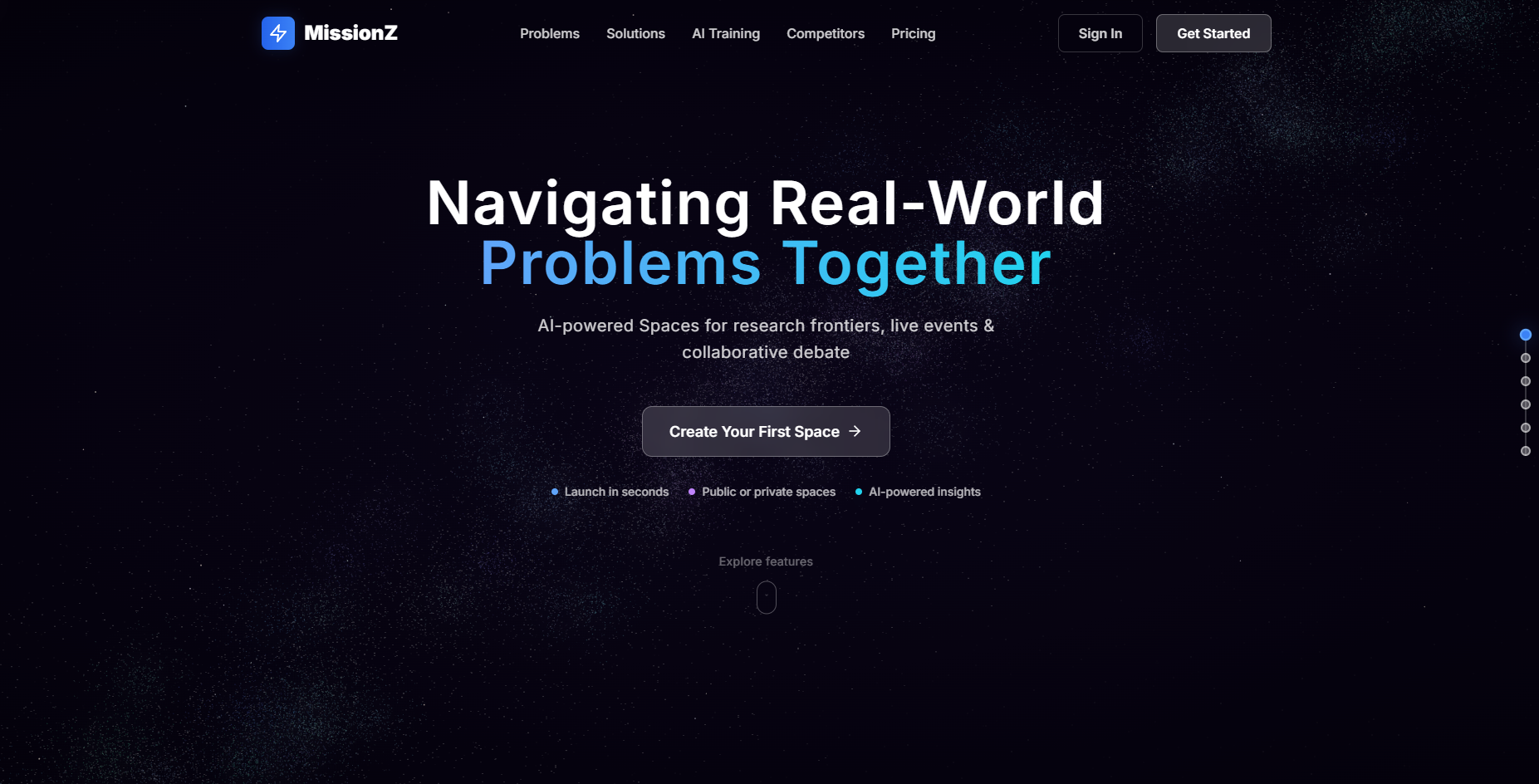
We saw that critical conversations—whether about groundbreaking research or unfolding world events—are fragmented across chat threads, news feeds, and static AI replies. At the hackathon, we challenged ourselves to fuse machine reasoning with real human insight, creating a platform where big questions get tackled head-on, collaboratively and data-first.
What it does
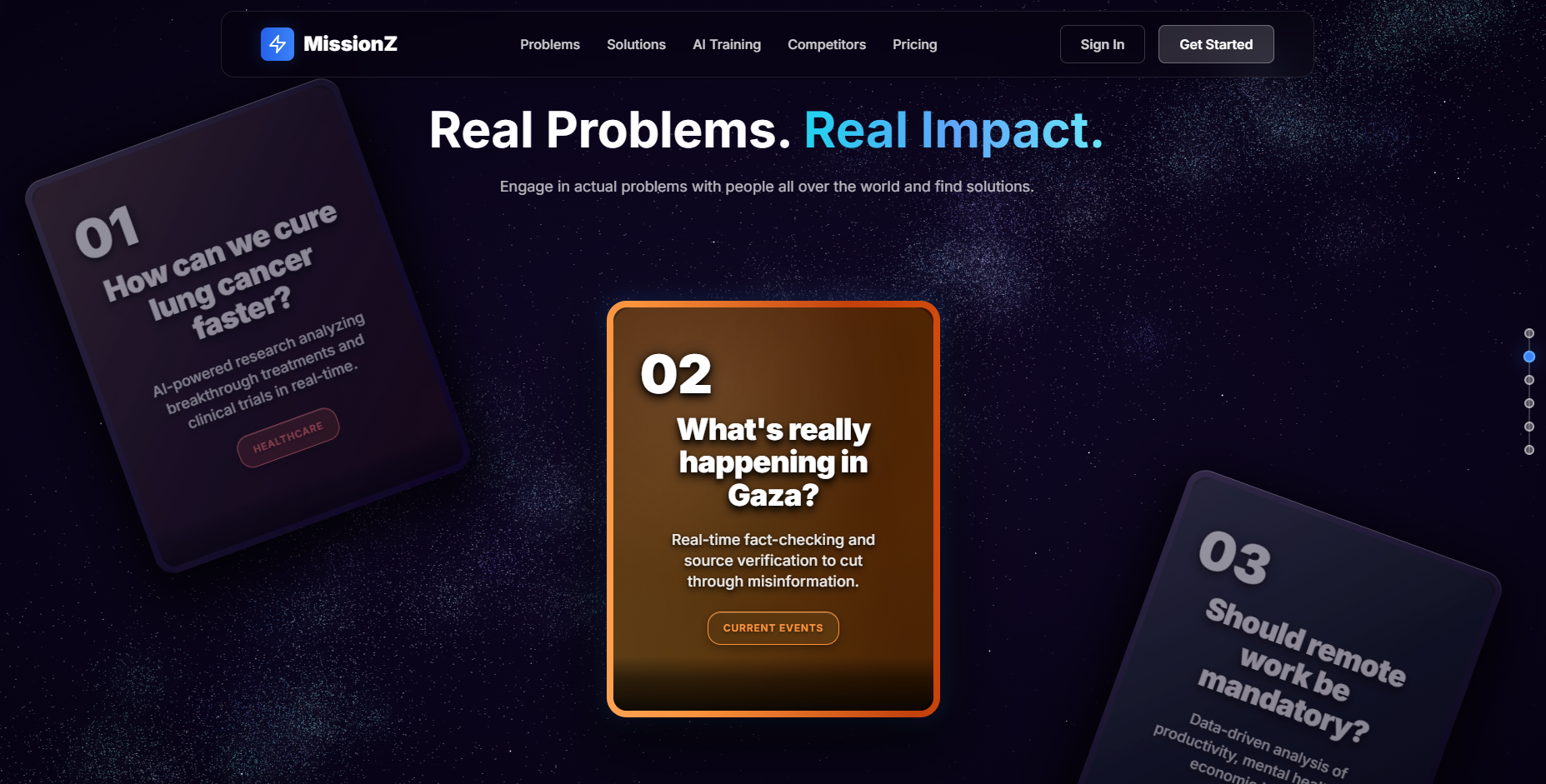
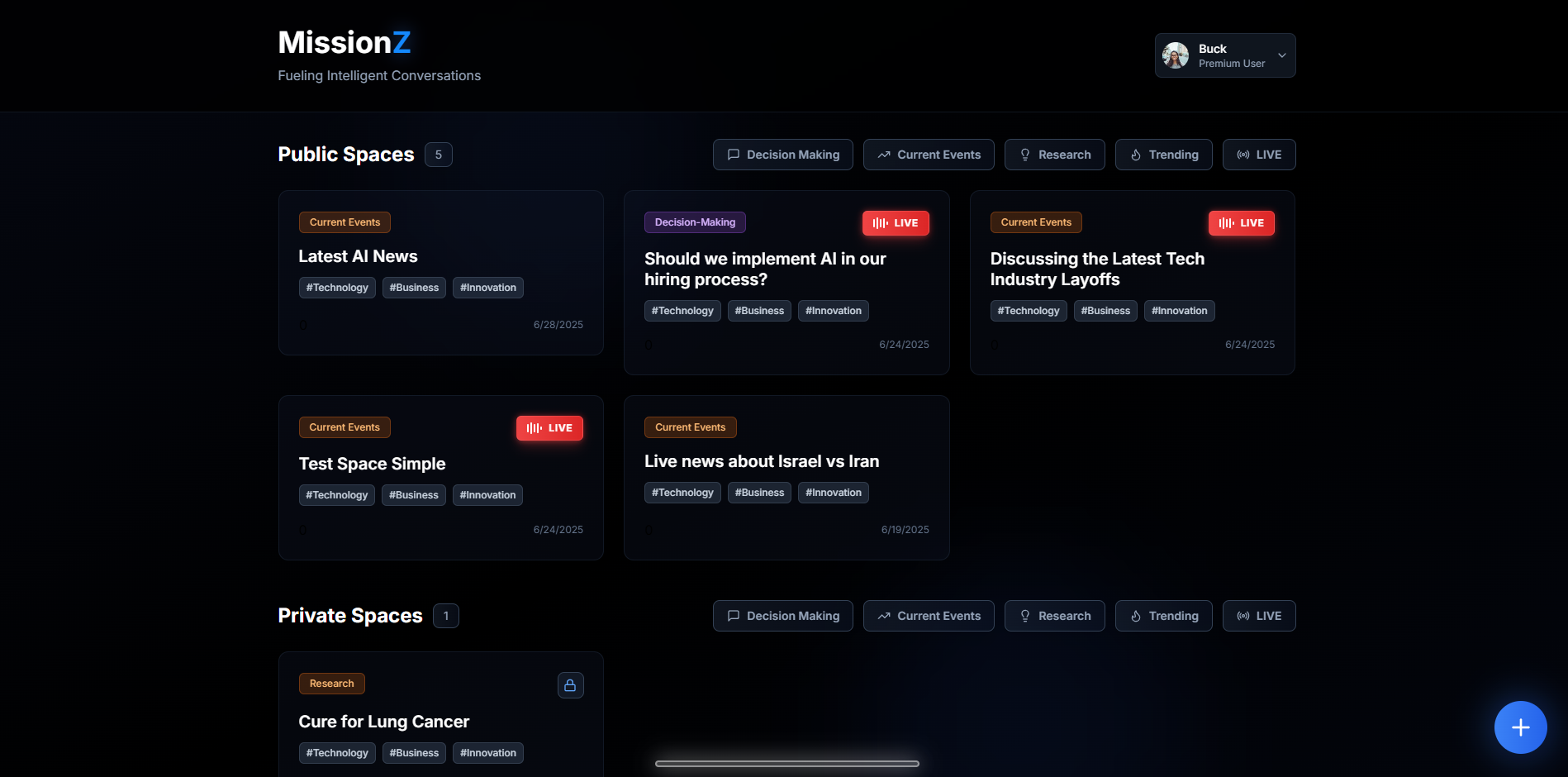
MissionZ empowers teams (and global communities) to launch AI-augmented Spaces on any frontier—be it “Solving Lung Cancer” or “Iran vs Israel Updates.” Inside each Space:
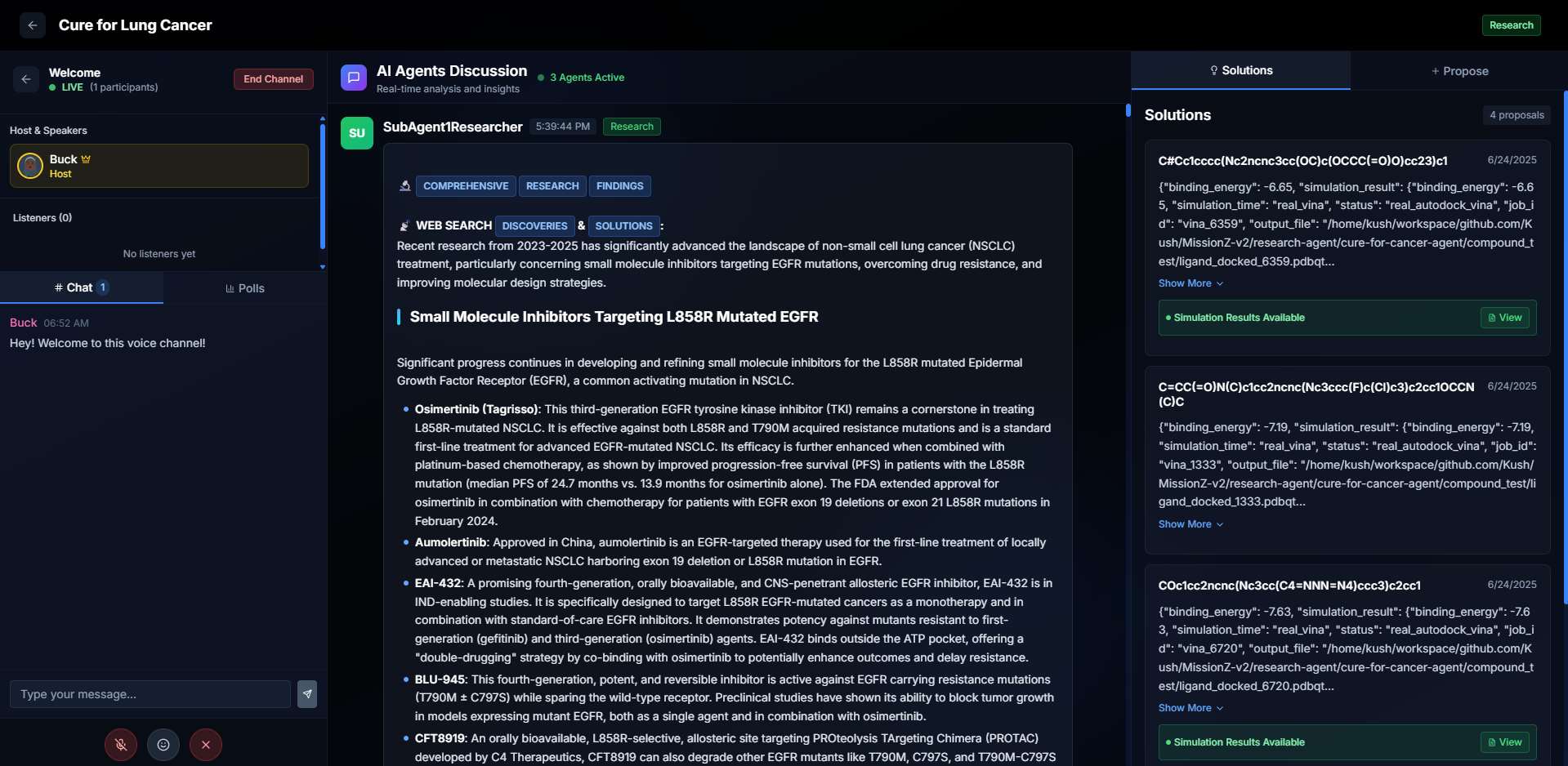
- AI agents debate and cross-check the latest studies or verified sources.
- Participants join via voice or chat, proposing solutions and refining ideas together.
- Instant polls capture consensus mid-discussion, driving decisions forward in real time.
How we built it
- Rapid UI Prototyping: Used Bolt + React with Framer Motion for polished, interactive panels and custom cursors.
- Multi-Agent AI Layer: Orchestrated transformer-based agents in recursive loops—propose → challenge → verify → iterate—written in Python and containerized for scale.
- Real-Time Comms: Leveraged WebSockets for synchronized voice, chat, and polling, ensuring latency under 200 ms.
- Verification Pipeline: Deployed microservices that ingest academic APIs and trusted news outlets, automatically bias-flagging and citing every fact.
Challenges we ran into
- Agent Stability: Tuning reward models so our agents converged—rather than spin endlessly—took dozens of hackathon hours and live testing.
- Syncing Streams: Keeping voice, chat, polls, and AI loops perfectly aligned under fluctuating network conditions required debouncing strategies and adaptive buffering.
- Performance on the Fly: Implementing dynamic WebGL backgrounds with Three.js while preserving 60 fps on low-end browsers pushed our frontend optimization skills to the limit.
Accomplishments We’re Proud Of
- Pushed Research Frontiers: In under 48 hours we built a live “Solving Lung Cancer” Space where AI agents and experts collaborated on real hypotheses, surfacing novel insights from the latest studies.
- Real-Time Events Engine: We demoed “Iran vs Israel Updates” with a live, bias-checked timeline—new developments streamed, verified, and summarized within minutes.
- Seamless AI+Human Fusion: Our recursive agent loops and voice/chat integration turned chaotic debates into data-driven workflows, proving you can co-create impactful solutions in one platform.
- Global Accessibility: From minute-by-minute news to deep academic research, we delivered a single interface that connects diverse communities and makes verified knowledge instantly reachable worldwide.
What we learned
- Iterative UX Wins: Micro-interactions (hover cues, scroll animations) dramatically boosted user engagement—even in a minimal demo.
- Modular AI is Key: Packaging agent debates into discrete, reusable services made rapid tweaks and team collaboration possible.
- Hackathon Synergy: Real-time feedback from teammates and judges guided us to prioritize features that showcase MissionZ’s core differentiator: true AI + human fusion.
What’s Next for MissionZ
- Deeper Research & News Coverage: Expand our verification pipelines to cover more scientific domains and emerging global events, ensuring every Space is backed by the most accurate data.
- Intelligent Conversation Ecosystem: Build a dedicated team to develop new agent personas, refine consensus metrics, and increase accuracy through continuous learning loops.
- Universal Access: Launch localized versions and mobile clients so anyone, anywhere, can join or host a Space—breaking down language and infrastructure barriers.
- Community-Powered Growth: Open an SDK for experts and developers to contribute domain-specific verification modules and plugins, accelerating MissionZ’s evolution as the go-to hub for fact-driven collaboration.
Built With
- bolt
- dicebear
- netlify
- railway
- socket.io
- supabase


Log in or sign up for Devpost to join the conversation.