Inspiration
Meetings are where the most important decisions in organizations are made, yet valuable knowledge is often lost once the meeting ends. Teams struggle with scattered notes, forgotten action items, missing recordings, and poor collaboration across distributed environments. Existing meeting assistants are either expensive, locked to a single AI provider, or lack resilience when AI services become unavailable.
We built BOLMEET to solve this problem by creating a reliable AI-powered meeting intelligence platform that automatically captures conversations, generates actionable insights, and securely stores meeting assets. We also wanted to eliminate downtime caused by AI quota limits by introducing a multi-provider AI architecture that intelligently switches providers behind the scenes without affecting the user experience.
What it does
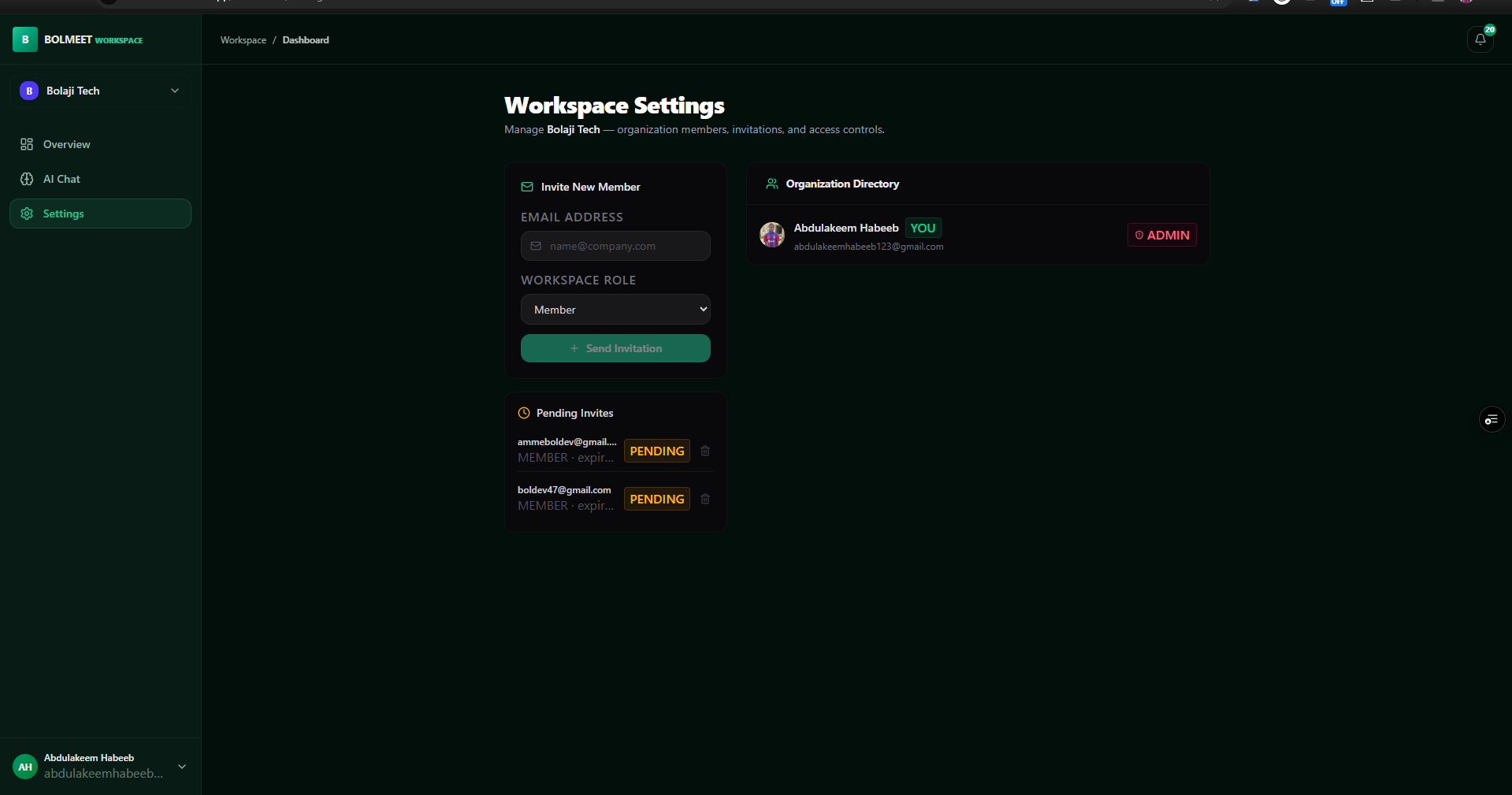
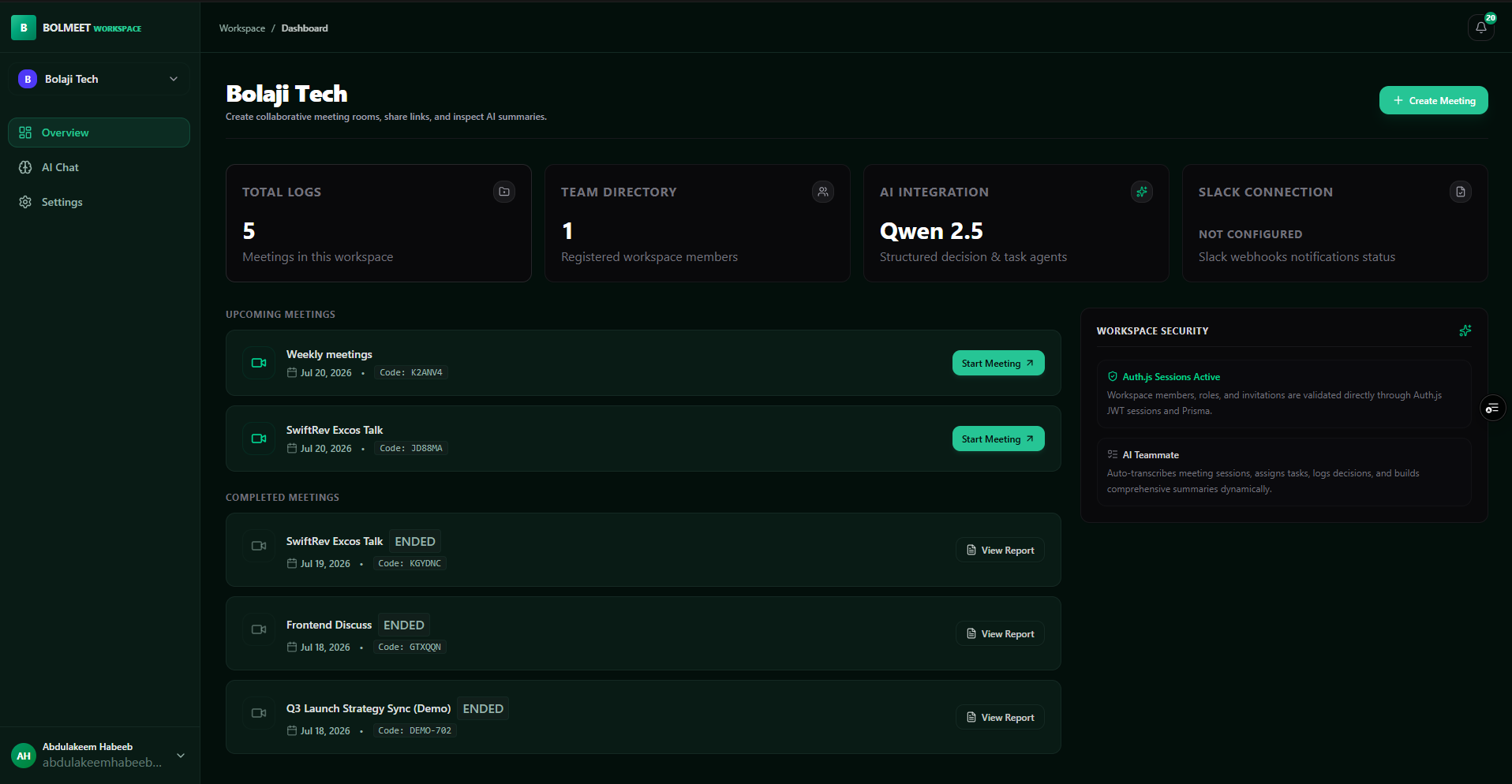
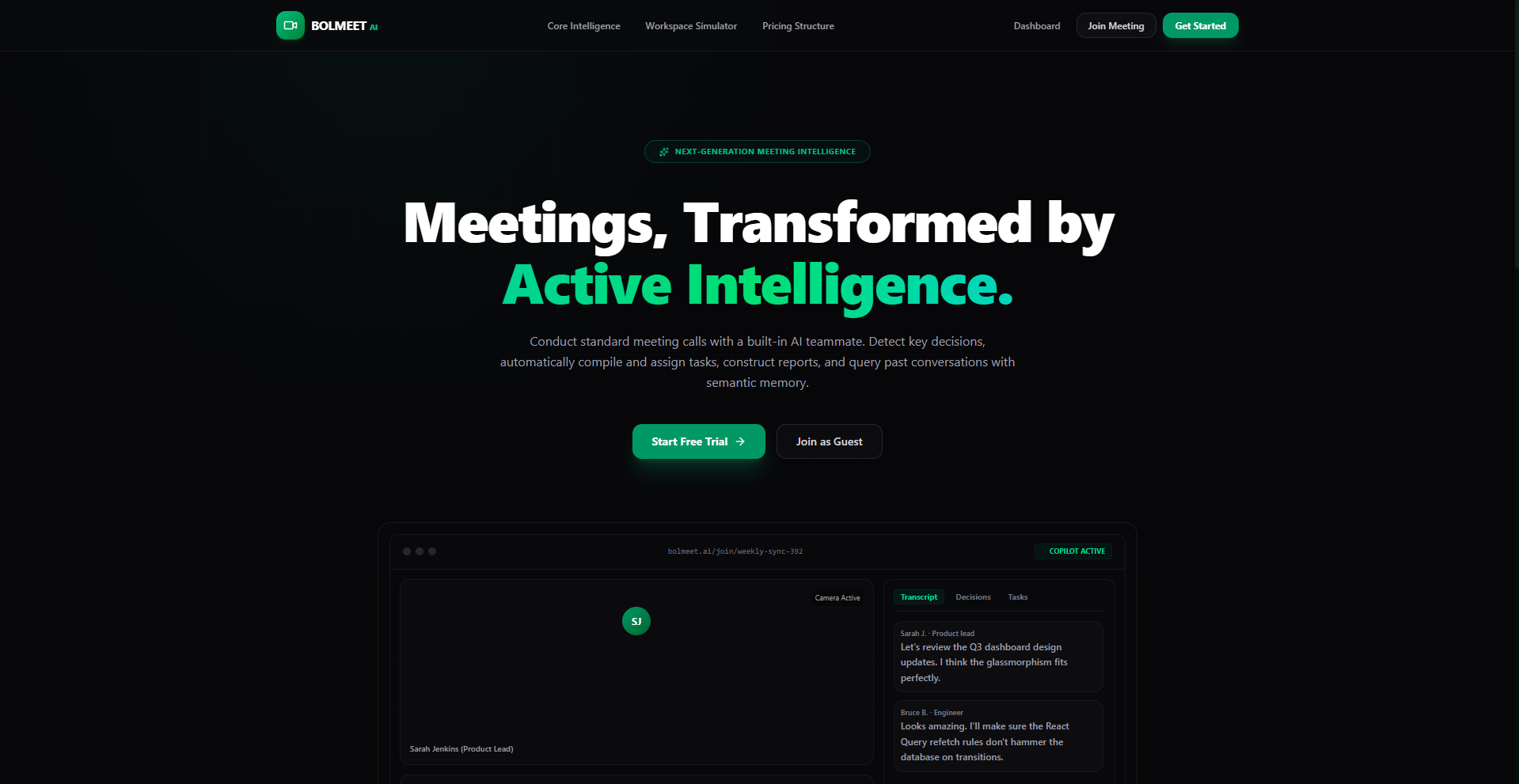
BOLMEET is an AI-powered meeting intelligence platform that helps organizations transform meetings into searchable knowledge and actionable outcomes.
Key features include:
- 🎙️ Live meeting recording
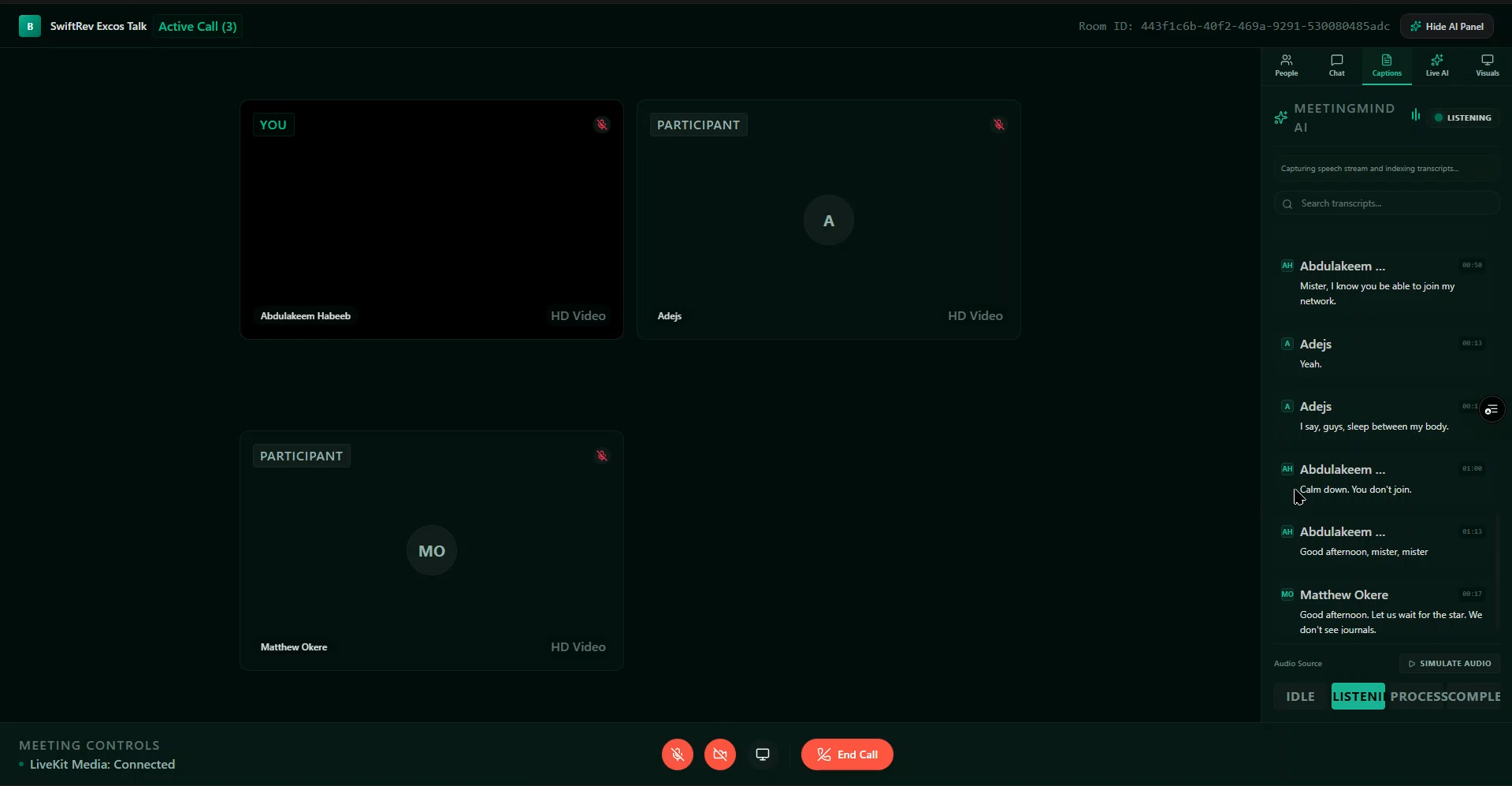
- 📝 Automatic meeting transcription
- 🤖 AI-generated meeting summaries
- ✅ Decision extraction
- 📌 Action item generation
- 📧 AI-generated follow-up reports
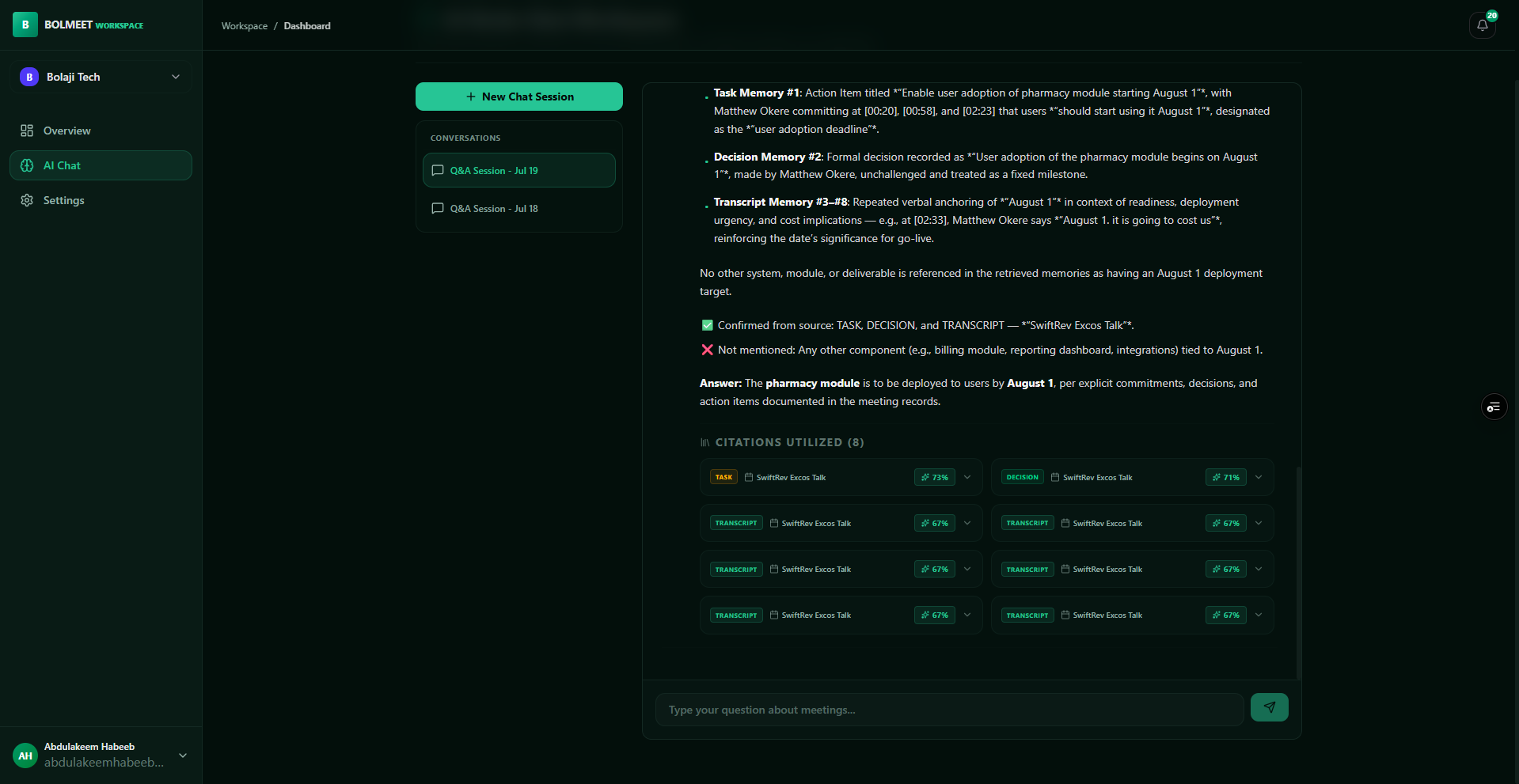
- 💬 AI meeting assistant with contextual chat
- 🖼️ Screenshot and visual content analysis
- 🧠 Semantic knowledge retrieval using vector embeddings
- ☁️ Secure cloud storage for recordings, screenshots, attachments, and exported reports
- 🔄 Intelligent multi-provider AI routing with automatic fallback between Qwen and Gemini
How we built it
BOLMEET was built using a modern full-stack architecture designed for scalability and resilience.
Frontend
- Next.js
- React
- TypeScript
- Tailwind CSS
Backend
- Next.js API Routes
- Prisma ORM
- PostgreSQL
- pgvector
AI Infrastructure
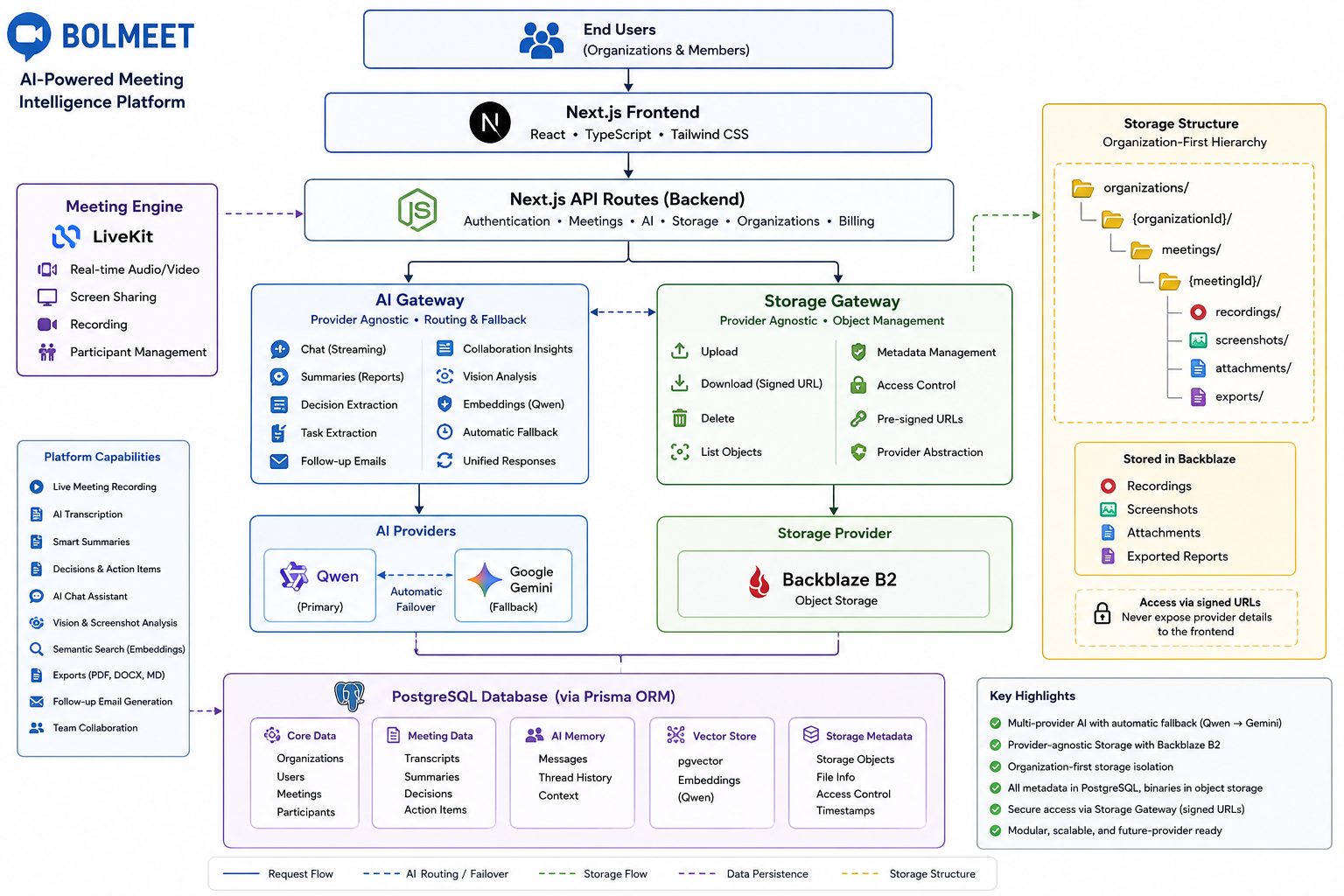
Instead of depending on a single AI provider, we designed a provider-agnostic AI Gateway that abstracts AI capabilities from the rest of the application.
The gateway supports:
- Qwen (Primary)
- Gemini (Automatic Fallback)
Every AI request—including summaries, decisions, task extraction, chat streaming, vision analysis, and embeddings—is routed through the gateway, allowing users to experience uninterrupted AI assistance even when one provider reaches quota or becomes unavailable.
Storage Infrastructure
We also designed a provider-agnostic Storage Gateway backed by Backblaze B2.
Meeting assets are organized using an organization-first storage hierarchy:
- Meeting recordings
- Screenshots
- Attachments
- Exported reports
Metadata is stored in PostgreSQL while large binary assets are securely stored in Backblaze, providing scalability without increasing database storage costs.
Challenges we ran into
One of our biggest challenges was avoiding vendor lock-in.
Initially, the application relied on a single AI provider, meaning users could experience failures whenever API quotas were exceeded or the provider became unavailable.
To solve this, we redesigned the AI architecture by introducing a centralized AI Gateway capable of routing requests across multiple providers without changing the application logic.
Another challenge was designing a scalable storage architecture. Rather than storing every meeting asset directly in the database, we separated metadata from binary files using a Storage Gateway backed by Backblaze B2. This required careful planning to maintain consistency, authorization, and reliability across uploads and downloads.
Accomplishments that we're proud of
We're especially proud of building an architecture that is resilient, scalable, and easy to extend.
Some highlights include:
- Built a provider-agnostic AI Gateway
- Integrated multiple AI providers with automatic failover
- Created a provider-agnostic Storage Gateway
- Integrated Backblaze B2 for scalable meeting asset storage
- Preserved a seamless user experience despite complex infrastructure changes
- Built a modular architecture that can easily support additional AI or storage providers in the future
What we learned
This project reinforced that architecture matters just as much as features.
We learned how valuable abstraction layers are for building maintainable software. By separating AI providers and storage providers behind gateways, the rest of the application remains clean, modular, and resilient to future changes.
We also gained practical experience designing systems that balance reliability, scalability, and cost while keeping the user experience simple.
What's next for BOLMEET
Our roadmap includes expanding BOLMEET into a complete AI-powered collaboration platform.
Future plans include:
- 🎧 AI-generated meeting audio summaries
- 📊 Analytics dashboard for meeting insights
- 🌍 Multi-language transcription and translation
- 📅 Calendar and productivity tool integrations
- 💬 Slack and Microsoft Teams integrations
- 📱 Mobile applications
- 🔐 Enterprise security enhancements
- 🤖 Additional AI providers for even greater resilience
- 📚 Organization-wide knowledge search across meetings and documents
- 🧩 Custom AI workflows and automation for enterprise teams
Our long-term vision is to make BOLMEET the intelligent workspace where every meeting becomes structured knowledge that drives better collaboration and decision-making.
Built With
- api
- authentication
- backblaze
- cloud
- css
- deepgram
- gemini
- jwt
- livekit
- next.js
- node.js
- pgvector
- postgresql
- prisma
- query
- qwen
- react
- rest
- tailwind
- typescript
- vector
- vercel
- webrtc
- zod

Log in or sign up for Devpost to join the conversation.