Live app: https://5a25kqeayc5ki2btob2zvzuhhq0gocaz.lambda-url.us-east-1.on.aws/ · Code + technical report: https://github.com/ShermaineYap/OpenCV-AI-Hack
Inspiration
In Malaysia, firefighters sum up most home fires in three words — lalai, lupa, leka (negligence, forgetting, distraction). In the US, cooking causes nearly half of all home fires and unattended cooking is by far the leading factor. The everyday version is the boil-over: you look away for ten seconds and the milk, pasta water or curry is over the rim, the gas flame is out and the hob is burnt. Turning the knob at that moment is too late, because the stove keeps heating for several seconds after you turn it down. I wanted a system that sees the spill coming — early enough to beat the stove's own heat lag.
What it does
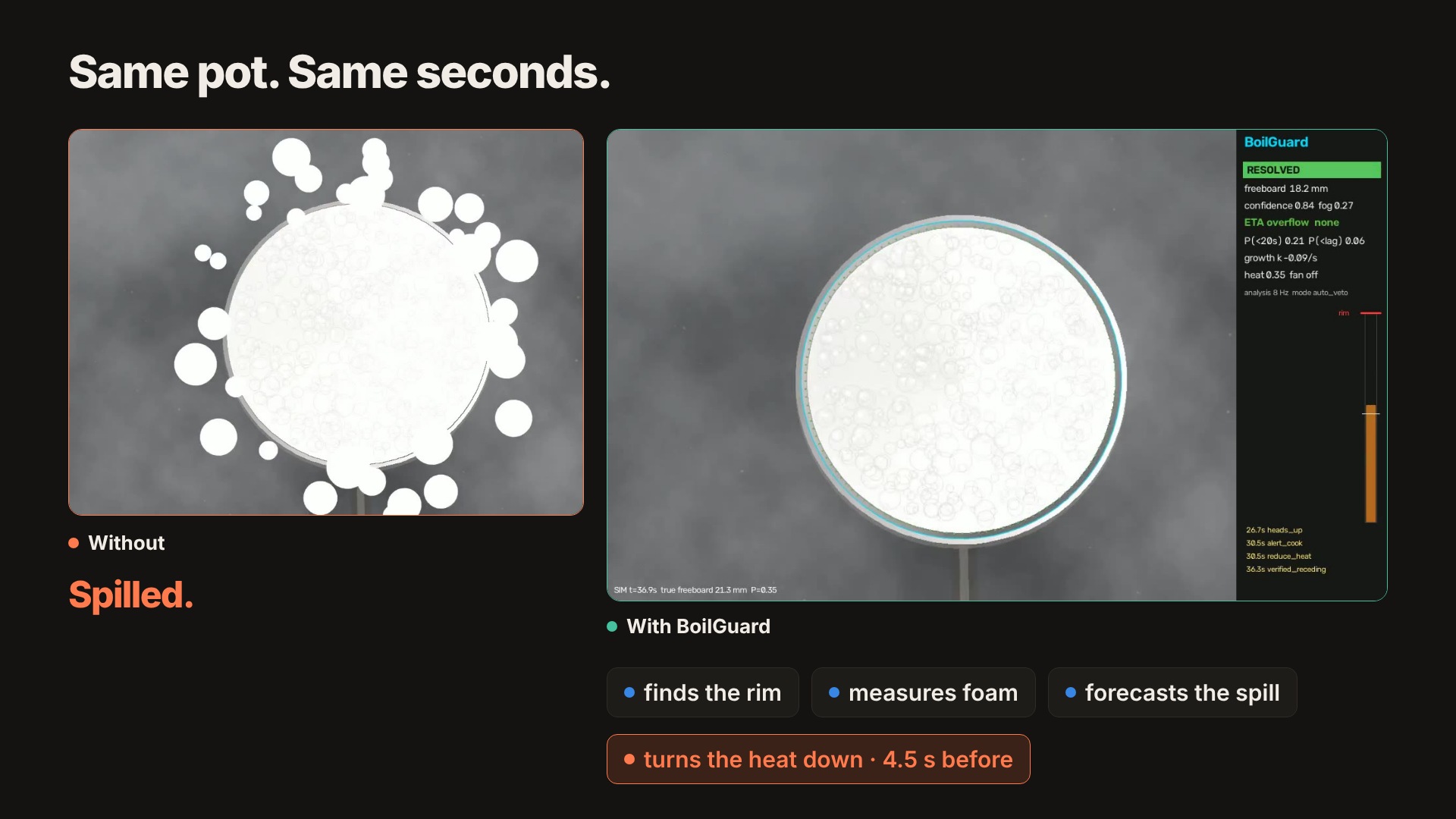
A camera above the stove (range hoods with cameras already exist) watches the pot. BoilGuard:
- finds the pot rim and measures, in millimetres, how far the foam is below it;
- forecasts the probability of spilling within the hob's heat lag and the time to overflow using a physics-informed model of foam growth;
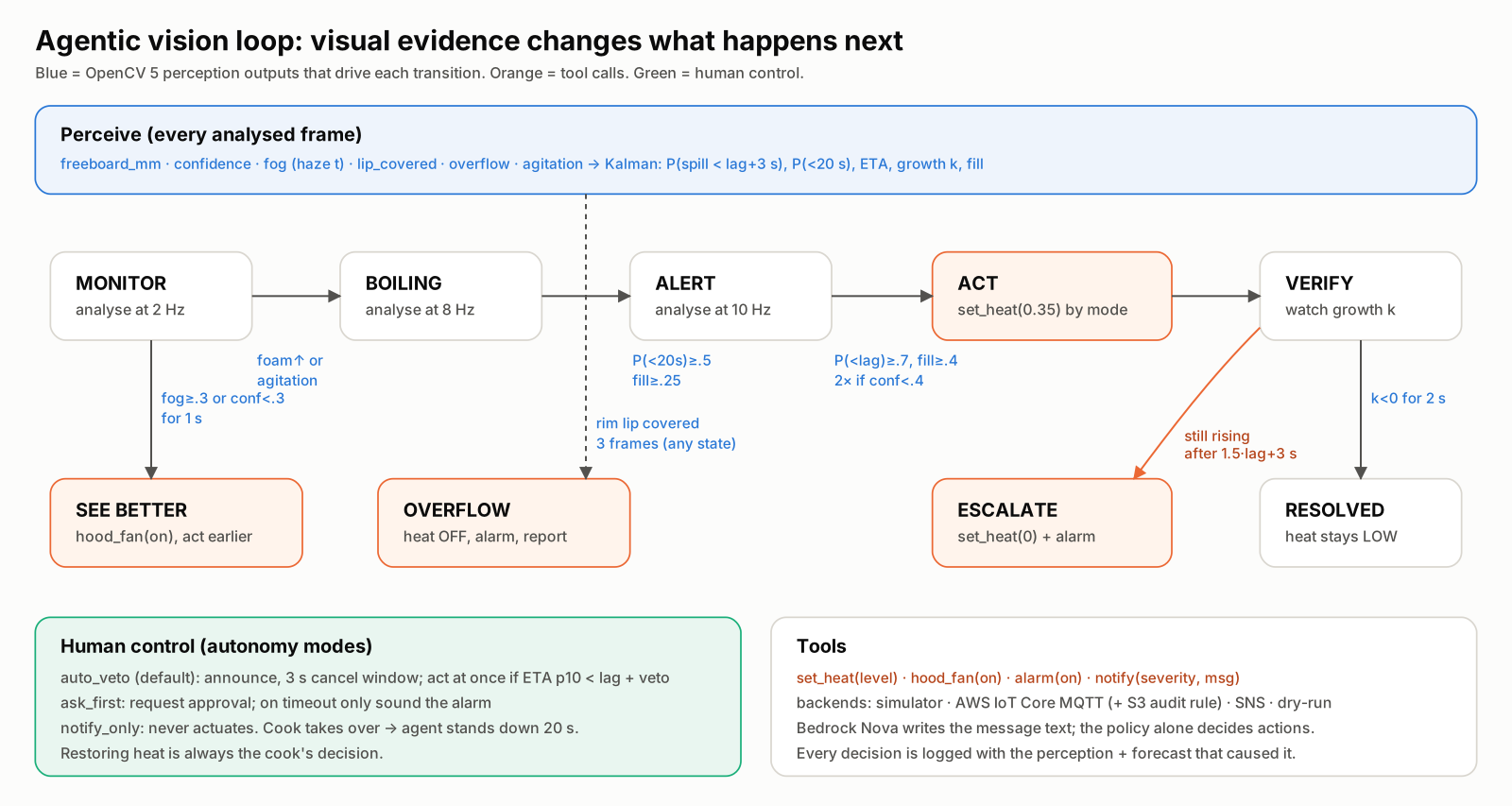
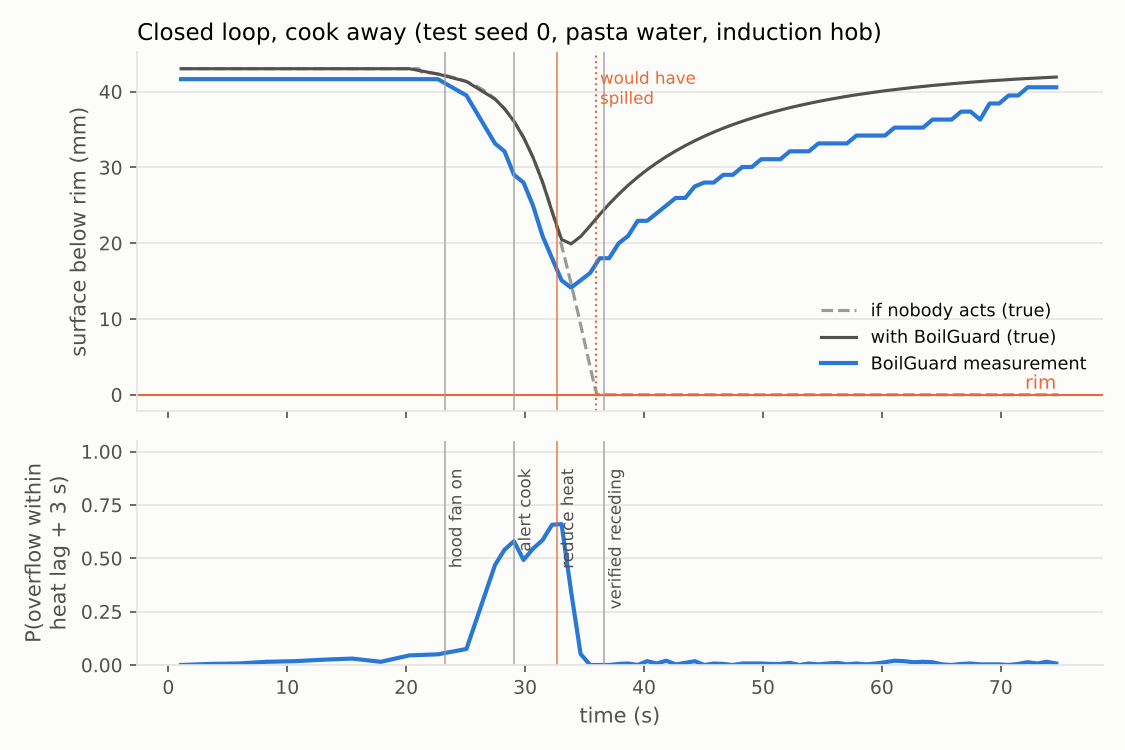
- acts: alerts the cook, lowers the heat (with a 3-second cancel window, "ask me first" or "notify only" modes), verifies from the video that the foam is going down, and switches the burner off with an alarm if it is not;
- when steam hides the pot it turns the hood fan on to see better and acts more cautiously;
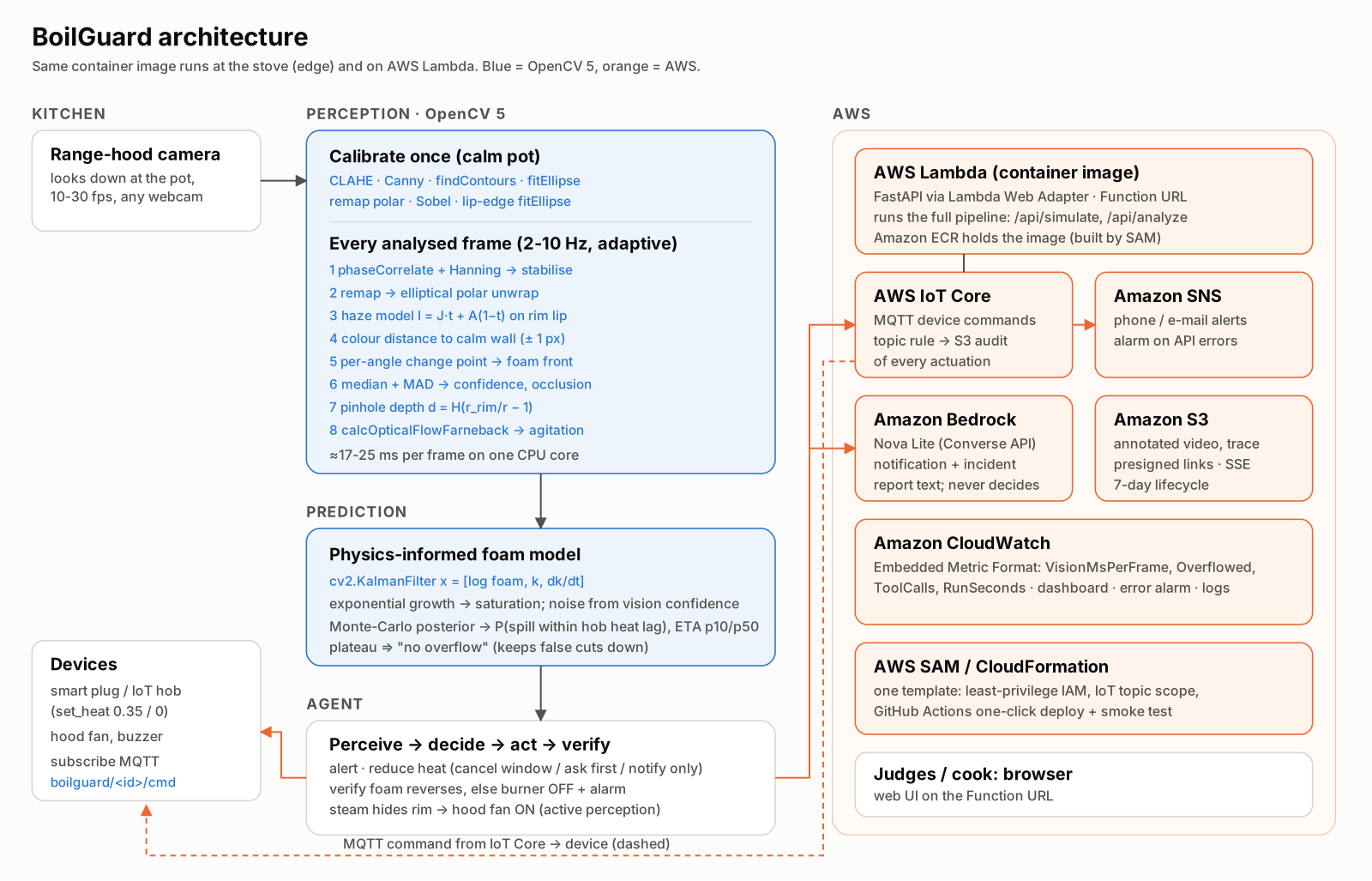
- sends commands through AWS IoT Core (audited in S3), alerts through Amazon SNS, and uses Amazon Bedrock (Nova) to write a plain-English notification and incident report.
The live web app lets anyone run a boil (milk, pasta water, curry, soup; induction, ceramic, coil; light to heavy steam; cook nearby or away) and see the annotated camera view, the forecast and every agent decision. You can also upload your own top-down clip.
How I built it
Perception — OpenCV 5, no training data needed. Rim: CLAHE, Canny, findContours and fitEllipse, scored by edge support, then refined to the inner edge of the bright rim lip with an elliptical-polar remap and a per-angle sub-pixel ellipse fit. Every frame: rim-anchored phaseCorrelate cancels hood vibration; an atmospheric scattering (dehazing) model fitted on the rim lip removes steam haze; because the pot's inner wall is static background, a vectorised per-angle change-point search finds the foam front; a median over 360 angles rejects hands and spoons; pinhole geometry turns the front's radius into millimetres; Farneback optical flow flags boiling onset. ~20 ms per frame on one CPU core.
Prediction — physics, not a black box. Foam grows exponentially and then saturates. A cv2.KalmanFilter tracks log-foam, its growth rate and the change of that rate, with measurement noise from the vision confidence. Monte-Carlo samples of the posterior give P(spill within heat lag) and ETA; a plateau predicts "no spill", which keeps the heat on for a simmer.
Agent. A deterministic perceive → decide → act → verify → escalate loop with three human-control modes and adaptive 2-10 Hz analysis. Every decision is logged with the evidence that caused it.
AWS. One SAM template: Lambda container image (FastAPI through the Lambda Web Adapter) behind a Function URL, IoT Core device topic + topic rule archiving every command to S3, SNS, Bedrock Converse, S3 with encryption and a 7-day lifecycle, CloudWatch Embedded Metric Format metrics, a dashboard and an error alarm. GitHub Actions runs the tests, deploys and smoke-tests the live endpoint.
Evaluation. With no real-stove dataset, I built a physically grounded boil-over simulator (logistic foam growth, heater thermal lag, steam, hands, tilt, camera shake, JPEG noise) that is also a closed-loop environment. Thresholds were tuned on a dev set and reported on a disjoint test set against baselines (no system, rim-threshold alarm, linear extrapolation).
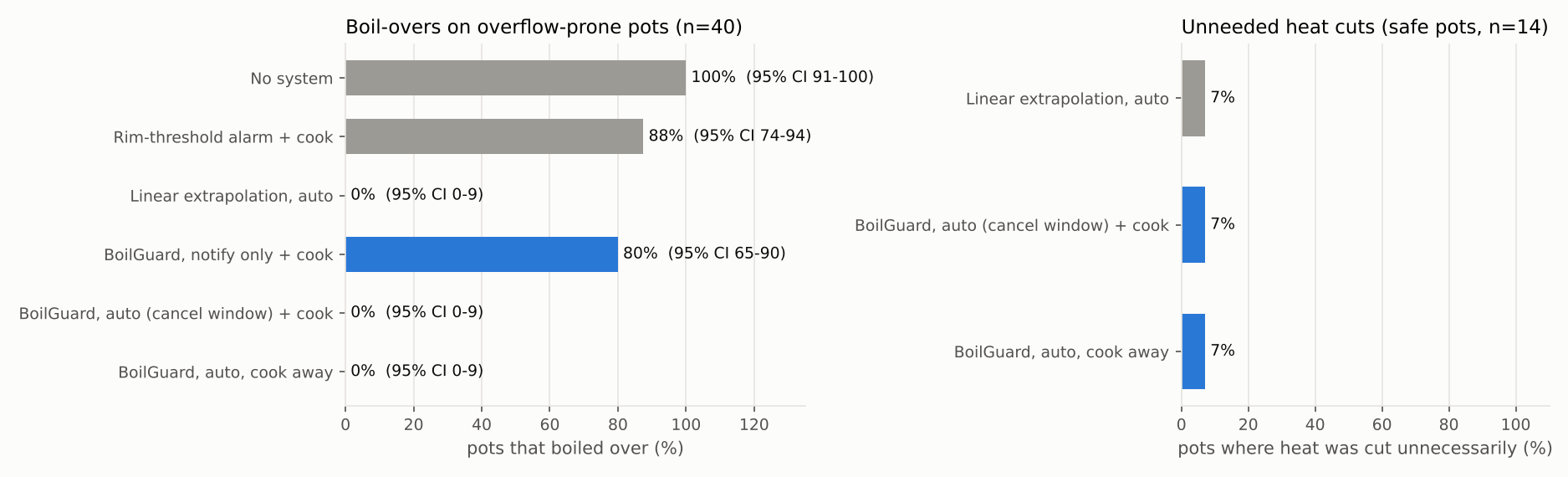
Results (60 held-out simulated scenes): with no system 100% of overflow-prone pots spill; a rim-threshold alarm with a cook nearby still lets 88% spill, and even BoilGuard's own warnings alone let 80% spill, because heat lag plus a 6-second human reaction is too slow. BoilGuard acting automatically prevented all 40 boil-overs (cook nearby or away), cut heat unnecessarily on 1 of 14 safe pots, and gave a silent heads-up a median 8.3 s before the spill. Surface measurement error was 3.1 mm (median), the time-to-spill forecast was within 1.2 s at 5 s out, and vision takes 18.6 ms per frame on one CPU core.
Challenges I ran into
- Steam. It fooled the first version into seeing an overflow. Treating steam as haze and fitting the dehazing model on the always-visible rim lip fixed it and gave a steam index for free.
- Hands over the pot dragged the image registration; registering only on the rim annulus, with sanity limits, and robust statistics over angles solved it.
- Telling a simmer from a spill early. Early on, exponential and saturating growth look the same. A probabilistic forecast plus a fill gate, tuned on a separate dev set, gave a good trade-off.
- Heat lag. Acting at "foam near the rim" is too late on electric hobs; the decision has to use the hob's lag, which is why the forecast is "spill within lag + 3 s".
Accomplishments that I'm proud of
- Millimetre-level surface measurement through steam, hands and camera shake with no training data.
- A closed-loop evaluation showing why the agent must act: warnings alone failed 80-88% of the time.
- 100% of boil-overs prevented on the held-out test set, with tuning done strictly on a separate dev set.
- A one-click, self-testing AWS deployment with audit of every device command, and a public web app anyone can try without a camera.
What I learned
Classical computer vision is still the right tool when you can describe the physics: modelling the wall as background, steam as haze and the camera as a pinhole gave millimetre measurements without any training data. And an honest evaluation (dev/test split, baselines, failure cases) changed the design more than any single algorithm.
Honest limitations
- All quantitative results come from a physically grounded simulator (60 held-out scenes; exact spill times are only available there). Real-stove validation is the next step.
- Dark soups fooled rim detection in 3 of 60 scenes, and the 20-second look-ahead warns on some simmers that later level off.
- Automatic heat control must be validated and certified before anyone relies on it; BoilGuard assists, it does not replace attention or smoke alarms.
- The demo video narration is an AI voice (Kokoro TTS), and its "live kitchen view" is a simulated camera feed showing real BoilGuard output.
What's next
A real-stove study with a hood camera on induction, ceramic and gas hobs; a Raspberry Pi / Graviton edge build; integration with Matter smart plugs and IoT-enabled hobs; more liquids (rice, porridge, jam); and a caregiver mode that notifies family members.
Built With
- amazon-bedrock
- amazon-cloudwatch
- amazon-nova
- amazon-sns
- amazon-web-services
- aws-iot-core
- aws-lambda
- aws-sam
- docker
- fastapi
- github-actions
- numpy
- opencv
- python

Log in or sign up for Devpost to join the conversation.