-
-

BogusAI Official Logo
-
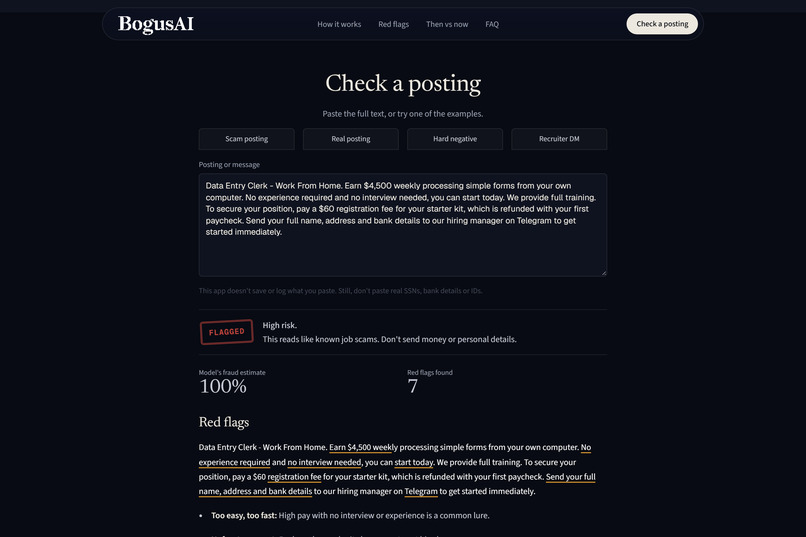
Scam Posting
-
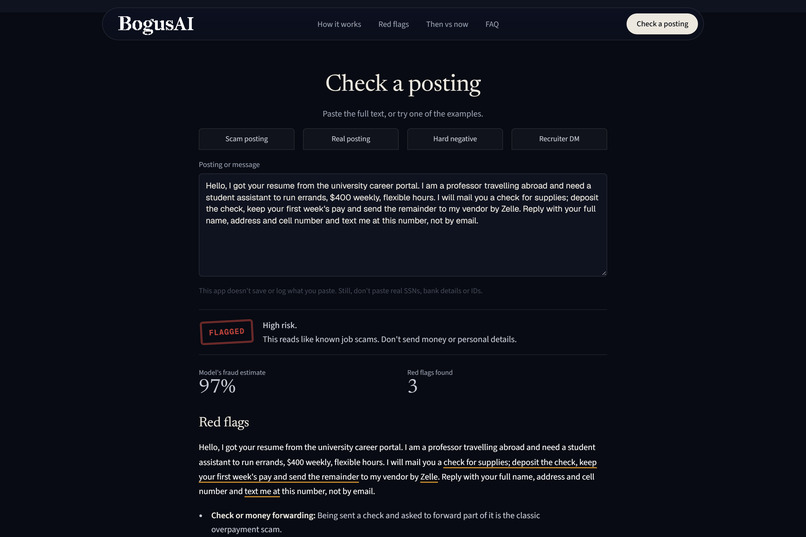
Recruitment DM Scam
-
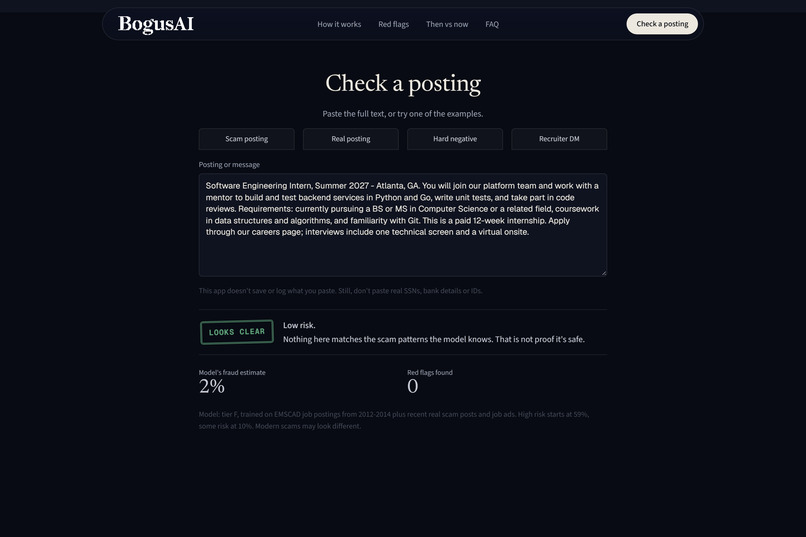
Real Internship Posting
-
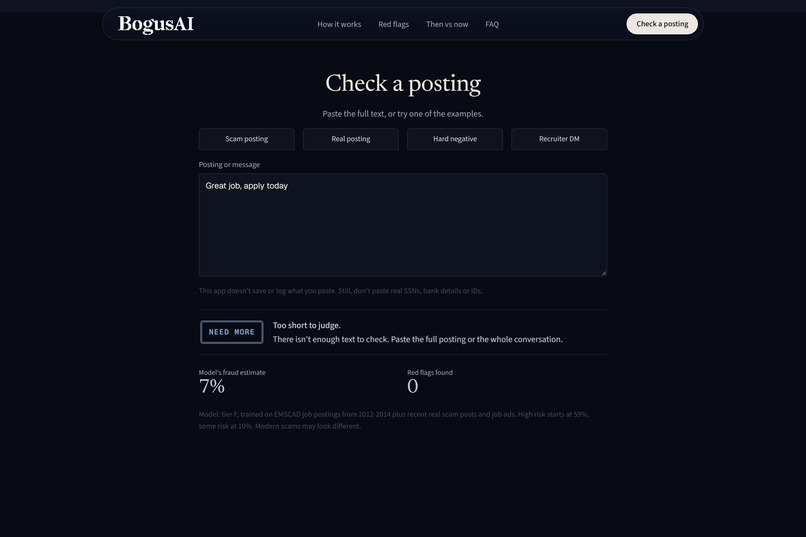
Too Short To Judge
-
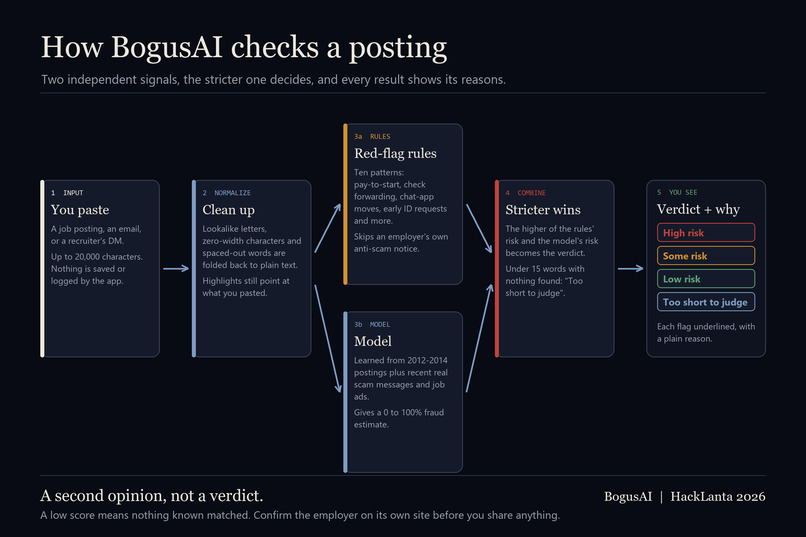
How It Works

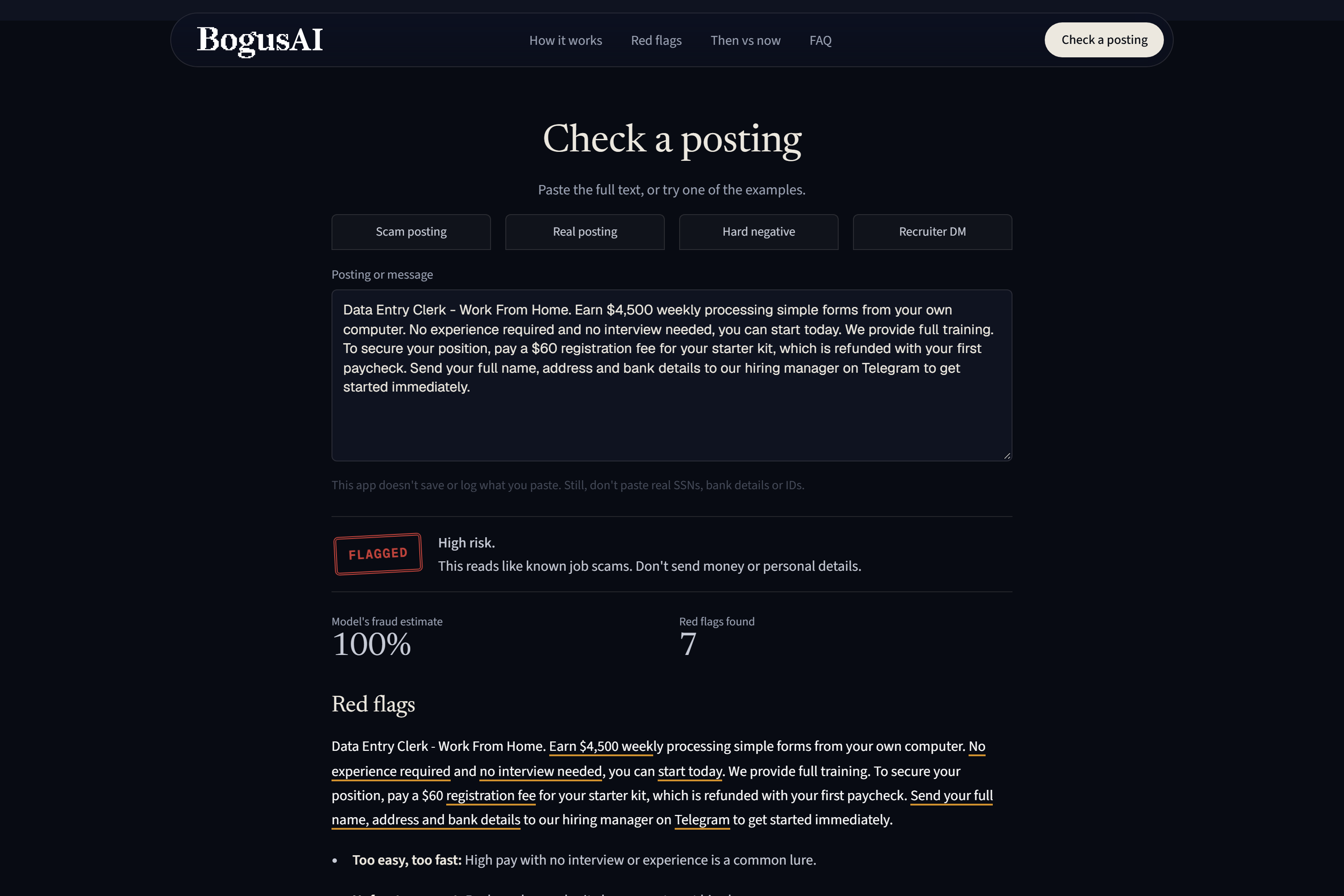
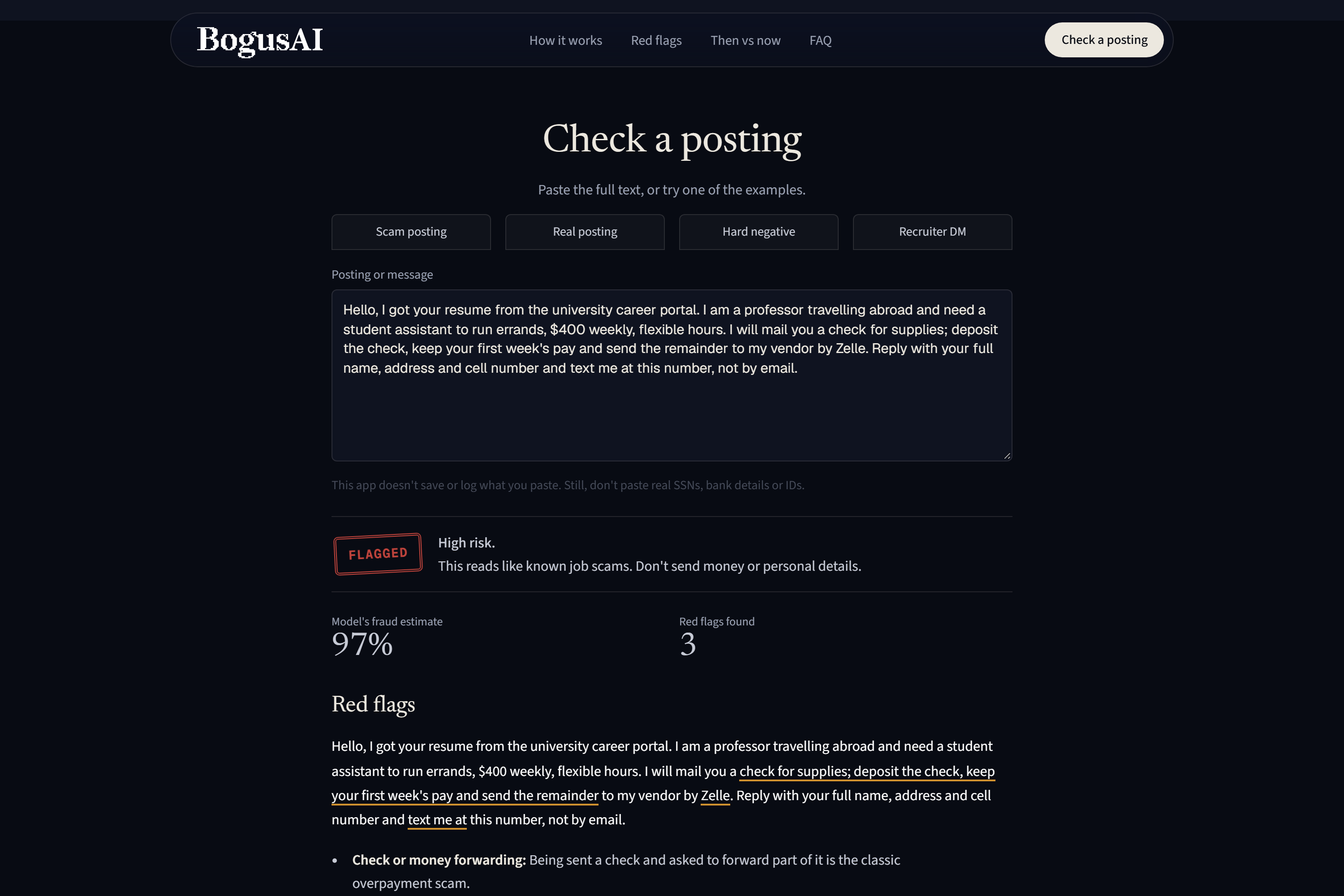
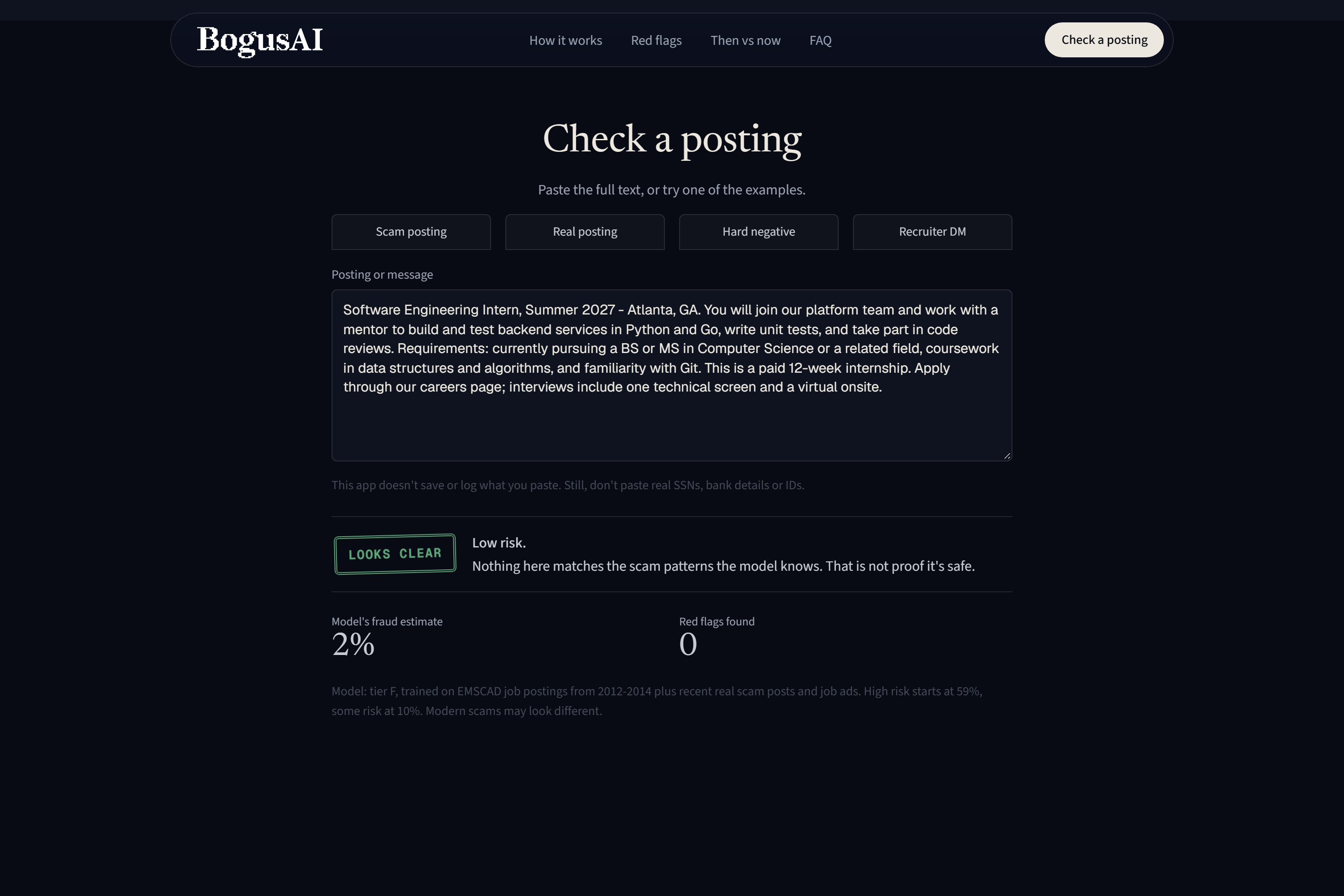
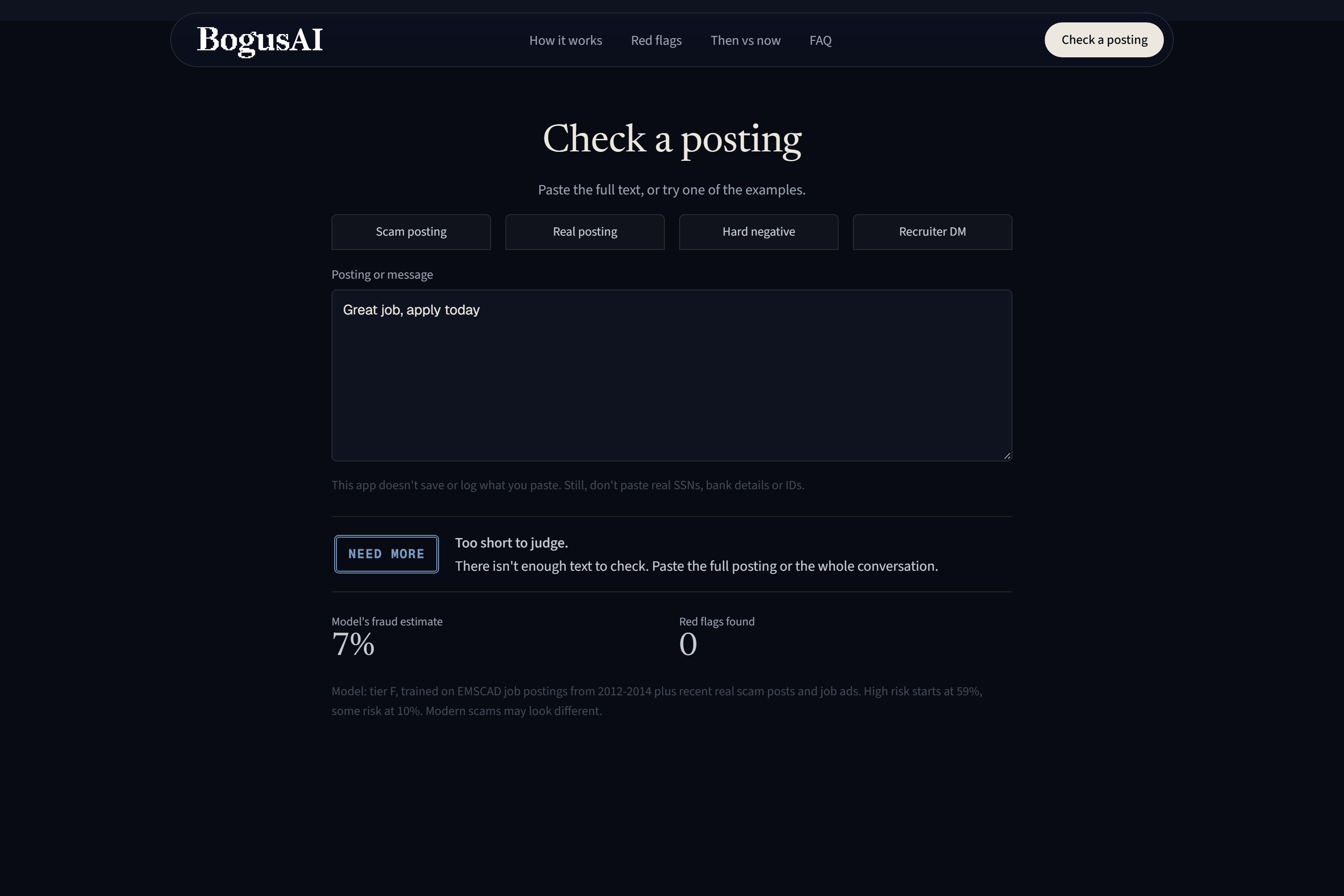
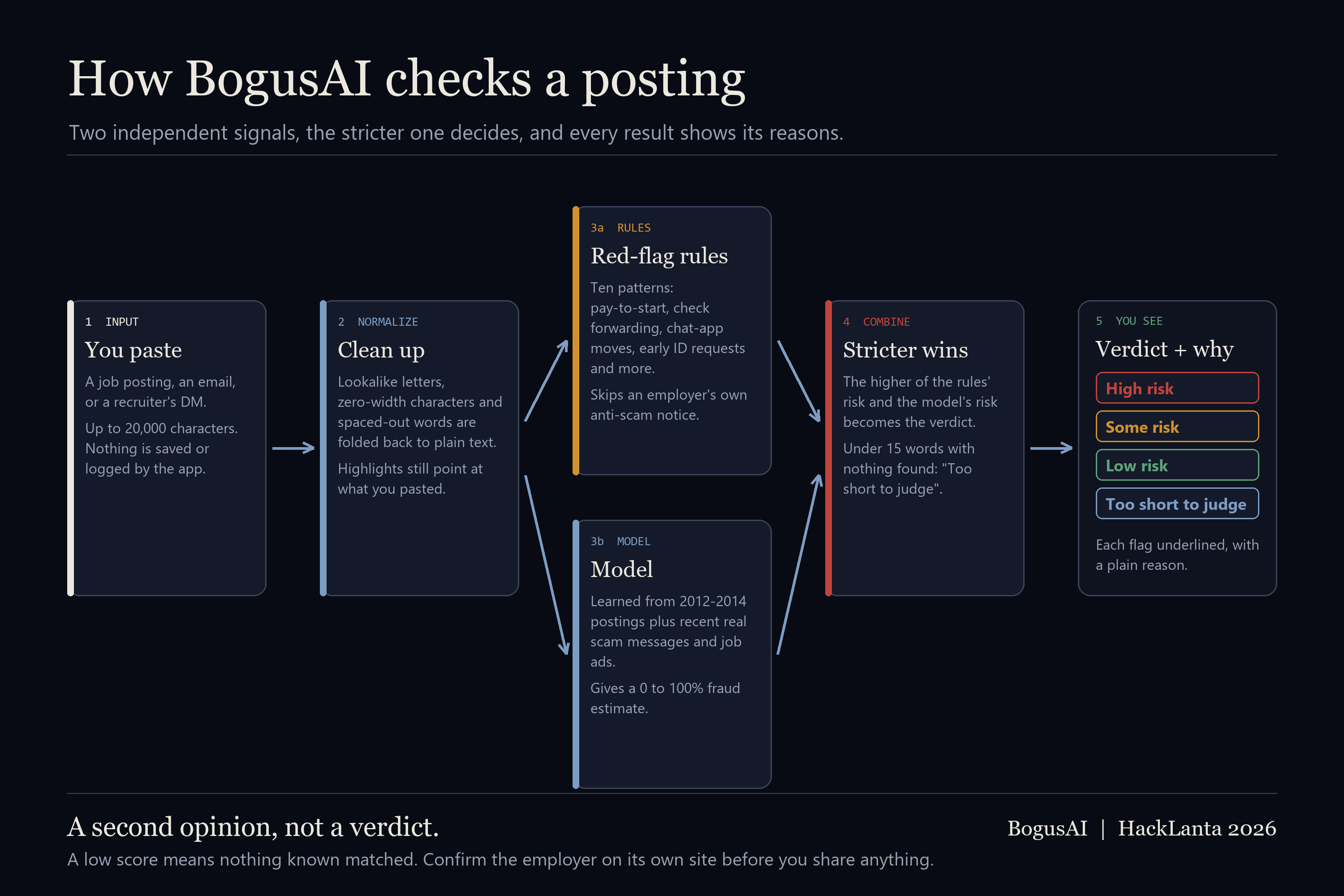
BogusAI was inspired by the everyday struggle of students who fall victim to false job postings. Real money, time and data is lost to scam postings daily. BogusAI assists in the verification of job postings' legitimacy. To add to the application mission we save no data from our users, no login , no account, no payments, just results.
BogusAI is trained on real life data sets of commonly reported job posting horror stories. Whether it be monetary requests, promises of unusual pay rates, lack of onboard screening or private data requests far too early in the process, BogusAI will ease, OR raise your doubts about a posting.
BogusAI was built using real job posting datasets and recent real scam messages paired against legitimate postings, this way it learns how scams look today. We implemented a rule-based red-flag engine to highlight exact scam phrases, upfront fees, and language related to depositing and sending checks, with plain-language reasoning for each.
Not only is pushing changes for different parts of the creative process is never 100% smooth, scams change faster than data does. A model trained on older postings caught most of the scams it had seen and far fewer of the modern ones, so we added recent real scam messages and paired them with a red-flag engine that reads the exact phrases. Teaching BogusAI to tell a scam from a warning was another hurdle: employers write “we will never ask you to pay a fee,” and early versions flagged it.
Hands down, the most rewarding portion of the creative process was seeing real progress. The final feeling of opening the project on a real web page on an external device was relieving to say the least. We are proud that BogusAI shows its work. Every result highlights the exact phrases behind it with a plain-language reason, so a student learns what to look for, not just what to trust. We rebuilt the model with recent real scam messages and legitimate postings, and it now catches more than four times as many modern scams as our first version. We tested it on 413 live postings from 61 employers, and fewer than 2 in 100 were flagged as high risk.
We learned that a model is only as current as its data. Strong results on older postings did not carry over to today’s scams, so we measured the gap and worked to close it instead of trusting a single score. We learned that an explanation does more than a number: students act on the exact phrase and the reason behind it. We also learned that testing on our own examples can flatter us, so we checked BogusAI against real, live postings. Finally, we learned to be honest about what a tool can and can’t catch, as stated on our site, due to the cat and mouse nature of data analysis problems in production can be presented.
We want BogusAI to keep pace with risks. We plan to grow our set of recent, real scam messages and incorporate human review to solidify the , so the tool learns from new tricks as they appear. We want it to read screenshots and short texts, where many scams actually arrive, and to recognize more legitimate gig and task-based work so real opportunities aren’t flagged. Beyond the site, we’d like to bring BogusAI to where students find jobs, such as a browser extension, and partner with campus career centers.
Built With
- claude-code
- css
- expressions
- git
- github
- html
- javascript
- joblib
- numpy
- python
- react
- regular
- scikit-learn
- streamlit
- tailwind
- tf-idf
- typescript


Log in or sign up for Devpost to join the conversation.