-
-
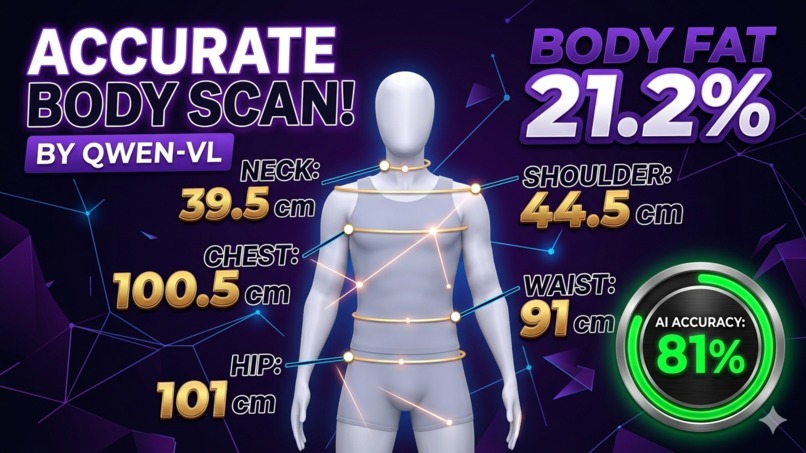
-
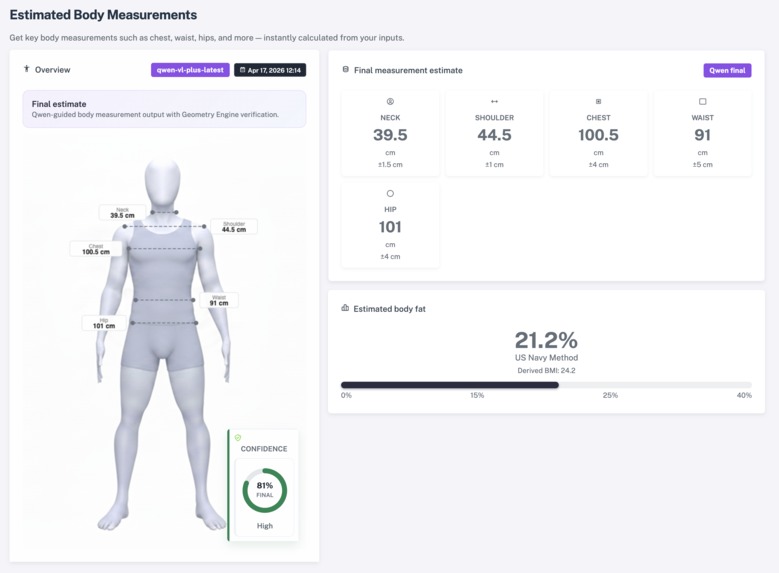
estimated body measurements
-
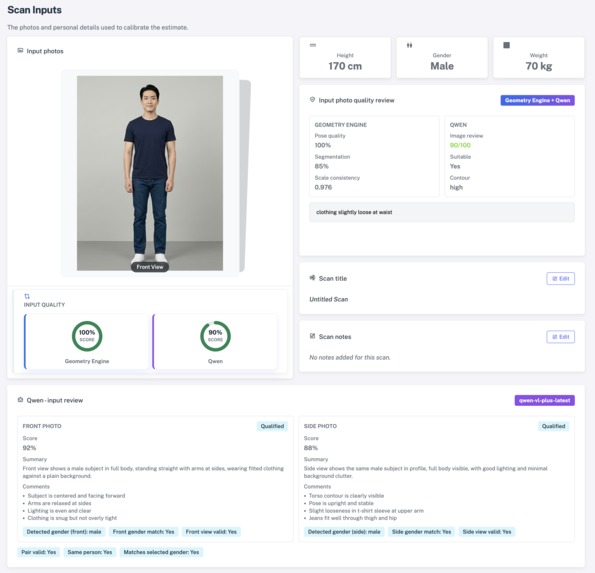
input review
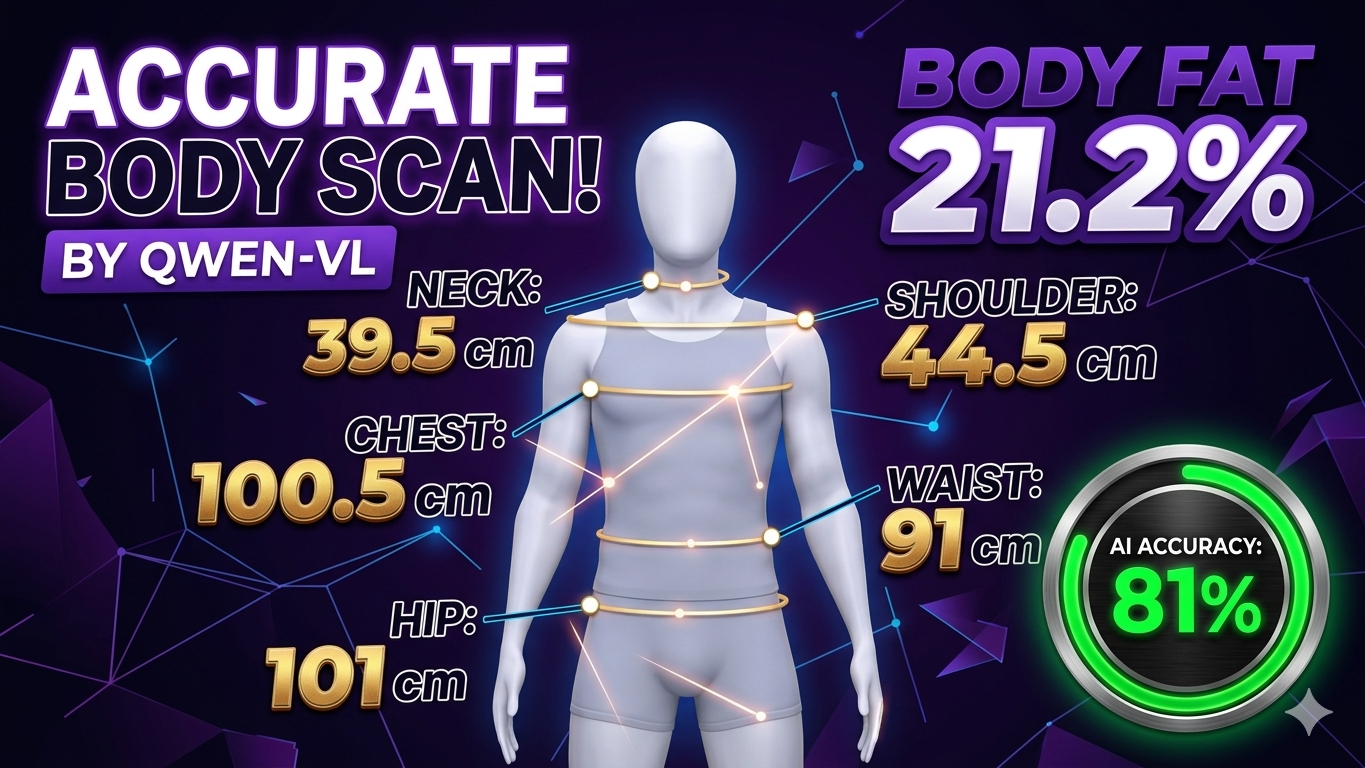
Inspiration
Finding accurate clothing sizes online is still frustrating. Most people only know rough measurements, size charts vary widely between brands, and shopping often turns into trial-and-error with returns.
For me, this problem is personal. I’ve always struggled to shop for clothes online because I don’t actually know my exact size. Every purchase feels like a guess—sometimes it fits, often it doesn’t. It’s inconvenient, time-consuming, and honestly discouraging.
At one point, I went to the gym last month and had a full body analysis—body fat, muscle mass, and other metrics. The process required specialized handheld equipment and took time. While the results were useful, it left me with a bigger question: why is understanding your own body still so inaccessible? How can ordinary people estimate and track these measurements regularly, easily, and without relying on expensive devices?
What I really wanted was a simple way to monitor my body measurements anytime—without needing to visit a gym or medical facility. Just something practical that works with what most people already have: a mobile phone.
When I saw the Elfie Challenge #2 in this hackathon, it immediately clicked. This wasn’t just a technical challenge, it was an opportunity to explore a problem I genuinely care about.
That’s why I built BodyLens, to make body measurement collection fast, private, and practical using just two photos and a known height.
What it does
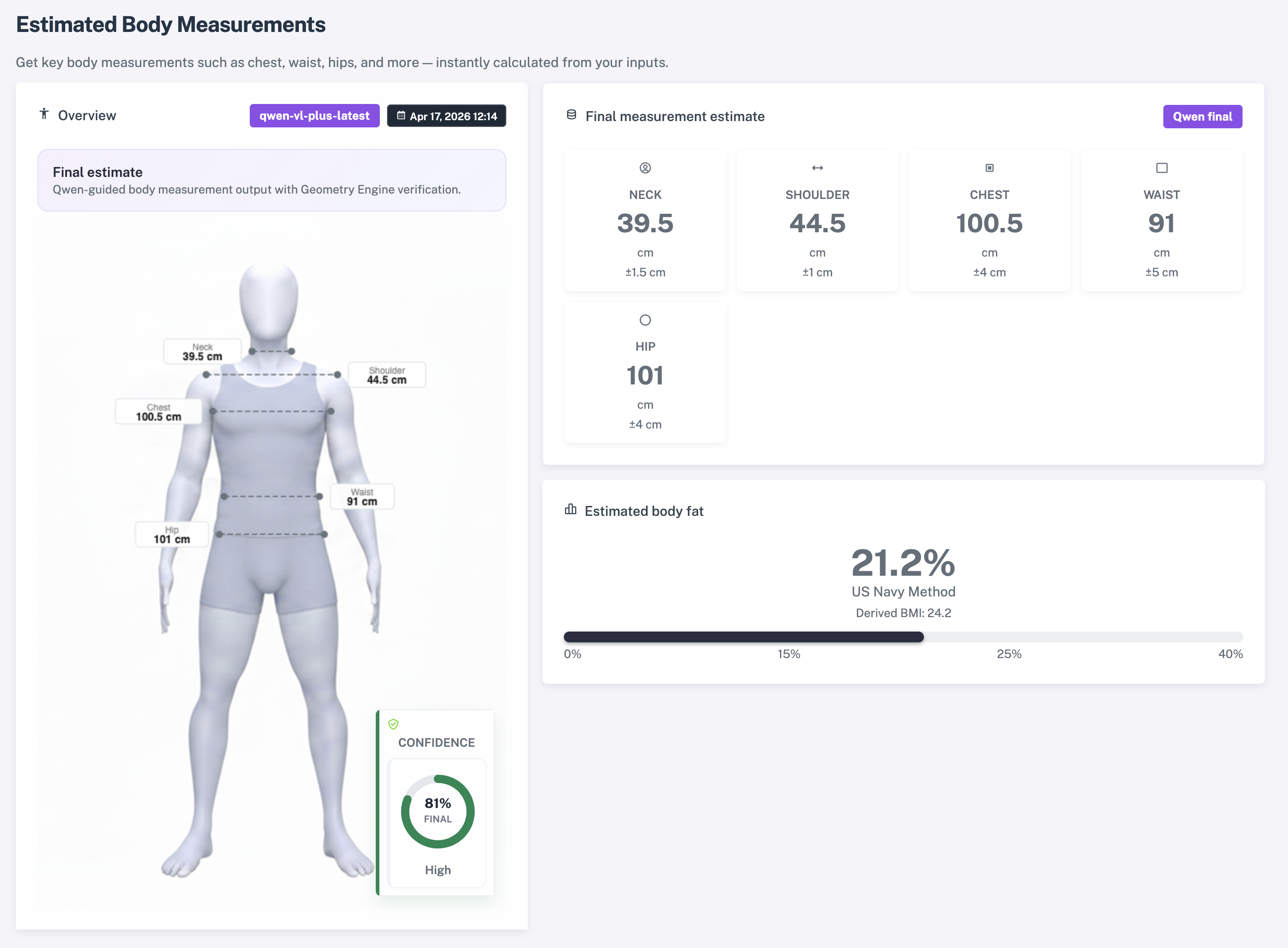
BodyLens estimates core body measurements (waist, chest, hip, neck, shoulder), computes body-fat percentage (US Navy method when inputs are available), and returns a confidence-aware result with quality signals and warnings.
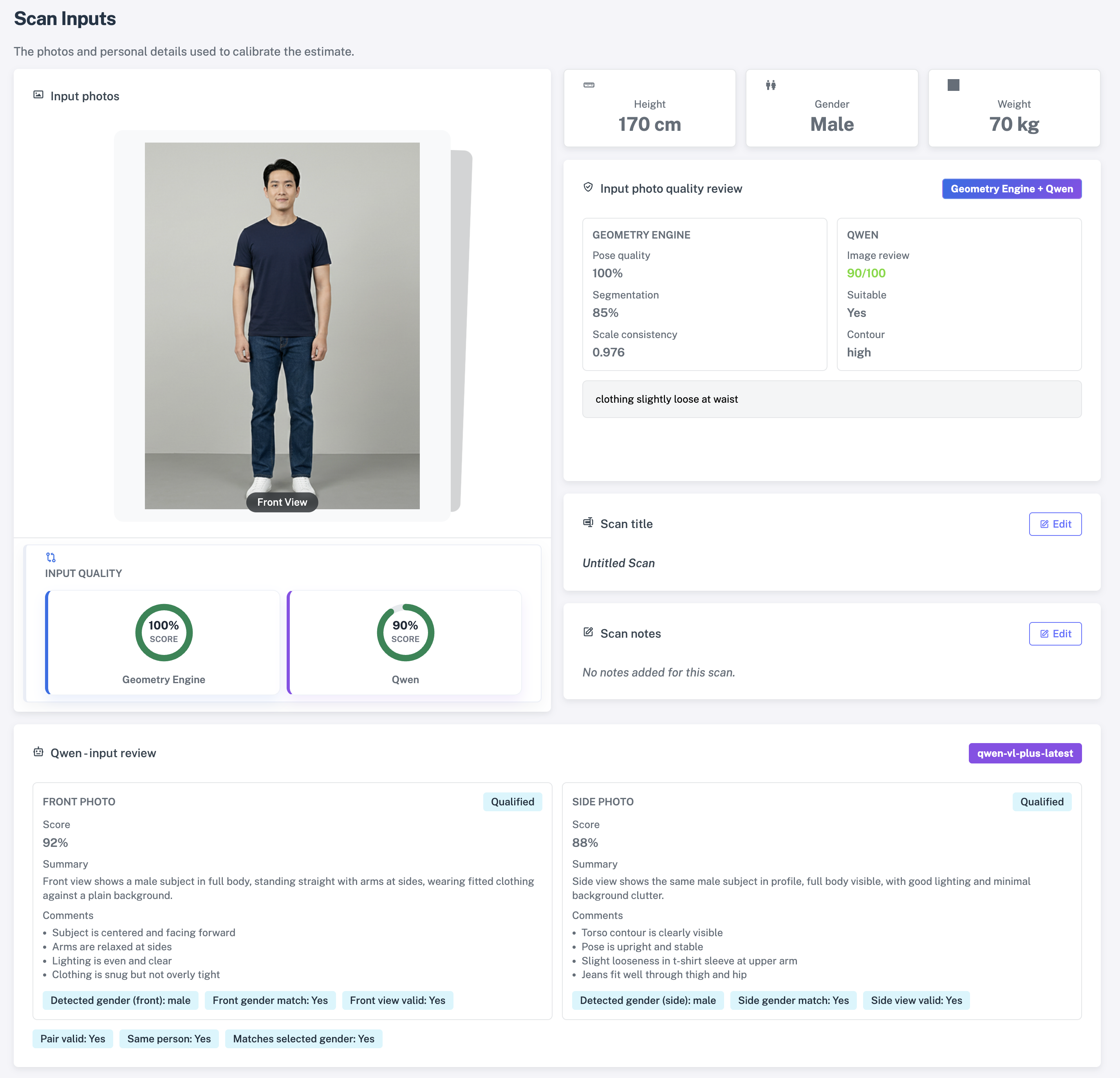
Users upload front and side photos plus height, then receive:
- structured measurements in centimeters
- uncertainty per measurement
- image quality and input-validity review
- an explainable result source (geometry-only, AI-assisted, or rejected for low quality)
- history tracking for each submitted estimate
The system is designed to reject unsafe inputs rather than produce overconfident numbers.
How we built it
BodyLens uses a hybrid architecture:
- Geometry Engine (Python Worker / FastAPI): my deterministic measurement core.
- MediaPipe Pose: detects body landmarks from front and side photos for height calibration, body alignment checks, and region localization (neck/chest/waist/hip).
- MediaPipe Segmentation: provides baseline body masks for contour extraction and direct geometric width/depth measurements.
- SAM2 branch: generates additional mask-driven candidates (
coarse,torso,fine) to improve contour coverage when baseline masks are weak. - Measurement candidate stack: computes multiple candidates (direct geometry, SAM2-based geometry, ratio-based, and body-profile priors), then compares them instead of trusting a single formula path.
- Reliability metrics: segmentation quality, landmark coverage, candidate agreement gap, and per-field confidence are used to score each candidate and estimate uncertainty.
- Node API (Express): orchestration, validation, history persistence, confidence scoring, and final response shaping.
- Qwen-VL integration (critical layer): this is the part that can actually "see" the uploaded photos and perform semantic judgments that pure geometry cannot.
- Visual understanding: inspects the real front/side images directly, not just numeric landmarks.
- Input validation: judges whether each view is truly usable (full body visibility, true side profile, posture quality, lighting, occlusion).
- Pair consistency checks: verifies front/side are the same person and flags invalid pairs.
- Clothing intelligence: classifies garment tightness by region (neck/chest/waist/hip/shoulder), which is used to correct measurement bias from loose clothing.
- Independent measurement + quality reasoning: provides a second estimate with explicit quality issues and confidence, then feeds fusion decisions.
- Fusion logic: combines Geometry Engine evidence and AI signals, applies clothing correction and uncertainty modeling, and can reject low-quality image pairs.
I also implemented layered logging and fallback execution (HTTP worker + direct Python mode) to keep processing robust in hackathon conditions.
Challenges we ran into
I ran into four major challenges:
- No single tool could solve the full problem reliably. Geometry, SAM2, and vision-language models each have different failure modes, so using only one of them produced blind spots. This is why I combined multiple tools and multiple validation layers instead of depending on a single estimator.
- Lack of ground-truth data. Within hackathon constraints, I did not have enough time and resources to collect a sufficiently large labeled dataset, which is critical for evaluating correctness and real accuracy.
- Time constraints on exploration. I wanted to test more vision models, reasoning models, and additional geometry approaches, and I also wanted to prototype a video-upload pipeline (not only 2 photos), but I could not complete all of that in the available time.
- Variability in pose, lighting, camera angle, and loose clothing caused unstable contours.
Accomplishments that we're proud of
- Built a full end-to-end measurement pipeline with deterministic vision + multimodal AI fusion.
- Integrated SAM2-derived measurement candidates into the evidence stack with confidence gating and fallback behavior.
- Made Qwen-VL a first-class safety and quality layer for photo validation, clothing judgment, and cross-image consistency checks.
- Added transparent quality diagnostics so users understand when results are reliable.
- Implemented correction logic for clothing looseness and generated uncertainty, not just point estimates.
- Designed the backend for production-minded behavior: async processing, error-safe responses, and result history.
Most importantly, I shipped a version that prefers trustworthy output over flashy but unreliable numbers.
What we learned
- I conducted industry and competitor research to validate market need and benchmark how leading players perform, including 3DLOOK, Nettelo, Meepl, Fit Analytics, Size Stream, Styku, and Bodygram.
- Measurement estimation is as much an input-quality problem as a modeling problem.
- Deterministic geometry gives stability; multimodal AI adds context and validation.
- Confidence without explainability is risky in body-related applications.
- Guardrails (quality checks, consistency checks, rejection criteria) materially improve user trust.
What's next for BodyLens
- Enlarge the ground-truth dataset with more subjects and more variation in pose, clothing, camera angle, and lighting.
- Explore additional geometry methods and additional vision-language models to compare robustness, correctness, and consistency.
- Investigate a self-trained model specialized for this exact body-measurement problem.
- Provide a mobile app SDK with input-quality control to guide users before capture/upload.
- Continue researching market needs and launch opportunities to identify the best path to product-market fit.
- Improve measurement accuracy with larger calibration datasets and benchmarked error metrics per body region.
- Add guided capture UX (live framing, posture hints, clothing recommendations) before photo submission.
- Expand outputs for practical use cases: fit profiles, brand size mapping, and change-over-time tracking.
- Continue privacy-first architecture with stronger data retention controls and optional on-device preprocessing.
- Introduce evaluation dashboards to compare geometry-only vs fusion performance over real-world samples.

Log in or sign up for Devpost to join the conversation.